







1. Introduction for Validation of Blending of Ingredients in Planetary Mixer:
The validation of blending in a Planetary Mixer (PLM) is performed to demonstrate that raw materials are mixed uniformly and the active ingredient is consistently distributed throughout the blend at the specified blending time. Ingredients are loaded according to the approved BMR and blended as per the operating SOP. Samples are collected in triplicate from 10 defined locations at different depths using a sampling thief and tested for active ingredient content. Results are evaluated individually and by %RSD. The blend should show uniform appearance, comply with specified assay limits, and achieve an RSD below 5% to confirm acceptable blending performance.
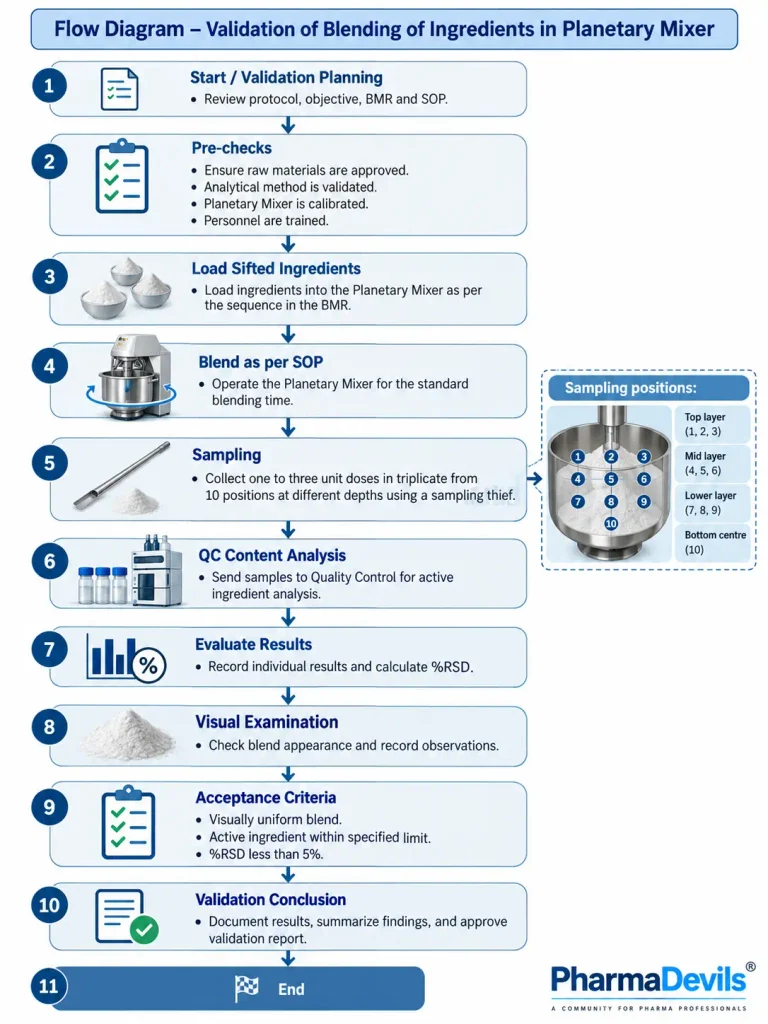
Skip to PDF content2. Flow Diagram for Validation of Blending of Ingredients in Planetary Mixer:
The flow diagram describes the systematic validation of the blending process performed in a Planetary Mixer. It begins with validation planning and verification of approved raw materials, calibrated equipment, validated analytical methods, and trained personnel. Sifted ingredients are loaded according to the BMR sequence and blended for the specified time as per SOP. Samples are then collected from 10 defined locations at different depths using a sampling thief and analyzed by Quality Control. Individual results and %RSD are evaluated along with visual blend appearance. Compliance with assay limits and %RSD below 5% confirms acceptable blending uniformity.
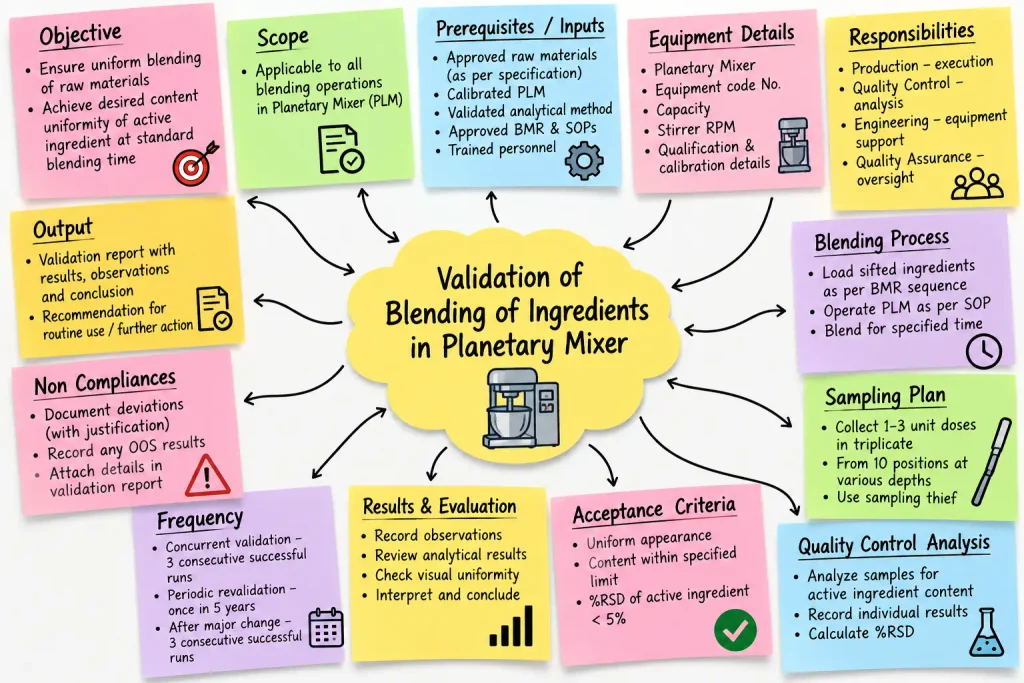
3. Brainstorming Analysis for Validation of Blending of Ingredients in Planetary Mixer:
Brainstorming analysis for the Validation of Blending of Ingredients in a Planetary Mixer is used to identify the key factors that may influence blend uniformity and validation success. The analysis considers raw material quality, approved BMR and SOPs, equipment qualification and calibration, stirrer RPM, blending time, loading sequence, trained personnel, sampling technique, and analytical testing. Special attention is given to collecting representative samples from different mixer locations and depths. Potential deviations, OOS results, and process inconsistencies are also considered. This analysis helps the validation team recognize critical variables, establish appropriate controls, and ensure consistent and uniform distribution of the active ingredient.
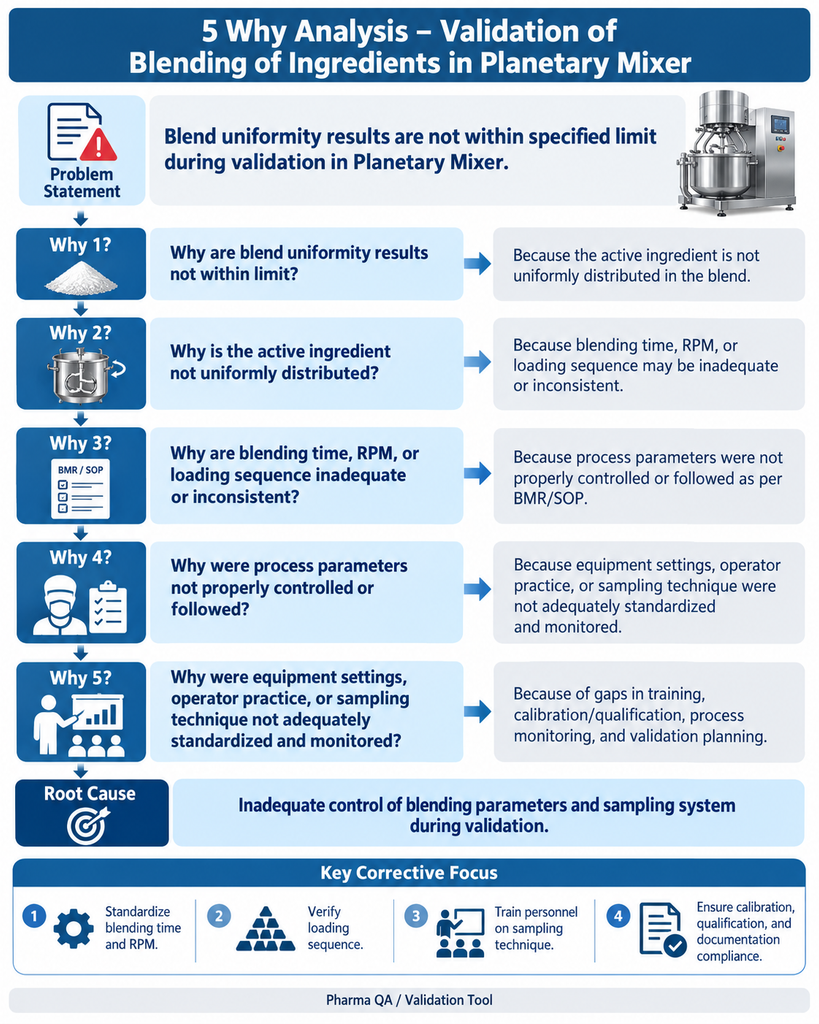
4. 5 Why Analysis for Validation of Blending of Ingredients in Planetary Mixer:
The 5 Why Analysis is used to identify the underlying causes of unsatisfactory blend uniformity during validation of the Planetary Mixer. The analysis begins with blend uniformity results being outside the specified limit and progressively examines possible reasons such as non-uniform API distribution, inadequate blending time, incorrect RPM, improper loading sequence, and failure to follow approved BMR or SOP requirements. Further evaluation considers equipment settings, operator practices, sampling technique, training, calibration, qualification, and process monitoring. The analysis helps determine the root cause and supports appropriate corrective actions to improve process control, sampling reliability, and consistent blending performance.
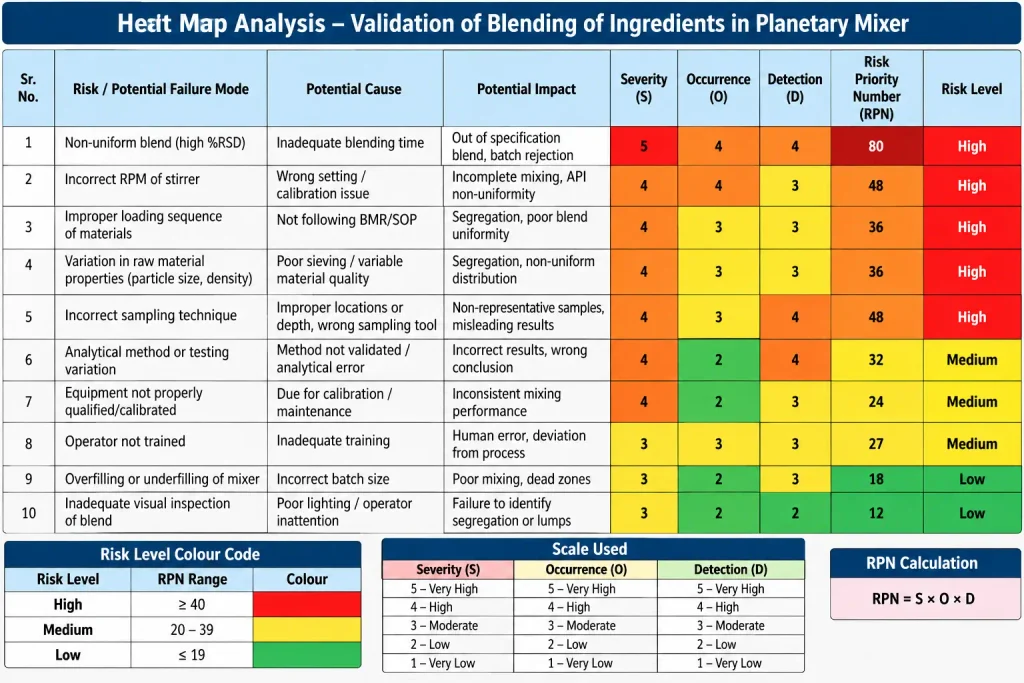
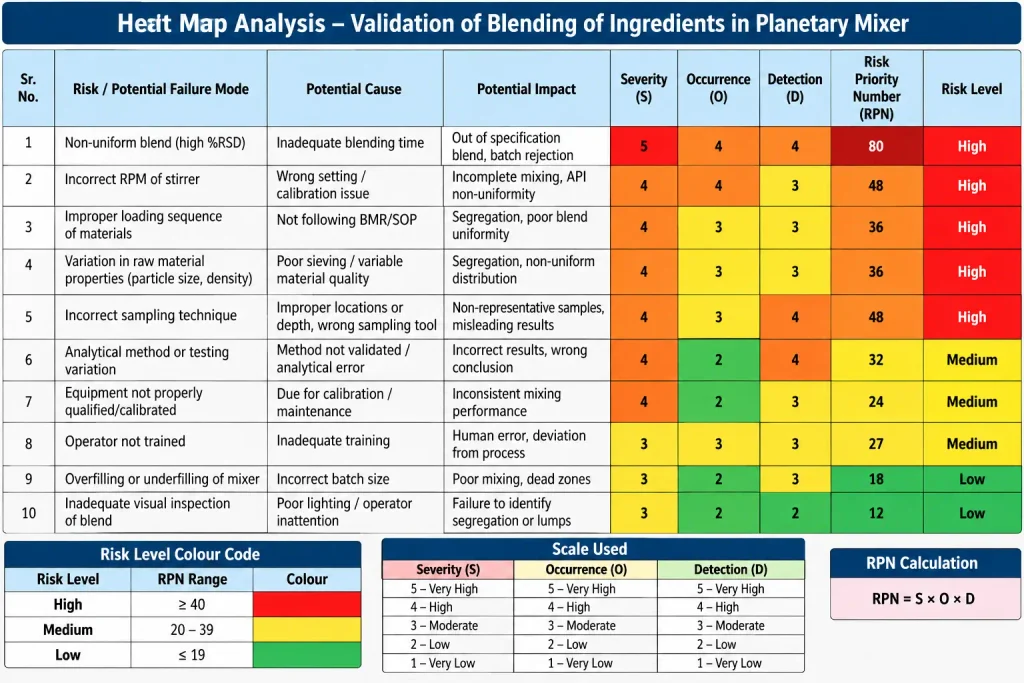
5. Heat Map Analysis for Validation of Blending of Ingredients in Planetary Mixer:
The Heat Map Analysis is used to evaluate and prioritize risks that may affect successful validation of blending in a Planetary Mixer. Potential failure modes such as inadequate blending time, incorrect stirrer RPM, improper loading sequence, raw material variability, sampling errors, analytical variation, equipment calibration issues, and operator errors are assessed using Severity, Occurrence, and Detection scores. These values are multiplied to calculate the Risk Priority Number (RPN). Risks are then categorized as high, medium, or low. This analysis helps identify critical areas requiring stronger controls, monitoring, training, calibration, and process standardization to ensure consistent blend uniformity.
6. Fishbone Analysis for Validation of Blending of Ingredients in Planetary Mixer:
The Fishbone Analysis identifies potential causes that may lead to non-uniform blending or validation failure in a Planetary Mixer. Possible causes are grouped under Man, Machine, Method, Material, Measurement, and Environment. Important factors include inadequate operator training, incorrect RPM, poor equipment calibration, insufficient blending time, improper loading sequence, particle-size variation, density differences, sampling errors, analytical variation, and unsuitable environmental conditions. By organizing these causes systematically, the analysis helps the validation team understand where failures may originate. It supports root-cause identification, risk reduction, process improvement, and establishment of effective controls for consistent blend uniformity.
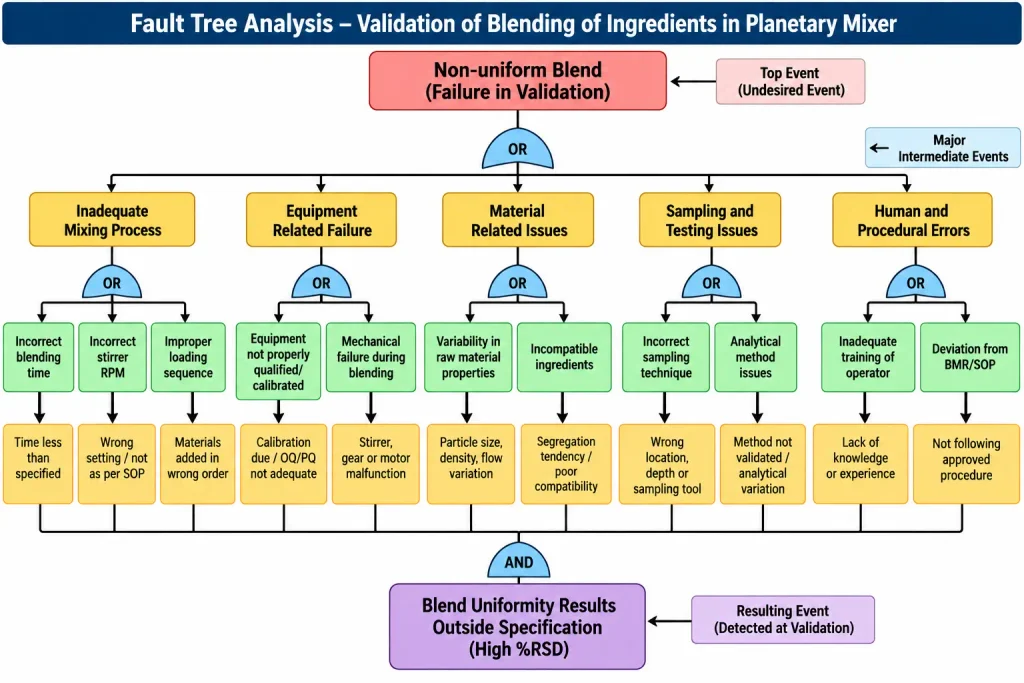
7. Fault Tree Analysis for Validation of Blending of Ingredients in Planetary Mixer:
The Fault Tree Analysis (FTA) evaluates the possible causes that can lead to a non-uniform blend or failure of blending validation in a Planetary Mixer. The top event is linked to major contributing factors such as inadequate blending conditions, equipment-related failures, raw material variability, sampling and testing errors, and operator or procedural deviations. Specific causes may include incorrect blending time, improper RPM, wrong loading sequence, inadequate qualification or calibration, particle-size or density variation, poor sampling technique, analytical variation, insufficient training, and failure to follow the approved BMR or SOP. FTA supports systematic root-cause identification and risk control.
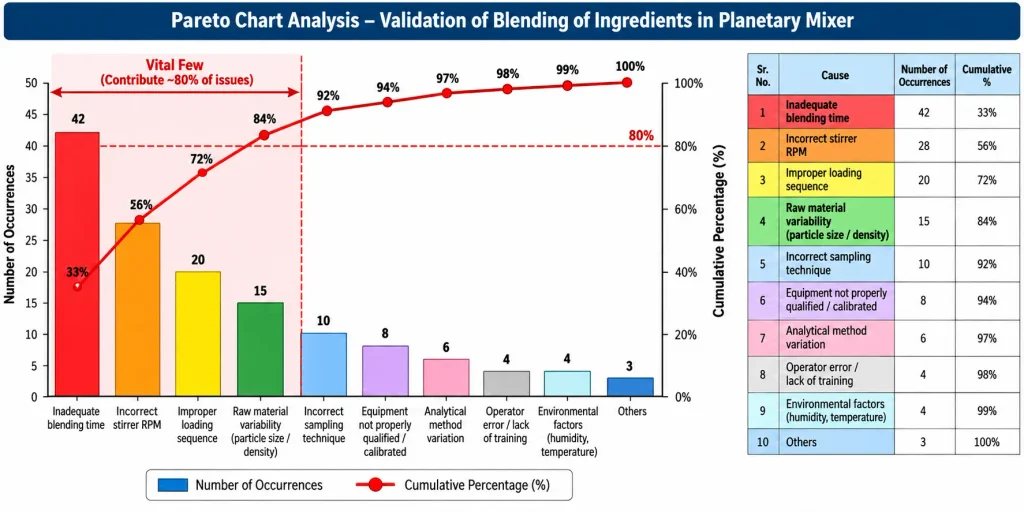
8. Pareto Chart Analysis for Validation of Blending of Ingredients in Planetary Mixer:
The Pareto Chart Analysis helps prioritize the major causes that may contribute to blending validation failure in a Planetary Mixer. Potential issues such as inadequate blending time, incorrect stirrer RPM, improper material loading sequence, raw material variability, sampling errors, equipment qualification gaps, analytical variation, operator errors, and environmental factors are arranged from highest to lowest occurrence. The cumulative percentage line identifies the vital few causes responsible for most problems. This analysis supports focused corrective and preventive actions by directing attention toward the highest-impact factors first, thereby improving blend uniformity, process consistency, validation reliability, and overall product quality.
9. Corrective Action & Preventive Action with Effectiveness Review:
Validation of Blending of Ingredients in Planetary Mixer
| Sr. No. | Observation / Potential Issue | Corrective Action | Preventive Action | Effectiveness Review |
|---|---|---|---|---|
| 1 | Blend uniformity result outside specified limit / high %RSD | Investigate the failed validation batch, review sampling results, blending time, RPM, loading sequence, and raw material characteristics. Repeat validation only after justified corrective measures. | Define and control validated blending time, RPM, loading sequence, and batch load in the BMR/SOP. | Review results of subsequent validation batches. Effectiveness is acceptable when assay results comply and %RSD remains below 5%. |
| 2 | Incorrect blending time | Verify actual blending duration against BMR and equipment records. Correct any deviation before repeating the study. | Clearly specify validated blending time in BMR and SOP and train operators accordingly. | Verify compliance with blending time during the next three validation/production batches with no recurrence. |
| 3 | Incorrect stirrer RPM | Check mixer RPM setting, calibration status, and equipment performance. Recalibrate or repair if required. | Include periodic calibration and pre-use verification of RPM. | Confirm RPM remains within approved setting during subsequent batches and blend uniformity remains acceptable. |
| 4 | Improper loading sequence | Review actual material addition sequence and identify deviation from BMR. Correct the sequence before repeating validation. | Clearly define material addition order in BMR and conduct operator training. | Review batch records for the next three batches and confirm 100% compliance with the approved loading sequence. |
| 5 | Sampling error or non-representative sampling | Review sampling technique, sampling thief, locations, depth, and quantity. Re-sample only where scientifically justified. | Standardize sampling from the defined 10 positions at different depths and train QC/QA personnel. | Observe sampling during subsequent validation runs and confirm reproducible results without abnormal location-to-location variation. |
| 6 | Equipment qualification/calibration gap | Verify qualification and calibration status of the Planetary Mixer and associated instruments. Complete overdue activities before use. | Maintain qualification, calibration, and preventive-maintenance schedules with status control. | QA review confirms all equipment remains within valid qualification/calibration status during future validation studies. |
| 7 | Raw material variability | Review particle size, density, moisture, sieving status, and approved raw-material results. Investigate abnormal material characteristics. | Control raw-material specifications and sieving requirements before charging into the mixer. | Review incoming material and blend-uniformity data for subsequent batches; no related trend or recurrence should be observed. |
| 8 | Analytical variation | Review analytical method, calculations, system suitability, reference standard, and analyst execution. Investigate any laboratory error. | Use validated analytical methods and ensure analysts are trained and qualified. | Repeatability and system-suitability results should remain acceptable, with no unexplained analytical variation. |
| 9 | Inadequate operator training | Retrain involved personnel on the BMR, SOP, mixer operation, sampling, and validation protocol. | Establish periodic training and competency assessment. | Training effectiveness should be verified through observation, assessment, and absence of repeat procedural deviations. |
| 10 | Documentation or procedural deviation | Correct documentation deficiencies through approved GMP procedures and investigate significant deviations. | Strengthen QA review of BMR, SOP, protocol, and validation documentation before execution. | Review the next three validation/production records. No repeat documentation or procedural deviation should occur. |
Overall Effectiveness Criteria
CAPA may be considered effective when subsequent validation demonstrates visually uniform blending, active ingredient content within the approved specification, and %RSD of active ingredient below 5%, with no recurrence of identified deviations. The validation report should document observations, analytical results, deviations, conclusions, recommendations, and any follow-up actions for final QA and Unit Head review.
10. Questions & Answers – Validation of Blending of Ingredients in Planetary Mixer:
- What is the objective of blending validation in a Planetary Mixer?
To demonstrate that raw materials are blended uniformly and that the active ingredient is distributed consistently at the standard blending time. - What is the scope of this validation protocol?
It is applicable to all blending operations performed in the Planetary Mixer (PLM). - What is the principle of blending in the Planetary Mixer?
Blending occurs due to rotation of the stirrer inside the Planetary Mixer. - Which departments are involved in the validation study?
Production, Quality Control, Engineering, and Quality Assurance are involved. - What documents should be followed during blending validation?
The SOP for Planetary Mixer operation, SOP for sampling with a sampling thief, and the approved Batch Manufacturing Record should be followed. - What prerequisites should be confirmed before validation?
Approved API, validated analytical method, equipment calibration details, training records, and required safety precautions should be verified. - How are ingredients loaded into the mixer?
Sifted ingredients are loaded into the Planetary Mixer according to the sequence specified in the BMR. - When should blend samples be collected?
Samples are collected at the standard blending time specified in the BMR. - How many sampling positions are used?
Samples are collected from 10 positions at different depths within the Planetary Mixer. - What are the sampling locations?
Positions 1–3 are from the top layer, positions 4–6 are 0.5 feet below the top layer, positions 7–9 are 1 foot below the top layer, and position 10 is at the bottom centre. - Which sampling tool is used?
A sampling thief is used for collecting blend samples. - What testing is performed on the samples?
Samples are sent to Quality Control for active ingredient content analysis. - How are validation results evaluated?
Individual test results are recorded and the percentage Relative Standard Deviation (%RSD) is calculated. - What is the acceptance criterion for blend appearance?
The blend should show uniform distribution when visually examined. - What is the acceptance criterion for active ingredient content?
The active ingredient content should comply with the specified Quality Control limits. - What is the acceptance criterion for %RSD?
The %RSD of active ingredient content at the optimal blending time should be less than 5%. - How should deviations or OOS results be handled?
Deviations, their justification, and any OOS results should be reviewed and documented in the validation report. - What type of validation is specified?
The protocol specifies concurrent validation and re-validation. - How many validation exercises are required for concurrent validation?
Three consecutive successful validation exercises are required. - Who reviews and approves the final validation report?
The validation report is reviewed by Unit Quality Assurance and the Unit Head, who also provide final approval.
11. Reference Guidelines – Validation of Blending of Ingredients in Planetary Mixer:
The following guidelines are suitable references for developing, executing, and documenting blending validation studies in pharmaceutical manufacturing:
- WHO Technical Report Series No. 1019, Annex 3 – Good Manufacturing Practices: Guidelines on Validation (2019)
Provides general principles for qualification and validation and includes guidance for non-sterile process validation. World Health Organization - WHO Good Manufacturing Practices for Pharmaceutical Products – Main Principles
Supports controlled manufacturing, documented procedures, trained personnel, equipment suitability, and consistent product quality. World Health Organization - WHO Guidelines for Sampling of Pharmaceutical Products and Related Materials – TRS No. 929, Annex 4
Relevant for establishing representative sampling procedures, sampling locations, techniques, and documentation during blend-uniformity studies. WHO Extranet - WHO Quality Assurance of Pharmaceuticals: A Compendium of Guidelines and Related Materials, Volume 2, 10th Edition
Provides comprehensive GMP guidance covering manufacturing, quality control, equipment validation, documentation, and pharmaceutical quality systems. World Health Organization - EU GMP – Annex 15: Qualification and Validation
Applicable for lifecycle-based qualification and validation of facilities, equipment, utilities, and manufacturing processes. - US FDA – Process Validation: General Principles and Practices
Useful for establishing a lifecycle approach to process design, process qualification, continued process verification, and demonstration of consistent manufacturing performance. - ICH Q8(R2) – Pharmaceutical Development
Relevant for understanding material attributes, process parameters, blending characteristics, and their relationship with finished-product quality. - ICH Q9(R1) – Quality Risk Management
Applicable for identifying and controlling risks related to blending time, mixer RPM, loading sequence, sampling, equipment, raw materials, and operator practices. - ICH Q10 – Pharmaceutical Quality System
Supports change management, CAPA, process performance monitoring, continual improvement, and maintenance of the validated state.