







1. Brief Description:
The Dry Mixing of Materials in Saizoner validation study is designed to demonstrate that raw materials are mixed effectively and that the active ingredient achieves acceptable blend uniformity at the standard dry-mixing time. The process applies to raw-material mixing in the Saizoner, where blending occurs through rotation of the agitator. The study involves Production, Engineering, Quality Control, and Quality Assurance, with verification of equipment qualification, calibration, analytical methods, training records, and applicable SOP/BMR requirements. During validation, sifted materials are loaded according to the BMR and mixed as per the operating SOP. Triplicate samples of approximately 1–3 unit doses are collected from 10 defined locations and analyzed for active-ingredient content. Acceptance requires visually uniform mixing, content within specified QC limits, and RSD below 5%. Concurrent validation requires three consecutive successful exercises, with periodic or change-based revalidation as specified.
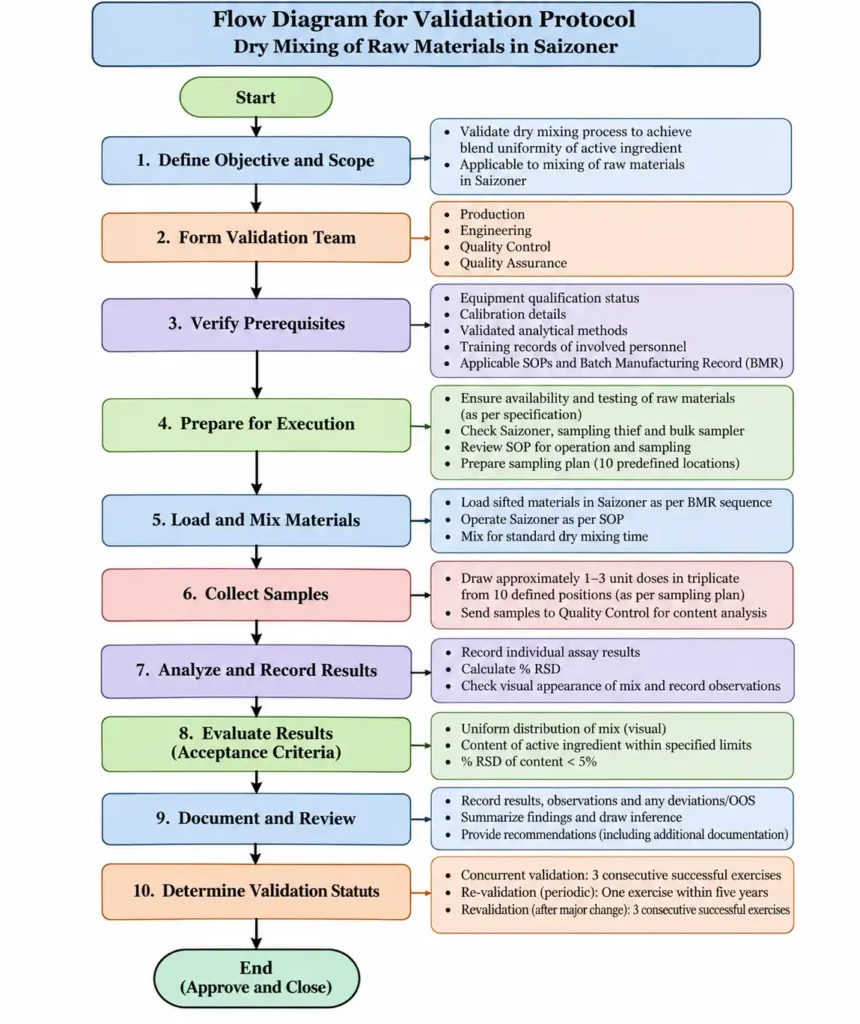
Skip to PDF content2. Flow Diagram:
The flow diagram presents the systematic execution of the Validation Protocol for Dry Mixing of Raw Materials in Saizoner. It begins with defining the objective and scope, followed by formation of the validation team comprising Production, Engineering, Quality Control, and Quality Assurance. Before execution, prerequisites such as equipment qualification, calibration, validated analytical methods, training records, applicable SOPs, and BMR are verified. Raw materials are then prepared, sifted, and loaded into the Saizoner according to the prescribed BMR sequence. The Saizoner is operated as per SOP for the specified dry-mixing time. Samples are collected in triplicate from 10 predefined locations and sent to QC for content analysis. Individual results are recorded, %RSD is calculated, and visual uniformity is assessed. Acceptance requires uniform mixing, active ingredient content within specified limits, and RSD below 5%. Results, deviations/OOS, conclusions, and recommendations are documented before final review, approval, and validation closure.
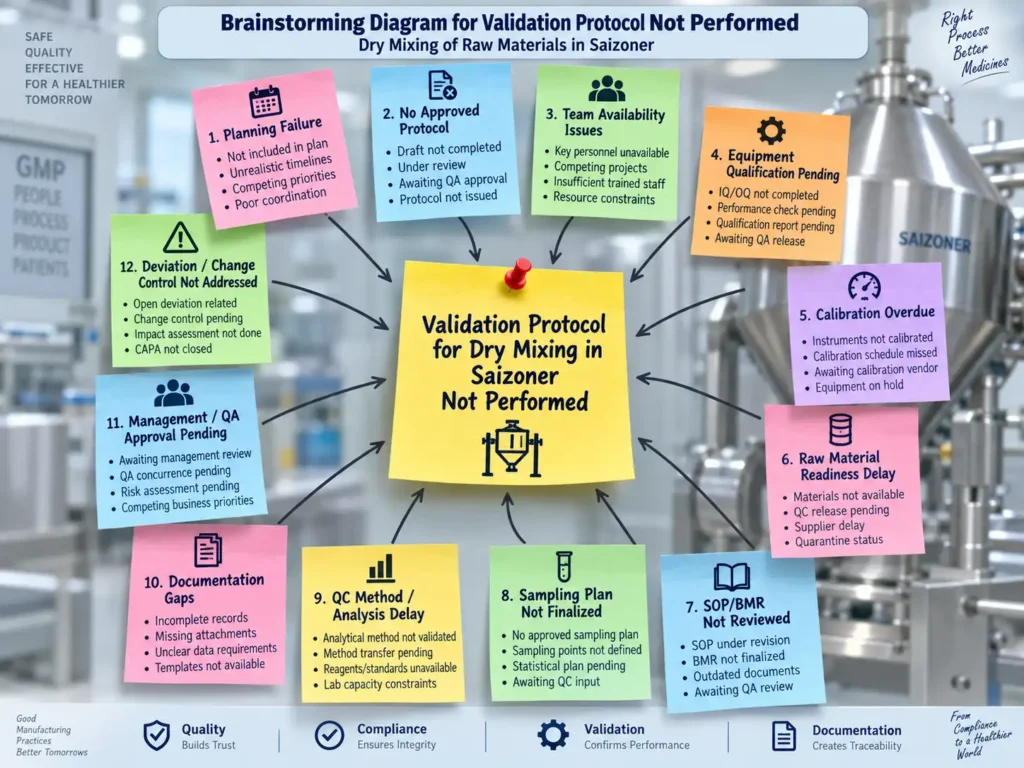
3. Brainstorming Analysis:
The brainstorming sticky-notes diagram identifies potential reasons why the Validation Protocol for Dry Mixing of Raw Materials in Saizoner may not be performed as planned. The central problem is surrounded by key contributing factors covering planning, personnel, equipment, materials, procedures, testing, and documentation. Major causes include inadequate validation planning, absence of an approved protocol, limited availability of Production/QA/QC personnel, pending equipment qualification, and overdue calibration. Other possible factors are raw-material unavailability or QC release delays, incomplete review of SOPs and BMR, and an unapproved sampling plan. Laboratory-related constraints such as non-validated analytical methods, unavailable standards/reagents, and insufficient QC capacity can further delay execution. Documentation gaps, pending QA or management approval, and unresolved deviations or change controls may also prevent validation. The diagram supports structured root-cause investigation and helps teams establish appropriate corrective and preventive actions before conducting the validation study.
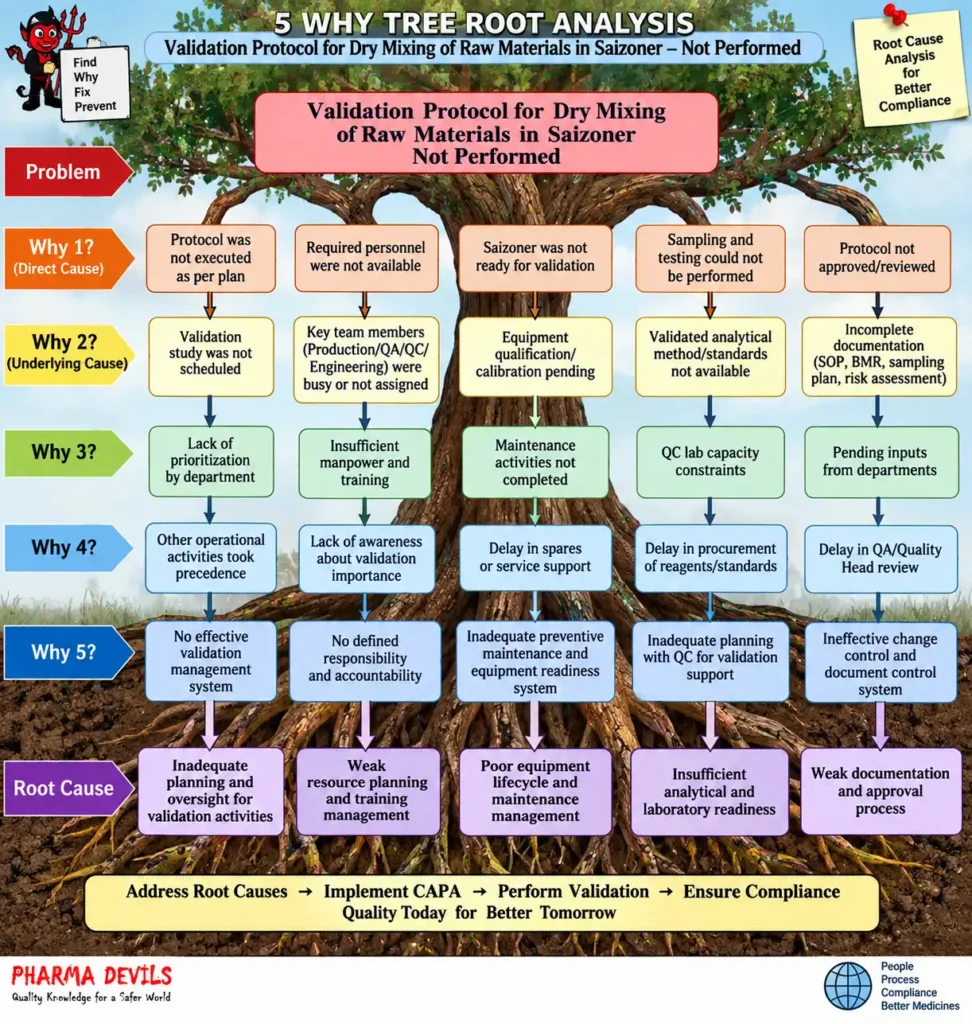
4. 5 WHY Analysis:
The 5 WHY analysis for the Validation Protocol for Dry Mixing of Raw Materials in Saizoner not performed identifies the underlying causes responsible for failure to execute the validation study. The analysis begins with the main problem and progressively evaluates contributing factors related to planning, manpower, equipment readiness, laboratory support, and documentation. Key causes include failure to schedule validation activities, non-availability of trained Production, QA, QC, and Engineering personnel, pending equipment qualification or calibration, and incomplete maintenance activities. Laboratory-related causes include unavailable validated analytical methods, limited QC capacity, and delays in procurement of standards or reagents. Documentation deficiencies such as incomplete SOPs, BMR, sampling plans, risk assessments, and delayed QA approval may also prevent execution. The identified root causes include inadequate validation planning, weak resource management, poor equipment lifecycle management, insufficient laboratory readiness, and ineffective document control. Appropriate CAPA should be implemented before validation is rescheduled and performed.
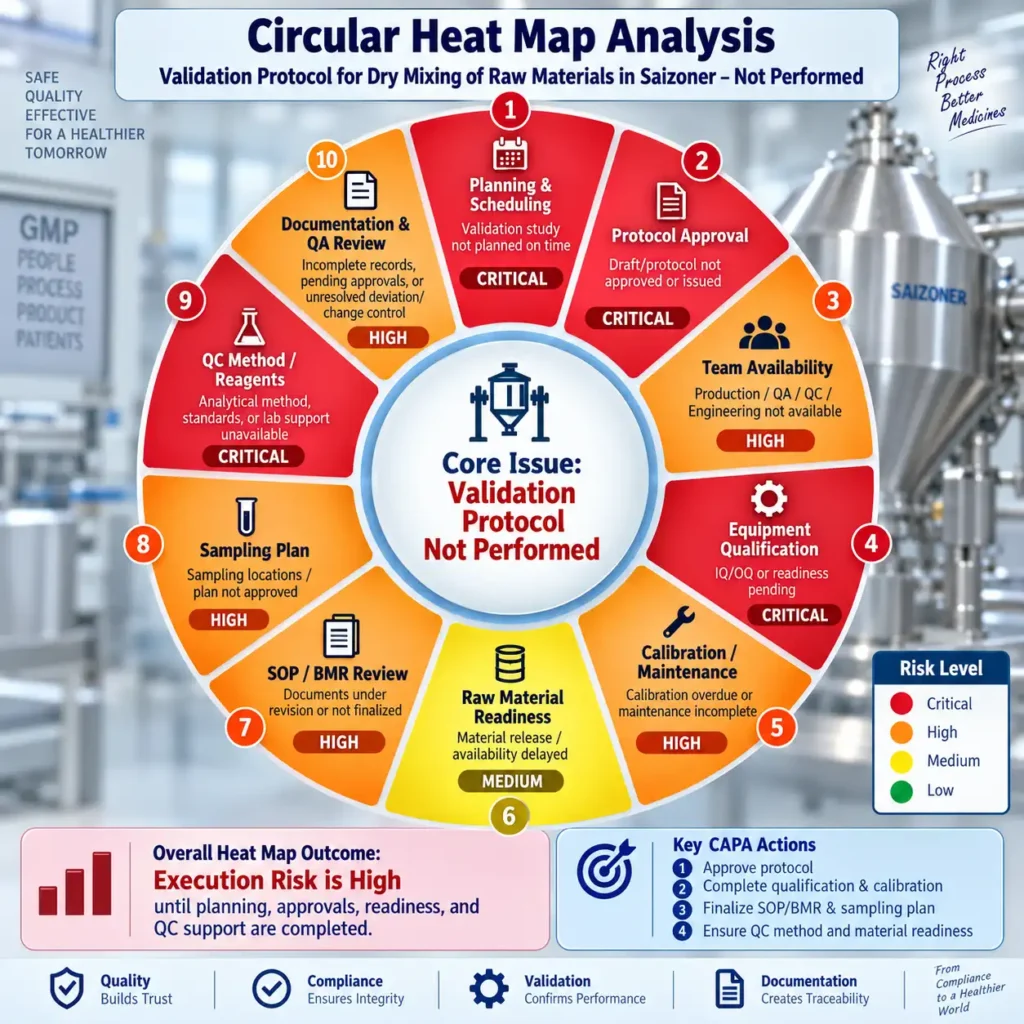
5. Heat Map Analysis:
The Heat Map Analysis for the Validation Protocol for Dry Mixing of Raw Materials in Saizoner Not Performed visually prioritizes the major risks that can prevent successful validation execution. The central issue is surrounded by key contributing factors classified according to their risk severity. Critical risks include inadequate planning and scheduling, pending protocol approval, incomplete equipment qualification, and unavailable QC analytical methods or reagents. High-risk factors include limited team availability, overdue calibration or maintenance, incomplete SOP/BMR review, an unapproved sampling plan, and documentation or QA review gaps. Raw-material readiness is categorized as a medium-level risk when material release or availability is delayed. The heat map helps the validation team quickly identify areas requiring immediate attention and prioritization. Corrective actions should focus on protocol approval, equipment readiness, document finalization, sampling-plan approval, QC preparedness, and resource availability. Overall, the diagram indicates that execution risk remains high until these critical and high-risk conditions are adequately controlled.
Questions and Answers:
- Q: What is the objective of the dry-mixing validation study?
A: To establish that the dry-mixing process achieves uniform distribution of the active ingredient at the standard mixing time and that blend-uniformity results meet specified limits. - Q: What is the scope of the validation protocol?
A: It is applicable to the mixing of raw materials in the Saizoner. - Q: What is the principle of mixing in the Saizoner?
A: Mixing of raw materials occurs through rotation of the Saizoner agitator. - Q: Which departments are responsible for the validation activity?
A: Production, Engineering, Quality Control, and Quality Assurance are involved in the validation study. - Q: What prerequisites should be verified before validation?
A: Equipment qualification, calibration status, validated analytical methods, training records, applicable SOPs, BMR details, and raw-material compliance should be verified. - Q: How should the materials be loaded into the Saizoner?
A: Sifted materials should be loaded according to the sequence specified in the Batch Manufacturing Record. - Q: How many sampling locations are specified?
A: Samples are collected from 10 predefined positions within the Saizoner. - Q: What quantity of sample is collected?
A: Approximately 1–3 unit doses in triplicate are collected from each specified sampling position. - Q: What testing is performed on the samples?
A: Samples are sent to Quality Control for active-ingredient content analysis, and individual test results are reported. - Q: Why is %RSD calculated?
A: %RSD is calculated to evaluate variability in active-ingredient content among samples collected from different locations. The protocol requires the RSD to be less than 5% at the optimal mixing time. - Q: What are the main acceptance criteria?
A: The blend should show uniform visual distribution, active-ingredient content should comply with QC specifications, and the RSD of active-ingredient content should be below 5%. - Q: How are deviations or OOS results handled?
A: Deviations, including justification for acceptance, and any OOS results encountered during validation should be documented and attached to the validation report. - Q: How many successful exercises are required for concurrent validation?
A: Three consecutive successful validation exercises are required. - Q: What is the frequency of periodic revalidation?
A: One validation exercise should be performed within five years. - Q: What is required after a major change?
A: Three consecutive successful revalidation exercises are required after a major change. - Q: Who reviews and approves the final validation report?
A: The validation report is reviewed by Unit Quality Assurance and the Unit Head, who also provide final approval.
Reference Guidelines:
- EU GMP – EudraLex Volume 4, Annex 15: Qualification and Validation
Provides principles for process validation, qualification, validation planning, documentation, change control, and lifecycle maintenance of validated processes.
EU GMP Annex 15 - US FDA – Process Validation: General Principles and Practices, 2011
Supports establishing documented evidence that manufacturing processes can consistently deliver products meeting predetermined quality requirements.
FDA Process Validation Guidance - WHO TRS 1019, Annex 3 – Good Manufacturing Practices: Guidelines on Validation
Provides WHO expectations for qualification and validation of pharmaceutical manufacturing processes and systems.
WHO Validation Guideline - ICH Q8(R2) – Pharmaceutical Development
Relevant for understanding material attributes, process parameters, process development, and establishment of an appropriate control strategy. - ICH Q9 – Quality Risk Management
Useful for risk-based determination of critical process parameters, sampling locations, equipment readiness, and validation controls. ICH lists Q9 among its core pharmaceutical quality guidelines. - ICH Q10 – Pharmaceutical Quality System
Supports lifecycle management, change management, CAPA, management responsibility, continual improvement, and maintenance of validated status. - PIC/S PI 006 – Recommendations on Qualification and Validation
Covers validation master planning, equipment qualification, non-sterile process validation, and related validation activities. PIC/S has published PI 006-4, which will enter into force on 1 October 2026; until then, PI 006-3 remains the listed current recommendation.