






1. Brief Description:
The Validation Report for Dry Mixing of Raw Materials in a Saizoner is designed to demonstrate that the defined mixing process consistently produces a uniform blend of active pharmaceutical ingredient within specified limits. The study applies to raw-material mixing in the Saizoner and is based on material mixing through agitator rotation. The protocol covers equipment identification and qualification status, applicable SOPs and BMR, API details, analytical references, calibration, personnel training, safety precautions, mixing time, sampling intervals, and validation dates. Blend uniformity is evaluated visually and by chemical analysis of active ingredient content. The protocol specifies that results must comply with the approved product specification and that the Relative Standard Deviation of active ingredient content at the optimum mixing time should be below 5%. Deviations and OOS results are documented and reviewed. Validation may be concurrent or re-validation, followed by observations, conclusions, recommendations, team approval, QA review, and final authorization.
Skip to PDF content2. Flow Diagram:
The flow diagram explains the complete validation process for dry mixing of raw materials in a Saizoner in a simple step-by-step way. The process starts with validation planning and pre-validation checks. Before mixing, the team verifies raw materials, API details, SOPs, BMR, equipment qualification, calibration status, and personnel training. The approved materials are then weighed and loaded into the Saizoner according to the BMR. Dry mixing is carried out for the specified time and RPM while following required safety precautions. Samples are collected at defined time intervals using the approved sampling method. The samples are tested for active ingredient content and blend appearance. The results are compared with the acceptance criteria, including content limits and RSD below 5%. If results fail, deviations or OOS results are investigated. Finally, results are documented, reviewed by QA, approved, and the validation is completed.
3. Brainstorming:
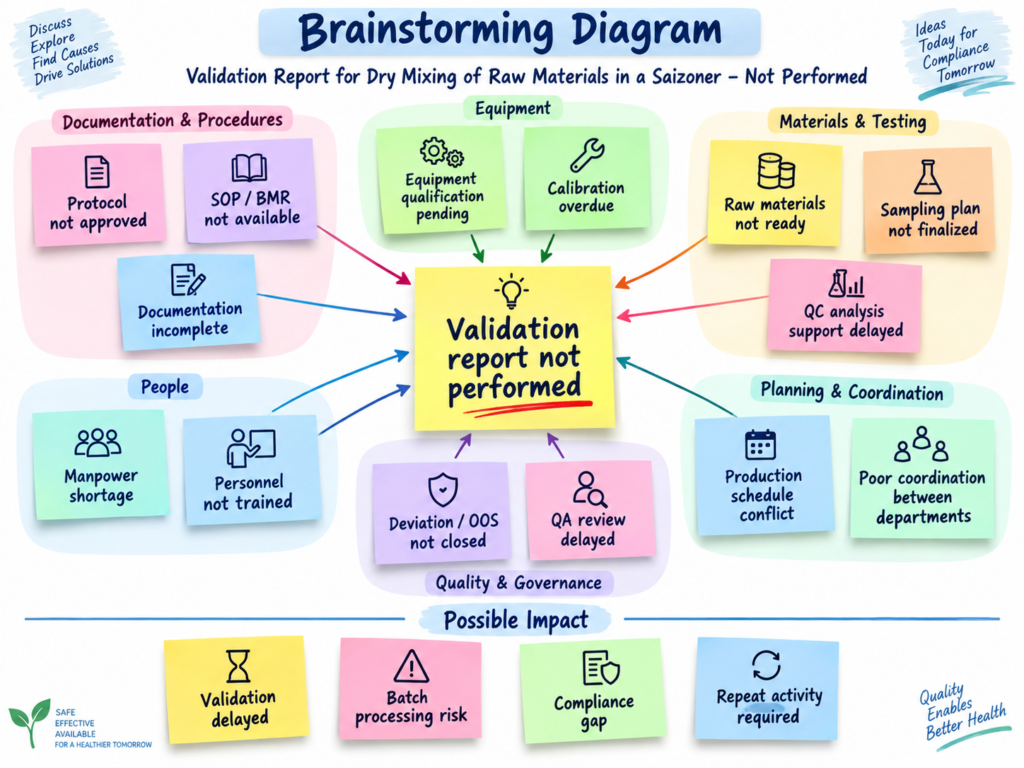
The brainstorming analysis for the Validation Report for Dry Mixing of Raw Materials in a Saizoner not compiled identifies the possible reasons that may delay or prevent completion of the validation report. Major causes include incomplete documentation, unapproved validation protocol, unavailable SOP or BMR, and missing supporting records. Equipment-related issues such as pending qualification or overdue calibration may also affect report compilation. Other possible causes include raw materials not being ready, an incomplete sampling plan, delayed QC analysis, and unavailable test results. Personnel factors such as manpower shortage, insufficient training, and unclear responsibility can further delay the activity. Poor coordination between Production, QA, QC, and Engineering, along with production schedule conflicts, may also contribute. Open deviations, OOS investigations, and delayed QA review can prevent final closure. This brainstorming exercise helps the team identify gaps, assign responsibilities, complete pending activities, and ensure timely compilation and approval of the validation report.
4. 5 Why Analysis:
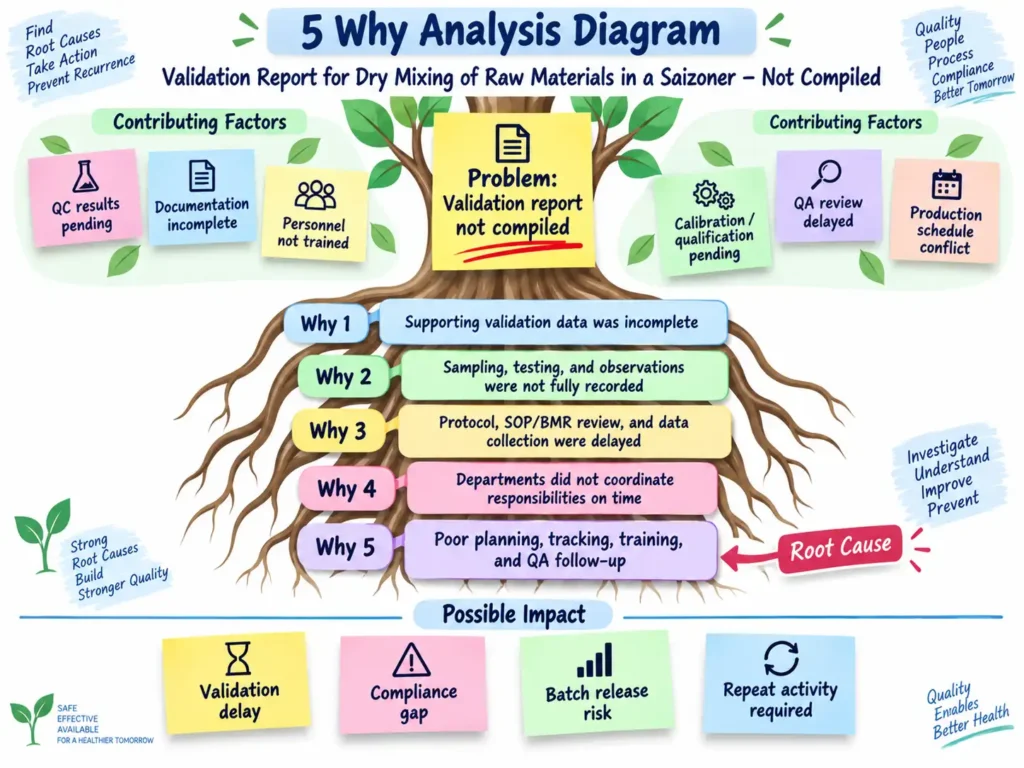
The 5 Why Analysis for the Validation Report for Dry Mixing of Raw Materials in a Saizoner not compiled identifies the underlying reason for the delay in completing the validation report. The first cause is that supporting validation data was incomplete. This occurred because sampling, testing, observations, and associated records were not fully documented. The protocol requires defined mixing details, sampling intervals, analytical testing, and evaluation against acceptance criteria. Further analysis indicates that protocol, SOP/BMR review, and data collection may have been delayed because Production, QC, QA, and Engineering responsibilities were not coordinated effectively. Pending QC results, equipment qualification or calibration records, deviations, and OOS investigations may also prevent timely report completion. The protocol requires deviations and OOS results to be documented before closure. The probable root cause is inadequate planning, responsibility tracking, training, interdepartmental coordination, and QA follow-up, resulting in delayed compilation, review, and approval of the validation report.
5. Fishbone Analysis:
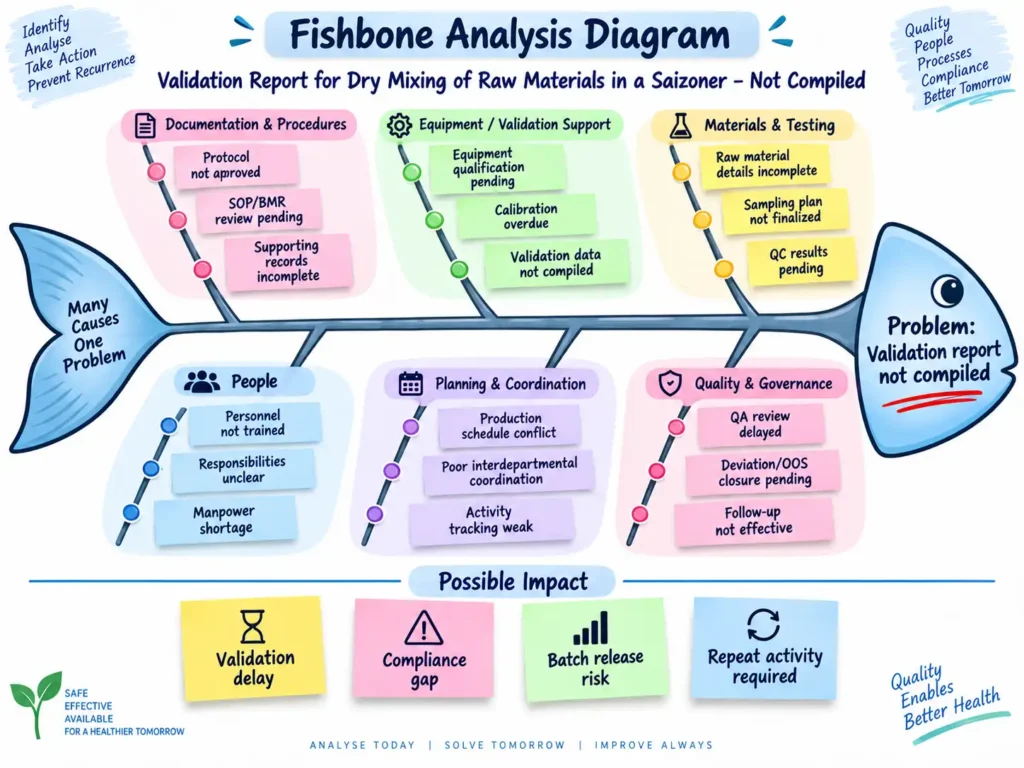
The Fishbone Analysis for the Validation Report for Dry Mixing of Raw Materials in a Saizoner not compiled identifies the major possible causes responsible for the incomplete validation report. The causes are grouped into six main categories: Documentation & Procedures, Equipment/Validation Support, Materials & Testing, People, Planning & Coordination, and Quality & Governance. Documentation-related causes include an unapproved protocol, pending SOP/BMR review, and incomplete supporting records. Equipment-related causes include pending qualification, overdue calibration, and missing validation data. Materials and testing issues include incomplete raw-material details, an unfinished sampling plan, and pending QC results. People-related factors include inadequate training, unclear responsibilities, and manpower shortages. Planning issues include production schedule conflicts, weak activity tracking, and poor coordination between departments. Quality-related causes include delayed QA review, open deviations/OOS, and ineffective follow-up. This analysis helps identify root causes and supports suitable corrective and preventive actions.
6. Heat Map Analysis:
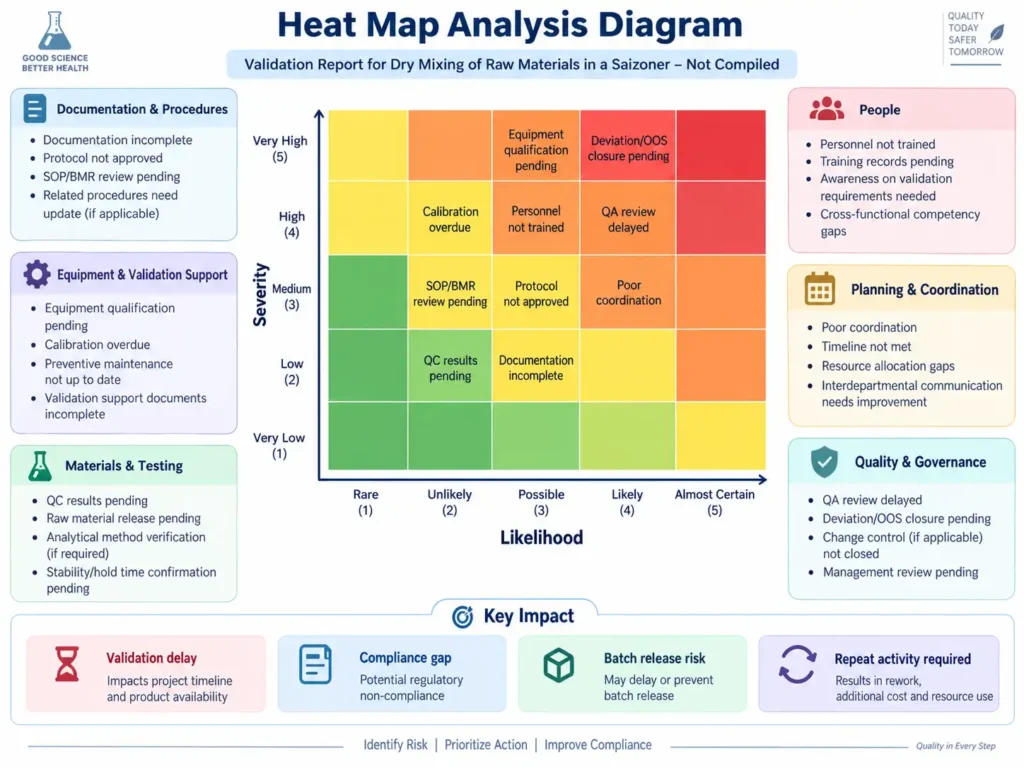
The Heat Map Analysis for the Validation Report for Dry Mixing of Raw Materials in a Saizoner not compiled shows the level of risk associated with different possible causes. Risks are assessed according to likelihood and severity, ranging from very low to very high. High-priority risks include pending equipment qualification, open deviation/OOS closure, delayed QA review, calibration overdue, and inadequate personnel training. Medium-level risks include an unapproved protocol, pending SOP/BMR review, and poor coordination between departments. Lower-level risks include incomplete documentation and pending QC results. The heat map helps the validation team understand which issues require immediate attention and which can be managed through routine follow-up. Major impacts may include validation delay, regulatory compliance gaps, batch release risk, and repetition of validation activities. By prioritizing higher-risk issues first, Production, QA, QC, and Engineering can take timely corrective actions and complete the validation report in a controlled and compliant manner.
Questions & Answers:
Validation Report for Dry Mixing of Raw Materials in a Saizoner
Q1. What is the objective of validation for dry mixing in a Saizoner?
Answer: The objective is to demonstrate that dry mixing achieves uniform distribution of the active ingredient at the standard mixing time and that blend-uniformity results remain within specified limits.
Q2. What is the scope of this validation?
Answer: It is applicable to the mixing of raw materials in a Saizoner.
Q3. What is the basic principle of mixing in the Saizoner?
Answer: Mixing occurs through rotation of the agitator inside the Saizoner.
Q4. Which departments are involved in the validation activity?
Answer: Production, Engineering, Quality Control, and Quality Assurance are responsible for the validation activity.
Q5. What equipment information should be available before validation?
Answer: Equipment code, capacity, agitator RPM, chopper RPM, qualification details, sampling-thief details, and bulk-sampler identification should be available.
Q6. Which documents should be followed during validation?
Answer: The approved SOP for Saizoner operation, SOP for sampling with a sampling thief, and the applicable Batch Manufacturing Record should be followed.
Q7. Why is calibration status important?
Answer: Calibration details should confirm that the Saizoner is within its approved calibration period before performing the validation study.
Q8. What information should be recorded during the validation procedure?
Answer: Equipment, product, mixing time as per BMR, sampling intervals, and the validation date should be recorded.
Q9. What are the main acceptance criteria?
Answer: The mix should show uniform visual distribution, active-ingredient content should comply with the specified limits, and the RSD of active-ingredient content at the optimum mixing time should be less than 5%.
Q10. What should be done if a deviation or OOS result occurs?
Answer: Details of deviations and OOS results should be formally documented, reviewed, and addressed before validation closure.
Q11. Why may a validation report remain uncompiled?
Answer: Possible reasons include incomplete sampling or analytical results, missing documentation, pending deviation/OOS closure, incomplete review, or delayed coordination between responsible departments.
Q12. What types of validation are mentioned in the protocol?
Answer: The protocol includes concurrent validation and re-validation.
Q13. How many successful exercises are required for concurrent validation?
Answer: Three consecutive successful validation exercises are specified.
Q14. What should be included in the final validation report?
Answer: It should include chemical-analysis results, appearance observations, summary of findings, recommendations, team approval, review, approval, and attachments where applicable.
Q15. What is the main risk if the validation report is not compiled?
Answer: The major risks are delayed validation closure, incomplete GMP evidence, difficulty demonstrating process consistency, possible batch-release impact, and a regulatory compliance gap.
Reference Guidelines:
- WHO Technical Report Series No. 1019, Annex 3 – Good Manufacturing Practices: Guidelines on Validation (2019). This is directly relevant to pharmaceutical process validation, qualification, documented protocols, validation reports, deviations, and lifecycle validation activities.
WHO Validation Guideline – TRS 1019 Annex 3 - EU GMP – EudraLex Volume 4, Annex 15: Qualification and Validation. Annex 15 provides GMP expectations for qualification and validation, including validation planning, protocols, reports, acceptance criteria, deviations, change control, and requalification/revalidation.
EU GMP Volume 4 – Annex 15 - US FDA – Process Validation: General Principles and Practices, January 2011. FDA describes process validation as a lifecycle activity and emphasizes establishing scientific evidence that a manufacturing process can consistently deliver quality products.
FDA Process Validation Guidance - ICH Q8(R2) – Pharmaceutical Development. Relevant for understanding material attributes, process parameters, product quality attributes, process understanding, and development of scientifically justified operating conditions such as mixing time and process parameters.
ICH Q8(R2) Pharmaceutical Development - ICH Q9(R1) – Quality Risk Management. Applicable for assessing risks associated with failure to perform or compile validation, including risks related to equipment, documentation, personnel, testing, deviations, and process variability.
- ICH Q10 – Pharmaceutical Quality System. Relevant to management responsibility, process performance monitoring, CAPA, change management, continual improvement, and maintaining validated processes throughout the product lifecycle.
ICH Q10 Pharmaceutical Quality System - WHO Quality Assurance of Pharmaceuticals, Volume 2 – Good Manufacturing Practices and Inspection, 10th Edition, 2024. This WHO compendium provides broader GMP guidance covering pharmaceutical quality systems, personnel, equipment, qualification, validation, manufacturing, documentation, and inspection expectations.