






Brief Description
This SOP describes the procedure for periodic visual inspection of drug products to identify any physical deterioration, packaging defects, or significant changes during the product’s shelf life. It applies to commercially manufactured drug products and defines responsibilities for QC personnel and QA/QC management. Products are selected for visual inspection according to the number of batches manufactured, with routine products generally inspected annually and sensitive products inspected more frequently up to expiry. Samples are retained in the same marketed pack configuration and examined under proper illumination for parameters such as appearance, colour, clarity, leakage, stickiness, discoloration, coating defects, mould growth, odour, and packaging integrity. Observations are documented in the prescribed visual inspection report. Any significant change requires investigation, assessment of potential impact on other batches, corrective action, and retention of investigation records. Annual product assessments, inspection schedules, and summary records are also maintained.
Skip to PDF content1. Flow Diagram:
The flow diagram illustrates the batch-selection process and inspection frequency for visual inspection of drug products. It begins with identifying the number of batches manufactured per month. When fewer than five batches are manufactured, every batch is selected for visual inspection. When production is between more than five and fewer than ten batches, every 5th batch is monitored, while for ten or more batches per month, every 10th batch is selected.
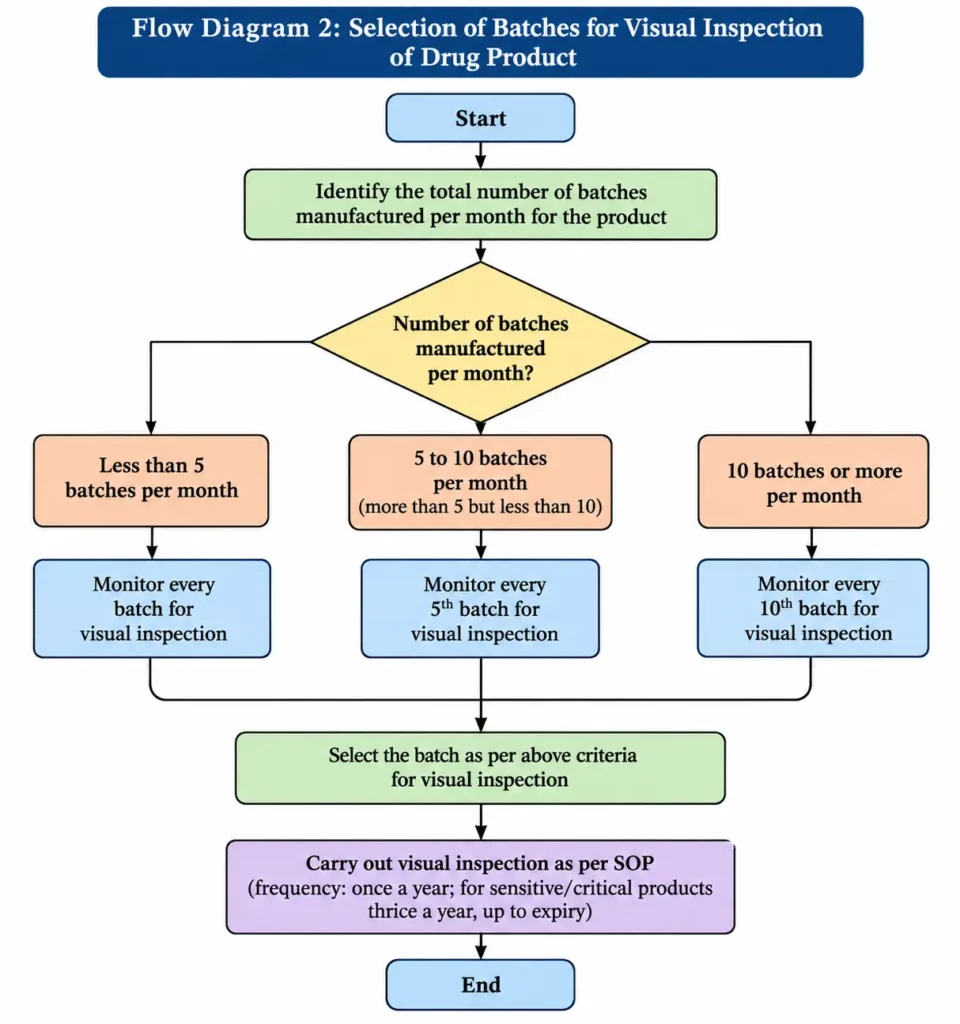
After batch selection, the selected product is subjected to visual inspection according to the SOP. Routine products are generally inspected once annually, while sensitive products require more frequent inspection up to expiry. The overall process ensures systematic monitoring of product appearance and helps identify deterioration or significant changes during shelf life.
2. Brainstorming for SOP Failure:
The brainstorming diagram identifies the major factors that may contribute to SOP failure in a pharmaceutical manufacturing area. The possible causes are grouped into key categories such as People, Methods, Machines/Equipment, Materials, Environment, Management, Documentation, and Other Factors.
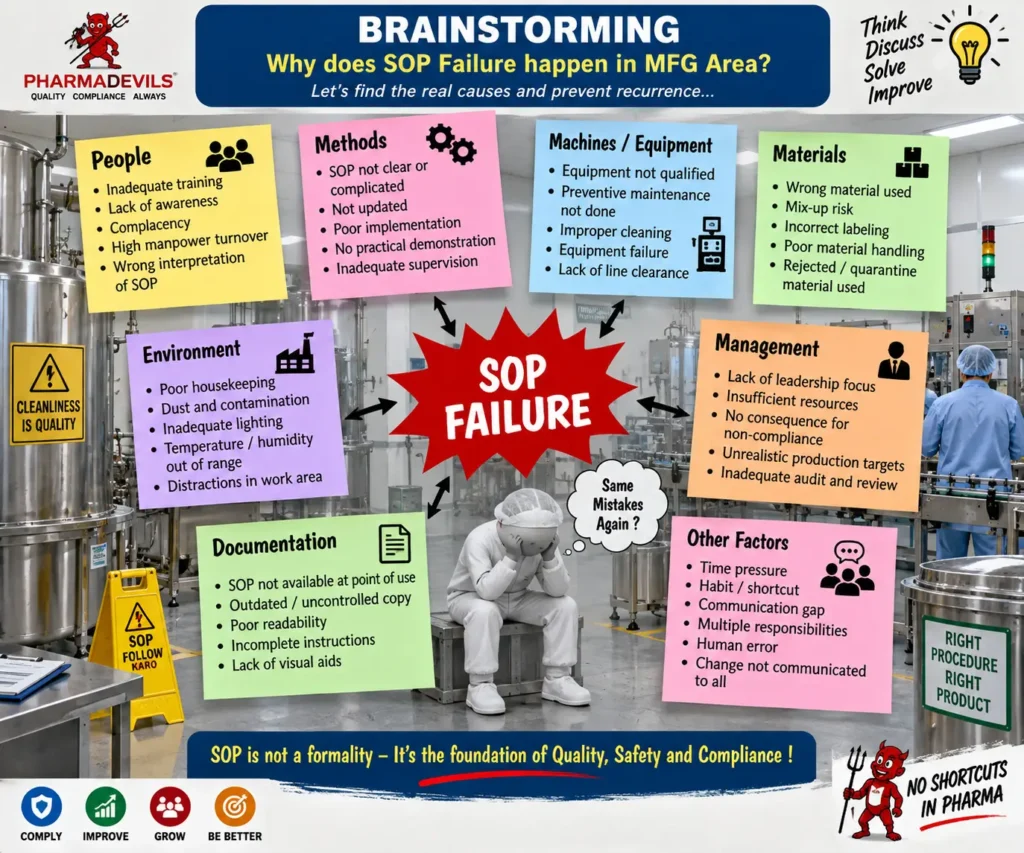
Typical concerns include inadequate training, poor SOP understanding, outdated or complicated procedures, lack of supervision, equipment qualification or maintenance issues, improper cleaning, material mix-ups, poor housekeeping, unsuitable environmental conditions, incomplete documentation, excessive production pressure, communication gaps, shortcuts, and human error. The purpose of this brainstorming exercise is to collect all potential causes before performing detailed root-cause analysis. It helps the investigation team systematically evaluate operational, procedural, equipment, environmental, and human-related weaknesses so that appropriate corrective and preventive actions (CAPA) can be developed to prevent recurrence and strengthen GMP compliance.
3. 5-Why Analysis for SOP Failure:
The 5-Why analysis diagram examines the underlying reasons for failure to follow an SOP in the manufacturing area. It begins with the problem that the SOP was not followed correctly and progressively explores deeper causes.
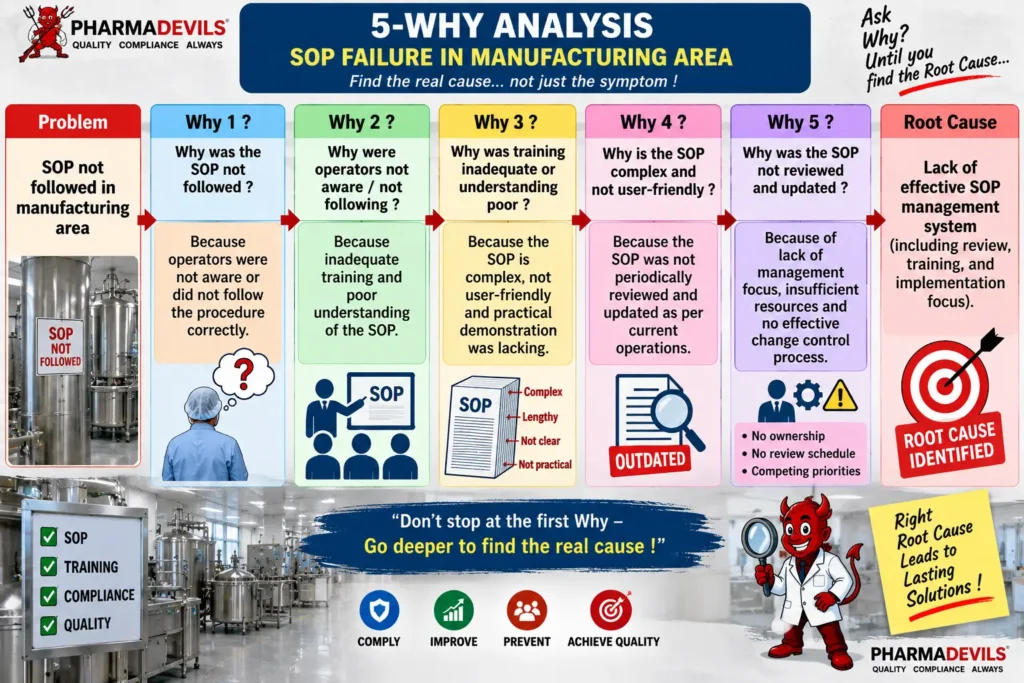
The analysis identifies possible contributors such as operator unawareness, inadequate training, poor understanding of the procedure, overly complex or impractical SOP instructions, lack of periodic SOP review, and weak management oversight. Each “Why” moves the investigation from the immediate human error toward the systemic cause. The final root cause is identified as an ineffective SOP management system, particularly weaknesses in SOP review, training, implementation, ownership, and change control. The diagram emphasizes that investigations should not stop at operator error; they should identify the management and system deficiencies that allowed the failure to occur. Corrective actions should therefore strengthen training effectiveness, SOP simplification, periodic review, supervision, change control, and compliance monitoring.
4. Fishbone Analysis for SOP Failure:
The Fishbone Analysis diagram identifies the major potential causes of SOP failure in a pharmaceutical manufacturing area. The causes are systematically grouped under People, Methods, Machines/Equipment, Materials, Environment, Management, and Documentation.
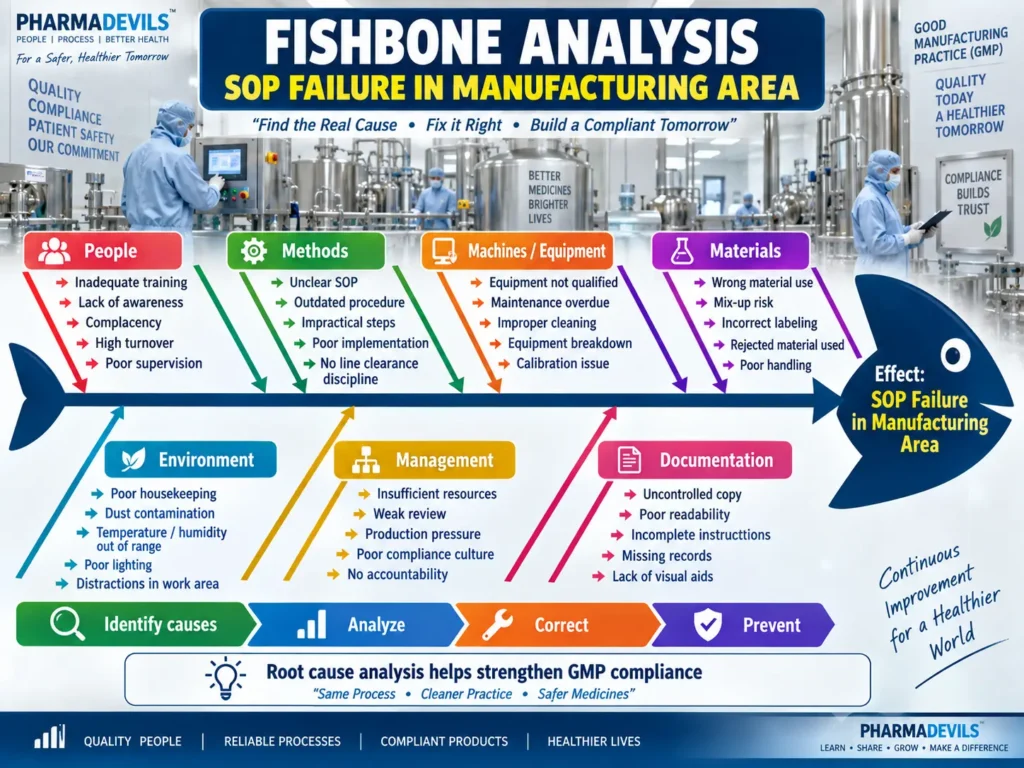
The analysis highlights issues such as inadequate training, lack of awareness, unclear or outdated SOPs, poor implementation, equipment qualification or maintenance gaps, improper cleaning, material mix-ups, incorrect labeling, poor housekeeping, unsuitable temperature or humidity, production pressure, weak compliance culture, uncontrolled SOP copies, and incomplete records. The purpose of the fishbone analysis is to ensure that SOP failure is investigated from multiple perspectives instead of attributing the event only to operator error. By identifying contributing factors across personnel, process, equipment, material, environment, management, and documentation systems, the organization can determine the most likely root causes and implement appropriate CAPA, training, procedural improvement, supervision, and compliance controls to prevent recurrence.
5. Fault Tree Analysis for SOP Failure:
The Fault Tree Analysis diagram systematically evaluates how different failures can contribute to SOP failure in the pharmaceutical manufacturing area. The top event is defined as the SOP not being followed or effectively implemented during manufacturing activities. The analysis groups potential causes into four major branches: Human Error, Procedural Issues, Equipment/Facility Issues, and Material & Environmental Issues. These include inadequate training, lack of awareness, intentional non-compliance, unavailable or unclear SOPs, outdated procedures, unqualified equipment, missed preventive maintenance, unsuitable facility conditions, wrong or unidentified materials, and environmental parameters outside acceptable conditions.
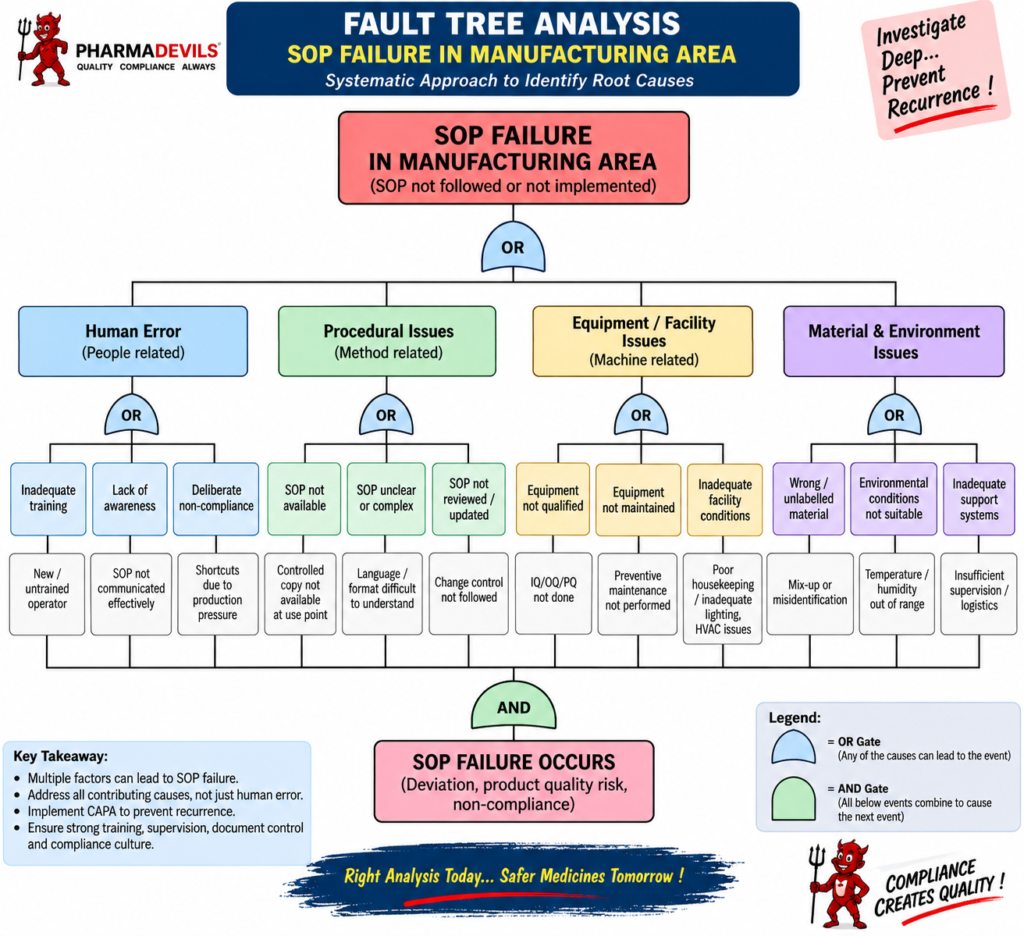
The diagram uses logical OR and AND gates to show how individual or combined failures may lead to deviation, non-compliance, or product-quality risk. The analysis supports identification of critical contributing factors so that appropriate CAPA, training, document control, maintenance, supervision, and environmental controls can be implemented to prevent recurrence.
Questions & Answers – Visual Inspection of Drug Product
Q1. What is the objective of the SOP for Visual Inspection of Drug Product?
Answer: The objective is to describe the procedure to be followed for visual inspection of drug products to identify deterioration during their shelf life.
Q2. What is the scope of this SOP?
Answer: The SOP applies to drug products manufactured and distributed as commercial batches for domestic markets.
Q3. Who is responsible for carrying out visual inspection activities?
Answer: Chemist-QC, Assistant Manager-QC, Manager-QC, and Head-QA/QC are responsible as defined in the SOP.
Q4. What is meant by visual inspection in this SOP?
Answer: Visual inspection is the examination of drug-product batches at periodic intervals up to shelf life to identify evidence of deterioration.
Q5. How frequently should drug products be visually inspected?
Answer: The SOP states that drug products are generally examined at least once a year, while sensitive products require more frequent inspection up to expiry.
Q6. How should samples for visual inspection be packed?
Answer: The sample should be retained in an intact pack that is the same as the marketed or intended commercial pack configuration.
Q7. Under what conditions should visual inspection be performed?
Answer: Visual inspection should be performed in the laboratory under proper illumination.
Q8. What precautions are required for temperature-sensitive products?
Answer: Such products should be allowed to attain ambient temperature before inspection, should preferably not remain at ambient temperature for more than 60 minutes, should be protected from heat, and should be returned to the designated storage condition immediately after inspection.
Q9. How are batches selected when fewer than five batches are manufactured per month?
Answer: All batches are to be monitored for visual inspection.
Q10. How are batches selected when ten or more batches are manufactured per month?
Answer: Every 10th batch is to be monitored for visual inspection.
Q11. What parameters are checked for coated tablets?
Answer: Parameters include tablet appearance, coating quality or cracks, stickiness or softening, discoloration, swelling, fungus or mould formation, crystals due to sublimation, odour, and peeling of coating.
Q12. What packaging attributes are checked for blister or strip packs?
Answer: Checks include legibility of overprinting details, foil intactness, deformation of blister cavities, visible cuts, and the condition of inserts where applicable.
Q13. How are visual inspection observations recorded?
Answer: A tick mark (√) is used when there is no significant change, while a cross mark (×) is used when a significant change is observed, with details documented in the remarks section.
Q14. What action is required if a significant change is observed?
Answer: The finding should be discussed with the technical unit head, corrective action should be worked out, the impact on other manufactured batches should be evaluated, and all investigation-related documents should be retained.
Q15. What records are maintained under this SOP?
Answer: The SOP includes a visual inspection schedule, tablet and liquid inspection reports, annual assessment of products kept for visual inspection, and a visual inspection summary.
Reference Guidelines:
- Revised Schedule M, Drugs Rules, 1945 – Good Manufacturing Practices for Pharmaceutical Products, India (G.S.R. 922(E), 28 Dec 2023). Relevant to pharmaceutical quality systems, QC, stability programmes, sampling, storage, documentation, and retention/reference samples. (CDSCO) CDSCO Revised Schedule M
- ICH Q1A(R2) – Stability Testing of New Drug Substances and Products. Relevant to batch selection, container-closure systems, specifications, testing frequency, storage conditions and evaluation of product quality throughout shelf life. (ICH Database) ICH Q1A(R2) Guideline
- EU GMP, EudraLex Volume 4, Annex 19 – Reference and Retention Samples. Particularly relevant where fully packaged retention samples are maintained for assessment of the finished product and its packaging. The European Commission has also published a revised Annex 19 that becomes applicable 24 September 2026. (Public Health)
- PIC/S GMP Guide PE 009, Annex 19 – Reference and Retention Samples. Covers representative retention/reference samples, sample quantity, packaging configurations and retention arrangements. (PIC/S)
- US FDA 21 CFR Part 211 – §§211.166 and 211.170. These provisions address the written stability-testing programme and reserve samples of finished drug products, supporting continued assessment of product quality during shelf life. (U.S. Food and Drug Administration)