







1. Introduction – SOP for Batch Reconciliation and Calculation of Yield:
The SOP for Batch Reconciliation and Calculation of Yield is established to provide a systematic procedure for reconciling materials used during pharmaceutical manufacturing and packing operations and for calculating the yield at different stages of batch processing. The procedure helps ensure that quantities of materials issued, consumed, returned, rejected, sampled, destroyed, and transferred are properly accounted for and documented in the respective Batch Manufacturing Record (BMR) and Batch Packing Record (BPR). Batch reconciliation is performed at applicable processing stages such as granulation, compression, inspection, coating, capsule filling, and imprinting, while packing-material reconciliation is completed after the packing activity. Any unexplained deviation from the established reconciliation or yield limits requires investigation involving Production and Quality Assurance. The SOP also defines the calculation of percentage variance, stage-wise yield, final yield, and non-recoverable loss. Proper implementation of this procedure supports material accountability, process control, traceability, detection of abnormal losses, prevention of mix-ups, and GMP compliance, thereby providing documented evidence that the manufactured and packed batch has been appropriately reconciled before final disposition.
Skip to PDF content2. Flow Diagram – SOP for Batch Reconciliation and Calculation of Yield:
The SOP for Batch Reconciliation and Calculation of Yield describes a controlled approach for accounting for materials and determining yield throughout pharmaceutical manufacturing and packing operations. The process begins with the issue of materials according to the approved BMR/BPR, followed by manufacturing stages such as granulation, compression, inspection, coating, capsule filling, or imprinting, as applicable. Semi-finished material reconciliation is performed at the relevant processing stages to compare actual quantities with expected quantities and to identify any unexplained loss or deviation.
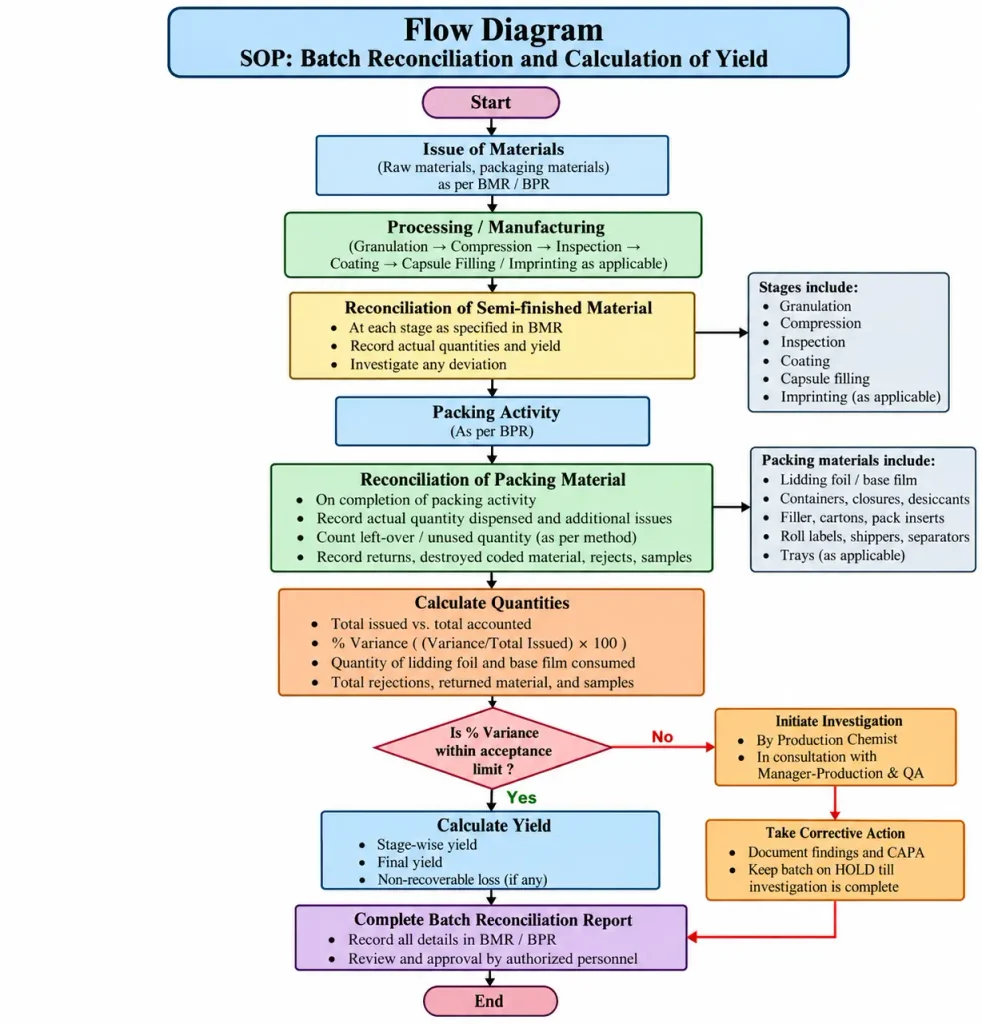
After completion of packing, packaging materials are reconciled by recording issued, consumed, returned, rejected, sampled, and destroyed quantities. The variance between the total quantity issued and the total accounted quantity is calculated and compared with the established acceptance limit. Where the percentage variance is outside the acceptable limit, an investigation is required and the batch is kept on hold until completion of the investigation. The procedure also includes stage-wise yield, final yield, and non-recoverable loss calculations, with all reconciliation and yield results documented in the BMR/BPR for review and batch disposition.
3. Benefits of Following SOP for Batch Reconciliation and Calculation of Yield:
Following the SOP for Batch Reconciliation and Calculation of Yield provides a structured system for maintaining complete material accountability throughout manufacturing and packing operations. The procedure requires reconciliation of semi-finished materials at applicable processing stages and reconciliation of packing materials after completion of packing, helping ensure that issued, used, returned, rejected, sampled, and destroyed quantities are properly documented. The SOP also supports accurate calculation of percentage variance, stage-wise yield, final yield, and non-recoverable loss, allowing Production and Quality Assurance to identify abnormal material losses or discrepancies at an early stage.
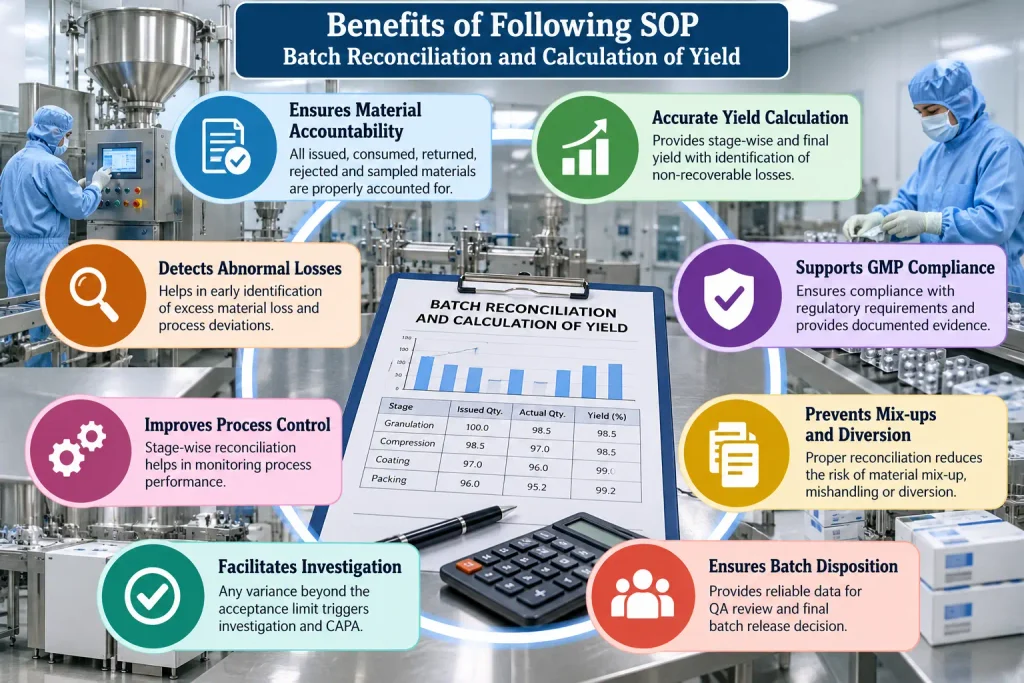
Proper implementation improves process control, strengthens traceability, reduces the risk of unexplained losses and material mix-ups, and provides reliable records in the BMR and BPR. If the percentage variance exceeds the specified acceptance limit, the procedure requires investigation and the batch to remain on hold until the investigation is completed.Overall, compliance with this SOP supports consistent batch evaluation, documented review, GMP compliance, and informed batch disposition by authorized personnel.
4. Brainstorming for SOP Failure – Batch Reconciliation and Calculation of Yield:
The brainstorming analysis for failure of the SOP for Batch Reconciliation and Calculation of Yield is intended to identify possible causes that may lead to inaccurate reconciliation, incorrect yield calculation, incomplete documentation, or unexplained material losses during manufacturing and packing operations. Potential causes include incorrect data entry in the BMR/BPR, incomplete issue and return records, weighing or counting errors, material mix-ups, packing material discrepancies, unrecorded rejects or samples, process deviations, communication gaps, and insufficient training. These failures can affect the accuracy of issued, consumed, returned, rejected, sampled, and destroyed quantity records.
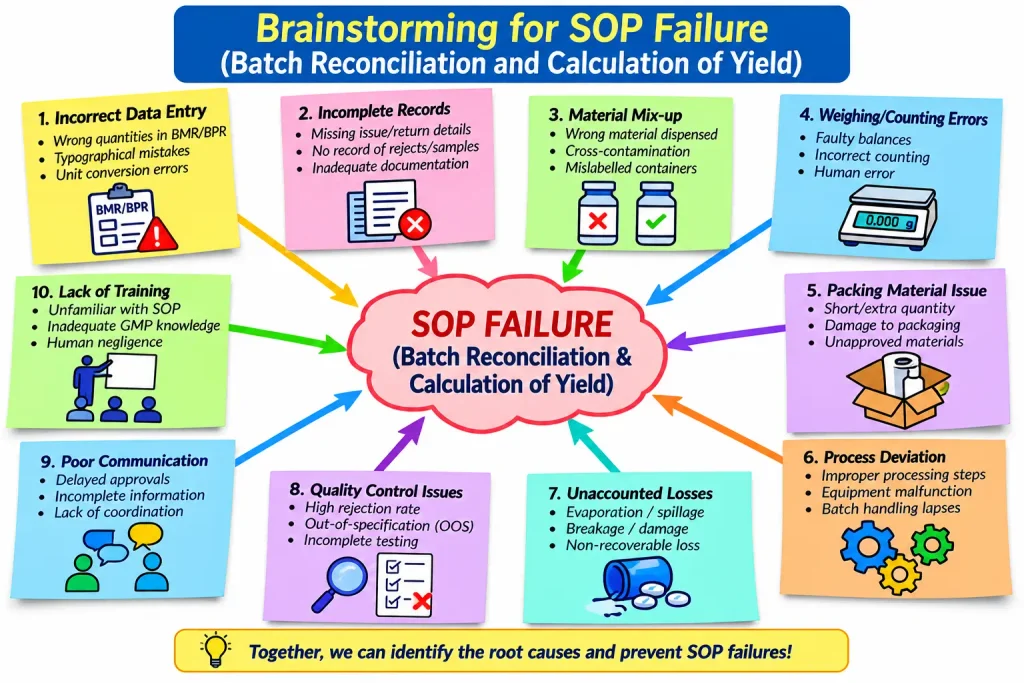
The SOP requires reconciliation at applicable manufacturing stages and completion of packing-material reconciliation after packing activities. Any deviation from the expected reconciliation or yield must be investigated in consultation with Production and Quality Assurance. Brainstorming these potential failure points helps the organization identify weaknesses before they result in significant discrepancies. It supports better training, accurate documentation, proper verification, stronger material accountability, timely investigation, and improved compliance with the established reconciliation and yield-calculation procedure.
5. 5-Why Analysis for SOP Failure – Batch Reconciliation and Calculation of Yield:
The 5-Why Analysis for failure of the SOP for Batch Reconciliation and Calculation of Yield is used to trace reconciliation and yield discrepancies back to their underlying root cause. The analysis begins with the problem of incorrect batch reconciliation or yield calculation and repeatedly asks “Why?” until the basic system weakness is identified. A typical chain may begin with a difference between issued, consumed, returned, rejected, or sampled quantities. This may be linked to incomplete recording in the BMR/BPR, missing entries for returns or rejects, inadequate verification of reconciliation data, and insufficient training or independent review. The SOP requires reconciliation of semi-finished material at applicable stages and investigation of deviations from the standard.
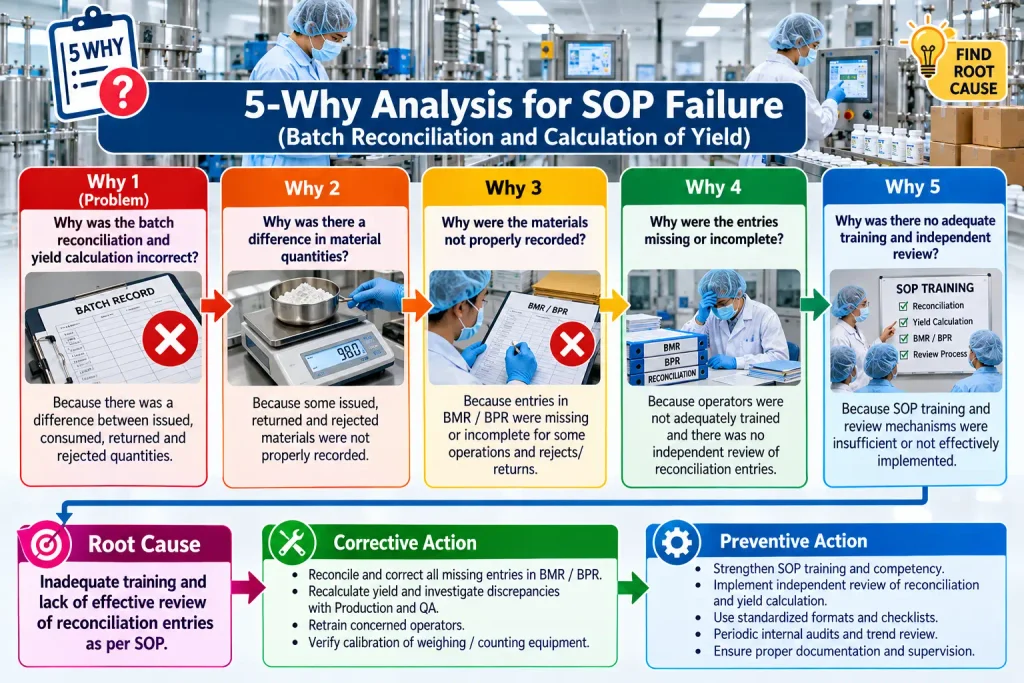
The probable root cause may therefore involve inadequate SOP training, weak documentation practices, or ineffective review of reconciliation and yield calculations. Corrective actions can include reconciliation of missing records, recalculation of yield, investigation of discrepancies, retraining of concerned personnel, and verification of weighing or counting equipment. Preventive actions may include standardized reconciliation formats, independent checking, periodic training, supervision, and trend review. This analysis helps ensure that the organization addresses not only the immediate discrepancy but also the underlying cause, thereby reducing recurrence and improving material accountability, documentation accuracy, and GMP compliance.
6. Fishbone Analysis for SOP Failure – Batch Reconciliation and Calculation of Yield:
The Fishbone Analysis for failure of the SOP for Batch Reconciliation and Calculation of Yield is used to systematically identify potential causes that may lead to reconciliation errors, incorrect yield calculation, unexplained material losses, and documentation discrepancies during pharmaceutical manufacturing and packing activities. The analysis groups possible causes under six major categories: Man, Method, Machine, Material, Measurement, and Environment. Man-related causes may include inadequate training, human error, poor supervision, or failure to follow the SOP. Method-related causes include unclear procedures, incomplete reconciliation steps, incorrect yield calculation methods, and poor documentation practices. Machine-related causes may involve uncalibrated balances, counting-device malfunction, equipment breakdown, or inadequate maintenance.
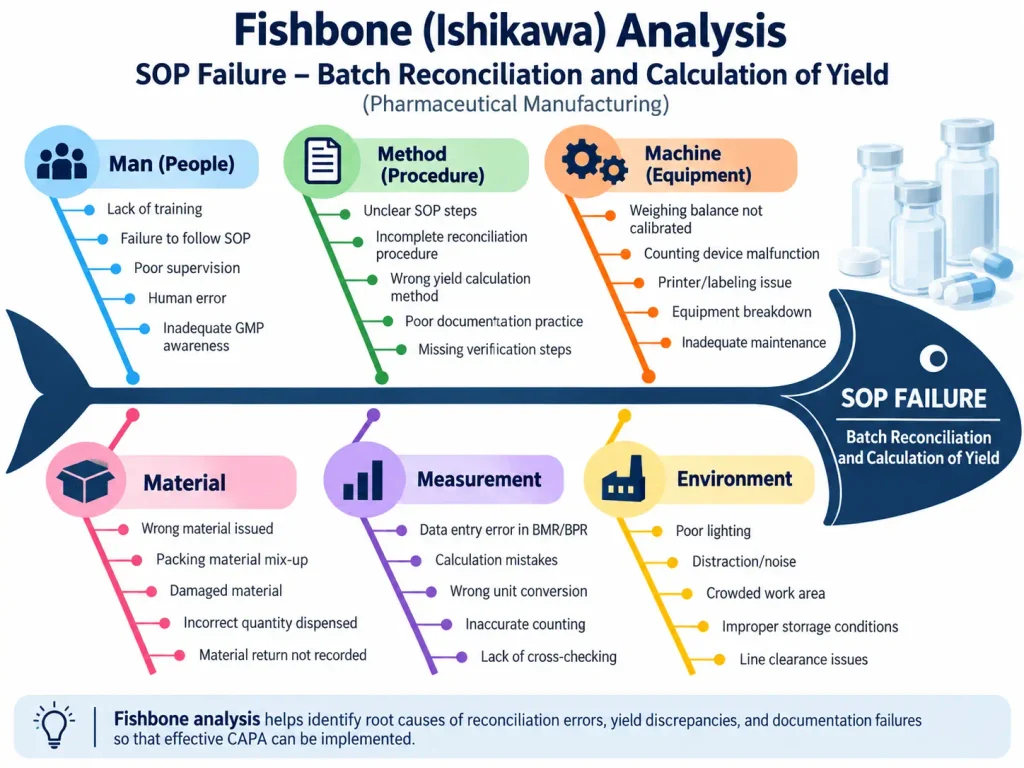
Material-related causes include wrong material issuance, packing material mix-ups, damaged material, incorrect quantities, or failure to record returned material. Measurement-related causes include calculation mistakes, wrong unit conversion, inaccurate counting, and lack of cross-checking. Environmental factors such as poor lighting, distractions, inadequate workspace, improper storage conditions, or line-clearance issues may also contribute to SOP failure. The SOP itself requires reconciliation of semi-finished material at applicable processing stages and investigation of deviations from the established standard in consultation with Production and Quality Assurance. Fishbone analysis therefore supports structured root-cause identification and helps define suitable corrective and preventive actions to strengthen batch reconciliation and yield control.
7. Fault Tree Analysis for SOP Failure – Batch Reconciliation and Calculation of Yield:
The Fault Tree Analysis for SOP Failure – Batch Reconciliation and Calculation of Yield provides a structured method for identifying the combinations of failures that can result in inaccurate batch reconciliation or incorrect yield calculation. The top event is defined as failure of the SOP for Batch Reconciliation and Calculation of Yield, which may arise from incorrect material reconciliation, incorrect yield calculation, incomplete or inaccurate BMR/BPR documentation, or unexplained material loss and deviation. Potential contributing causes include wrong material issuance, inaccurate counting or weighing, unrecorded returned or rejected material, wrong formulas or unit conversions, incorrect stage-wise quantities, calculation errors, missing entries, delayed documentation, equipment malfunction, packing material discrepancies, and deviations that are not properly investigated.
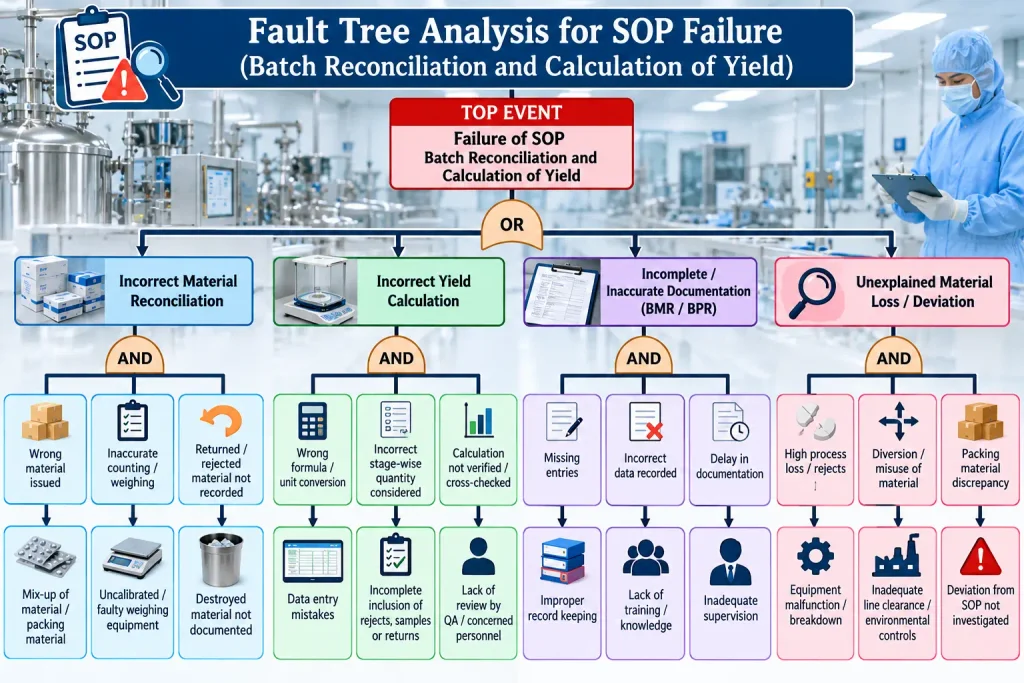
The SOP requires semi-finished material reconciliation at applicable stages and requires deviations from the standard to be investigated in consultation with Production and Quality Assurance. It also requires calculation of packing-material variance and specifies that the batch should remain on hold when the percentage variance is outside the acceptance limit until the investigation is completed. Fault Tree Analysis therefore helps trace the top failure event back to its underlying causes, supports systematic root-cause investigation, and provides a logical basis for defining suitable corrective and preventive actions to improve reconciliation accuracy, yield reliability, documentation control, and GMP compliance.
8. Impact Assessment of SOP Failure – Batch Reconciliation and Calculation of Yield:
Failure to properly follow the SOP for Batch Reconciliation and Calculation of Yield can have significant impact on material accountability, manufacturing control, documentation accuracy, and batch disposition. Inaccurate reconciliation may result in unexplained differences between issued, consumed, returned, rejected, sampled, destroyed, and transferred quantities, making it difficult to confirm complete accountability of the batch materials. The SOP requires reconciliation of semi-finished material at applicable manufacturing stages and reconciliation of packing materials after completion of packing activities. Any failure in these activities may lead to incorrect yield calculations, unrecognized process losses, packing-material discrepancies, and unreliable BMR/BPR records.
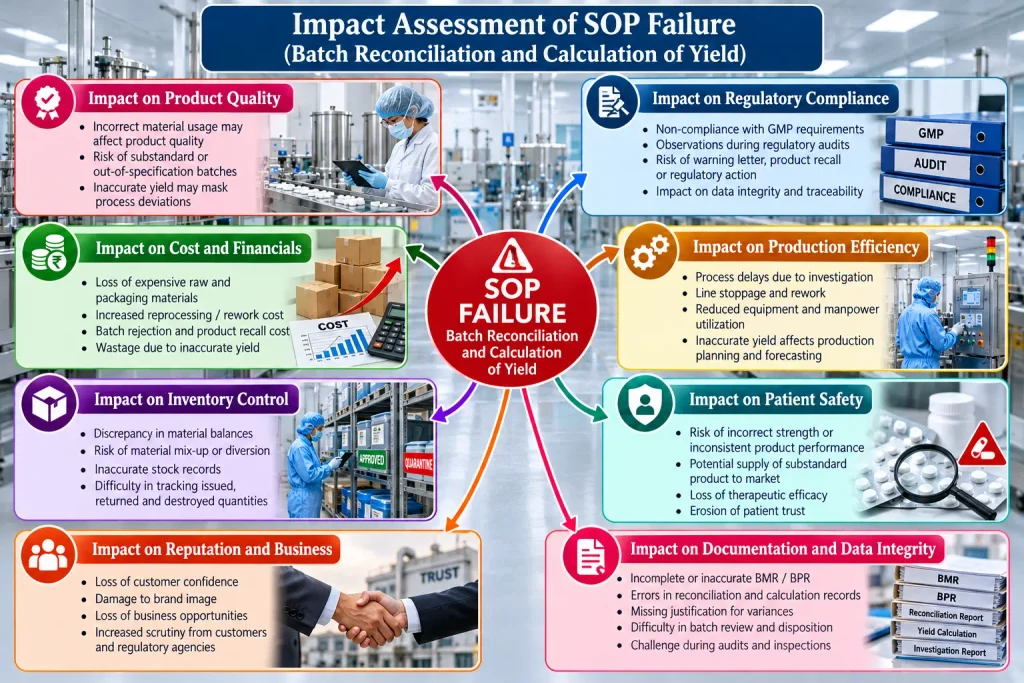
The impact may extend to product quality, production efficiency, inventory control, investigation workload, documentation and data integrity, financial loss, and GMP compliance. The SOP specifically requires investigation when reconciliation or variance does not meet the established acceptance criteria, and the batch is to remain on hold until the investigation is completed. Therefore, effective implementation of this SOP is important to ensure accurate yield calculation, timely detection of abnormal losses, proper material traceability, reliable batch records, and scientifically justified batch review and disposition.
9. CAPA for SOP Failure – Batch Reconciliation and Calculation of Yield:
The CAPA for failure of the SOP for Batch Reconciliation and Calculation of Yield is intended to correct identified reconciliation and yield-calculation errors, prevent recurrence, and verify that implemented actions remain effective. Typical failures may involve incorrect weighing or counting, missing BMR/BPR entries, incomplete recording of returned, rejected, or sampled material, calculation errors, inadequate training, poor documentation, or insufficient review. Corrective actions should include rechecking and, where required, re-performing reconciliation, correcting documented errors through the approved GDP system, verifying yield and variance calculations, investigating discrepancies with Production and Quality Assurance, retraining concerned personnel, and ensuring weighing or counting equipment is suitably calibrated. The SOP requires investigation when deviations from the standard occur and also requires the batch to remain on hold when percentage variance is outside the acceptance limit until the investigation is completed.
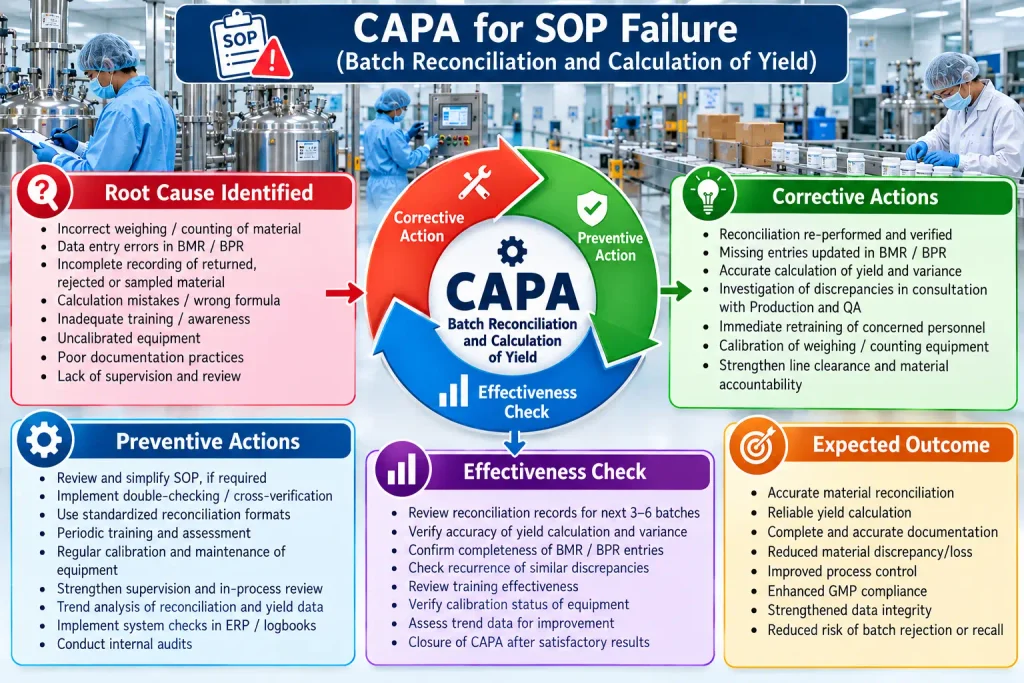
Preventive actions may include strengthening SOP training, introducing independent verification of calculations, improving reconciliation formats, periodic review of yield trends, better supervision, and routine verification of equipment status. Effectiveness can be checked by reviewing subsequent batch reconciliation records, confirming accurate BMR/BPR entries, verifying acceptable variance and yield results, and ensuring similar discrepancies do not recur. Effective CAPA strengthens material accountability, documentation accuracy, process control, data integrity, and GMP compliance, while reducing the risk of repeated reconciliation errors and incorrect batch disposition.
Question & Answer – SOP for Batch Reconciliation and Calculation of Yield:
Q1. What is the objective of this SOP?
The objective is to describe the procedure for batch reconciliation and calculation of yield during manufacturing and packing operations.
Q2. Who is responsible for execution of the SOP?
The Chemist/Officer-Production and concerned Production personnel are responsible for execution, while the Sr. Manager-Production and Head-QA/QC are responsible for effective implementation.
Q3. At which stages is semi-finished material reconciliation performed?
It is performed after granulation, compression, inspection, coating, capsule filling, and imprinting, as applicable.
Q4. What should be done if there is a deviation from the standard reconciliation?
An investigation should be carried out in consultation with Manager-Production and Manager-Quality Assurance.
Q5. When should packing material reconciliation be performed?
Packing material reconciliation should be completed after completion of the packing activity of the batch.
Q6. Which packing materials are covered under reconciliation?
The SOP includes lidding foil, base film, closures, containers, desiccants, filler, cartons, pack inserts, roll labels, shippers, separators, and trays.
Q7. How are unused packing materials handled?
Unused primary packing material is returned to the warehouse through the applicable material return procedure, and the returned quantity is recorded in the BPR.
Q8. How are leftover coded packing materials handled?
Leftover coded packing materials are physically counted and destroyed after verification by the concerned Chemist, with the destroyed quantity recorded in the BPR.
Q9. What quantities are included during packing reconciliation?
The SOP requires recording of in-process rejects, quantity transferred to BSR, sampled quantity, attached samples, and material returns.
Q10. How is percentage variance calculated?
% Variance = (Variance / Total Issued) × 100.
Q11. What happens if the percentage variance exceeds the acceptance limit?
An investigation is required by Production and Quality Assurance, and the batch is kept on HOLD until the investigation is completed.
Q12. How is final yield generally calculated?
The SOP calculates yield stage-wise by comparing the actual quantity obtained with the applicable batch size or quantity transferred, depending on the manufacturing stage.
Q13. How is the final packed yield calculated?
The SOP specifies:
% Final Yield = (Total Quantity Packed / Batch Size) × 100.
Q14. How is non-recoverable loss calculated?
% Non-recoverable loss = 100 − % Final Yield.
Q15. Where are reconciliation and yield calculations recorded?
They are recorded in the applicable Batch Manufacturing Record (BMR) and Batch Packing Record (BPR).
Q16. Why is batch reconciliation important?
It confirms that issued, used, returned, rejected, sampled, and packed quantities are properly accounted for and helps detect unexplained losses or discrepancies before batch disposition.
Reference Guideline – SOP for Batch Reconciliation and Calculation of Yield:
1. Good Manufacturing Practices (GMP) – applicable requirements for pharmaceutical manufacturing, material accountability, documentation, reconciliation, yield calculation, and batch record control.