







1. Introduction – SOP for Batch Release System:
The SOP for Batch Release System establishes a controlled and documented procedure for the release of in-process products, bulk finished products for packing, and finished packed products for dispatch. It defines the system to be followed for batch processing, packing, review, approval, rejection, hold, and final release activities. The procedure involves coordinated activities between Production, IPQA, Quality Control, Quality Assurance, Warehouse, and authorized personnel. Samples are withdrawn and tested by QC, analytical reports are reviewed by QA, and appropriate status labels such as “APPROVED,” “ON HOLD,” or “REJECTED” are assigned based on evaluation and investigation results. Before final release, the completed BMR/BPR, analytical results, reconciliation, deviations, and terminal inspection records are reviewed by Quality Assurance. Only batches meeting established specifications, GMP requirements, and applicable regulatory requirements are authorized for market distribution.
2. Flow Diagram – SOP for Batch Release System:
The Flow Diagram for Batch Release System represents the sequential activities followed for release of in-process, bulk finished, and finished product batches. The process begins after completion of the manufacturing stage, when Production raises a sample requisition and IPQA collects the required samples, applies the “SAMPLED” status label, and forwards them to Quality Control for analysis. QC assigns an analytical reference number, performs testing, and submits the analytical report for QA review.
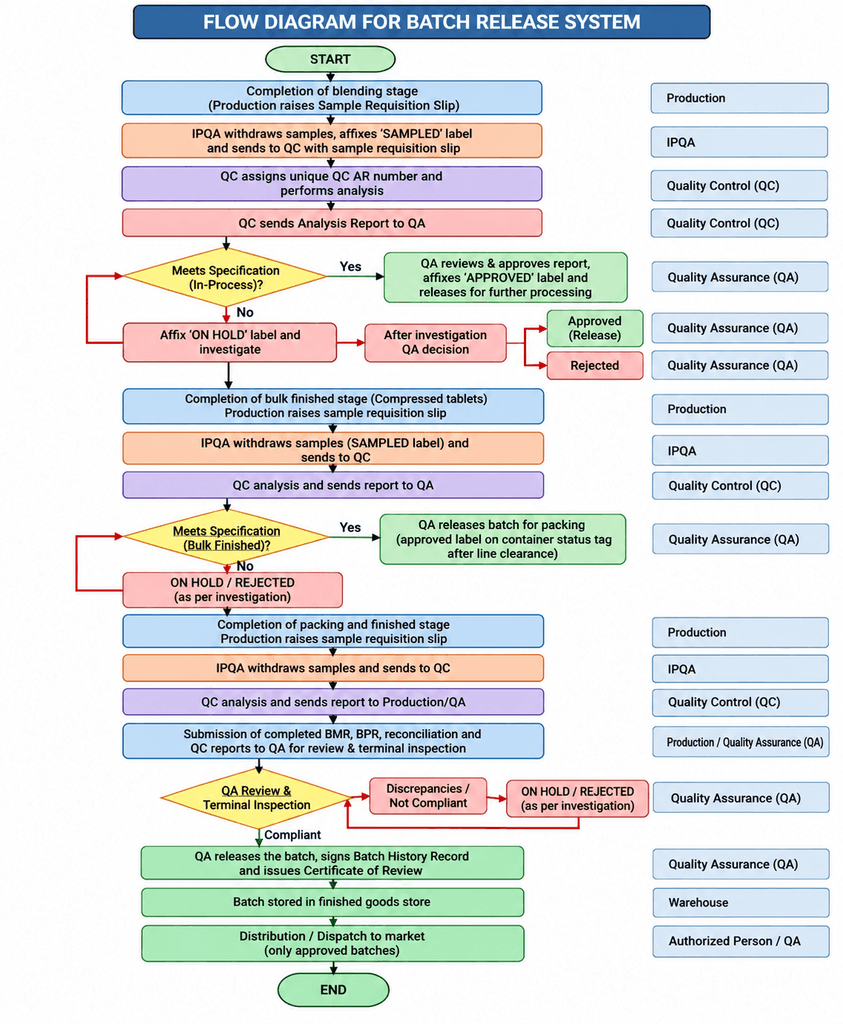
If the batch complies with specifications, QA assigns “APPROVED” status and permits further processing or packing. In case of OOS or unresolved investigation, the batch is placed “ON HOLD” and, after investigation, is either approved or rejected. After packing, the completed BMR/BPR, QC reports, reconciliation records, and terminal inspection documentation are reviewed by QA. Only batches found compliant are finally released, stored in the finished goods store, and permitted for dispatch and market distribution.
3. Benefits of Following SOP – Batch Release System:
Following the SOP for Batch Release System ensures that pharmaceutical batches are reviewed, tested, documented, and approved in a controlled manner before further processing, packing, or market distribution. The SOP defines coordinated responsibilities for Production, IPQA, Quality Control, Quality Assurance, Warehouse, and authorized personnel, helping maintain a clear and consistent release process. Proper implementation improves product quality and safety, regulatory compliance, documentation accuracy, traceability, accountability, and consistency between batches. Analytical testing and QA review help identify non-compliant or OOS batches at an early stage so they can be placed “ON HOLD,” investigated, approved, or rejected based on documented conclusions.
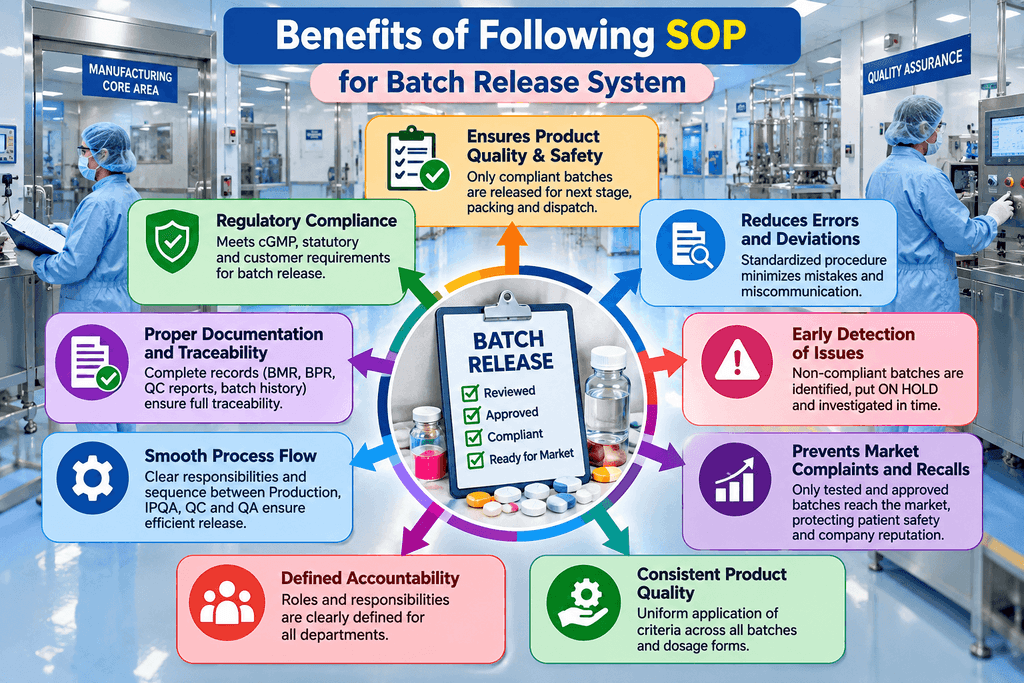
The SOP also ensures systematic review of BMR/BPR, QC reports, deviations, reconciliation, terminal inspection, and batch history records before final release. This minimizes errors, prevents unauthorized distribution, supports GMP compliance, and ensures that only approved batches are released to the market.
4. 5-Why Analysis – SOP for Batch Release System:
The 5-Why Analysis for SOP Failure – Batch Release System is used to identify the underlying causes of a failure occurring during batch release activities in the pharmaceutical core area. The analysis begins with the problem of a batch being released without complete compliance with the approved procedure and then progressively examines why the failure occurred.
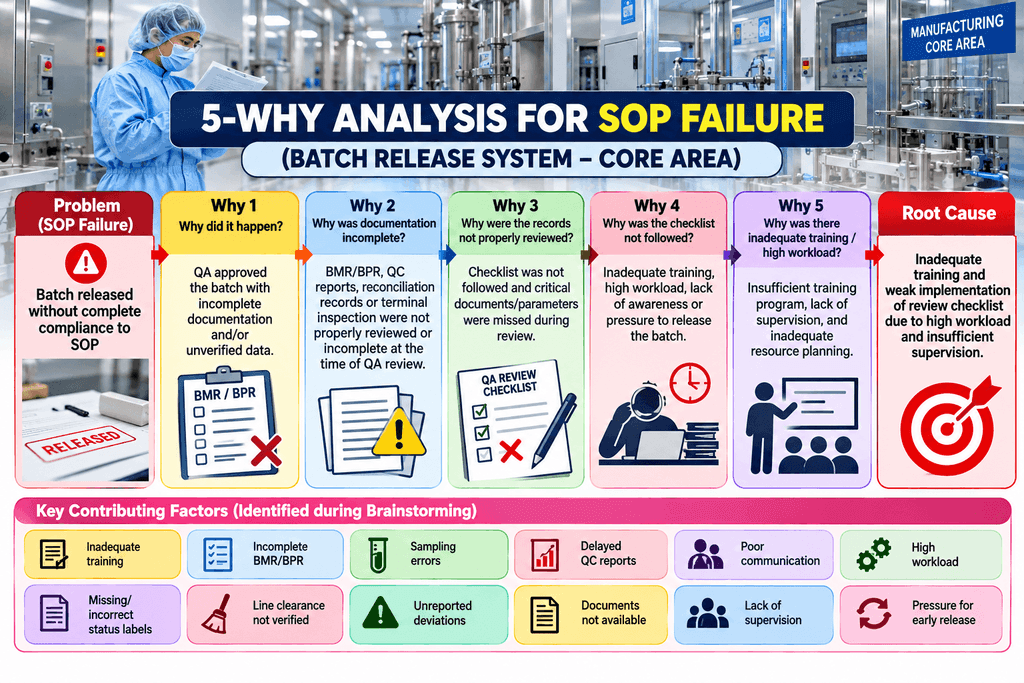
Potential causes include incomplete BMR/BPR documentation, missing or delayed QC reports, inadequate review of reconciliation and terminal inspection records, failure to follow QA review checklists, insufficient training, high workload, weak supervision, and pressure for early batch release. The SOP requires completed batch manufacturing and packing records to be submitted to Quality Assurance for review and terminal inspection before final release. The analysis ultimately helps establish the root cause and supports appropriate CAPA, such as improved training, stronger supervisory review, checklist enforcement, workload management, and verification of all required documents before QA approval and final batch release.
5. Fishbone Analysis – SOP for Batch Release System:
The Fishbone Analysis for SOP Failure – Batch Release System identifies the potential causes that may contribute to failure of batch release activities in the pharmaceutical core area. The causes are grouped into major categories such as Man/People, Method, Machine/Equipment, Material/Documents, Measurement/QC, and Environment/Management. Important contributing factors include inadequate training, insufficient supervision, poor communication, missed SOP steps, failure to perform line clearance, unreported deviations, equipment or labeling issues, incomplete BMR/BPR, missing status labels, sampling errors, delayed QC reports, improper review, reconciliation errors, high workload, manpower shortage, and pressure for early release.
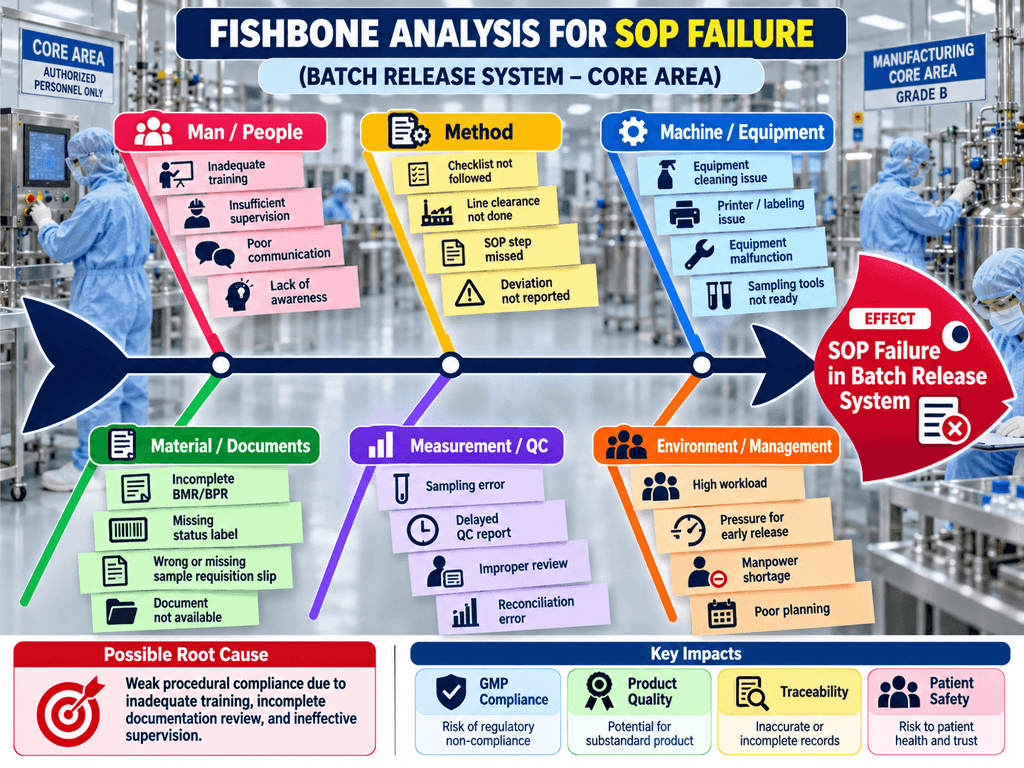
These factors can interfere with the controlled batch release process, which requires Production, IPQA, QC, QA, Warehouse, and authorized personnel to perform defined responsibilities. The SOP also requires QA review of batch documentation and terminal inspection before final release. Fishbone analysis helps organize possible causes systematically so the most likely root causes can be investigated and suitable CAPA can be implemented.
6. Fault Tree Analysis – SOP for Batch Release System:
The Fault Tree Analysis for SOP Failure – Batch Release System illustrates how multiple failures in the pharmaceutical core area can combine and result in an incorrect or non-compliant batch release. The top event is “Batch Released without Compliance to SOP.” This may occur because of incomplete or incorrect documentation, inadequate QA review or approval, process/operational non-compliance, and human or system-related factors.
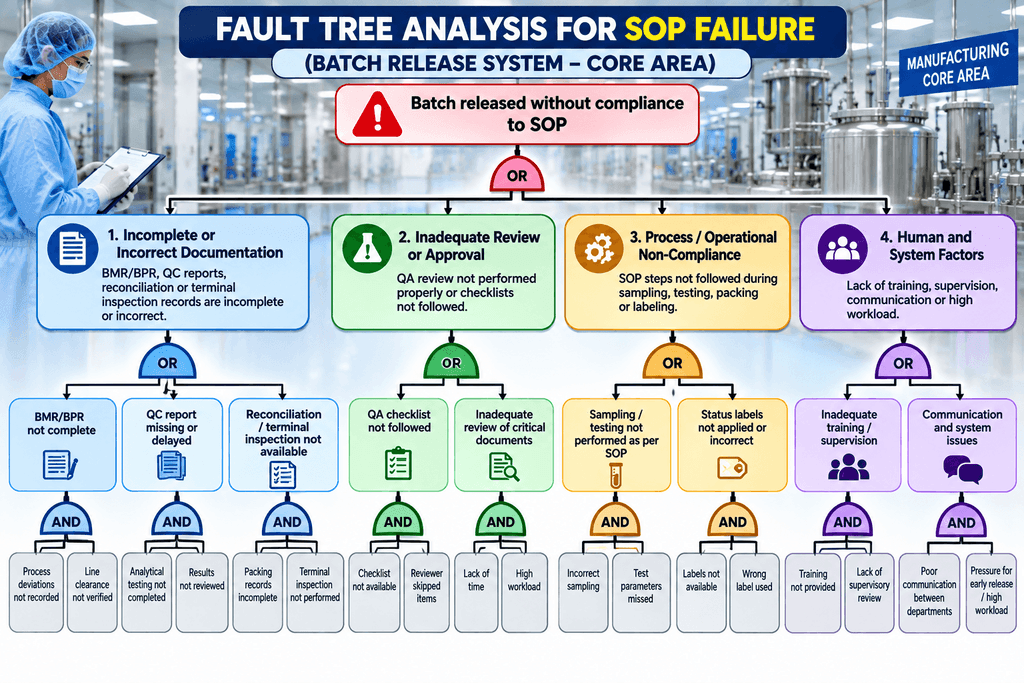
Typical contributing causes include incomplete BMR/BPR, delayed or missing QC reports, unavailable reconciliation or terminal inspection records, failure to follow QA review checklists, improper sampling or testing, incorrect status labeling, inadequate training, weak supervision, poor communication, high workload, and pressure for early release. The SOP requires QA to review batch manufacturing records and QC reports, record discrepancies, perform terminal inspection, and release the batch only after satisfactory review. Fault Tree Analysis helps trace the top event back to its basic causes so that appropriate corrective and preventive actions can be implemented to strengthen the batch release system.
7. Impact Assessment – SOP for Batch Release System:
The Impact Assessment for SOP Failure – Batch Release System evaluates the possible consequences when the approved batch release procedure is not followed correctly in the pharmaceutical core area. Failure in sampling, testing, documentation, QA review, status labeling, reconciliation, terminal inspection, or final authorization can affect product quality, patient safety, regulatory compliance, operations, finances, reputation, and internal quality systems.
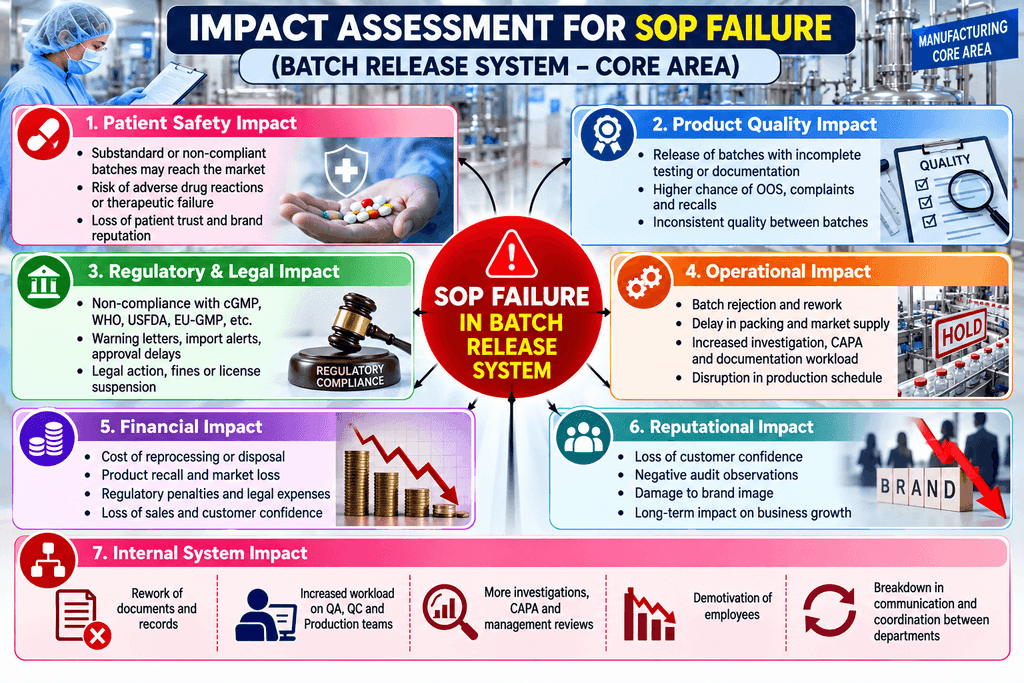
A non-compliant batch may be released prematurely, increasing the risk of OOS results, complaints, recalls, rework, rejection, or supply delays. The SOP requires completed BMR/BPR, QC reports, and batch documentation to be reviewed by Quality Assurance, with discrepancies recorded during terminal inspection before final release. The SOP also specifies that only approved batches are to be released for distribution, and authorized personnel must certify that each batch has been produced and controlled according to applicable requirements. Therefore, SOP failure can lead to additional investigations, CAPA workload, regulatory observations, financial loss, and reduced confidence in the pharmaceutical quality system.
8. CAPA – SOP for Batch Release System:
The Corrective and Preventive Action (CAPA) for SOP Failure – Batch Release System is intended to address identified deficiencies in batch release activities and prevent their recurrence. Key failures may include incomplete BMR/BPR and QC reports, inadequate training, failure to follow QA review checklists, process non-compliance, high workload, insufficient supervision, and poor interdepartmental communication. Corrective actions should focus on immediate containment of affected batches, completion and review of pending documents, retraining of concerned personnel, investigation of process deviations, and re-verification of critical release activities. Preventive actions should include mandatory document and QA review checklists, periodic training and assessment, independent review of critical records, line-clearance verification, periodic internal audits, workload monitoring, and improved communication between Production, IPQA, QC, QA, and Warehouse.
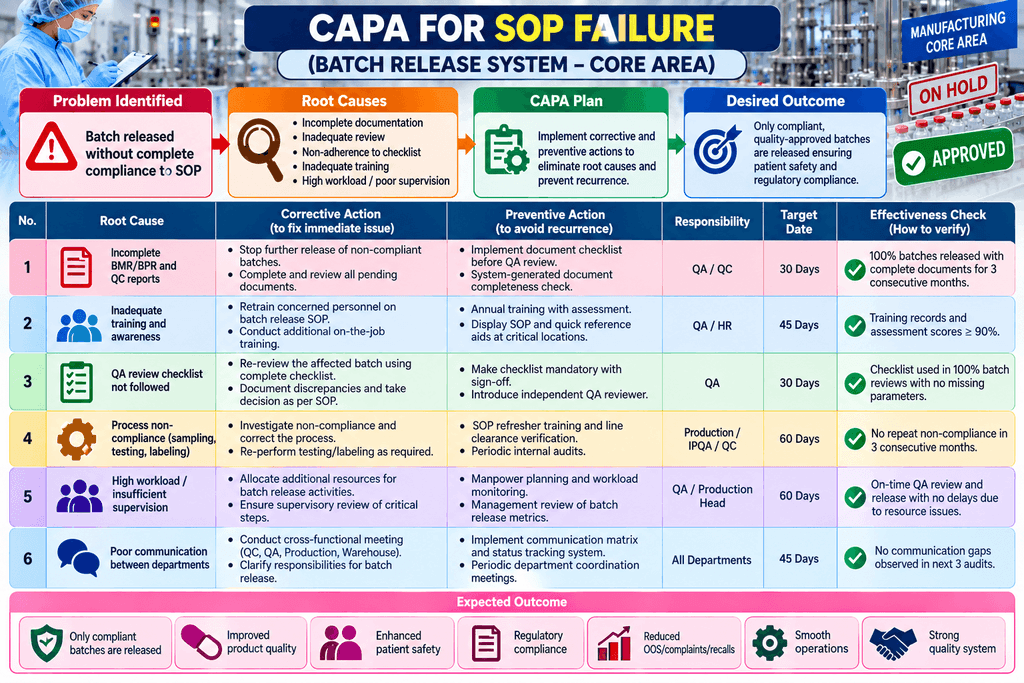
The SOP requires QA to review the completed batch documentation and terminal inspection before final release, while only approved batches are permitted for market distribution. Effective CAPA implementation strengthens compliance, improves traceability, reduces repeat deviations, and helps ensure that only compliant batches are released.
Questions & Answers – SOP for Batch Release System:
- What is the objective of the SOP for Batch Release System?
The objective is to define the procedure for release of in-process products, bulk finished products for packing, and packed finished products for dispatch. - What is the scope of this SOP?
The SOP applies to the systems followed for releasing batches for processing, packing, and dispatch. - Who is responsible for implementation of the Batch Release SOP?
Concerned personnel are responsible for execution, while Production, QC, QA, Warehouse and Head-QA/QC personnel are responsible for effective implementation. - When is sampling initiated after blending?
After completion of the blending stage, Production raises a sample requisition slip and informs IPQA for sampling. - What does IPQA do after withdrawing the sample?
IPQA affixes a duly signed “SAMPLED” label on the status tag and forwards the withdrawn samples to Quality Control for analysis. - What is the role of Quality Control during batch release?
QC assigns a unique QC AR reference number, performs analysis, and forwards the analysis report for further review. - What happens when an in-process batch complies with requirements?
QA reviews and approves the analytical report and releases the batch for further processing by affixing the duly signed “APPROVED” label. - What happens if the batch shows an OOS result and investigation is pending?
QA affixes an “ON HOLD” label while the investigation remains pending. - What status is assigned after completion of an OOS investigation?
Depending on the investigation conclusion, QA affixes either an “APPROVED” label if the batch is released or a “REJECTED” label if the batch is rejected. - How is a bulk finished batch released for packing?
Release for packing is based on batch reconciliation at the bulk finished stage and compliance with in-process specifications. - What documents are submitted to QA after completion of packing?
The completed and sequentially clipped Batch Manufacturing Record and Batch Packing Record, checked and signed by the Production Department Head, are submitted to QA for review and terminal inspection. - What does QA review before final batch release?
QA reviews the Batch Manufacturing Record and Quality Control report, and any deviations or discrepancies are recorded in the QA terminal inspection report. - Who performs final batch release?
After the terminal inspection report is attached to the BMR, the QA Head releases the batch and signs the Batch History Record. - Where are released batches stored before dispatch?
Released batches are stored in the finished goods store. - Who certifies a batch for sale and distribution?
An authorized person certifies that the production batch has been produced and controlled in accordance with the licence and applicable regulatory requirements. - Can a batch be distributed without approval?
No. The SOP states that only an approved batch is released for distribution in the market. - Who can release a batch in the absence of the QA Head?
In the absence of the QA Head, an appointed nominee may release the batch for dispatch. - What important documents are included as annexures in the SOP?
The SOP includes a Batch Release Flow Chart, final BMR/BPR review checklist, Certificate of Review for compliance to specification and GMP, and dispatch checklists for new products.
Reference Guidelines – SOP for Batch Release System:
- In-House Quality Management System / Approved SOPs, BMR/BPR and Specifications – primary internal reference for batch review and release.
- Schedule M – Good Manufacturing Practices, India.
- WHO GMP – World Health Organization Good Manufacturing Practices.
- USFDA cGMP requirements.
- EU GMP – European Union Good Manufacturing Practice.
- MHRA GMP requirements – United Kingdom.
- TGA GMP requirements – Australia.
- MCC regulatory/GMP requirements, where applicable.
- FSSAI requirements, where applicable to relevant products.