







1. Brief Introduction for SOP for Approval and Release of Batch (Finished Product):
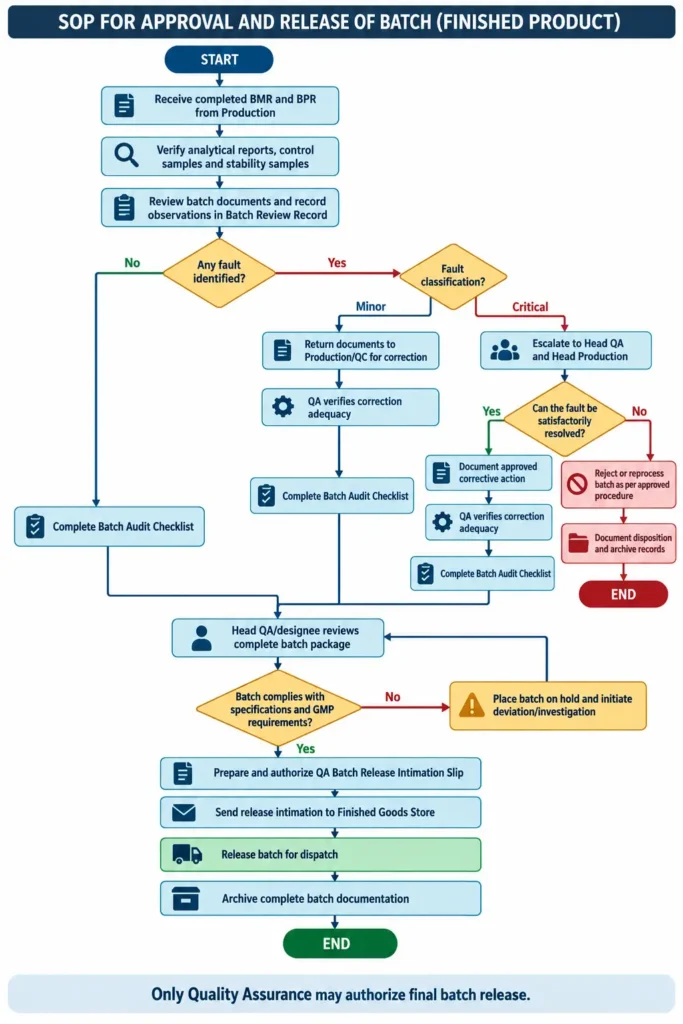
This Standard Operating Procedure defines the process for reviewing, approving, and releasing finished-product batches before dispatch. It applies to batches manufactured at the site and assigns responsibility to the Quality Assurance Executive and Head of Quality Assurance. QA receives completed Batch Manufacturing Records and Batch Packaging Records, confirms availability of analytical reports, control samples, and stability samples, and reviews documentation. Identified deficiencies are recorded in the Batch Review Record and classified as critical or minor. Critical faults may affect product quality and can result in reprocessing or rejection, whereas minor faults require documented correction. QA verifies corrections, completes the Batch Audit Checklist, and reviews manufacturing, packaging, in-process, analytical, reconciliation, deviation, environmental, and line-clearance records. Following satisfactory review, the Head of QA or designee authorizes release through a QA Batch Release Intimation Slip, informs Finished Goods Stores, and ensures archival of complete batch documentation for traceability and inspection readiness.
Skip to PDF content2. Flow Diagram for SOP for Approval and Release of Batch (Finished Product):
The flow diagram presents the systematic process for approval and release of a finished-product batch. The process begins when Quality Assurance receives the completed Batch Manufacturing Record and Batch Packing Record from Production. QA verifies analytical reports, control samples, stability samples, manufacturing details, in-process controls, reconciliation, line clearance, deviations, and supporting documents. Any identified fault is classified as minor or critical. Minor faults are returned to Production or QC for correction and subsequently verified by QA. Critical faults are escalated to the Head of QA and Head of Production for assessment, corrective action, reprocessing, or batch rejection. After completing the Batch Audit Checklist, the Head of QA or an authorized designee reviews the complete batch package. Noncompliant batches are placed on hold for investigation. Compliant batches receive an authorized QA Batch Release Intimation Slip, which is sent to the Finished Goods Store. The batch is then released for dispatch, and all records are securely archived.
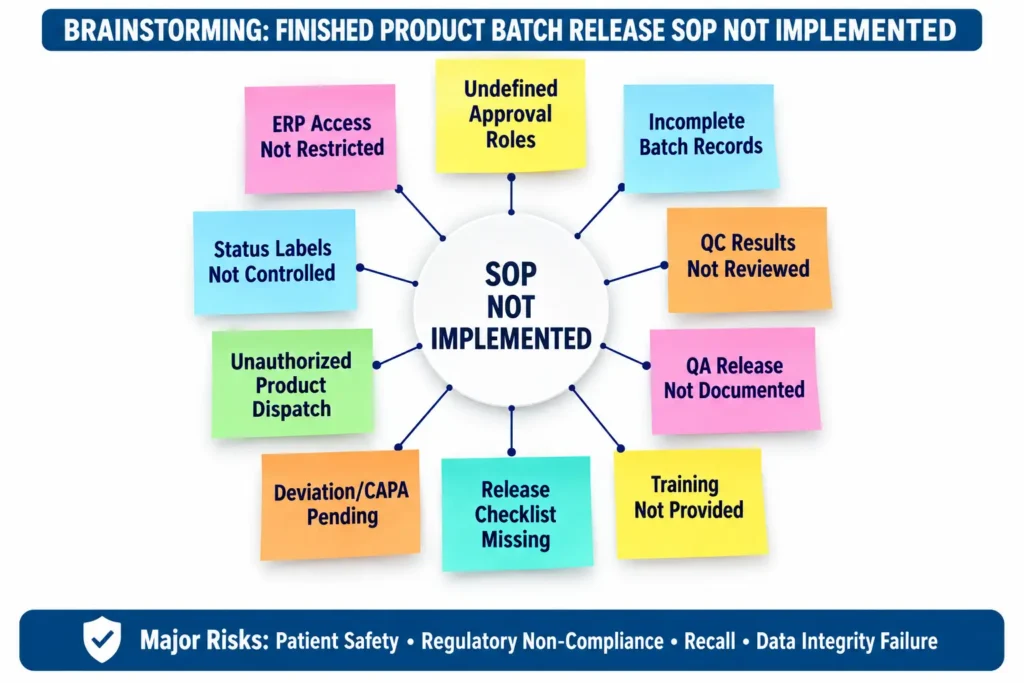
3. Brainstorming for SOP for Approval and Release of Batch (Finished Product) not implemented:
The brainstorming diagram explains possible reasons why the SOP for approval and release of finished product batches was not implemented. It highlights gaps such as unclear approval responsibilities, incomplete batch manufacturing and packing records, unreviewed quality control results, missing QA release documentation, inadequate employee training, and absence of a standard release checklist. It also identifies pending deviations or CAPA, uncontrolled product status labels, unrestricted system access, and unauthorized dispatch of finished goods. These issues may allow a batch to reach the market without complete verification of quality, safety, identity, strength, purity, and regulatory compliance. The purpose of brainstorming is to collect ideas from QA, QC, Production, Warehouse, and IT personnel before selecting the true root causes. Each suspected cause should be checked against records, interviews, system access logs, training files, and release documents. Corrective actions should then assign responsibilities, establish controls, train staff, and prevent unapproved batch distribution from recurring.
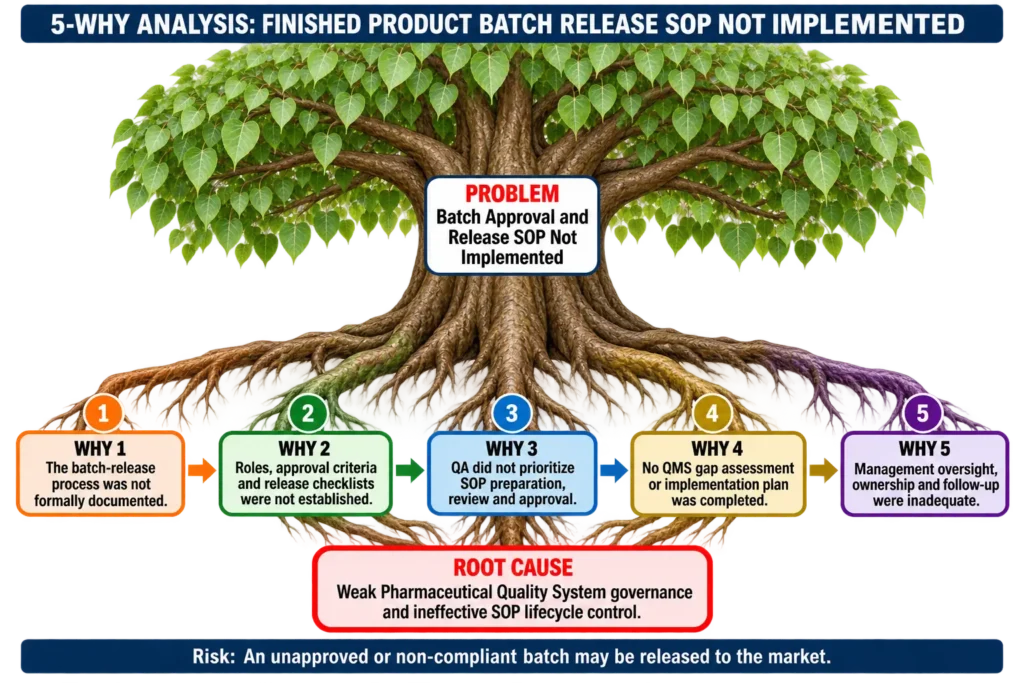
4. 5-Why Analysis for SOP for Approval and Release of Batch (Finished Product) not implemented:
The 5-Why analysis explains why the SOP for approval and release of finished-product batches was not implemented. The first reason was that the batch-release process had not been formally documented. This happened because responsibilities, approval criteria, and release checklists were not clearly established. Further investigation showed that the Quality Assurance department did not prioritize the preparation, review, approval, and implementation of the SOP. This weakness continued because no proper QMS gap assessment or time-bound implementation plan was prepared. Finally, inadequate management oversight, unclear ownership, and weak follow-up allowed the issue to remain unresolved. The analysis identifies weak Pharmaceutical Quality System governance and ineffective SOP lifecycle control as the main root cause. Without an approved procedure, a batch may be released without reviewing manufacturing records, analytical results, deviations, CAPA, reconciliation, and regulatory requirements. Management should assign responsibility, approve the SOP, train concerned employees, restrict release authorization, and regularly verify implementation effectiveness.
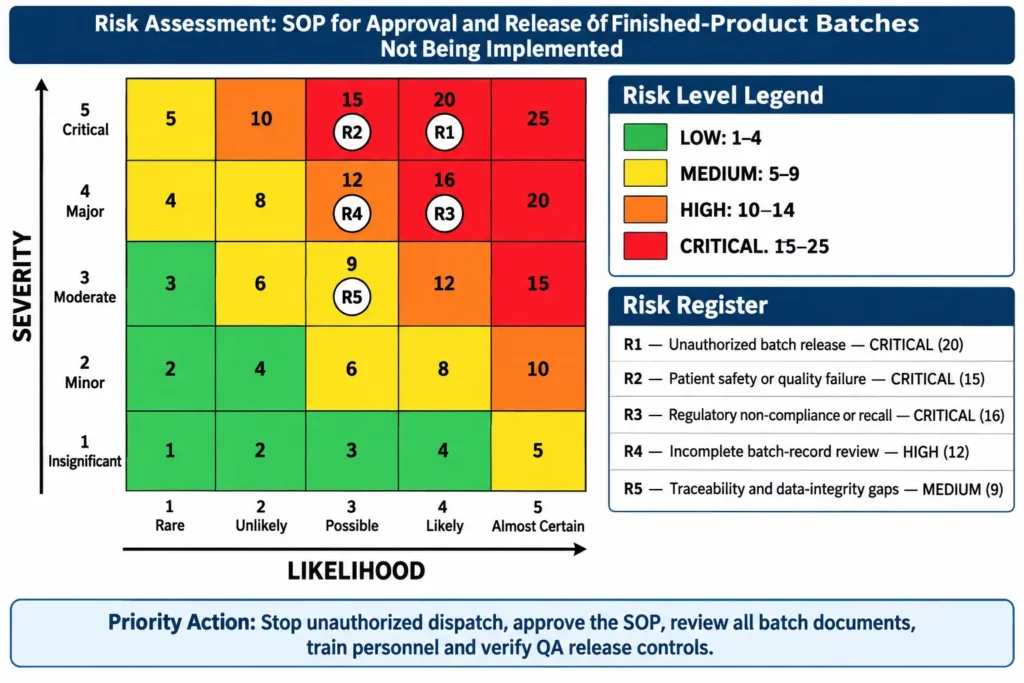
5. Heat Map Analysis for SOP for approval and release of finished-product batches is not implemented:
The heat map evaluates risks created when the SOP for approval and release of finished-product batches is not implemented. It compares each risk according to its likelihood of occurring and the severity of its possible impact. Unauthorized batch release receives a critical score of 20, because it can directly expose patients and the company to serious consequences. Patient safety or product quality failure scores 15, while regulatory non-compliance or product recall scores 16; both require immediate action. Incomplete batch-record review is rated high with a score of 12, as important manufacturing, testing, deviation, or reconciliation information may be missed. Traceability and data-integrity gaps score 9, representing a medium but significant risk. The colour-coded matrix helps management identify priorities quickly. Immediate controls should stop unauthorized dispatch, approve and implement the SOP, verify complete batch documentation, restrict release authority, train responsible employees, and confirm effectiveness through periodic QA review and internal audits.
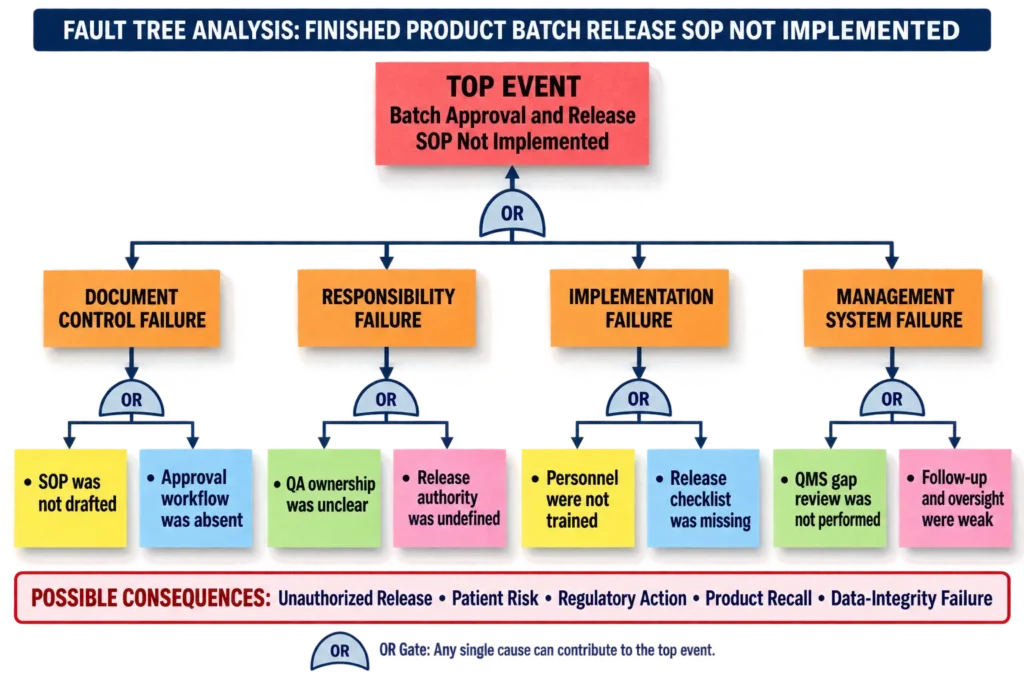
6. Fault Tree Analysis for SOP for approval and release of finished-product batches to remain unimplemented:
The fault tree analysis shows how several individual failures can cause the SOP for approval and release of finished-product batches to remain unimplemented. The top event is linked through an OR gate, meaning any major failure may independently contribute to the problem. Document control failure may occur when the SOP is not drafted or an approval workflow is absent. Responsibility failure results when QA ownership is unclear or release authority is undefined. Implementation failure develops when concerned personnel are not trained or a standard release checklist is missing. Management system failure may arise when a QMS gap review is not performed and management follow-up is weak. These combined weaknesses can lead to unauthorized batch release, patient risk, regulatory action, product recall, and data-integrity failures. Corrective action should include preparing and approving the SOP, defining responsibilities, training employees, controlling release authorization, completing batch review, and periodically checking implementation effectiveness through audits.
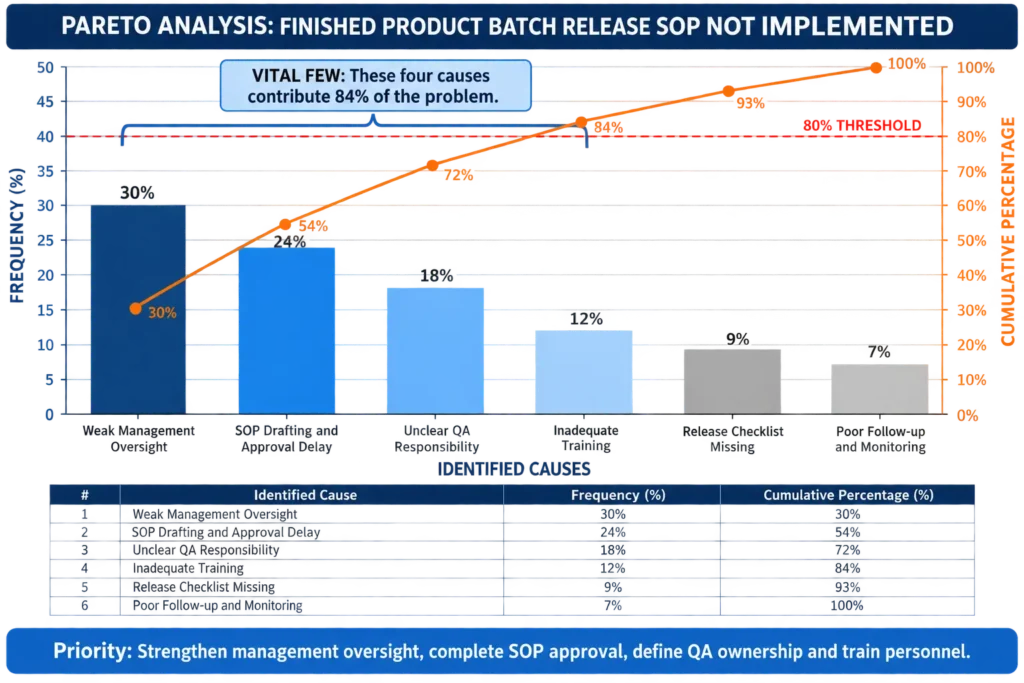
7. Pareto Chart Analysis for SOP for approval and release of finished-product batches remained unimplemented:
The Pareto chart ranks the main reasons why the SOP for approval and release of finished-product batches remained unimplemented. The bars are arranged from the highest to the lowest contribution, while the orange line shows the cumulative percentage. Weak management oversight is the largest cause, contributing 30%. Delays in SOP drafting and approval contribute 24%, bringing the cumulative total to 54%. Unclear QA responsibility adds 18%, increasing the total to 72%. Inadequate training contributes another 12%, taking the cumulative contribution to 84%. Therefore, these first four causes are the vital few and should receive immediate corrective action. Missing release checklists and poor follow-up contribute the remaining 16%. Management should establish clear ownership, complete SOP drafting and approval, train concerned personnel, introduce controlled batch-release checklists, and monitor implementation. Addressing the highest-ranking causes first will produce the greatest improvement, reduce unauthorized release risk, and strengthen regulatory compliance and patient protection across operations.
8. Corrective and Preventive Action (CAPA) for SOP for approval and release of finished-product batches remained unimplemented:
Immediate Correction and Containment
| No. | Action | Responsibility | Target |
|---|---|---|---|
| 1 | Stop the dispatch of all finished-product batches until documented QA approval is confirmed. | QA Head/Warehouse | Immediate |
| 2 | Identify all batches manufactured, released, or distributed during the period when the SOP was unavailable. | QA | Within 1 day |
| 3 | Quarantine unreleased batches and apply controlled “UNDER TEST” or “QUARANTINE” status labels. | QA/Warehouse | Immediate |
| 4 | Perform retrospective review of BMR/BPR, analytical results, deviations, OOS/OOT, CAPA, reconciliation, validation and stability commitments. | QA/QC | Within 7 days |
| 5 | Conduct documented quality-risk assessments for batches already distributed; initiate recall assessment if product quality or patient safety may be affected. | QA/Qualified Management | Within 7 days |
Corrective Actions
| No. | Corrective action | Responsibility | Target |
|---|---|---|---|
| 1 | Investigate the failure using 5-Why, Fishbone or Fault Tree Analysis. | QA | 7 days |
| 2 | Prepare, review and approve the finished-product batch approval and release SOP. | QA/QC/Production | 15 days |
| 3 | Define the authorized batch-release person and responsibilities of QA, QC, Production and Warehouse. | QA Head | 15 days |
| 4 | Develop a controlled batch-release checklist covering all mandatory records and results. | QA | 15 days |
| 5 | Train all concerned personnel and evaluate their understanding through written or practical assessment. | QA/Training | Before implementation |
| 6 | Restrict ERP release and warehouse dispatch permissions to authorized QA personnel only. | QA/IT | 20 days |
| 7 | Record the release decision, date, signature, batch status and supporting-document references. | Authorized QA Person | Every batch |
Preventive Actions
- Include SOP implementation status in monthly Quality Management Review.
- Maintain an SOP tracker with preparation, approval, training, implementation and review dates.
- Configure electronic alerts for pending review, approval and training.
- Perform periodic self-inspection of batch-release controls.
- Introduce QA authorization before changing batch status from quarantine to released.
- Review the system after regulatory, process, product or organizational changes.
- Include batch-release activities in induction and annual GMP refresher training.
- Establish deputy authorization to ensure continuity during absence of the primary release person.
Effectiveness Verification
After three months, QA should review at least 10 consecutive released batches and confirm:
- 100% completion of the release checklist.
- 100% QA authorization before dispatch.
- No batch released with pending critical deviation, OOS or required investigation.
- No unauthorized ERP status change.
- 100% training completion.
- No repeat deviation or audit observation.
The CAPA may be closed only when these criteria are met and documented. This approach supports the pharmaceutical quality-system and GMP principles described by WHO GMP.
9. Questions and Answers for SOP for approval and release of finished-product batches remained unimplemented:
1. What is batch approval and release?
It is the documented decision by authorized Quality Assurance personnel that a finished-product batch meets all approved quality and regulatory requirements.
2. Who is responsible for releasing a finished-product batch?
Only an authorized QA person or other legally designated person should approve and release the batch.
3. Why is a batch-release SOP necessary?
It provides a consistent procedure for reviewing documents, test results, deviations, reconciliation and other release requirements.
4. Can a batch be dispatched without documented QA release?
No. The batch must remain under quarantine until formal QA approval and status change are completed.
5. What documents should be reviewed before batch release?
BMR/BPR, analytical results, Certificate of Analysis, reconciliation records, environmental records, deviations, OOS/OOT investigations, CAPA and applicable validation documents.
6. What should happen if the batch-release SOP is not implemented?
Dispatch should be stopped, affected batches identified, a deviation initiated and a documented quality-risk assessment performed.
7. What should be done for batches already distributed?
QA should perform a retrospective review and health-hazard assessment. Recall evaluation should be initiated if quality or patient safety is uncertain.
8. Can a batch be released when a deviation is open?
Only after documented assessment confirms that the deviation does not adversely affect product quality, safety, efficacy or compliance. Critical investigations should normally be completed before release.
9. Why is a release checklist required?
It ensures that every mandatory document, test result, investigation, approval and reconciliation is reviewed consistently.
10. How should electronic batch-release access be controlled?
Release permission should be restricted to authorized QA users through unique usernames, defined access rights and audit trails.
11. What training is required?
Concerned QA, QC, Production, Warehouse and IT personnel should receive SOP training followed by documented effectiveness evaluation.
12. What are the risks of releasing a batch without an SOP?
Risks include unauthorized release, missed defects, patient harm, product recall, data-integrity failures and regulatory action.
13. How can recurrence be prevented?
Approve the SOP, define responsibilities, control system access, introduce release checklists, maintain an SOP tracker and perform periodic audits.
14. How should CAPA effectiveness be verified?
QA should review consecutive released batches and confirm complete documentation, authorized release, trained personnel and absence of repeat deviations.
15. When can the CAPA be closed?
CAPA should be closed only after all actions are completed and documented effectiveness criteria demonstrate sustainable compliance.
10. Reference Guidelines for SOP for approval and release of finished-product batches:
The following guidelines may be referred to when preparing and implementing an SOP for approval and release of finished-product batches:
- Schedule M of the Drugs Rules, 1945 – India
Good Manufacturing Practices and requirements of premises, plant and equipment for pharmaceutical products. Refer particularly to Quality Assurance, documentation, batch records, finished-product testing and release requirements.
Central Drugs Standard Control Organisation - WHO Good Manufacturing Practices for Pharmaceutical Products: Main Principles
Refer to sections covering the pharmaceutical quality system, Quality Control, batch-processing records, batch-packaging records, finished-product evaluation and authorized release.
WHO GMP Standards - EU Guidelines for Good Manufacturing Practice—EudraLex Volume 4
- Chapter 1: Pharmaceutical Quality System
- Chapter 4: Documentation
- Chapter 6: Quality Control
- Annex 16: Certification by a Qualified Person and Batch Release
- PIC/S Guide to Good Manufacturing Practice—PE 009
Refer to Part I, particularly Chapters 1, 4, 6 and 8, for quality-system, documentation, testing, release and complaint/recall controls.
PIC/S Publications - ICH Q10—Pharmaceutical Quality System
Provides guidance on management responsibility, process performance, product-quality monitoring, CAPA, change management and continual improvement.
ICH Quality Guidelines - ICH Q9(R1)—Quality Risk Management
Applicable to risk assessment of batches affected by missing, delayed or ineffective release controls.
ICH Quality Guidelines - US FDA—21 CFR Part 211: Current Good Manufacturing Practice for Finished Pharmaceuticals
- 21 CFR 211.22: Responsibilities of the Quality Control Unit
- 21 CFR 211.165: Testing and release for distribution
- 21 CFR 211.188: Batch production and control records
- 21 CFR 211.192: Production-record review and investigation
- 21 CFR 211.194: Laboratory records
- Company-Specific Approved Documents
- Site Quality Manual
- SOP for document control
- SOP for deviation and CAPA management
- SOP for OOS and OOT investigation
- SOP for product recall
- SOP for handling returned goods
- SOP for electronic access and data integrity
- Approved BMR/BPR and finished-product specifications
- Batch-release checklist and authorization matrix