







Brief Description
This SOP describes the procedure for validation of calculators used in the Quality Control department to ensure that each calculator functions properly and provides accurate calculation results according to specified requirements. The procedure requires all QC calculators to be listed, assigned unique serial numbers, and provided with a validation/calibration label showing the Calculator ID, validation date, validated by, and next due date. Validation is performed by selecting three quantitative tests from a product and comparing calculations performed using the calculator with calculations recorded/performed through the logbook. The acceptance criterion specifies that there should be no difference in the second decimal value, and validation is performed once every year. The SOP also defines responsibilities for protocol preparation, checking, approval, and result evaluation. Annexure-I provides a structured format for recording batch number, test, calculator value, logbook value, remarks, and detailed calculations.
Skip to PDF content1. Flow Diagram:
The flow diagram illustrates the systematic process for validation of calculators used in the Quality Control department. The process begins by identifying and listing all calculators used in QC, followed by assigning each calculator a unique serial number. A validation/calibration label is then affixed showing the calculator ID, validation date, person performing the validation, and next due date.
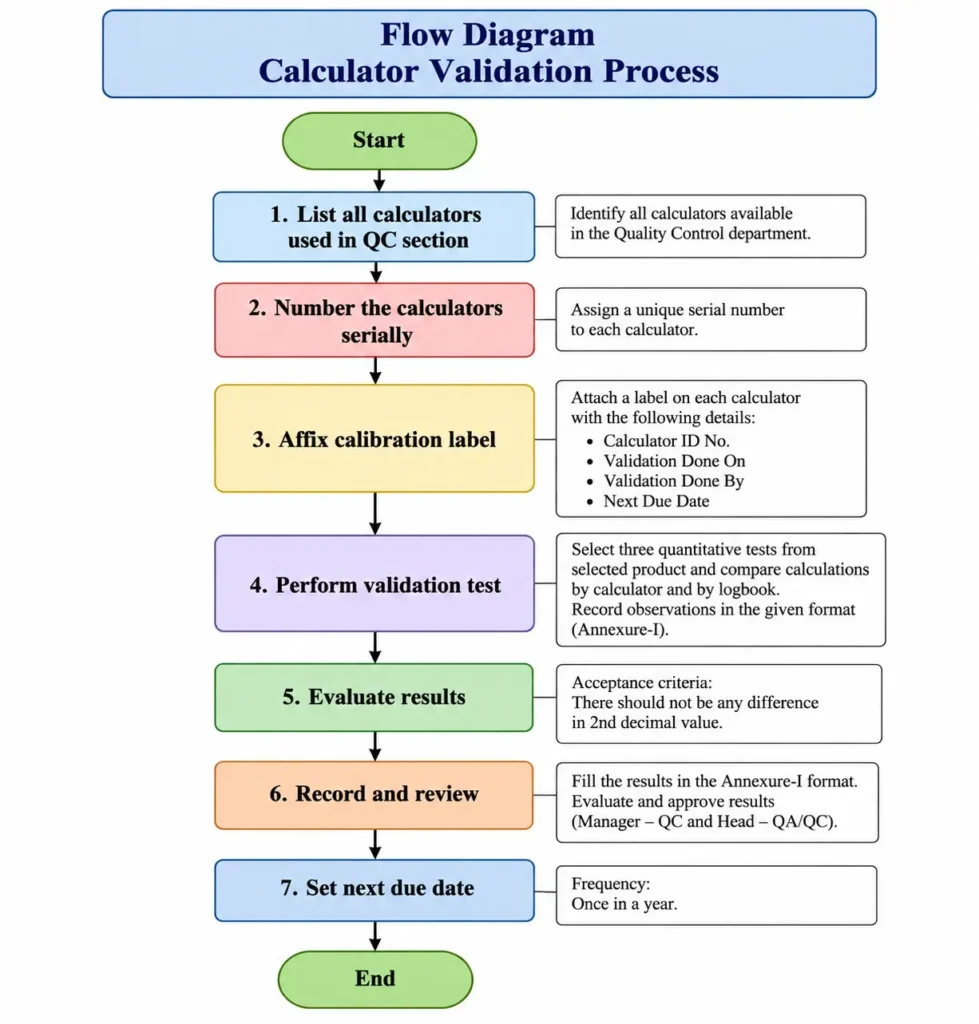
For performance verification, three quantitative tests from a selected product are evaluated by comparing results obtained using the calculator with calculations recorded in the logbook. The results are assessed against the acceptance criterion that there should be no difference in the second decimal value. The observations are documented in Annexure-I, reviewed and approved by authorized QC/QA personnel, and the next validation due date is established. Calculator validation is performed once annually to maintain accuracy and reliability of QC calculations.
2. Brainstorming for SOP Failure:
The brainstorming diagram highlights the major potential causes of SOP failure in a pharmaceutical manufacturing area. It identifies personnel-related factors such as inadequate training, lack of awareness, high manpower turnover, language barriers, poor accountability, and insufficient supervision. Operational pressures—including high workload, production time pressure, frequent process or product changes, and equipment condition—may also contribute to non-compliance.
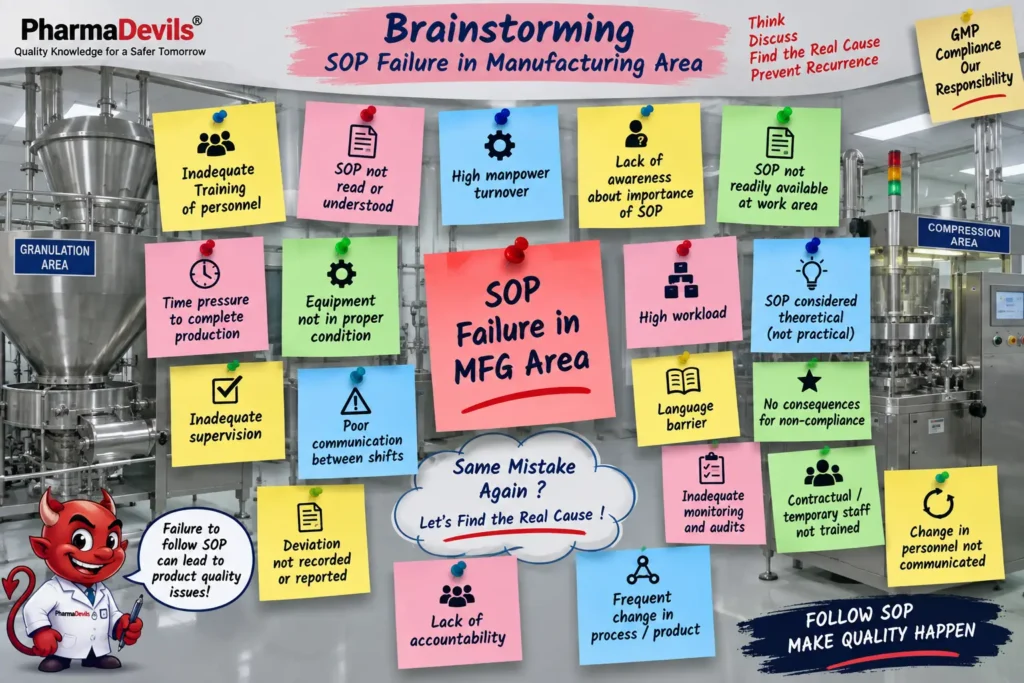
The diagram further emphasizes system-related weaknesses such as poor communication between shifts, SOPs not being readily available at the workplace, inadequate monitoring and audits, deviations not being reported, and changes in personnel not being properly communicated. It also highlights situations where SOPs are treated as theoretical documents rather than practical working instructions. Overall, the brainstorming exercise helps the investigation team identify possible root causes, strengthen GMP compliance, improve employee awareness, and develop appropriate CAPA to prevent recurrence of SOP failures.
3. 5-Why Analysis for SOP Failure:
The 5-Why analysis diagram systematically investigates the underlying reasons for failure to follow an SOP in the manufacturing area. It starts with the observed problem—operators not following the prescribed procedure—and progressively asks “Why?” to identify deeper contributing factors.
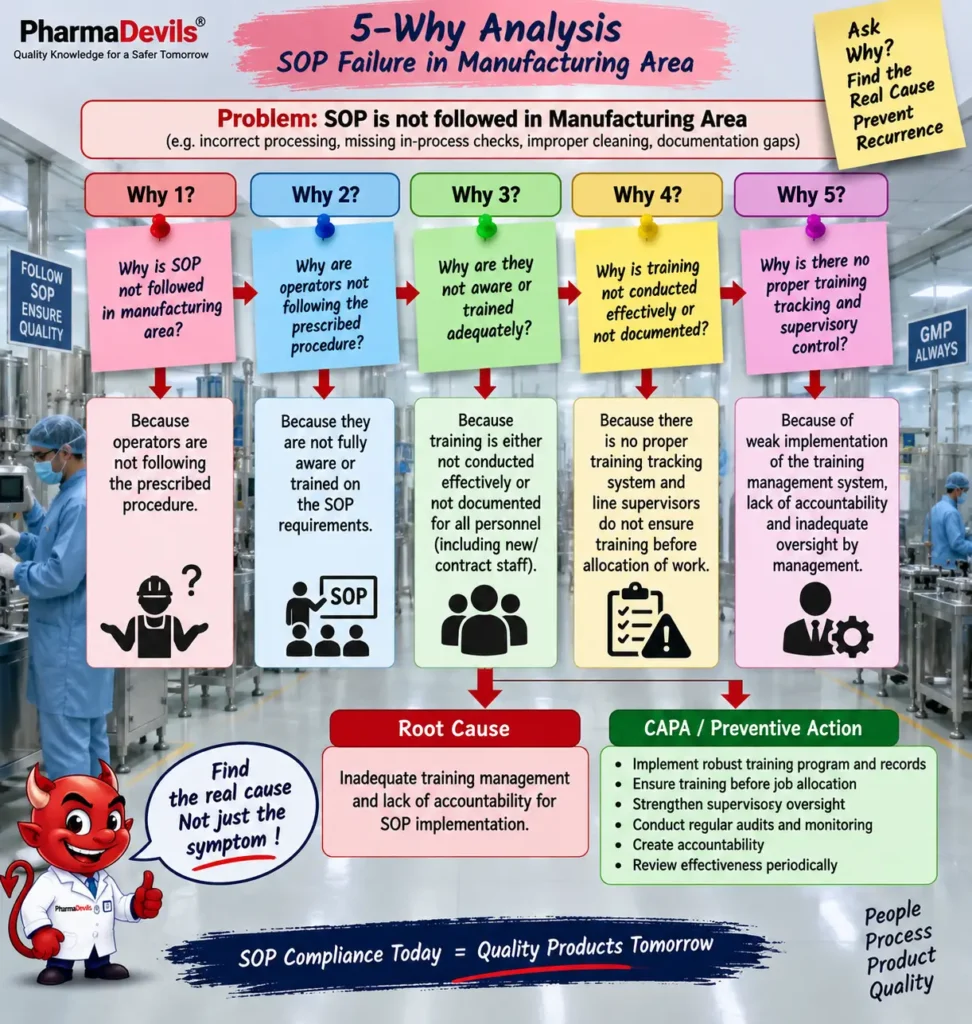
The analysis highlights insufficient operator awareness, inadequate or ineffective training, incomplete training documentation, weak training tracking, and inadequate supervisory control. The investigation ultimately identifies the probable root cause as weakness in the training management system and insufficient accountability for SOP implementation. The diagram also emphasizes appropriate CAPA, including strengthening SOP training, ensuring personnel are trained before job allocation, improving supervisory monitoring, maintaining complete training records, performing periodic audits, assigning clear accountability, and reviewing CAPA effectiveness. This structured approach helps prevent recurrence and strengthens GMP compliance, process consistency, product quality, and manufacturing discipline.
4. Fishbone Analysis for SOP Failure:
The Fishbone Analysis identifies potential causes of SOP failure in the manufacturing area by grouping them into major categories such as Manpower, Method, Machine, Material, Environment, and Management. Personnel-related causes include inadequate training, poor SOP awareness, language barriers, manpower turnover, negligence, and insufficient supervision.
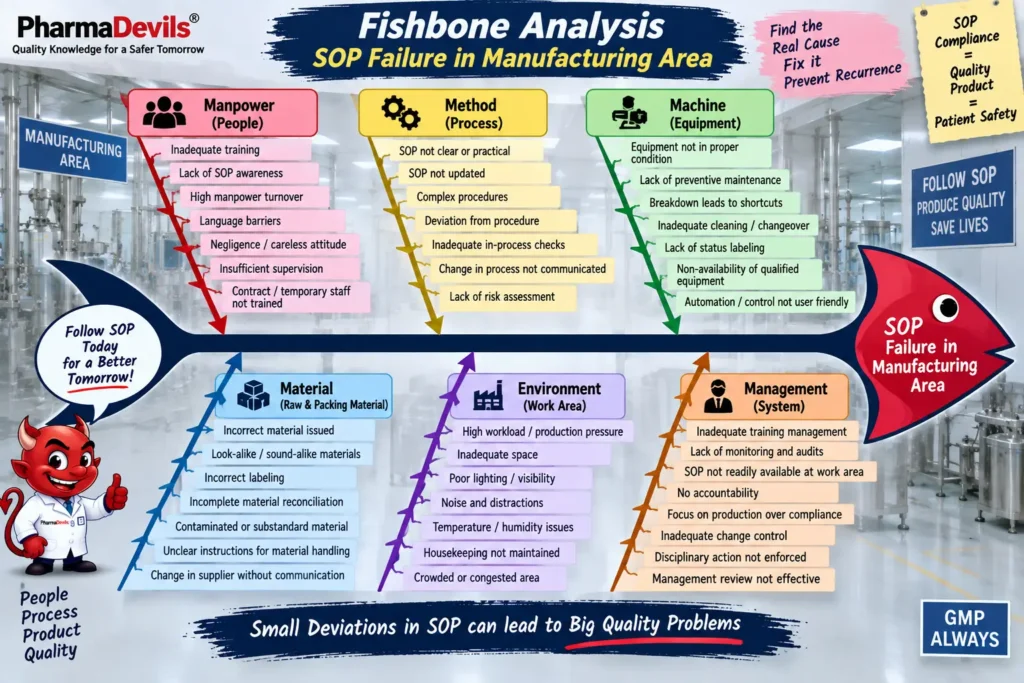
Method-related factors include unclear or outdated SOPs, complex procedures, inadequate in-process checks, poor communication of process changes, and insufficient risk assessment. Machine-related causes may involve equipment malfunction, inadequate preventive maintenance, poor cleaning or changeover practices, and improper equipment status labeling. Material factors include incorrect material issuance, labeling errors, incomplete reconciliation, and use of substandard materials. Environmental causes may involve production pressure, poor lighting, inadequate space, temperature or humidity issues, and weak housekeeping. Management-related causes include inadequate training systems, lack of monitoring, poor accountability, weak change control, and ineffective management review. Overall, the Fishbone Analysis helps systematically identify possible root causes so that suitable CAPA can be implemented to strengthen SOP compliance and prevent recurrence.
5. Fault Tree Analysis for SOP Failure:
The Fault Tree Analysis diagram evaluates the potential causes leading to SOP failure in the manufacturing area. The top event—failure to follow or implement the SOP—is broken down into four major contributing branches: Personnel-related failure, SOP/Documentation failure, Equipment/Process failure, and Management/Oversight failure.
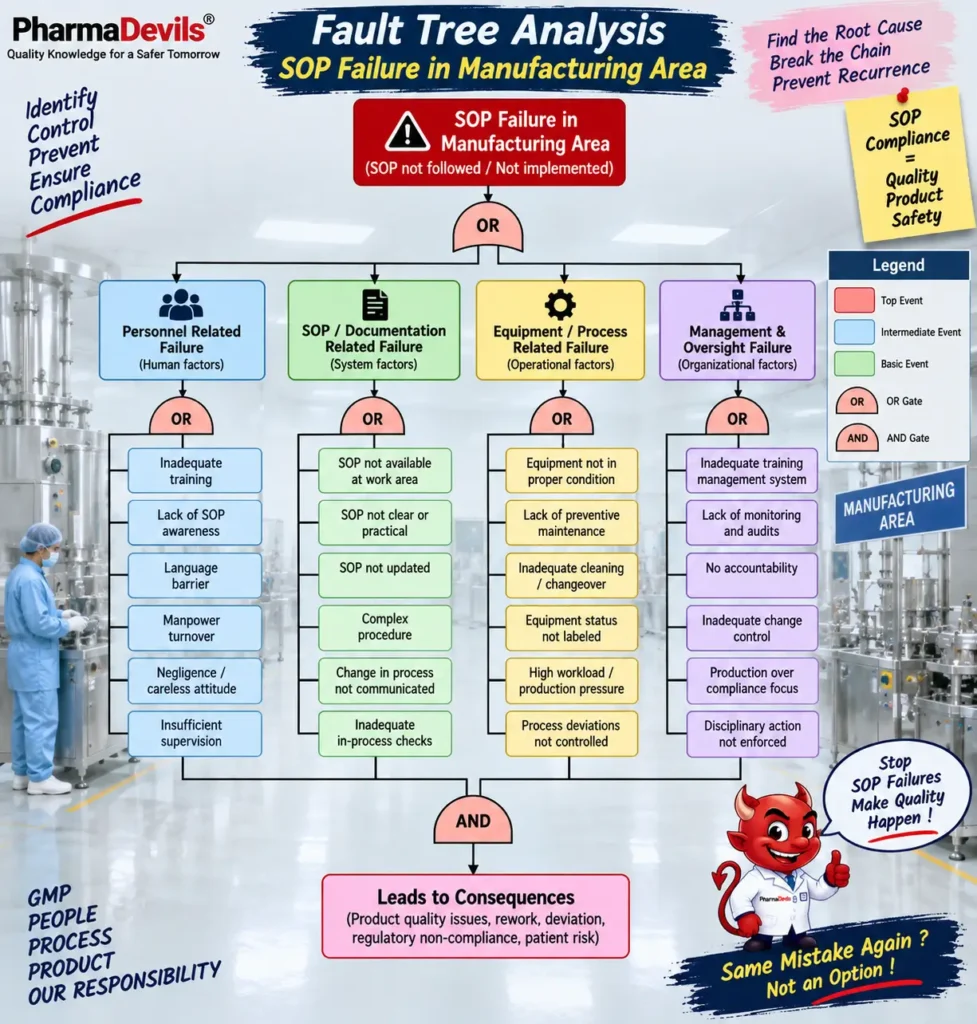
Personnel causes include inadequate training, poor SOP awareness, language barriers, manpower turnover, negligence, and insufficient supervision. Documentation-related causes include SOP unavailability, unclear or outdated procedures, complex instructions, poor communication of process changes, and inadequate in-process checks. Equipment and process factors include improper equipment condition, insufficient preventive maintenance, inadequate cleaning/changeover, missing status labeling, production pressure, and uncontrolled deviations. Management-related causes include weak training systems, inadequate audits, poor accountability, ineffective change control, and excessive focus on production over compliance. The analysis shows how multiple basic and intermediate failures can combine to cause quality defects, deviations, rework, regulatory non-compliance, and potential patient risk, helping teams identify root causes and implement effective CAPA.
Questions & Answers – SOP for Calculator Validation
Q1. What is the objective of the Calculator Validation SOP?
Answer: The objective is to lay down the procedure for carrying out validation of calculators used in the Quality Control department.
Q2. What is the scope of calculator validation?
Answer: The SOP ensures that the calculator is working properly and provides correct output with respect to the specified requirements.
Q3. Who is responsible for generating calculator validation data and developing the validation protocol?
Answer: The Executive – Quality Control is responsible for calculator validation data generation and development of the validation protocol.
Q4. Who checks the calculator validation protocol?
Answer: The Manager – Quality Control checks the calculator validation protocol.
Q5. Who approves the calculator validation protocol?
Answer: The Head of the Quality Control Department approves the calculator validation protocol.
Q6. Who evaluates and approves the calculator validation results?
Answer: The Manager – Quality Control and Head – QA/QC are responsible for evaluation and approval of the validation results.
Q7. What is the first step in calculator validation?
Answer: All calculators used in the Quality Control section are listed.
Q8. How are calculators identified?
Answer: All calculators are numbered serially to provide individual identification.
Q9. What information is included on the calculator validation label?
Answer: The label contains the Calculator ID Number, Validation Done On, Validation Done By, and Next Due Date.
Q10. How is the calculator performance verified?
Answer: Three quantitative tests from a selected product are chosen, and calculations performed using the calculator are compared with calculations made through the logbook.
Q11. What is the acceptance criterion for calculator validation?
Answer: There should not be any difference in the second decimal value between the compared calculations.
Q12. What is the frequency of calculator validation?
Answer: Calculator validation is performed once in a year.
Q13. Who provides training on this SOP?
Answer: The Manager – QC acts as the trainer, while Executives – Quality Control are the trainees.
Q14. What is the duration of training?
Answer: The training duration specified in the SOP is half an hour.
Q15. Which annexure is used for recording calculator validation results?
Answer: Annexure-I – Detailed Calculations is used to document the validation results.
Q16. What details are recorded in Annexure-I?
Answer: Annexure-I records the serial number, batch number, test, value obtained by calculator, value obtained by logbook, remarks, performer/checker details, dates, and detailed calculations.
Q17. What is the controlled-copy distribution of this SOP?
Answer: The controlled copy is maintained with the Head of Department – Quality Control, while the master copy is maintained with the Head of Department – Quality Assurance.
Q18. What is the purpose of comparing calculator and logbook calculations?
Answer: The comparison verifies that the calculator provides consistent calculation results within the defined acceptance criterion. This is demonstrated through the SOP-required comparison of calculator and logbook values.
Reference Guidelines:
- WHO TRS 1052, Annex 4 – Good Practices for Pharmaceutical Quality Control Laboratories (2024): relevant to QC laboratory equipment, data processing, documented controls, and reliability of laboratory results. (World Health Organization)
- WHO TRS 1019, Annex 3, Appendix 5 – Validation of Computerized Systems: supports validation based on intended use, risk, accuracy, reliability, and documented evidence. (World Health Organization)
- EU GMP, EudraLex Volume 4, Annex 11 – Computerised Systems: applicable when calculators or electronic calculation systems form part of GMP computerized activities; emphasizes validation and reliable operation. (Public Health)
- PIC/S PI 011-3 – Good Practices for Computerised Systems in Regulated GxP Environments: provides guidance on control, validation, and lifecycle management of computerized systems used for GxP activities. (PIC/S)
- US FDA 21 CFR 211.68 – Automatic, Mechanical and Electronic Equipment: requires applicable electronic equipment to be routinely calibrated, inspected, or checked according to a written program to assure proper performance. (U.S. Food and Drug Administration)
- US FDA 21 CFR 211.160 – Laboratory Controls: supports scientifically sound laboratory controls and appropriate control of equipment used in laboratory testing. (U.S. Food and Drug Administration)