




1. Introduction – SOP for Campaign Batch Cleaning Procedure:
The SOP for Campaign Batch Cleaning Procedure describes the standardized method for cleaning manufacturing and packing areas and associated equipment during campaign production. Its purpose is to ensure that residues such as granules, fines, tablets, strips, labels, stereos, and printed packing materials from the previous batch are properly removed before continuing with the next batch of the same product or performing a product changeover. The procedure covers batch-to-batch changeover of the same product, including removal of residual materials, cleaning of equipment surfaces, windows, machine bases and floors, application of cleaned-status labels, protection of cleaned equipment, and documentation in equipment usage and cleaning logbooks. It also defines weekend cleaning during a campaign and cleaning during product changeover, including cleaning of ceilings, walls, doors, AHU supply and return grills, pass boxes, waste bins, flexible pipes, dust-extraction pipelines, equipment and floors. Following this SOP helps maintain proper housekeeping, equipment cleanliness, batch segregation, traceability, and consistent GMP practices throughout manufacturing and packing operations.
Skip to PDF content2. Flow Diagram – SOP for Campaign Batch Cleaning Procedure:
The SOP for Campaign Batch Cleaning Procedure defines a systematic sequence for cleaning equipment, accessories, manufacturing areas, and packing areas during campaign production. The procedure begins after completion of the batch process and transfer of the product to the next stage. All residual materials such as granules, fines, tablets, strips, labels, stereos, and printed packing materials are removed from the equipment and surrounding area. The procedure also includes removal of the previous batch status label, cleaning of equipment surfaces, glass windows, machine bases, floors, ceilings, walls, doors, AHU supply and return grills, pass boxes, waste bins, flexible pipes, and dust-extraction pipelines as applicable.
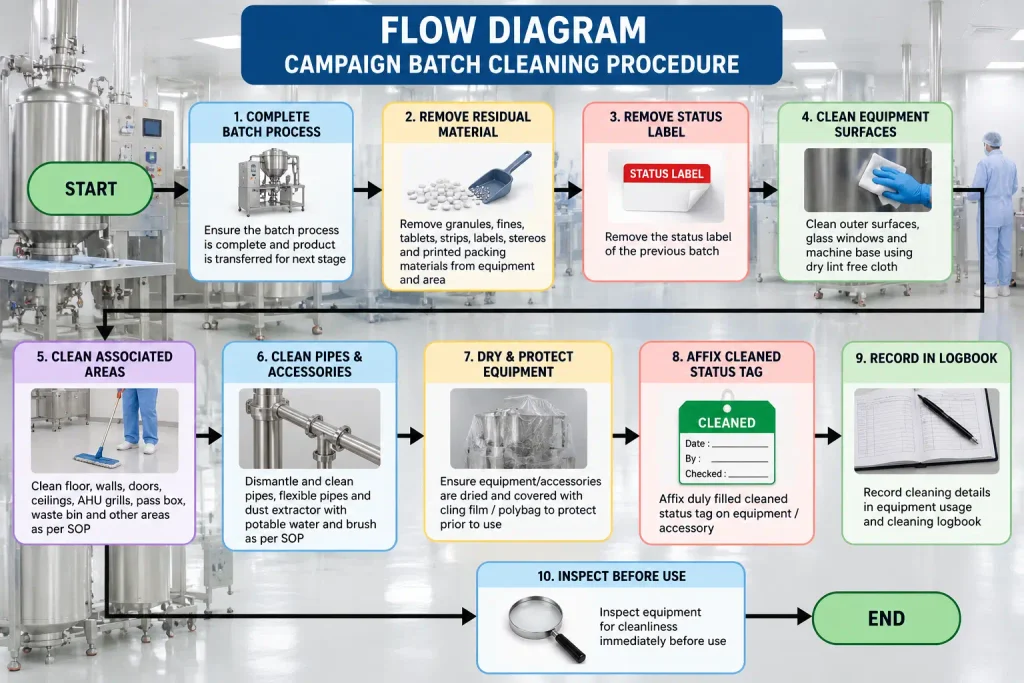
After cleaning, equipment and accessories are dried, protected with cling film or polybags, and provided with a duly completed cleaned status tag. Cleaning details are recorded in the equipment usage and cleaning logbook, followed by inspection of the equipment for cleanliness immediately before use. Following this SOP helps ensure consistent cleaning practices, proper batch changeover, effective removal of product residues, accurate cleaning documentation, and readiness of manufacturing equipment and areas for subsequent processing.
3. Benefits of Following SOP – Campaign Batch Cleaning Procedure:
Following the SOP for Campaign Batch Cleaning Procedure ensures that manufacturing and packing areas, equipment, accessories, and associated surfaces are cleaned in a controlled and consistent manner between campaign batches. The procedure requires removal of residual materials such as granules, fines, tablets, strips, labels, stereos, and printed packing materials before the next batch or product changeover.
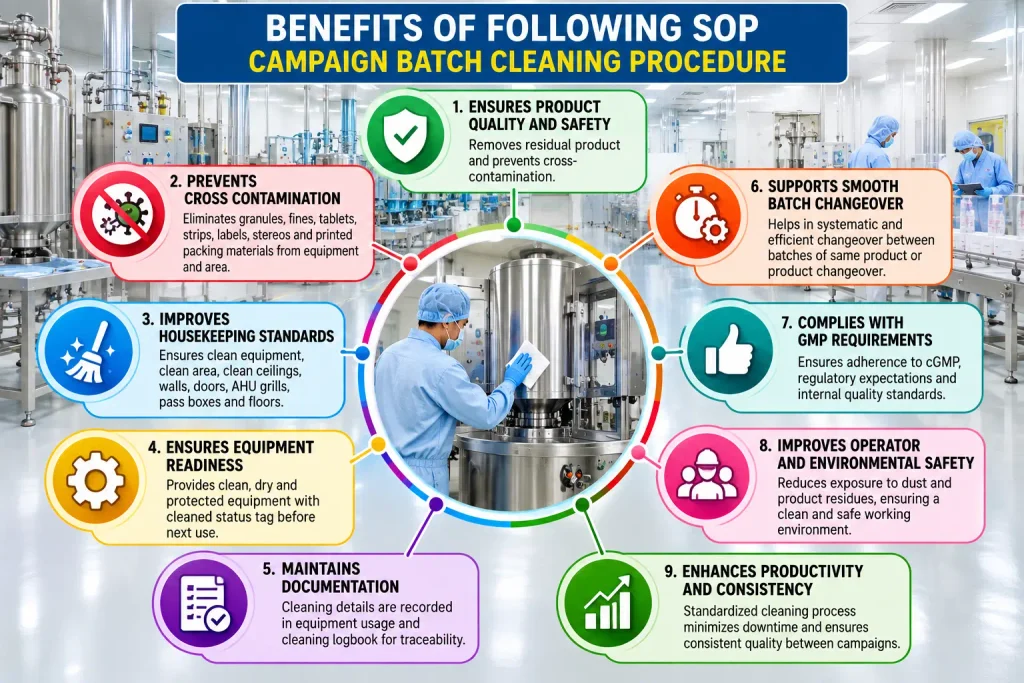
Proper implementation of this SOP helps maintain good housekeeping by covering cleaning of equipment surfaces, floors, ceilings, walls, doors, AHU supply and return grills, pass boxes, waste bins, flexible pipes, and dust-extraction lines. It also supports equipment readiness by requiring cleaned equipment and accessories to be dried, protected with cling film or polybags, and identified with an appropriate cleaned-status tag before use. The SOP further strengthens traceability because cleaning details are recorded in the equipment usage and cleaning logbook and the equipment is inspected for cleanliness immediately before use. Overall, following the procedure supports consistent cleaning practices, orderly batch changeover, proper documentation, and compliance with the GMP-based cleaning requirements stated in the SOP.
4. Brainstorming Analysis for SOP Failure – Campaign Batch Cleaning Procedure:
The Brainstorming Analysis for SOP Failure – Campaign Batch Cleaning Procedure identifies potential causes that may lead to ineffective or incomplete cleaning during pharmaceutical manufacturing and packing operations. Key concerns include inadequate training, incomplete removal of product residues, failure to follow the prescribed cleaning sequence, improper cleaning tools, poor use of PPE, insufficient supervision, and time pressure created by the next batch schedule. The analysis also highlights failures such as residual labels and printed packing materials remaining in the area, poor housekeeping of floors, walls, ceilings and AHU grills, difficult-to-clean equipment design, and incomplete documentation in the equipment cleaning logbook. These issues can directly affect the effectiveness of campaign cleaning and batch changeover activities.
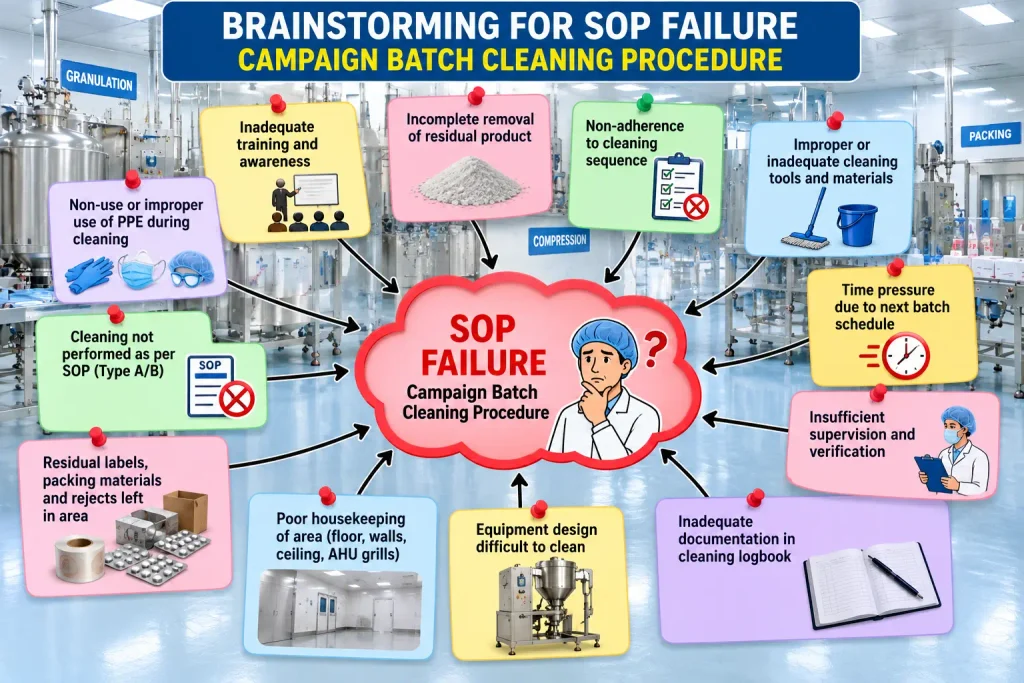
The SOP specifically requires removal of residual product and packing materials, cleaning of equipment and areas, documentation of cleaning activities, supervision by Production, and inspection of equipment before use. It also includes cleaning of ceilings, walls, doors, AHU grills, pass boxes, waste bins, pipes and floors during weekend or product-changeover cleaning. This brainstorming exercise helps the team identify possible failure points early so that suitable training, supervision, cleaning controls, documentation practices, and preventive actions can be strengthened.
5. 5-Why Analysis for SOP Failure – Campaign Batch Cleaning Procedure:
The 5-Why Analysis for SOP Failure – Campaign Batch Cleaning Procedure is used to identify the underlying reasons for ineffective campaign cleaning in the pharmaceutical manufacturing area. The problem considered is the presence of residual product or packing materials on equipment or within the manufacturing area after cleaning. The analysis starts with incomplete cleaning of residues such as granules, fines, tablets, labels, and printed packing materials. The SOP specifically requires these materials to be removed from the equipment and area before proceeding further. Further questioning may identify failures such as not following the defined cleaning sequence, inadequate attention to critical areas, insufficient operator training, weak supervision, or ineffective review of cleaning activities.
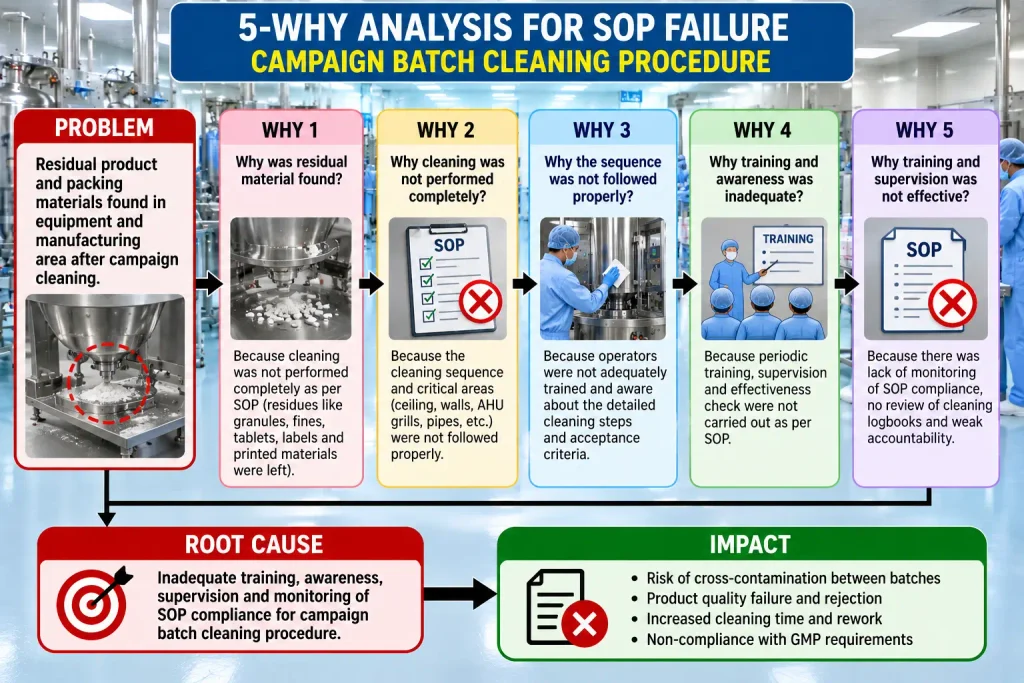
The SOP requires supervision of the cleaning operation by the Production Chemist, checking of equipment cleaning logbooks, and inspection of equipment for cleanliness immediately before use. It also requires cleaning of critical associated areas such as ceilings, walls, doors, AHU supply and return grills, pipes, waste bins, and floors during applicable cleaning activities. The 5-Why approach helps identify the probable root cause behind SOP failure so that focused corrective and preventive actions can be established to improve cleaning compliance and reduce recurrence.
6. Fishbone Analysis for SOP Failure – Campaign Batch Cleaning Procedure:
The Fishbone Analysis for SOP Failure – Campaign Batch Cleaning Procedure identifies the major contributing causes that can result in ineffective cleaning during campaign manufacturing. The causes are grouped under key categories such as Man, Method, Machine, Material, Measurement/Documentation, and Environment. Under Man, possible causes include inadequate training, lack of awareness, poor PPE practices, and insufficient supervision. Under Method, failures may occur when the defined cleaning sequence is not followed, required Type A/Type B cleaning is missed, critical cleaning steps are skipped, or the previous batch status label is not removed. The SOP specifically requires removal of residual materials and previous status labels during batch changeover. Under Machine and Material, difficult-to-clean equipment parts, dust extraction pipelines, remaining granules or fines, labels, printed packing materials, and unsuitable cleaning materials may contribute to incomplete cleaning. The SOP requires cleaning of flexible pipes, dust-extractor pipes, equipment, accessories, and surrounding areas as applicable.
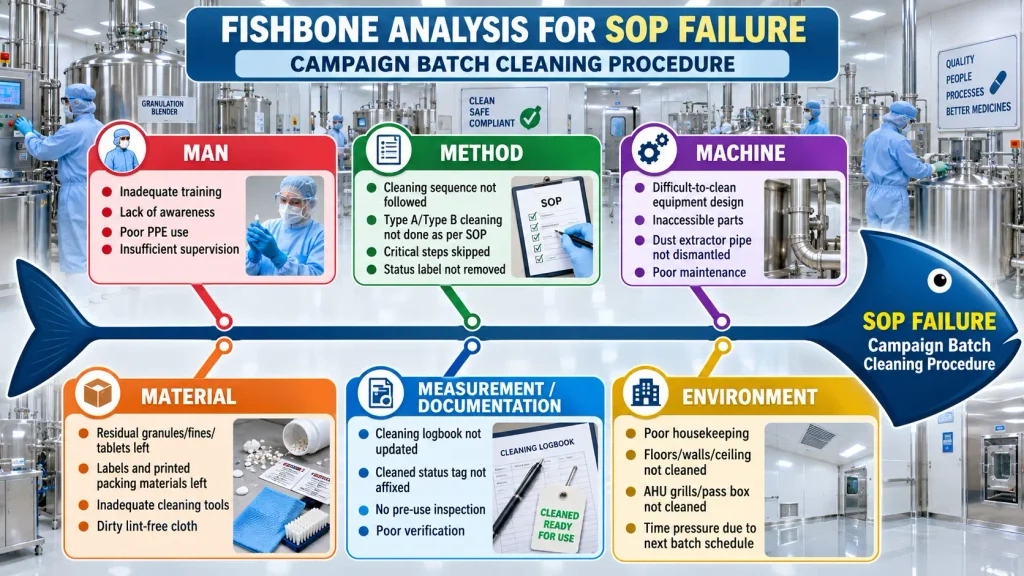
Under Measurement/Documentation, potential failures include incomplete cleaning-log entries, missing cleaned-status tags, inadequate verification, and failure to inspect equipment before use. The SOP requires cleaning records, supervision, and pre-use cleanliness inspection. Under Environment, poor housekeeping of floors, walls, ceilings, AHU grills, doors, and pass boxes can contribute to SOP failure. This Fishbone Analysis helps organize potential causes systematically so that the most probable causes can be investigated further and suitable corrective and preventive actions can be established.
7. Fault Tree Analysis for SOP Failure – Campaign Batch Cleaning Procedure:
The Fault Tree Analysis for SOP Failure – Campaign Batch Cleaning Procedure evaluates the possible causes that can lead to the top event of residual product or packing materials remaining in equipment or the manufacturing area after campaign cleaning. The fault tree groups the failure into major contributing branches such as incomplete removal of product and packing materials, failure to follow the defined cleaning sequence, inadequate cleaning of associated areas, and inadequate verification or documentation. These branches are further linked to basic causes such as residues left inside equipment, labels or printed materials not removed, missed Type A/Type B cleaning, critical areas not cleaned, poor housekeeping, pipes or dust-extraction lines not cleaned, lack of pre-use inspection, and incomplete logbook entries.
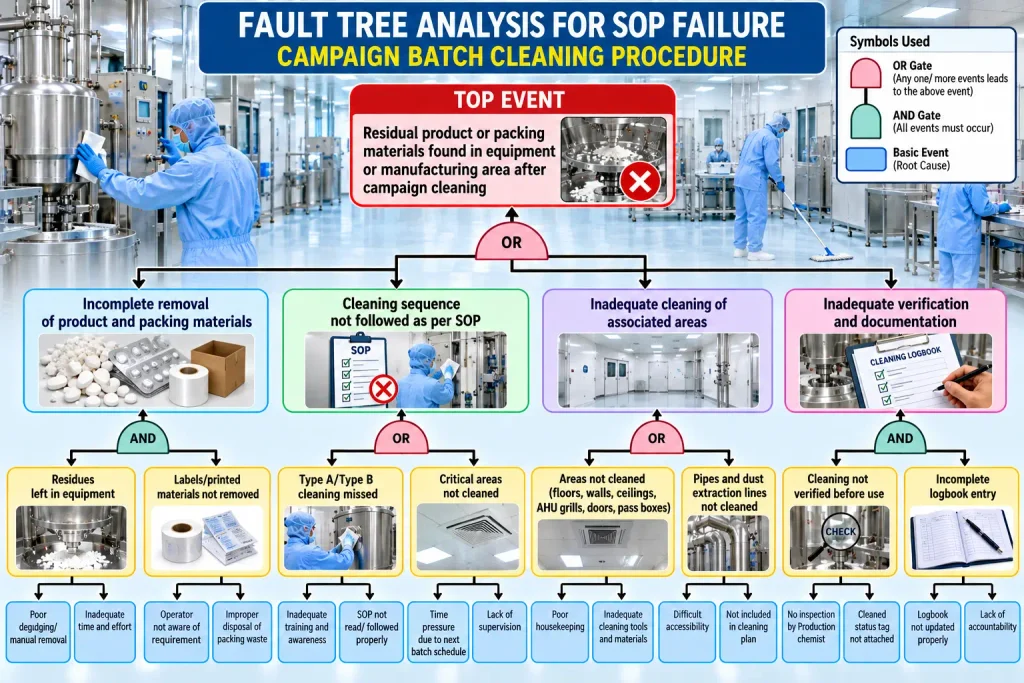
The SOP requires removal of residual granules, fines, tablets, strips, labels, stereos, and printed packing materials, followed by removal of the previous batch status label. It also requires cleaning of ceilings, walls, doors, AHU supply and return grills, pass boxes, waste bins, pipes, equipment, and floors during applicable campaign or product-changeover cleaning. The SOP further requires affixing a cleaned-status tag, recording cleaning details in the equipment usage and cleaning logbook, supervision by the Production Chemist, and inspection of equipment for cleanliness immediately before use.This Fault Tree Analysis helps visualize how individual failures can combine to cause overall SOP failure and supports identification of areas requiring stronger procedural control, verification, and documentation.
8. Impact Assessment for SOP Failure – Campaign Batch Cleaning Procedure:
The Impact Assessment for SOP Failure – Campaign Batch Cleaning Procedure evaluates the consequences that may arise when cleaning is not performed effectively after campaign manufacturing. The primary concern is that residual product, labels, printed packing materials, or other contaminants may remain on equipment or within the manufacturing area, despite the SOP requirement to remove these materials during changeover. Such a failure can affect product quality by increasing the possibility of carryover or contamination between batches. It may also lead to additional cleaning, rework, production delays, and reduced equipment availability. The SOP also requires cleaning of associated areas such as ceilings, walls, doors, AHU supply and return grills, pass boxes, waste bins, pipes, equipment, and floors; failure to clean these areas properly can reduce overall housekeeping and cleaning effectiveness.
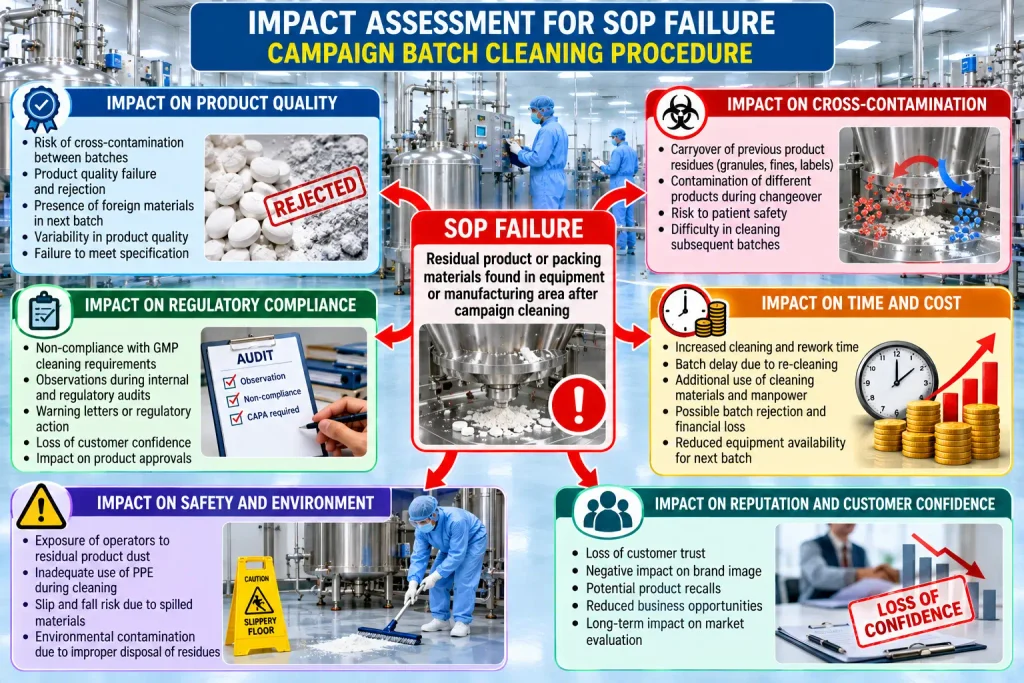
There can also be an impact on documentation and GMP compliance if cleaned-status tags are not affixed, cleaning logbooks are incomplete, or pre-use inspection is not performed. The SOP requires cleaning records, supervision by the Production Chemist, and inspection of equipment for cleanliness immediately before use. Overall, SOP failure can adversely affect cleaning effectiveness, batch changeover control, product protection, operational efficiency, and compliance with the GMP-based requirements stated in the procedure.
9. CAPA for SOP Failure – Campaign Batch Cleaning Procedure:
The Corrective and Preventive Action (CAPA) for SOP Failure – Campaign Batch Cleaning Procedure is intended to eliminate identified cleaning deficiencies and prevent their recurrence during pharmaceutical manufacturing and packing operations. Corrective actions should address immediate deficiencies such as residual product or packing material left on equipment, incomplete cleaning of associated areas, inadequate documentation, and missed verification. The SOP requires removal of residues and previous batch status labels, followed by cleaning of equipment and manufacturing areas.
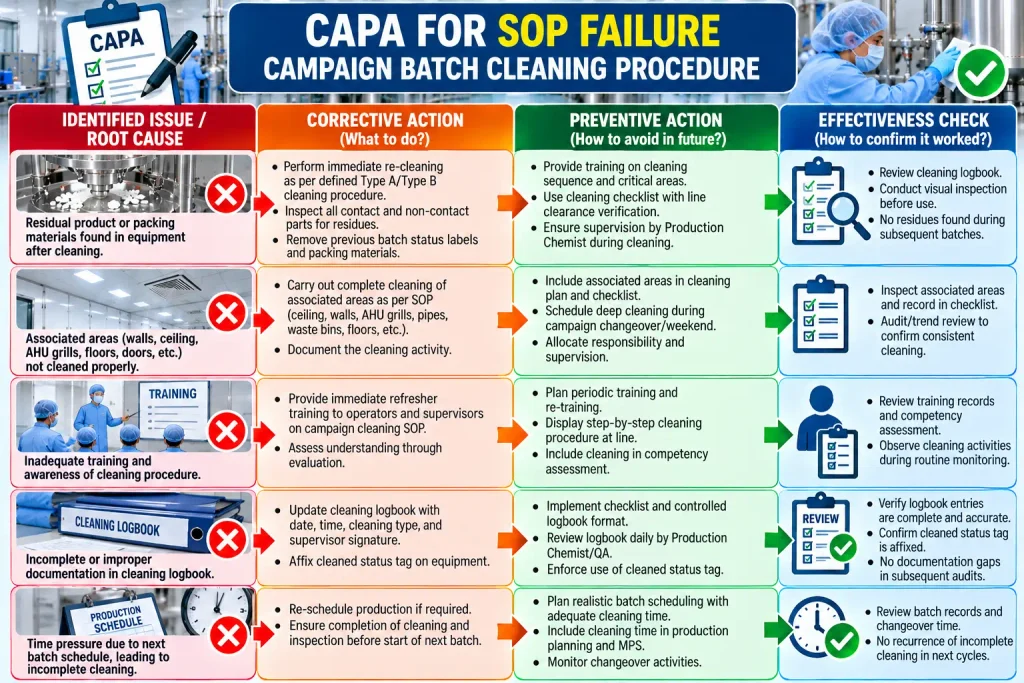
Preventive actions should strengthen operator training, cleaning checklists, supervision, batch-changeover planning, controlled documentation, and routine review of cleaning activities. Particular attention should be given to ceilings, walls, doors, AHU supply and return grills, pass boxes, waste bins, pipes, equipment, and floors, as these areas are included in the SOP cleaning requirements.Effectiveness should be verified through cleaning-logbook review, visual inspection before equipment use, confirmation of cleaned-status tags, routine supervision, and monitoring for recurrence of cleaning failures. The SOP specifically requires the Production Chemist to supervise cleaning, review equipment cleaning logbooks, and inspect equipment for cleanliness before use. An effective CAPA system helps ensure that identified cleaning failures are corrected, underlying weaknesses are controlled, and campaign batch cleaning remains consistent and compliant with the procedure.
Questions & Answers – SOP for Campaign Batch Cleaning Procedure:
Q1. What is the objective of the SOP for Campaign Batch Cleaning Procedure?
Answer: The objective is to describe the procedure for campaign batch cleaning of manufacturing and packing areas.
Q2. Who is responsible for execution of this SOP?
Answer: The concerned Production person and Production Chemist are responsible for execution of the SOP.
Q3. Who is responsible for effective implementation of the SOP?
Answer: AGM-Production and Head-Production are responsible for effective implementation.
Q4. What is meant by batch-to-batch changeover of the same product?
Answer: It is the changeover from one batch of a product to the next batch of the same product in granulation, compression, or packing sections.
Q5. What should be ensured before starting cleaning of individual equipment?
Answer: The process on that equipment should be complete and the product should be removed and transferred to the next processing stage.
Q6. Which residual materials should be removed during campaign cleaning?
Answer: Granules, fines, tablets, strips, stereos, labels, and printed packing materials should be removed from the equipment and area.
Q7. What should be done with the previous batch status label?
Answer: The status label of the previous batch should be removed.
Q8. How should equipment surfaces and glass windows be cleaned?
Answer: Outer surfaces are dry mopped as specified, while glass windows and the machine base are cleaned using a dry lint-free cloth.
Q9. How should cleaned equipment and accessories be protected before use?
Answer: They should be dried and exposed parts covered with cling film. Cleaned accessories may be transferred to the cleaned-equipment room and covered with a polybag, as applicable.
Q10. What identification is required after cleaning?
Answer: A duly filled cleaned-status tag should be affixed on the equipment or accessory.
Q11. Where should cleaning details be recorded?
Answer: Cleaning details should be recorded in the equipment usage and cleaning logbook.
Q12. Who supervises the cleaning operation?
Answer: The Production Chemist supervises the cleaning operation and checks the equipment cleaning logbooks.
Q13. What check is required immediately before equipment use?
Answer: The equipment should be inspected for cleanliness immediately before use.
Q14. Which areas are included in weekend or product-changeover cleaning?
Answer: The procedure includes cleaning of ceilings, tube-light fixtures, walls, doors, AHU supply and return grills, flexible pipes, glass windows, pass boxes, waste bins, dust-extractor pipes, equipment, and floors.
Q15. How should dust-extractor pipes be cleaned?
Answer: Tri-clover fittings are opened, the dust-extractor pipe is dismantled, and the pipe is cleaned with potable water and a long-handle brush; hot potable water may be used if required.
Q16. How should the floor and underneath of equipment be cleaned?
Answer: They should be cleaned using a floor-cleaning machine and mop assembly as per the applicable SOP.
Q17. What is the reference stated in the SOP?
Answer: The SOP states the reference as “As per GMP.”
Q18. Why is documentation important in campaign batch cleaning?
Answer: The SOP requires cleaned-status identification and recording of cleaning details in the equipment usage and cleaning logbook, supporting traceability and verification of cleaning activities.
Reference Guidelines – SOP for Campaign Batch Cleaning Procedure:
- WHO Good Manufacturing Practices for Pharmaceutical Products – requirements for premises, equipment cleaning, sanitation, prevention of contamination, and documented procedures.
- EU GMP – EudraLex Volume 4, Part I
- Chapter 3 – Premises and Equipment
- Chapter 5 – Production
- Annex 15 – Qualification and Validation
These provide expectations for equipment cleanliness, prevention of cross-contamination, cleaning validation, and documented changeover controls.
- PIC/S Guide to Good Manufacturing Practice for Medicinal Products – PE 009 – guidance on cleaning, production-area controls, equipment, sanitation, and prevention of product carryover.
- US FDA – 21 CFR Part 211
- 21 CFR 211.56 – Sanitation
- 21 CFR 211.67 – Equipment Cleaning and Maintenance
- 21 CFR 211.182 – Equipment Cleaning and Use Log
- 21 CFR 211.188 – Batch Production and Control Records
- ICH Q7 – Good Manufacturing Practice Guide for Active Pharmaceutical Ingredients – relevant principles for equipment cleaning, cleaning procedures, documentation, and contamination control.
- WHO Technical Report Series – GMP and Cleaning Validation Guidance – useful for establishing scientifically justified cleaning procedures and controls.