







1. Introduction:
The SOP for Allocation of Batch Number establishes a controlled and systematic method for assigning unique batch numbers to products manufactured within the Production Department. A properly defined batch numbering system is essential in pharmaceutical manufacturing because it provides clear identification and traceability of every batch throughout manufacturing, packing, quality control, release, distribution, and documentation activities. The SOP applies to commercial production and formulation batches and defines the responsibilities of Quality Assurance, Production, and QA/QC personnel for implementation of the numbering system. The procedure describes the allocation of batch numbers based on manufacturing and packing status. Different codes may represent the dosage form, party or customer, manufacturing year, and sequential batch number. For example, specific letters are used to distinguish Tablets, Liquids, and Ointments, while serial numbers provide unique identification for individual batches. Quality Assurance maintains batch-number records in the relevant BMR and BPR logs and ensures that all required information is properly documented. The SOP also defines the procedure for cancellation of an allotted batch number. Once cancelled, the number is treated as a dead number and is not reused for any future batch, thereby maintaining complete traceability and preventing duplication or mix-ups.
Skip to PDF content2. Flow Diagram:
The flow diagram explains the allocation of batch numbers in a simple and controlled sequence. The process starts when a batch number is required for product manufacturing. As per the SOP, the QA Chemist is responsible for assigning the batch number according to the defined numbering system.
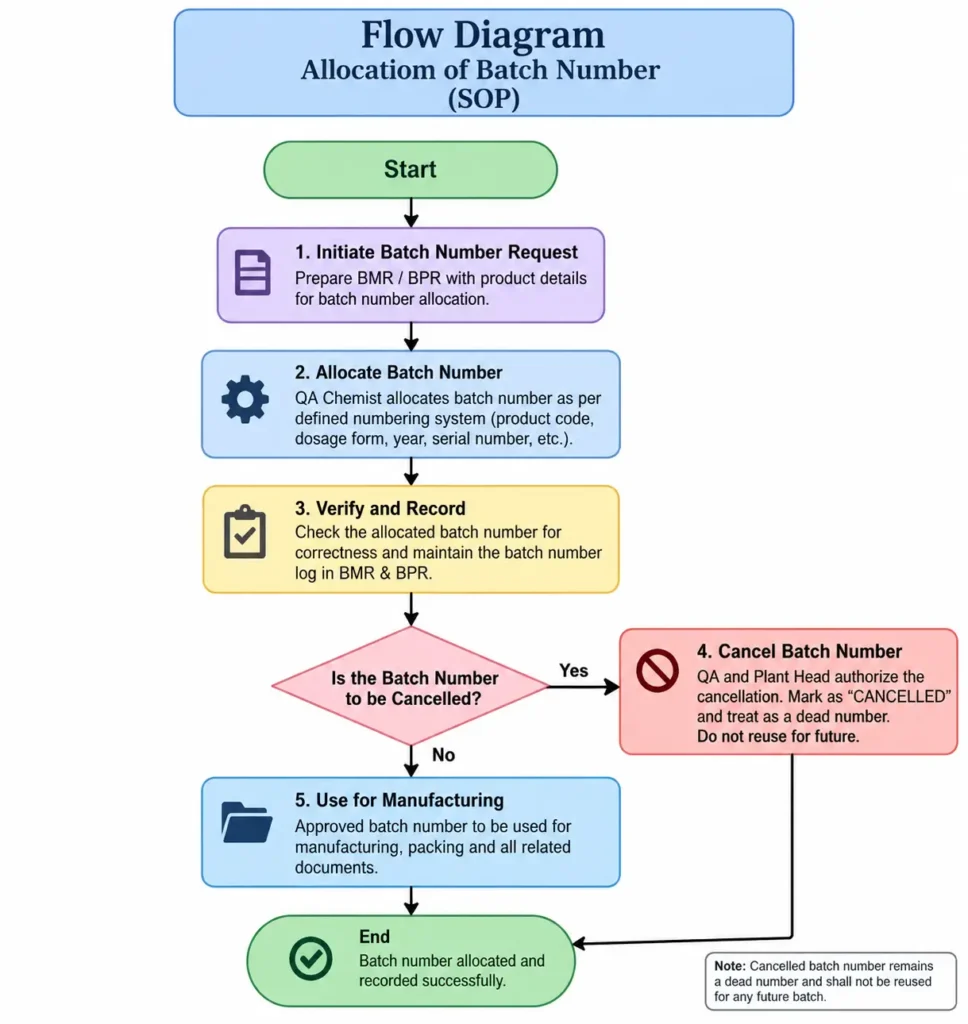
The batch number may contain specific codes representing the dosage form, year of manufacture, party or product code, and serial number. After allocation, the number is verified and entered into the appropriate BMR and BPR batch number logs to maintain proper traceability and documentation. If the allotted batch number needs to be cancelled, the cancellation must be authorized by Quality Assurance and the Plant Head. A cancelled batch number is treated as a dead number and must never be reused for any future batch. This system helps prevent duplication, mix-ups, and documentation errors while ensuring complete batch traceability.
3. Brainstorming for SOP Failure:
The brainstorming diagram identifies possible reasons for SOP failure in the allocation of batch numbers. The causes are grouped into major areas such as people, method, system, information, management, measurement, and workplace conditions. Common issues include inadequate training, lack of SOP awareness, human errors, inconsistent numbering patterns, incomplete BMR/BPR details, use of old or cancelled batch numbers, poor supervision, and insufficient verification.
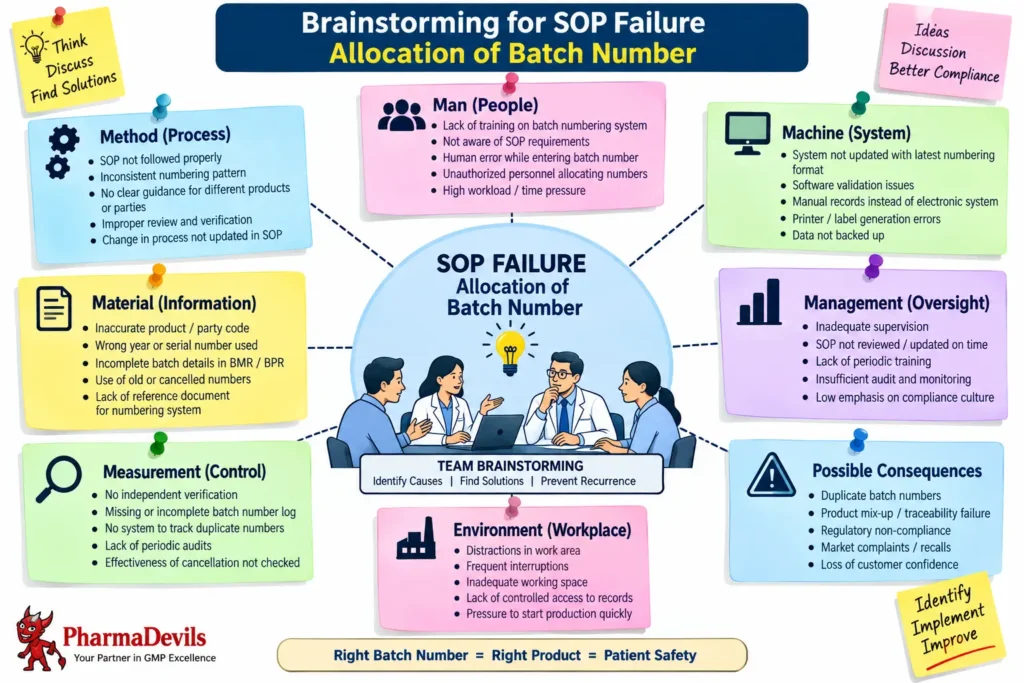
The purpose of brainstorming is to collect all possible causes before deciding the actual root cause. It helps the QA and Production teams discuss practical problems that may lead to duplicate or incorrect batch numbers. Such failures can affect product traceability, create documentation errors, and increase the risk of mix-ups or regulatory non-compliance. By reviewing these potential causes, the organization can identify suitable corrective and preventive actions, improve employee training, strengthen batch-number verification, update procedures, and establish better monitoring controls to prevent recurrence.
4. 5-Why Analysis for SOP Failure:
The 5-Why Analysis identifies the possible root cause of SOP failure during batch number allocation in the manufacturing area. The investigation starts with the problem of an incorrect, old, or cancelled batch number being used on manufacturing documents or labels. It then examines why the operator used the wrong number, why verification was not performed, why training and SOP adherence were weak, and why supervision and line-clearance controls were ineffective.
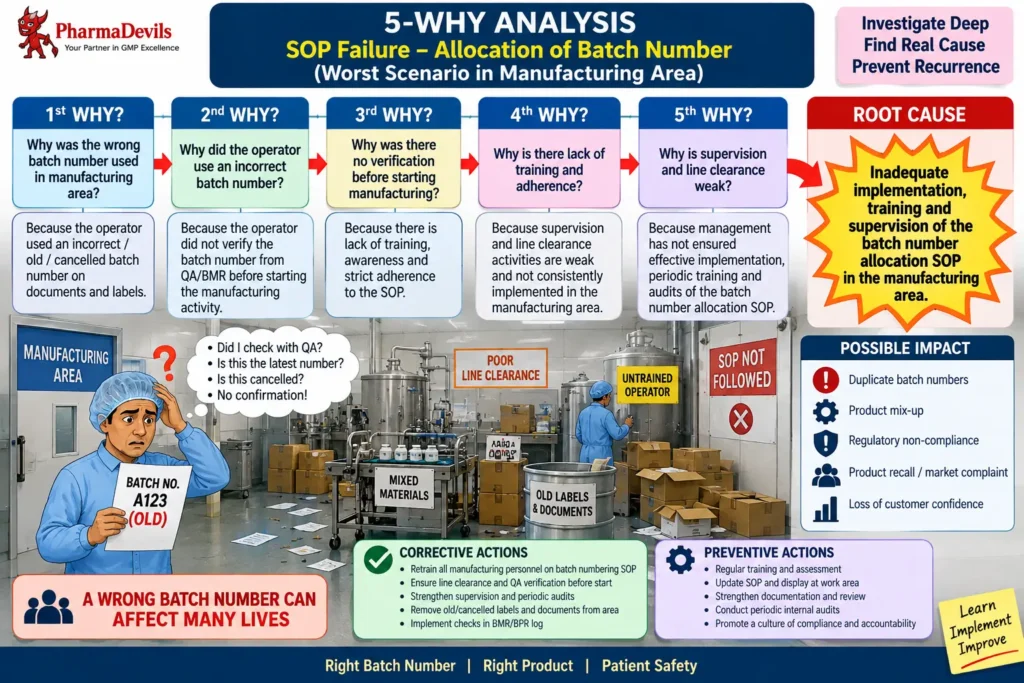
The analysis indicates that the main root cause may be inadequate implementation, training, and supervision of the batch number allocation SOP. Such failures can lead to duplicate batch numbers, product mix-ups, poor traceability, regulatory non-compliance, and even product recall. To prevent recurrence, the organization should strengthen personnel training, QA verification, line clearance, documentation review, periodic audits, and supervisory checks. Cancelled batch numbers should remain permanently unused, as required by the SOP.
5. Fishbone Analysis for SOP Failure:
The Fishbone Analysis identifies the possible causes of SOP failure in the allocation of batch numbers in the manufacturing area. The causes are divided into major categories such as Man, Method, Machine, Material, Measurement, Management, and Environment. Possible issues include inadequate training, human error, failure to follow the SOP, inconsistent numbering patterns, poor line clearance, outdated systems, incorrect product or party codes, incomplete BMR/BPR records, weak supervision, missing verification, and poor document control.
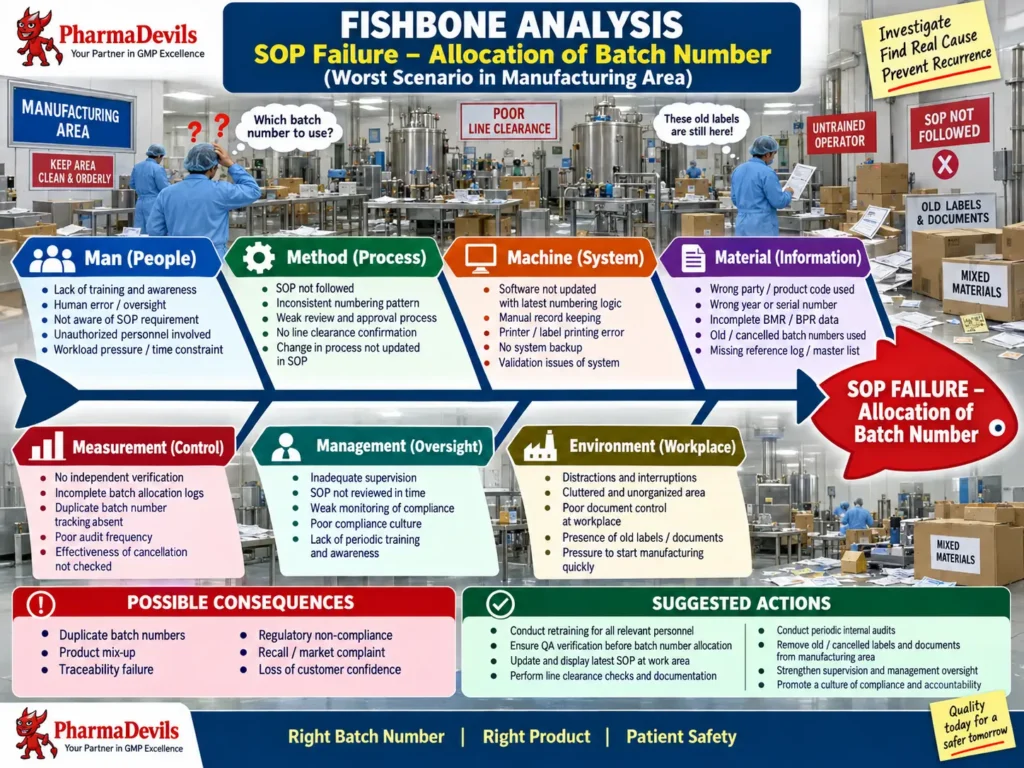
These failures can result in duplicate batch numbers, product mix-ups, traceability problems, regulatory non-compliance, market complaints, or product recalls. The analysis helps the investigation team systematically review all contributing factors instead of focusing on only one cause. Based on the findings, suitable actions may include retraining personnel, strengthening QA verification, improving line clearance, updating the SOP and numbering system, removing obsolete documents, conducting periodic audits, and improving supervision to prevent recurrence.
6. Fault Tree Analysis for SOP Failure:
The Fault Tree Analysis shows how SOP failure in batch number allocation can develop from several basic causes in the manufacturing area. The main failure event is the use of a wrong, duplicate, or cancelled batch number. The diagram groups the possible causes into human error, inadequate verification and control, weak systems or methods, and poor supervision or management.
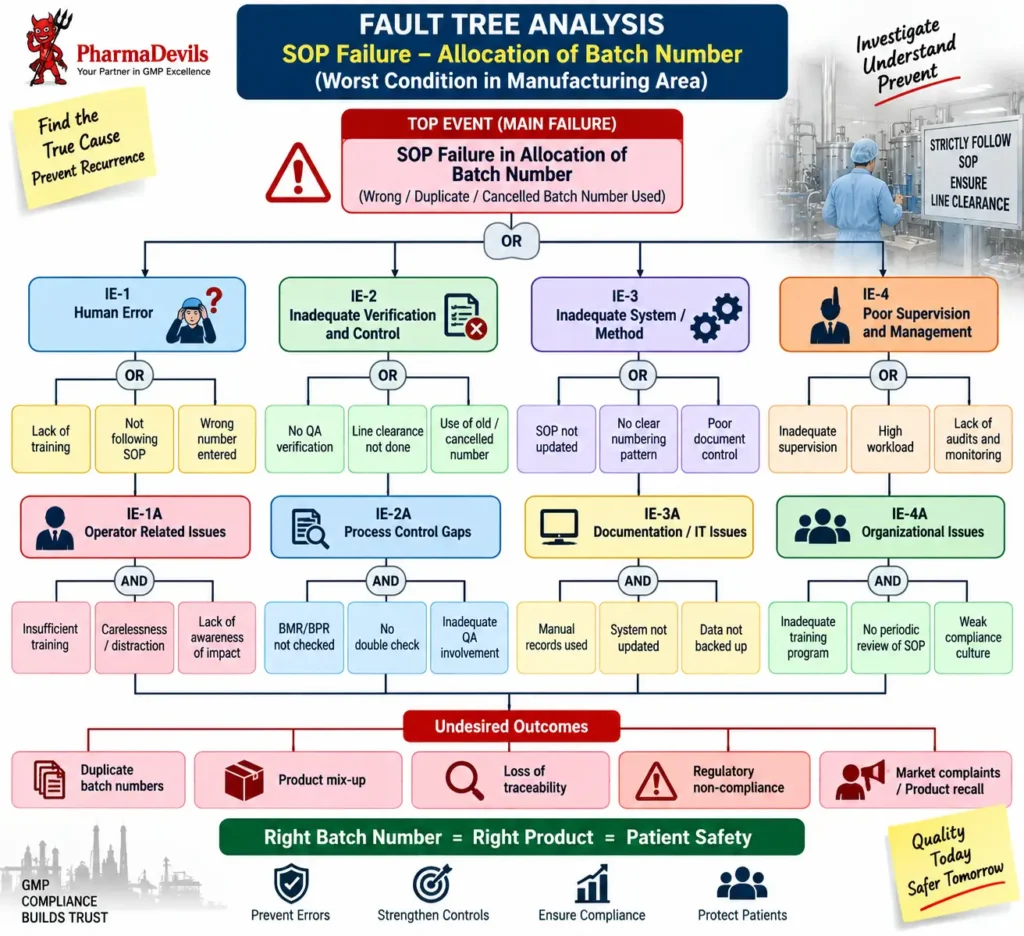
Examples include lack of training, failure to follow the SOP, incorrect number entry, absence of QA verification, incomplete line clearance, use of obsolete or cancelled numbers, outdated procedures, weak document control, high workload, and insufficient audits. These causes may combine and result in serious outcomes such as duplicate batch numbers, product mix-ups, loss of traceability, regulatory non-compliance, market complaints, or product recall. The analysis helps identify where controls are failing so that corrective actions can focus on stronger training, verification, documentation, supervision, and periodic review.
Questions & Answers:
- Q: What is the objective of the SOP for Allocation of Batch Number?
A: The objective is to define a controlled procedure for allocating batch numbers to products manufactured in the facility. - Q: What is the scope of this SOP?
A: It applies to the batch numbering system used for commercial production and formulation batches in the Production Department. - Q: Who is responsible for execution of the batch number allocation SOP?
A: The QA Chemist is responsible for execution of the SOP. - Q: Who is responsible for effective implementation of the SOP?
A: Manager-Production and Head-QA/QC are responsible for effective implementation. - Q: On what basis is the batch numbering system established?
A: The batch numbering system is based on the manufacturing and packing status of the product. - Q: What do the letters T, L and O represent in the batch numbering system?
A: They represent dosage forms: T for Tablet, L for Liquid and O for Ointment. - Q: What is the purpose of the serial number in a batch number?
A: The serial number uniquely identifies the individual batch within the defined numbering sequence. The SOP describes serial numbering ranges such as 0001 to 9999 for specified series. - Q: Where are allotted batch numbers recorded?
A: The QA Chemist maintains the batch numbers in the relevant BMR and BPR logs for individual series. - Q: What should be entered when a column in the Batch Number Log is not applicable?
A: The entry “NA” should be made when a particular column does not require information. - Q: Who can authorize cancellation of an allotted batch number?
A: Cancellation must be authorized by Quality Assurance and the Plant Head. - Q: What happens to BMR/BPR documents issued against a cancelled batch number?
A: They are to be withdrawn and destroyed within two weeks after cancellation of the batch number by Quality Assurance. - Q: Can a cancelled batch number be reused for another batch?
A: No. A cancelled batch number is treated as a dead number and is not carried forward or reused for any future batch. - Q: Why is proper batch number allocation important?
A: It supports unique batch identification and controlled documentation through BMR, BPR and batch-number logs, helping maintain traceability and preventing duplication or mix-ups. - Q: What can happen if the SOP for batch number allocation is not followed?
A: Possible consequences include incorrect or duplicate batch numbers, documentation errors, product mix-ups, loss of traceability and compliance concerns. - Q: What should be checked before using an allotted batch number?
A: The number should be verified against the approved numbering system and corresponding batch-number log before being entered into manufacturing or packing documentation. - Q: What is BMR?
A: BMR means Batch Manufacturing Record. - Q: What is BPR?
A: BPR means Batch Packing Record. - Q: What does BFG stand for?
A: BFG stands for Bulk Finish Good as defined in the SOP. - Q: What does FG stand for?
A: FG stands for Finish Good. - Q: What are the key controls to prevent batch number allocation failure?
A: Key controls include trained personnel, QA verification, accurate BMR/BPR logging, correct use of numbering codes, proper cancellation control, supervisory review and ensuring cancelled numbers are never reused.
Reference Guidelines:
- Revised Schedule M, Drugs Rules, 1945 – G.S.R. 922(E), Government of India
This is the most directly relevant reference. It specifically requires an SOP describing the batch/lot numbering system, requires each batch of intermediate, bulk or finished product to have a specific batch number, states that the same batch number must not be repeatedly used, and requires batch-number allocation to be immediately recorded in a logbook with date, product identity and batch size.
Official Revised Schedule M – CDSCO - WHO Good Manufacturing Practices for Pharmaceutical Products: Main Principles – TRS 986, Annex 2
WHO GMP provides the international framework for documented production, batch records, traceability, labeling controls, investigation of discrepancies and maintenance of distribution records for individual batches. (World Health Organization)
WHO GMP – TRS 986 Annex 2 - EU GMP – EudraLex Volume 4, Part I, Chapter 4: Documentation
Chapter 4 establishes GMP expectations for controlled documentation, generation and completion of manufacturing records, document accuracy, traceability and retention. These principles support controlled allocation and recording of batch numbers. (Public Health)
EU GMP EudraLex Volume 4 - US FDA – 21 CFR §211.188, Batch Production and Control Records
This regulation requires a batch production and control record for every drug-product batch and complete documentation of manufacturing, processing, packing, labeling and identification of materials used. (eCFR)
21 CFR 211.188 – Batch Production and Control Records - Company SOPs and Related Controlled Documents
The attached SOP itself references procedures covering preparation, approval, issuance and retrieval of BMR, preparation/approval/issuance of Sugar Manufacturing Records, and related manufacturing documentation.