







1. Introduction – SOP for Carrying Out Entries in Area Usage Record:
The SOP for Carrying Out Entries in Area Usage Record establishes a standardized procedure for documenting all activities performed within pharmaceutical production and process areas. The Area Usage Record provides traceable evidence of when an area was used, the activity performed, the associated product and batch, and the personnel responsible for performing, checking, and verifying the activity. The SOP requires the record to be maintained in all process-area rooms and specifies recording the area name, date, activity such as cleaning or manufacturing, product name, batch number, and operation start and completion times using the 24-hour clock system. The individual performing the operation must sign the record, the Production Chemist must check the activity, and the entries are subsequently verified by QA. Relevant remarks, including the type of cleaning performed, are also documented. Proper implementation of this SOP strengthens GMP compliance, data integrity, accountability, traceability, area-status control, batch investigation, and audit readiness by providing a clear chronological history of activities carried out in each manufacturing area.
Skip to PDF content2. Flow Diagram – SOP for Carrying Out Entries in Area Usage Record:
The SOP for Carrying Out Entries in Area Usage Record defines a systematic method for recording and controlling activities performed in pharmaceutical process areas. The flow begins with maintaining an Area Usage Record in each process room and using the prescribed . The user records the area name, date, activity performed, and, where applicable, the product name and batch number. Start and completion times are documented using the 24-hour clock system.
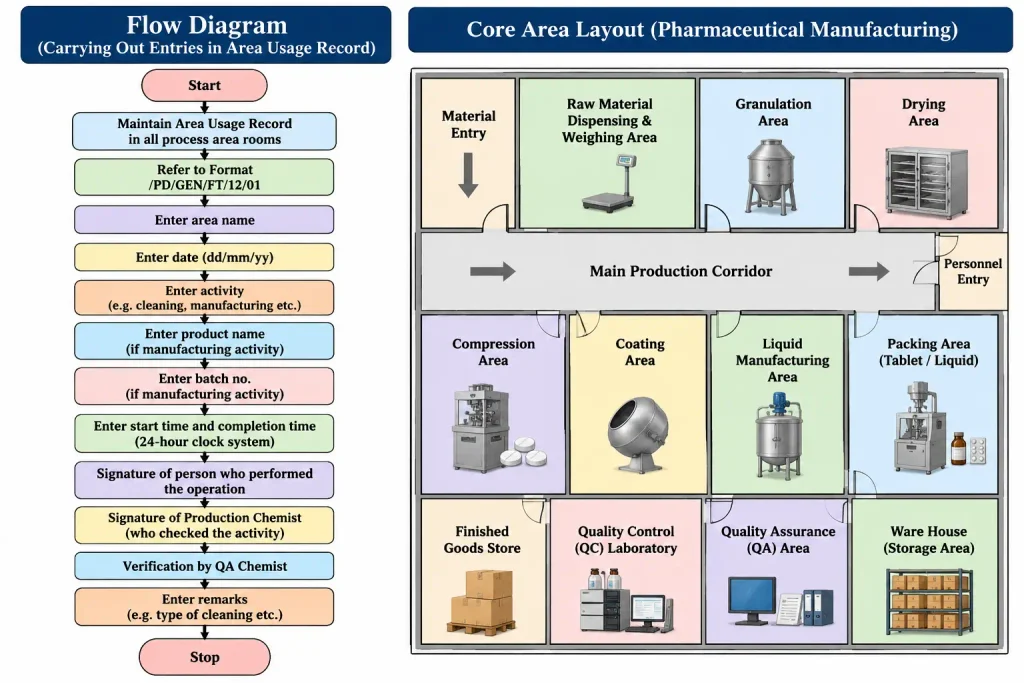
After completion of the activity, the person performing the operation signs the record, followed by checking by the Production Chemist and verification by the QA Chemist. Any relevant details, such as the type of cleaning performed, are entered in the remarks column. Following this SOP ensures traceability, accountability, chronological documentation, area-use control, GMP compliance, and reliable review of manufacturing and cleaning activities within the core production area.
3. Benefits of Following the SOP for Carrying Out Entries in Area Usage Record:
Following the SOP for Carrying Out Entries in Area Usage Record provides several important GMP and operational benefits within pharmaceutical manufacturing areas. The SOP requires that each process-area room maintain an Area Usage Record containing the area name, date, activity performed, product name, batch number, start and completion time, signatures, QA verification, and remarks.
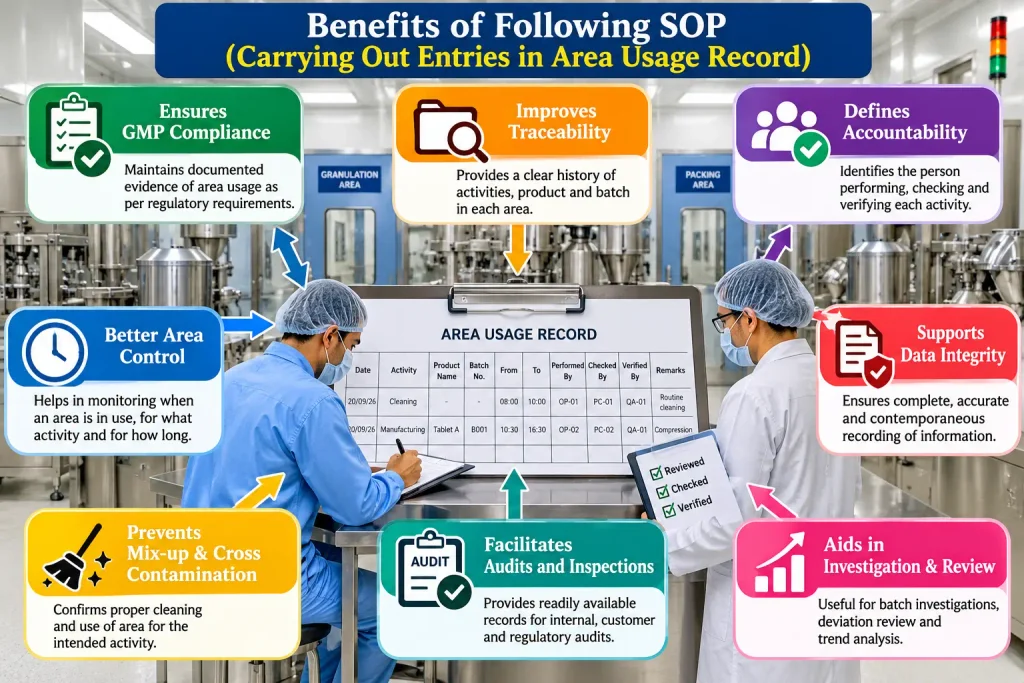
Proper implementation improves traceability by creating a chronological history of area activities and strengthens accountability by identifying who performed, checked, and verified each operation. It also supports data integrity through complete and contemporaneous documentation, improves area-use control, and provides useful evidence during investigations, deviations, and audits. Recording cleaning and manufacturing activities also helps demonstrate that the area was appropriately used and reviewed before subsequent operations. Overall, this SOP supports consistent documentation, effective production oversight, GMP compliance, and reliable QA review of activities performed in the manufacturing area.
4. Brainstorming for SOP Failure – Carrying Out Entries in Area Usage Record:
The Brainstorming Analysis for SOP Failure – Carrying Out Entries in Area Usage Record identifies the most common reasons that may lead to improper maintenance of the Area Usage Record in pharmaceutical core areas. The SOP requires the record to be maintained in all process-area rooms using the prescribed format and includes entry of area name, date, activity, product name, batch number, start and completion time, signatures, QA verification, and remarks.
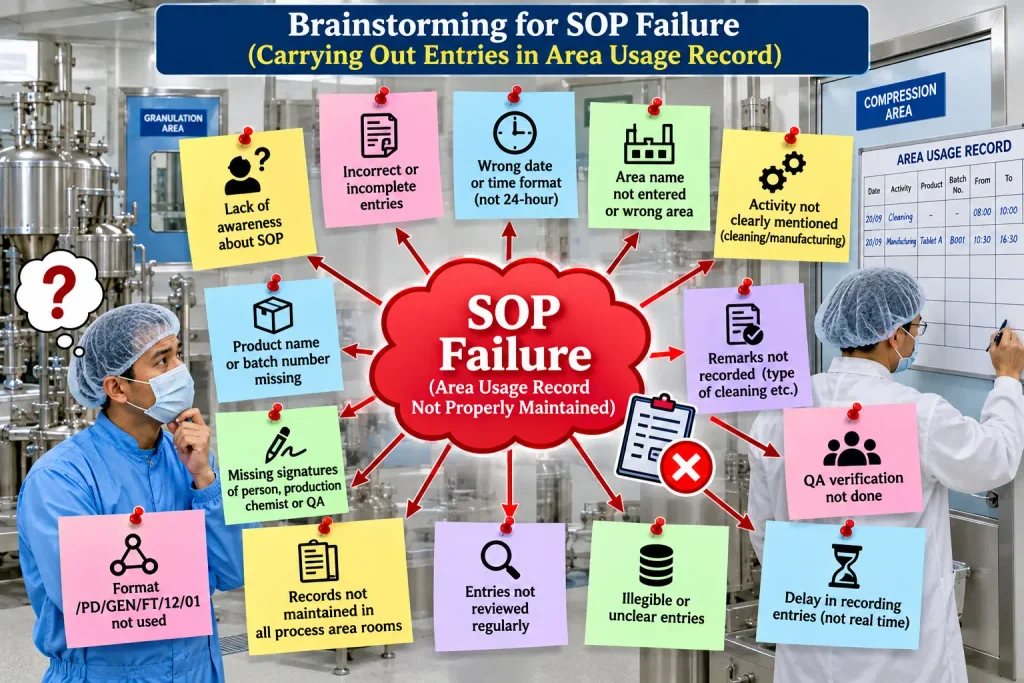
Potential failure points include lack of SOP awareness, incomplete or incorrect entries, wrong date or time format, missing area identification, unclear activity description, missing product or batch details, absent signatures, delayed recording, illegible entries, omission of remarks, and failure of QA verification. The brainstorming exercise helps the Production and QA teams recognize documentation weaknesses before they result in traceability gaps, data-integrity concerns, investigation difficulties, or GMP observations. It also provides a practical basis for further root-cause analysis and CAPA development.
5. 5-Why Analysis for SOP Failure – Carrying Out Entries in Area Usage Record:
The 5-Why Analysis for SOP Failure – Carrying Out Entries in Area Usage Record is used to identify the underlying reasons why the Area Usage Record may be incomplete, incorrect, or not maintained as required. The SOP expects entries such as area name, date, activity, product name, batch number, start and completion time, signatures, QA verification, and remarks to be recorded correctly.
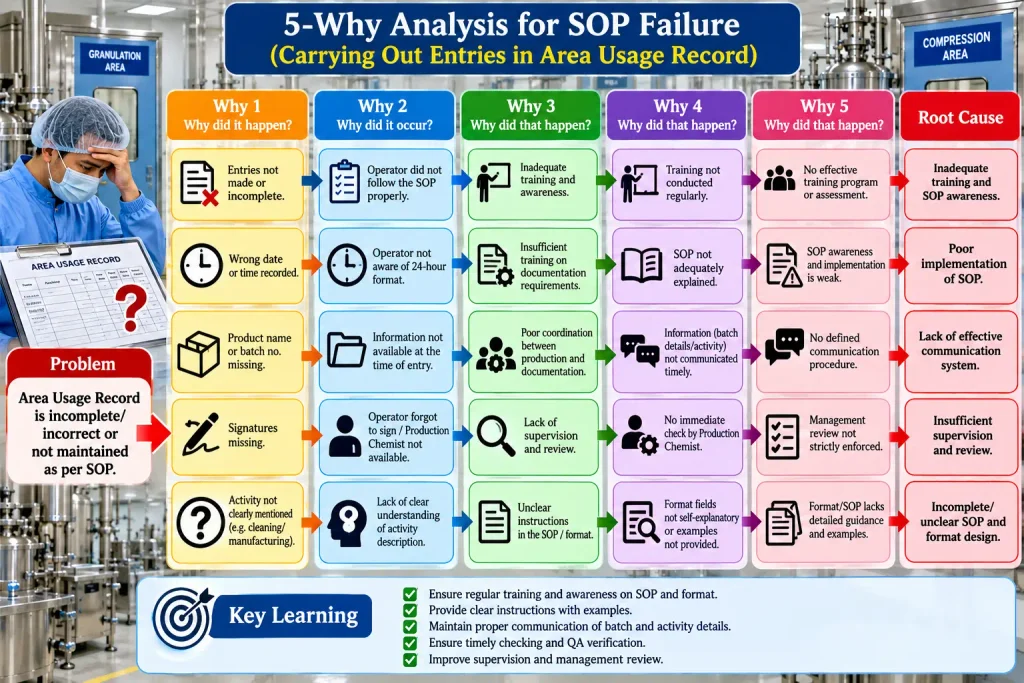
The analysis traces visible problems such as missing entries, wrong date or time format, absent product or batch details, missing signatures, and unclear activity descriptions back through successive “Why” questions. Possible underlying causes include inadequate SOP awareness, insufficient training, weak communication, lack of timely supervision, delayed checking, and unclear instructions or format fields. The purpose of the 5-Why method is to move beyond the immediate documentation error and determine the actual system weakness responsible for repeated failure. This analysis supports focused corrective and preventive actions such as refresher training, clearer documentation instructions, improved communication of batch details, timely Production and QA review, and stronger supervisory control.
6. Fishbone Analysis for SOP Failure – Carrying Out Entries in Area Usage Record:
The Fishbone Analysis for SOP Failure – Carrying Out Entries in Area Usage Record is used to systematically identify possible causes responsible for incomplete, incorrect, or poorly maintained Area Usage Records in pharmaceutical core areas. The SOP requires recording details such as area name, date, activity, product name, batch number, start and completion time, signatures, QA verification, and remarks.
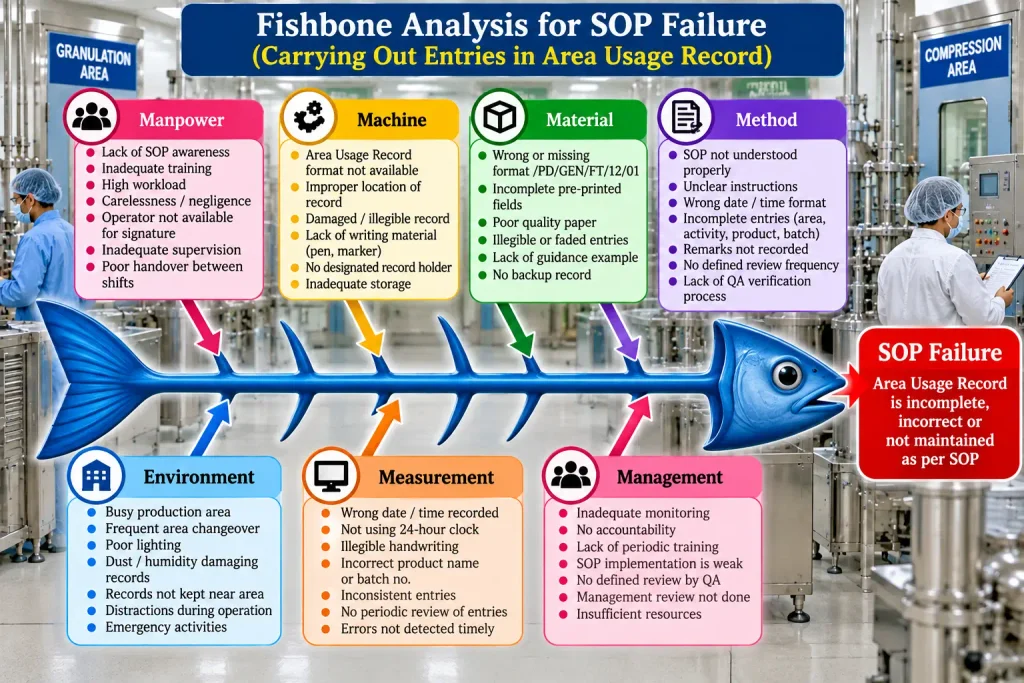
The analysis groups potential causes under major categories such as Manpower, Machine, Material, Method, Environment, Measurement, and Management. Typical causes may include lack of SOP awareness, inadequate training, unavailable or damaged record formats, unclear instructions, incorrect date or time entries, missing product or batch information, poor handwriting, delayed signatures, weak supervision, insufficient QA review, and inadequate management oversight. Using the Fishbone method helps the Production and QA teams visualize how multiple contributing factors can combine to cause documentation failure. It supports structured root-cause investigation and helps define focused CAPA actions to strengthen GMP compliance, data integrity, traceability, accountability, and reliable control of area usage records.
7. Fault Tree Analysis for SOP Failure -Carrying Out Entries in Area Usage Record:
The Fault Tree Analysis for SOP Failure – Carrying Out Entries in Area Usage Record evaluates how different documentation failures can combine to result in the top event: Area Usage Record incomplete, incorrect, or not maintained as per SOP. The SOP requires recording the area name, date, activity, product name, batch number, start and completion time, signatures, QA verification, and remarks in the prescribed record.
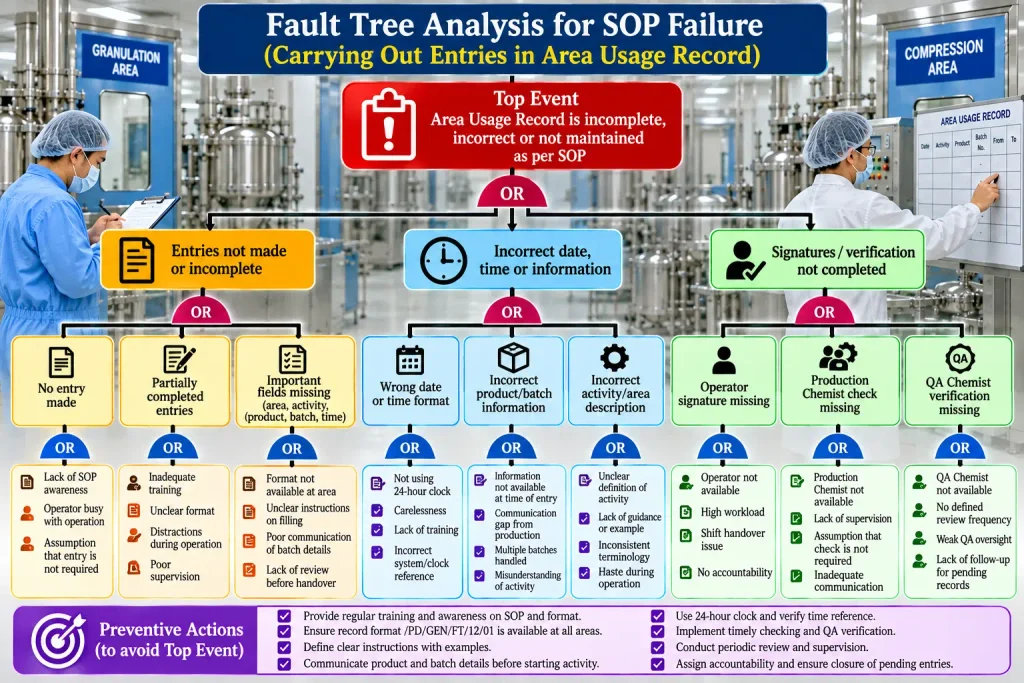
The fault tree divides the failure into major branches such as entries not made or incomplete, incorrect date/time or activity information, and missing signatures or verification. Contributing causes may include lack of SOP awareness, inadequate training, unclear instructions, non-availability of the prescribed format, poor communication of product or batch details, failure to use the 24-hour clock system, high workload, delayed checking, weak supervision, and insufficient QA follow-up. This analysis helps identify both immediate and underlying causes of documentation failure. It supports preventive measures such as regular training, availability of the correct format, clear filling instructions, timely Production review, QA verification, improved communication, periodic supervision, and defined accountability, thereby strengthening GMP compliance, traceability, and data integrity.
8. Impact Assessment for SOP Failure -Carrying Out Entries in Area Usage Record:
The Impact Assessment for SOP Failure – Carrying Out Entries in Area Usage Record evaluates the consequences that may arise when the Area Usage Record is incomplete, incorrect, or not maintained as required. The SOP requires proper documentation of the area name, date, activity, product name, batch number, start and completion time, signatures, QA verification, and remarks.
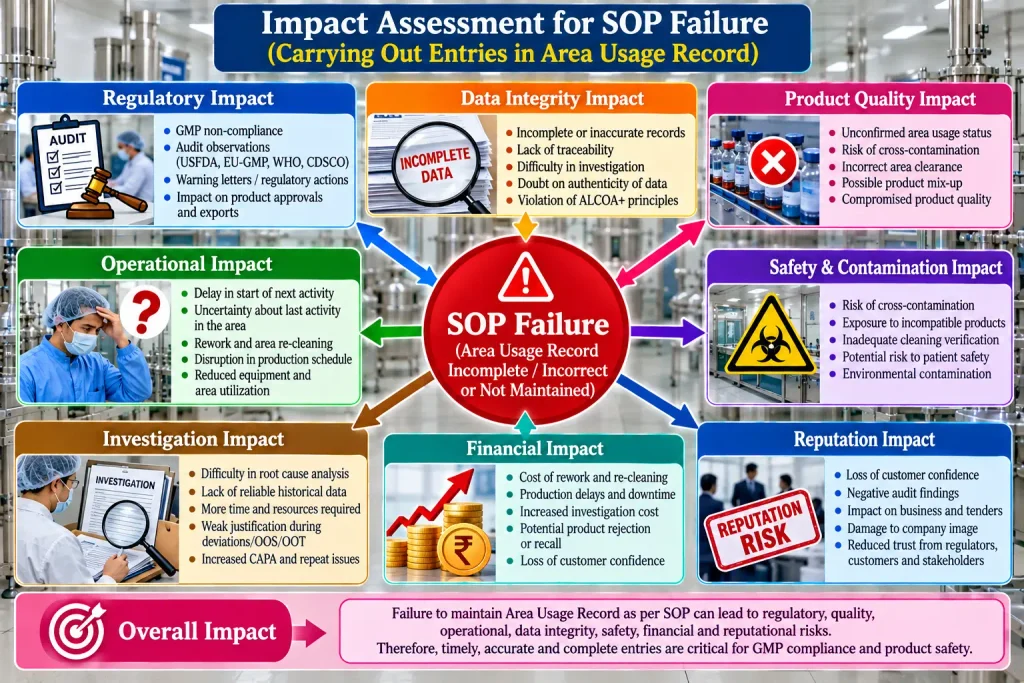
Failure to follow these requirements can affect several critical areas, including GMP compliance, data integrity, product quality, operational continuity, investigation effectiveness, contamination control, financial performance, and organizational reputation. Incomplete or inaccurate entries may create traceability gaps, uncertainty about previous activities, difficulty during deviation or complaint investigations, delays in subsequent operations, and possible need for re-cleaning or additional verification. The assessment therefore highlights that timely, accurate, legible, and complete Area Usage Record entries are essential for maintaining reliable documentation, supporting QA oversight, demonstrating compliance during audits, and ensuring that manufacturing areas are used and controlled appropriately.
9. CAPA for SOP Failure – Carrying Out Entries in Area Usage Record:
The CAPA for SOP Failure – Carrying Out Entries in Area Usage Record is designed to correct existing documentation deficiencies and prevent recurrence of similar failures in pharmaceutical manufacturing areas. The SOP requires proper recording of the area name, date, activity, product name, batch number, start and completion time, signatures, QA verification, and remarks in the prescribed Area Usage Record.
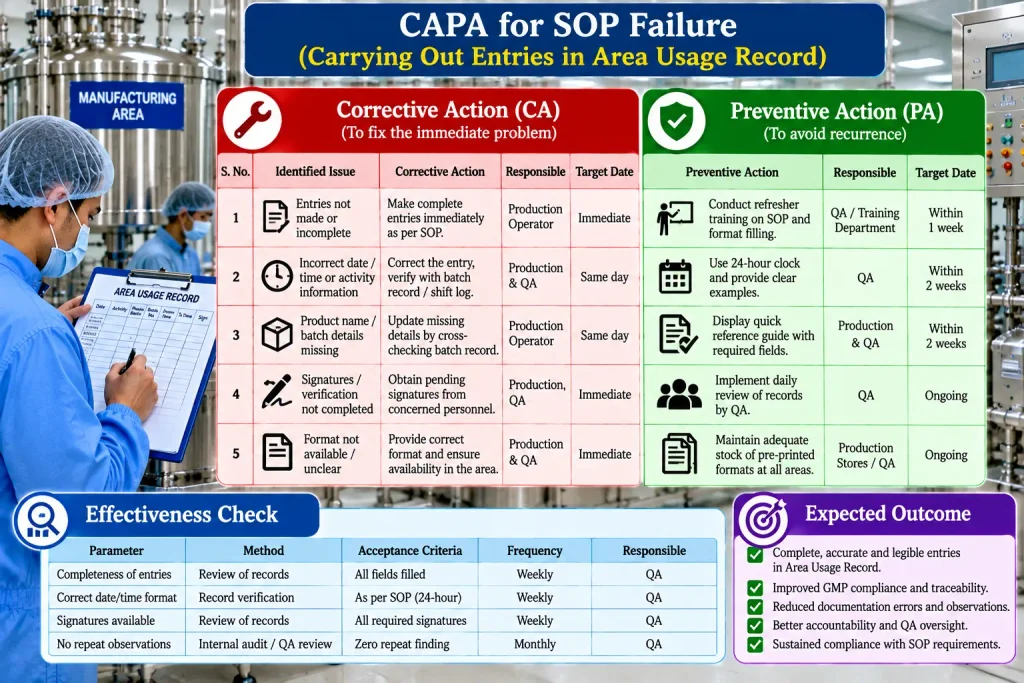
Corrective actions may include completing missing entries where justified, correcting incorrect date or time information, updating missing product or batch details, obtaining pending signatures, and ensuring the correct Area Usage Record format is available in the concerned area. Preventive actions include refresher training, clear instructions for record completion, use of the 24-hour clock system, routine QA review, adequate availability of controlled formats, stronger supervision, and periodic compliance monitoring. Effectiveness should be verified through periodic review of completed records, checking completeness and accuracy of entries, confirming required signatures and QA verification, and monitoring for repeat documentation errors. Effective implementation of CAPA strengthens GMP compliance, traceability, data integrity, accountability, and sustained control of area usage documentation.
Questions & Answers – SOP for Carrying Out Entries in Area Usage Record:
- What is the objective of this SOP?
The objective is to describe the procedure for carrying out entries in the Area Usage Record. - What is the scope of this SOP?
The scope covers carrying out entries in the Area Usage Record. - Who is responsible for execution of this SOP?
The concerned Production Person and Production Chemist are responsible for execution of the SOP. - Who is responsible for effective implementation of this SOP?
The Manager-Production and Head-QA/QC are responsible for effective implementation. - Where should the Area Usage Record be maintained?
It should be maintained in all process-area rooms. - Which format is used for the Area Usage Record?
The SOP refers to Format /PD/GEN/FT/12/01 for filling the Area Usage Record. - What basic area information should be entered?
The name of the area should be entered in the respective space. - How should the date be recorded?
The date should be entered in the respective column in the prescribed date format stated in the SOP. - What type of activity should be recorded?
The activity performed, such as cleaning or manufacturing, should be entered in the respective column. - When should the product name and batch number be entered?
The product name and batch number should be entered when there is a manufacturing activity. - How should operation start and completion times be recorded?
The start and completion times should be entered in the respective columns using the 24-hour clock system. The SOP gives the example that 2 PM should be written as 14:00 hrs. - Who should sign after performing the operation?
The person who carried out the operation should sign in the respective column. - Who checks the activity recorded in the Area Usage Record?
The Production Chemist who checked the activity should sign in the respective column. - Who verifies the Area Usage Record entries?
The entries should be verified by the QA Chemist. - What should be entered in the remarks column?
Relevant remarks, such as the type of cleaning performed, should be mentioned in the remarks column. - What is the reference mentioned in the SOP?
The SOP states the reference as “As per GMP.” - What is Annexure-I of the SOP?
Annexure-I is the Area Usage Record. - What details are provided in the Area Usage Record format?
The annexure includes fields for Date, Activity, Product Name, Batch No., From, To, Performed By, Checked By, Verified By, and Remarks.
Reference Guideline – SOP for Carrying Out Entries in Area Usage Record:
- WHO Good Manufacturing Practices (GMP) for Pharmaceutical Products – requirements for documentation, records, traceability, and controlled manufacturing activities.
- EU Guidelines for Good Manufacturing Practice, EudraLex Volume 4, Chapter 4 – Documentation – requirements for contemporaneous, legible, accurate, and traceable records.
- US FDA 21 CFR Part 211, especially 21 CFR 211.100, 211.180, and 211.188 – written procedures, record retention, and batch production/control documentation.
- PIC/S Guide to GMP, PE 009, Chapter 4 – Documentation – expectations for controlled records, completion of entries, signatures, dates, corrections, and traceability.
- WHO Guidance on Good Data and Record Management Practices – principles supporting complete, consistent, accurate, attributable, and contemporaneous documentation.
- ALCOA+ Data Integrity Principles – Attributable, Legible, Contemporaneous, Original, Accurate, Complete, Consistent, Enduring, and Available.