







1. Introduction:
The SOP for Document Entries provides a standard and uniform method for recording information in pharmaceutical documents. Its main purpose is to ensure that entries are clear, readable, complete, accurate, and easy to understand, thereby reducing the possibility of misinterpretation or documentation errors. The SOP applies to documentation used in batch manufacturing, testing, and other related pharmaceutical activities and is followed by personnel from Quality Assurance, Production, Warehouse, Quality Control, Utilities, Human Resources, and other concerned departments. According to the SOP, entries should be made in clear and legible handwriting, overwriting should be avoided, and supporting printouts or attachments should be properly signed and dated. Entries should be made at the time the activity is performed. All required columns should be completed, and where information is not applicable, “NA” should be written with proper signature and date. Significant cancellations should include a reason or remark, and ditto marks should not be used. The SOP also requires entries to be made by the person responsible for the activity. Pencil, inappropriate pens, scrap paper, and “post-it” notes should not be used for recording raw data. These practices help maintain reliable and consistent pharmaceutical documentation.
Skip to PDF content2. Flow Diagram:
The flow diagram explains the correct way to make document entries in pharmaceutical records. The process starts by reading and understanding the document and identifying all required fields or columns.
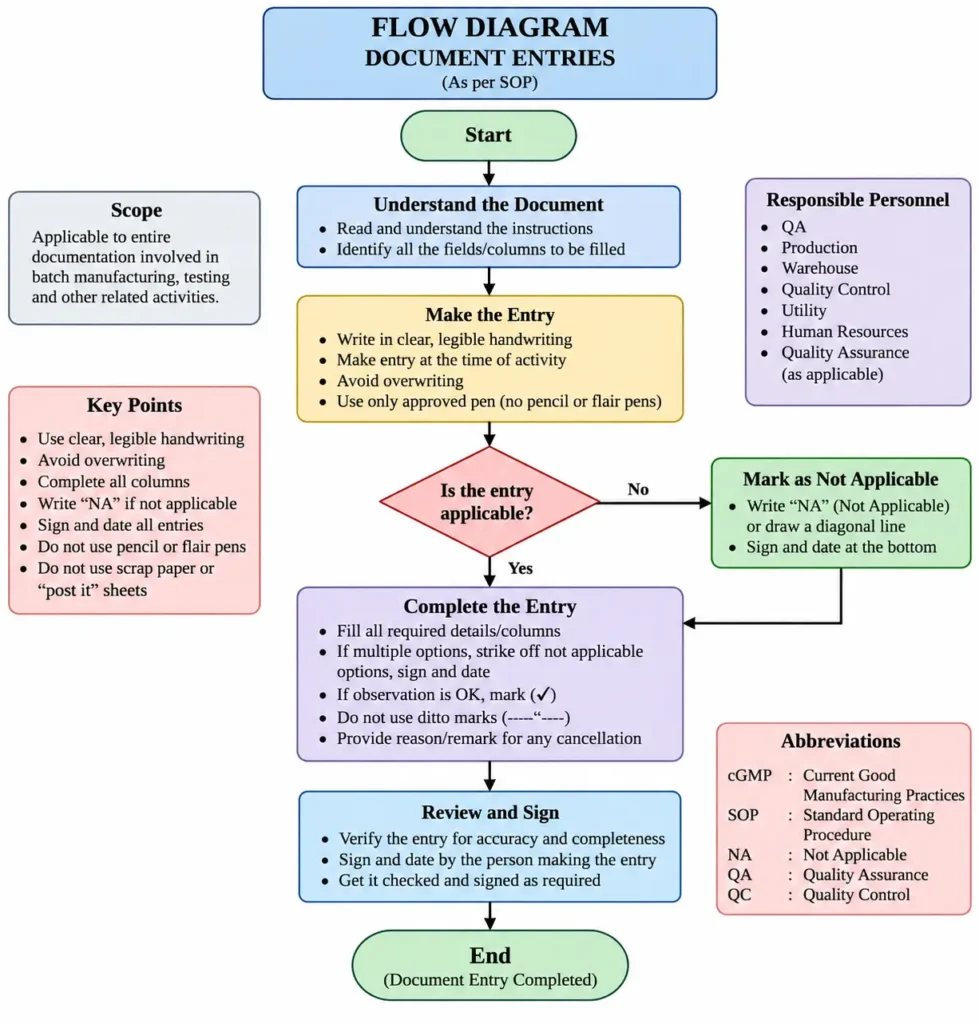
Entries should be made in clear and readable handwriting at the same time the activity is performed. Overwriting should be avoided, and only approved pens should be used. Pencil, flair pens, scrap paper, or post-it notes should not be used for recording information. If any field is not applicable, write “NA” (Not Applicable) or draw a diagonal line as required, then sign and date it. All required columns should be completed. If an observation is acceptable, it can be marked with a tick, and any cancellation should include a proper reason or remark. Ditto marks should not be used. Finally, the entry should be checked for completeness and accuracy, then signed and dated by the responsible person. This system helps keep pharmaceutical records clear, complete, traceable, and easy to understand.
3. Benefits of Following the SOP:
Following the SOP for Document Entries helps employees record information in a clear, correct, and uniform way. When entries are written properly and at the time the activity is performed, the chance of mistakes or missing information becomes lower. The SOP requires clear handwriting, complete entries, proper signing and dating, and correct handling of fields that are not applicable.
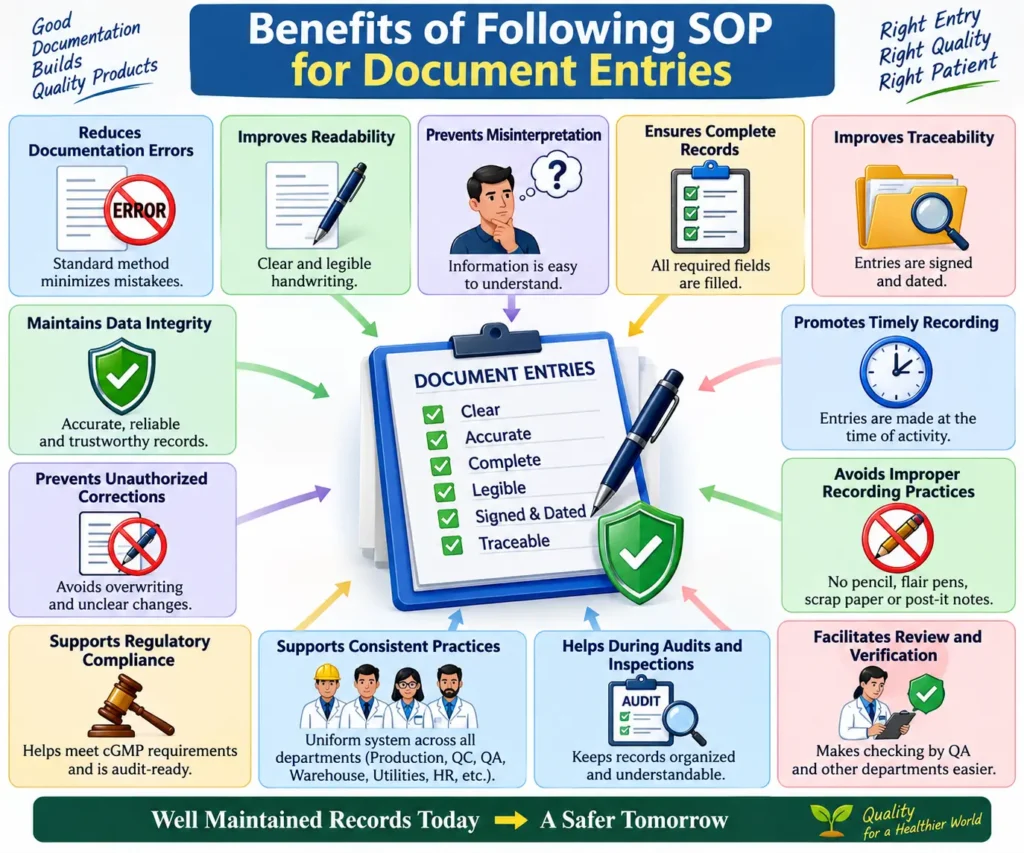
It also improves traceability, because it becomes easier to identify who performed the activity and when it was done. Avoiding overwriting, pencil, scrap paper, and post-it notes helps keep records reliable and controlled. Proper document entries make checking and review easier for QA and other departments. They also help during audits and inspections because the records are easier to understand and follow. In simple words, following this SOP helps maintain clear, complete, trustworthy, and well-organized pharmaceutical records.
4. Brainstorming for SOP Failure:
The brainstorming diagram shows the possible reasons why the SOP for Document Entries may not be followed properly. It helps the team identify different problems before deciding the actual root cause. Common issues include unclear handwriting, overwriting, incomplete columns, missing signatures or dates, delayed entries, use of pencil, scrap paper, incorrect use of abbreviations, missing attachments, no “NA” marking, use of ditto marks, and cancellation without a proper reason.
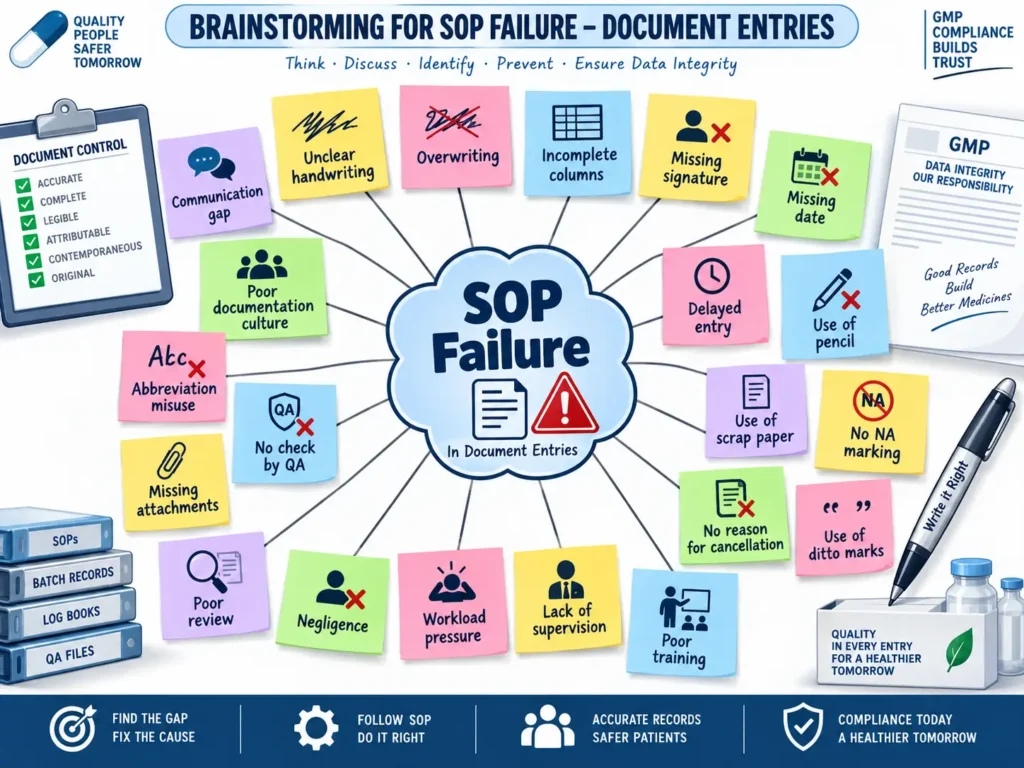
The diagram also highlights people- and system-related causes such as poor training, lack of supervision, high workload, negligence, communication gaps, weak review by QA, and poor documentation culture. Brainstorming allows QA and concerned departments to discuss all possible causes together. After identifying these causes, the organization can perform further investigation, provide training, strengthen review controls, and implement suitable corrective and preventive actions. This helps improve data integrity, traceability, GMP compliance, and reliability of pharmaceutical records.
5. 5-Why Analysis for SOP Failure:
The 5-Why analysis explains why the SOP for Document Entries may not be followed properly in the pharmaceutical core area. It starts with the main problem and then asks “Why?” several times to reach the deeper cause.The first problem may be incomplete, unclear, or delayed entries. This can happen because operators do not follow the documentation steps correctly. A further reason may be insufficient training or poor understanding of the SOP and Good Documentation Practices. Weak supervision and inadequate review during routine operations can allow these mistakes to continue.
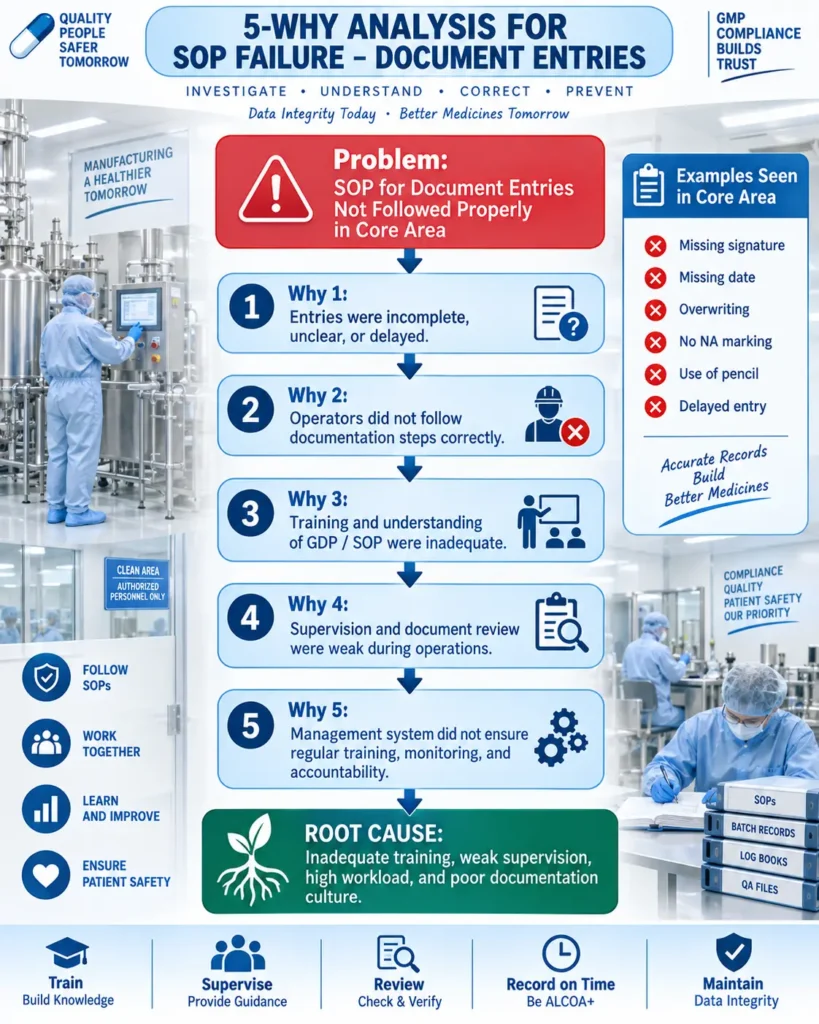
The analysis then points toward broader system issues such as lack of regular training, monitoring, and accountability. Common examples include missing signatures, missing dates, overwriting, failure to mark “NA,” use of pencil, and delayed recording. The purpose of the 5-Why analysis is to identify the root cause rather than only correcting the visible error. Corrective actions can then focus on better training, stronger supervision, timely recording, regular review, and improved documentation practices.
6. Fishbone Analysis for SOP Failure:
The fishbone diagram shows the possible reasons why the SOP for Document Entries may not be followed properly in the manufacturing area. It groups the causes into different categories so that the investigation team can understand where the problem may be coming from. The Manpower section includes inadequate training, negligence, lack of awareness, high workload, and poor supervision. The Method section covers issues such as poor understanding of the SOP, delayed entries, incorrect use of “NA,” wrong corrections, and use of ditto marks. Problems related to Machine/Tools may include non-availability of the correct pen, wrong stationery, logbook format problems, or weak document control.
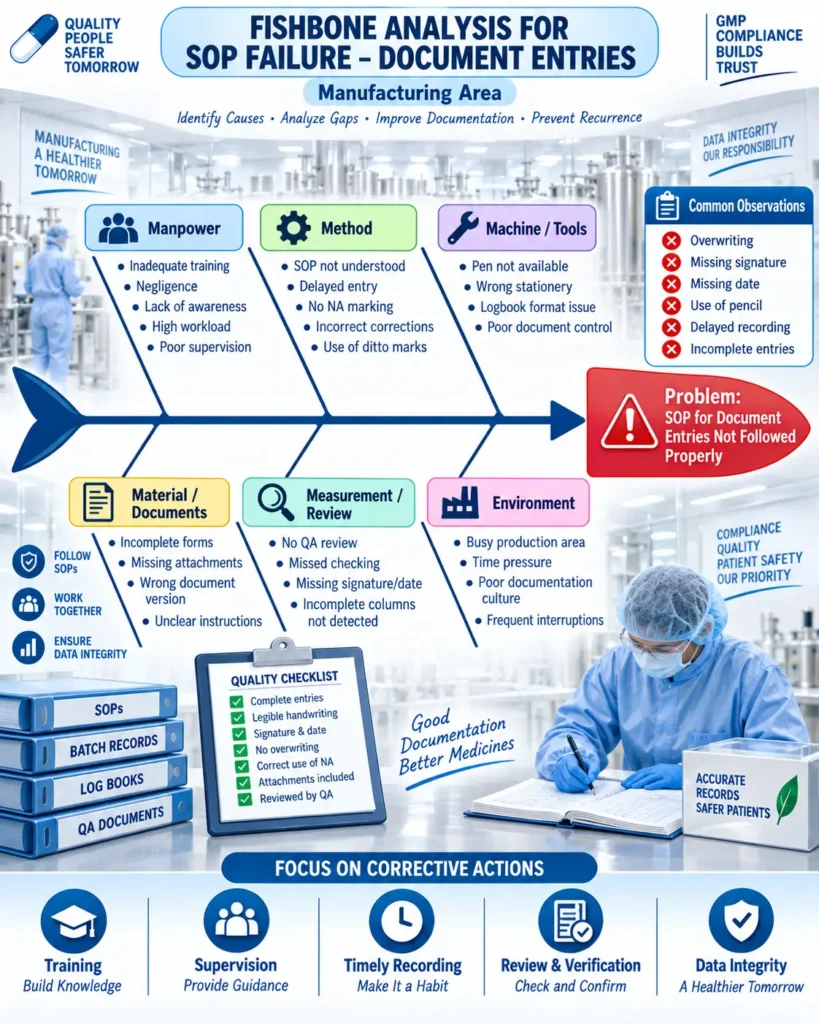
The diagram also highlights Material/Documents, Measurement/Review, and Environment causes, such as incomplete forms, missing attachments, wrong document versions, missed QA review, missing signatures or dates, time pressure, frequent interruptions, and poor documentation culture. This analysis helps the team identify possible causes and plan suitable corrective actions such as training, better supervision, timely recording, review and verification, and stronger data-integrity practices.
7. Fault Tree Analysis for SOP Failure:
The Fault Tree Analysis explains how different problems can lead to failure in following the SOP for Document Entries in the pharmaceutical core area. The main failure may appear as incorrect, incomplete, or delayed document entries. The diagram shows four major causes: SOP not properly understood by personnel, SOP not followed during operation, inadequate review and supervision, and a weak documentation system. These causes may be linked with inadequate training, lack of competency assessment, negligence, workload pressure, poor supervision, missed QA review, incorrect document formats, or use of obsolete SOPs and logbooks.
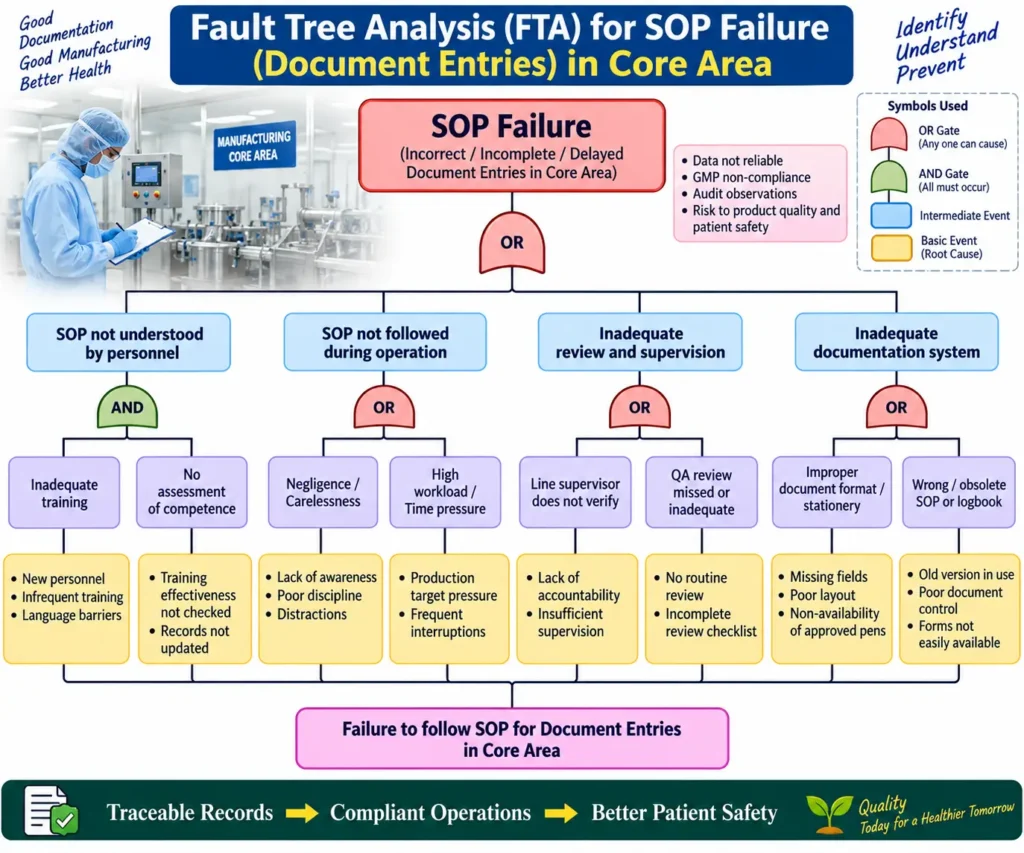
The analysis also shows deeper causes such as new or insufficiently trained personnel, language barriers, lack of awareness, frequent interruptions, poor accountability, missing fields, non-availability of approved pens, and weak document control. Using Fault Tree Analysis helps the investigation team understand how several smaller failures can combine and result in a major SOP failure. It supports better training, supervision, document control, review practices, data integrity, GMP compliance, and patient safety.
8. Impact Assessment:
The impact assessment image explains what can happen when the SOP for Document Entries is not followed properly in the pharmaceutical core area. Poor or incomplete entries can affect data integrity, product quality, traceability, audit readiness, and overall GMP compliance. Incorrect, delayed, or missing information may make it difficult to understand what actually happened during manufacturing or testing. Missing signatures, dates, or important observations can also make batch review and investigation more difficult.
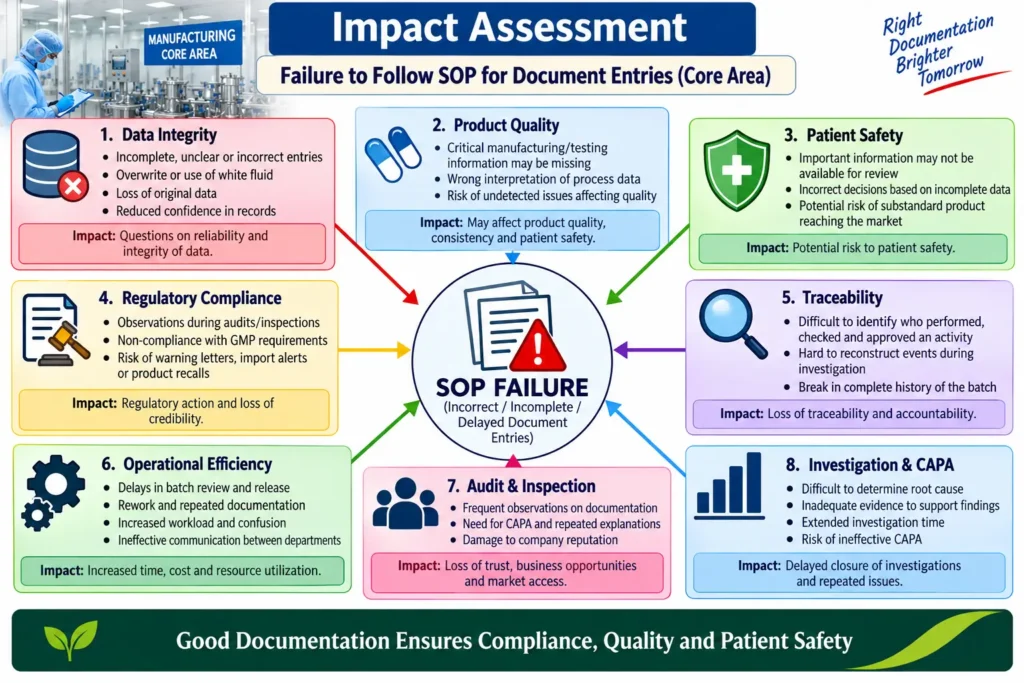
Poor documentation may lead to audit observations, additional investigations, CAPA, rework, delays in batch release, and increased workload. In serious cases, incomplete records may also affect decisions related to product quality and patient safety. In simple words, proper document entries help maintain accurate records, easy traceability, smooth operations, effective investigations, and better compliance. Good documentation supports both product quality and patient safety.
Questions & Answers:
- What is the objective of the SOP for Document Entries?
The objective is to provide guidelines for making document entries in a uniform manner and to minimize the risk of misinterpretation. - Where is this SOP applicable?
It is applicable to documentation related to batch manufacturing, testing, and other associated activities. - Who is responsible for executing this SOP?
QA personnel are responsible for execution of the SOP, while Production, Warehouse, QC, Utility, HR, and QA personnel are responsible for following it. - How should document entries be written?
All entries should be made in clear and legible handwriting. - Is overwriting allowed in documents?
No. Overwriting should be avoided. - When should an entry be made?
The entry should be made at the time the activity is performed. - What should be done when a column is not applicable?
Write “NA” (Not Applicable) or draw a diagonal line as described in the SOP, and provide signature and date at the bottom. - How should an acceptable observation be recorded?
An acceptable observation may be indicated with a tick mark, and the meaning of any legend used should be specified at the bottom of the document. - What should be done for a significant cancellation?
A proper reason or remark should be entered in the record. - Can ditto marks be used for repeated information?
No. Repeated observations, signatures, or dates should be rewritten. Ditto marks should not be used. - What signatures are required for an activity?
The SOP requires signatures for the person who performed the operation and the person who checked it. - Can abbreviations be used in documents?
Short forms and abbreviations should be avoided as far as possible. If unavoidable, the full form should be provided at the end of the document. - Who should make the document entry?
The person responsible for the operation should make the document entry. - Can pencil or flair pens be used for document entries?
No. The SOP specifically states that pencil or flair pens should not be used. - Can scrap paper or post-it notes be used for recording raw data?
No. Raw data should not be recorded on scrap paper or post-it sheets. - What should be written for a non-working Sunday in logbooks?
The entry should be made as “weekly off” instead of “Sunday.” - Why is proper document entry important?
Proper entries help maintain a uniform documentation system, reduce misinterpretation, and make records clearer and easier to review.
Reference Guidelines:
- WHO – Guideline on Data Integrity, WHO TRS No. 1033, Annex 4. It emphasizes that records should follow ALCOA+ principles: attributable, legible, contemporaneous, original, accurate, complete, consistent, enduring, and available. (World Health Organization)
WHO Data Integrity Guideline - EU GMP – EudraLex Volume 4, Chapter 4: Documentation. This chapter provides GMP requirements for preparation, control, completion, retention, and management of pharmaceutical documentation and records. (Public Health)
EU GMP Volume 4 - US FDA – Data Integrity and Compliance With Drug CGMP: Questions and Answers. This guidance explains FDA expectations for reliable, complete, consistent, and accurate CGMP records and data. (U.S. Food and Drug Administration)
FDA Data Integrity Guidance - WHO – Good Data and Record Management Practices, TRS No. 996, Annex 5. It covers good documentation practices for paper and electronic records, including permanent entries, contemporaneous recording, corrections, traceability, and retention of original records. (Iris)
- WHO Quality Assurance of Pharmaceuticals, 10th Edition, 2024. This compendium brings together current WHO pharmaceutical quality-assurance and GMP guidance relevant to documentation and data management. (who.int)