







1. Introduction to Batch Packing Record (BPR) of Cetirizine Dihydrochloride, Phenylephrine Hydrochloride & Paracetamol Tablets:
The Batch Packing Record (BPR) of Cetirizine Dihydrochloride, Phenylephrine Hydrochloride & Paracetamol Tablets is a controlled GMP document used to record and verify all activities performed during the packing of the finished pharmaceutical product. Each uncoated tablet contains Cetirizine Dihydrochloride IP 5 mg, Phenylephrine Hydrochloride IP 10 mg, and Paracetamol IP 325 mg. The BPR provides documented evidence of packing material dispensing, equipment identification, line clearance, machine setup, overprinting verification, and in-process quality checks. It also records blister or strip packing operations, leak testing, carton and shipper inspection, rejection analysis, packing material reconciliation, yield calculations, and final batch verification. These records help ensure that the correct product, batch number, manufacturing date, expiry date, and other required details are printed accurately on the packaging materials. Proper completion and review of the BPR support traceability, prevention of product mix-ups, identification of packing discrepancies, and compliance with applicable Good Manufacturing Practices (GMP). Production personnel are responsible for recording packing activities accurately, while Quality Assurance (QA) reviews the completed records to ensure that the documented operations meet approved procedures and established quality requirements before batch release.
Skip to PDF content2. Flow Diagram – Batch Packing Process for Cetirizine Dihydrochloride, Phenylephrine Hydrochloride & Paracetamol Tablets:
The batch packing process ensures that Cetirizine Dihydrochloride, Phenylephrine Hydrochloride & Paracetamol Tablets are packed accurately and in accordance with approved packing procedures and Good Manufacturing Practices (GMP). The process begins with packing line clearance and dispensing of approved packing materials, followed by equipment setup and verification of overprinting details, including batch number, manufacturing date, and expiry date.
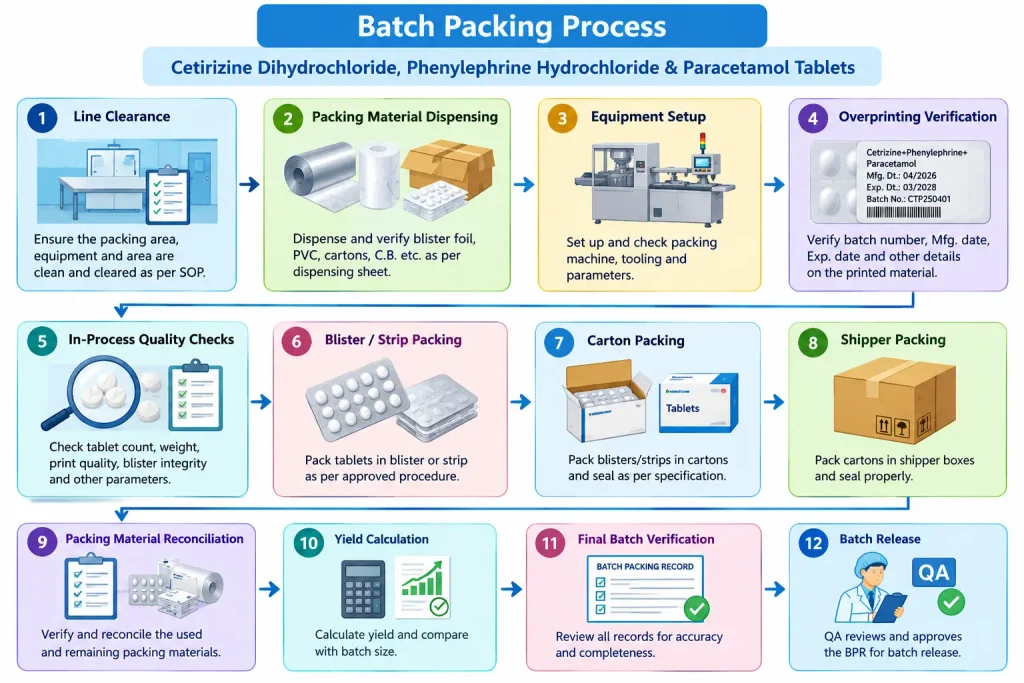
During blister or strip packing, in-process checks are performed to verify tablet count, packaging integrity, sealing quality, and printed information. The packed blisters or strips are then placed into cartons and shipper boxes as per the approved packing specifications. Packing material reconciliation and rejection analysis are performed to account for used, rejected, and remaining materials. Finally, yield calculations and batch packing records are reviewed for accuracy and completeness. Quality Assurance (QA) verifies the documented activities and approves the batch for release in accordance with established procedures and applicable GMP requirements.
3. Critical Process Parameters (CPP) and Critical Quality Attributes (CQA) for Cetirizine Dihydrochloride, Phenylephrine Hydrochloride & Paracetamol Tablets:
Critical Process Parameters (CPPs) and Critical Quality Attributes (CQAs) play an important role in maintaining the quality and consistency of Cetirizine Dihydrochloride, Phenylephrine Hydrochloride & Paracetamol Tablets during the batch packing process. CPPs are the process parameters and operational controls that require appropriate monitoring during packing. These include packing line clearance, dispensing and verification of packing materials, machine setup, operating speed, sealing temperature and pressure, overprinting accuracy, in-process checks, carton packing, shipper packing, and packing material reconciliation. These parameters should be controlled according to approved procedures and established specifications.
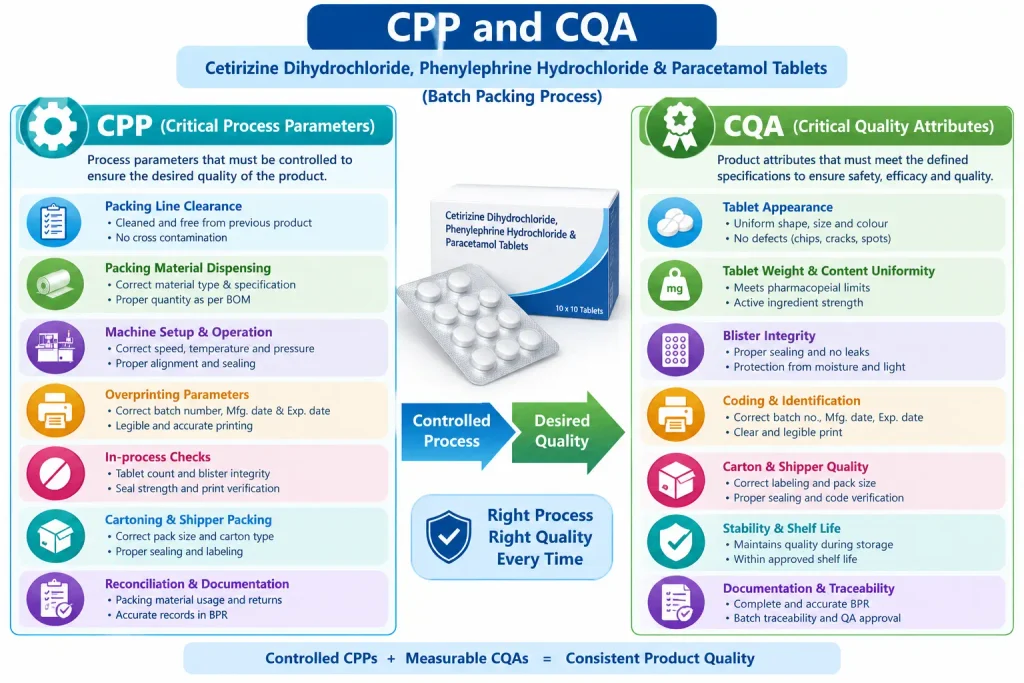
CQAs are the quality characteristics that must meet predefined acceptance criteria to ensure the packed product meets its intended quality requirements. These include tablet appearance, weight and content uniformity as applicable to the product specifications, blister integrity, sealing quality, correct batch identification, legible manufacturing and expiry dates, carton and shipper quality, and packaging integrity. Proper monitoring of CPPs and verification of CQAs help prevent packing errors, product mix-ups, packaging defects, and documentation discrepancies. Accurate recording in the Batch Packing Record (BPR), along with appropriate Quality Assurance (QA) review, supports product traceability and consistent quality throughout the packing operation.