







1. Introduction – Batch Packing Record (BPR) of Paracetamol, Bromhexine HCl, Chlorpheniramine Maleate, Phenylephrine Hydrochloride & Guaiphenesin Tablets:
The Batch Packing Record (BPR) for Paracetamol, Bromhexine Hydrochloride, Chlorpheniramine Maleate, Phenylephrine Hydrochloride & Guaiphenesin Tablets is an essential pharmaceutical documentation system designed to ensure the controlled, consistent, and traceable packaging of finished tablets in accordance with Good Manufacturing Practices (GMP). This combination formulation contains five active pharmaceutical ingredients, each providing a specific therapeutic function. Paracetamol acts as an analgesic and antipyretic, Bromhexine Hydrochloride functions as a mucolytic agent, Chlorpheniramine Maleate provides antihistaminic activity, Phenylephrine Hydrochloride acts as a nasal decongestant, and Guaiphenesin serves as an expectorant.
| Active ingredient | Strength |
|---|---|
| Paracetamol IP | 325 mg |
| Bromhexine IP | 8 mg |
| Chlorpheniramine Maleate IP | 2 mg |
| Phenylephrine HCl IP | 10 mg |
| Guaiphenesin IP | 100 mg |
The formulation also specifies Tartrazine Lake as a colouring agent, with instructions to protect the tablets from heat and light. The primary objective of the Batch Packing Record is to establish a systematic approach for documenting all packaging activities, beginning with the receipt of inspected tablets from the manufacturing department and continuing through packaging material dispensing, line clearance, overprinting verification, machine setup, blister or strip packing, secondary packaging, and finished product transfer. The record includes essential in-process quality checks such as sealing roller temperature, machine speed, leak testing, environmental conditions, carton filling quantities, shipper verification, and printed packaging information. Additionally, the BPR provides structured formats for recording packaging material reconciliation, rejection analysis, destruction of rejected materials, yield calculations, and final verification by authorized Production and Quality Assurance personnel. Proper implementation of this BPR supports product identification, prevention of packaging mix-ups, batch traceability, data integrity, regulatory compliance, and consistent packaging quality. The document serves as an important reference during batch review, quality investigations, internal audits, regulatory inspections, and finished product release activities.The Batch Packing Record provides a documented control framework to ensure that Paracetamol, Bromhexine HCl, Chlorpheniramine Maleate, Phenylephrine Hydrochloride & Guaiphenesin Tablets are packed, inspected, reconciled, and verified according to approved procedures and applicable GMP requirements.
Skip to PDF content1. Flow Diagram – Batch Packing Record (BPR) of Paracetamol, Bromhexine HCl, Chlorpheniramine Maleate, Phenylephrine Hydrochloride & Guaiphenesin Tablets:
The flow diagram illustrates the systematic sequence of packaging operations for Paracetamol, Bromhexine HCl, Chlorpheniramine Maleate, Phenylephrine Hydrochloride & Guaiphenesin Tablets in accordance with approved Batch Packing Record (BPR) procedures and Good Manufacturing Practices (GMP). The process begins with the receipt of inspected tablets from the manufacturing department, followed by verification of batch details, quantities, and packaging material dispensing records. Before commencing packing operations, line clearance is performed to ensure equipment cleanliness, removal of previous product materials, and prevention of cross-contamination or mix-ups. Machine setup includes verification of sealing temperature, operating speed, environmental conditions, and initial packaging quality. Primary packaging is performed using blister or strip packing machines, with periodic leak testing and in-process quality checks.
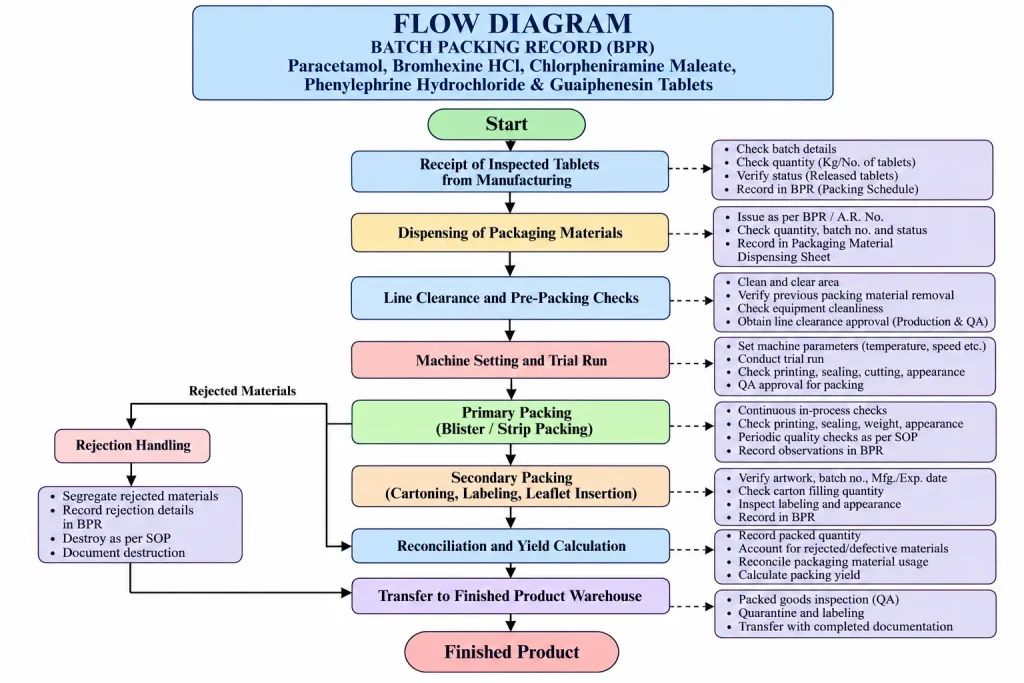
Secondary packaging involves carton filling, labeling, and shipper packing, ensuring correct batch numbers, manufacturing dates, expiry dates, and packaging quantities. Rejected or defective materials are identified, segregated, documented, and handled according to approved procedures. After completion of packing, packaging materials are reconciled, rejection quantities are evaluated, and the final packing yield is calculated. Finally, completed packed goods are transferred to the finished product store following the required quality verification, release authorization, and documentation. The flow diagram emphasizes product traceability, packaging integrity, reconciliation accuracy, GMP compliance, and quality assurance throughout the batch packing process.
2. Critical Process Parameters (CPP) and Critical Quality Attributes (CQA) of Paracetamol, Bromhexine HCl, Chlorpheniramine Maleate, Phenylephrine Hydrochloride & Guaiphenesin Tablets (BPR):
The Critical Process Parameters (CPP) and Critical Quality Attributes (CQA) diagram illustrates the essential packaging process controls and quality requirements for Paracetamol, Bromhexine HCl, Chlorpheniramine Maleate, Phenylephrine Hydrochloride & Guaiphenesin Tablets in accordance with Good Manufacturing Practices (GMP). Critical Process Parameters (CPP) include packaging machine settings, sealing roller temperature, machine speed, packaging material specifications, environmental temperature, relative humidity, and sealing conditions. These parameters require appropriate monitoring and control to maintain consistent packaging performance and prevent defects. The Batch Packing Record also specifies in-process checks such as blister or strip leak testing, overprinting verification, carton filling quantity, shipper packing accuracy, and packaging material reconciliation. Leak testing is recorded initially, during foil changes, and every two hours.
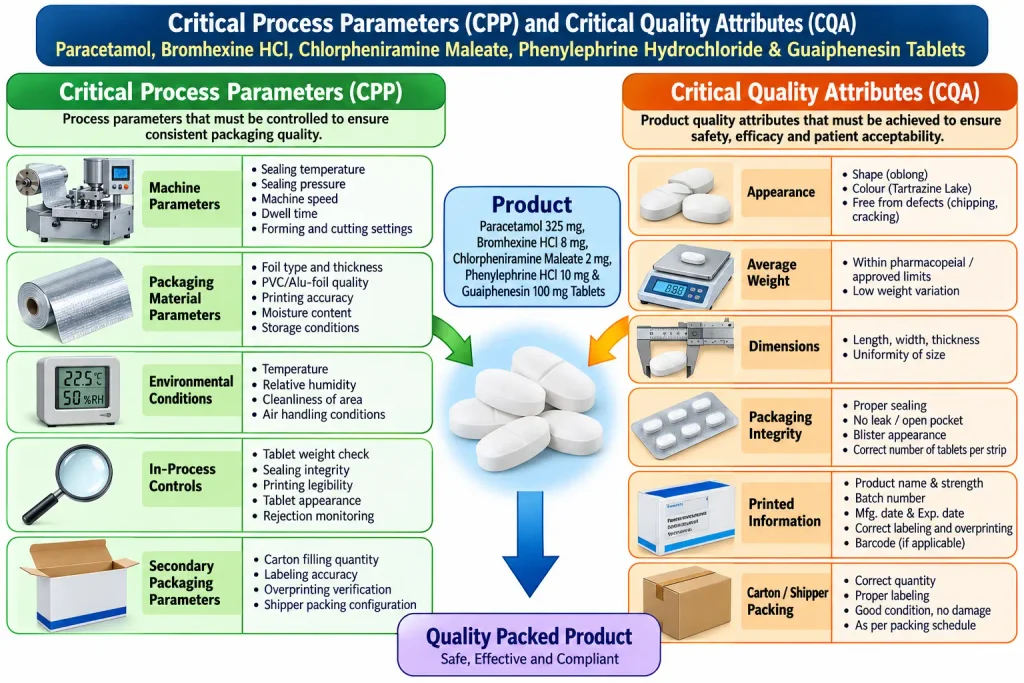
Critical Quality Attributes (CQA) include tablet appearance, correct product identification, packaging integrity, accurate labeling, correct tablet count, and protection against contamination, moisture, and physical damage. Tablet weight, dimensions, and other finished-product specifications are additional quality attributes governed by the approved product specifications. The diagram highlights the relationship between controlled packaging parameters and the quality of the finished packed product. Effective monitoring, documentation, and verification help minimize packaging defects, labeling errors, and product mix-ups.
Conclusion: Proper control of CPPs and verification of CQAs support consistent product quality, packaging integrity, patient safety, traceability, and regulatory compliance.
Note: The diagram provides an illustrative overview. The parameters formally classified as critical, their acceptance limits, and monitoring frequencies must be established through approved specifications, process validation, and quality risk assessment.