






1. Introduction – Batch Manufacturing Record (BMR) for Cetirizine Hydrochloride Tablets IP 10 mg:
The Batch Manufacturing Record (BMR) for Cetirizine Hydrochloride Tablets IP 10 mg is a comprehensive Good Manufacturing Practices (GMP) document designed to ensure the systematic manufacturing, monitoring, documentation, and quality control of film-coated tablets. Each tablet contains Cetirizine Hydrochloride IP 10 mg, an antihistamine used for the relief of allergic symptoms such as sneezing, runny nose, itching, and urticaria. The BMR provides detailed instructions for raw material dispensing, sifting, binder preparation, wet granulation, fluid bed drying, milling, blending, lubrication, tablet compression, and film coating. The manufacturing process involves equipment such as a Rapid Mixer Granulator (RMG), Fluid Bed Dryer (FBD), Multimill, Octagonal Blender, and tablet compression machine. The document specifies a theoretical batch size of 600 kg, equivalent to 50,00,000 tablets, with a target tablet weight of 120 mg before film coating. Critical manufacturing parameters, including mixing time, drying temperature, loss on drying (LOD), blending speed, tablet weight variation, hardness, thickness, friability, and disintegration time, are monitored and documented throughout production. The BMR also incorporates line clearance verification, in-process quality control checks, equipment identification, material reconciliation, yield calculations, sampling records, and Quality Assurance verification. Proper implementation of this BMR supports batch-to-batch consistency, product quality, traceability, regulatory compliance, and documented manufacturing control in accordance with applicable GMP requirements and approved product specifications.
Skip to PDF content2. Flow Diagram – Batch Manufacturing Record (BMR)Manufacturing Process of Cetirizine Hydrochloride Tablets IP 10 mg:
The Batch Manufacturing Record (BMR) for Cetirizine Hydrochloride Tablets IP 10 mg describes the systematic manufacturing process to ensure product quality, consistency, and GMP compliance. The flow diagram illustrates the major manufacturing stages, including raw material dispensing, sifting, binder preparation, wet granulation, drying, milling, blending, lubrication, tablet compression, film coating, and blister packing.
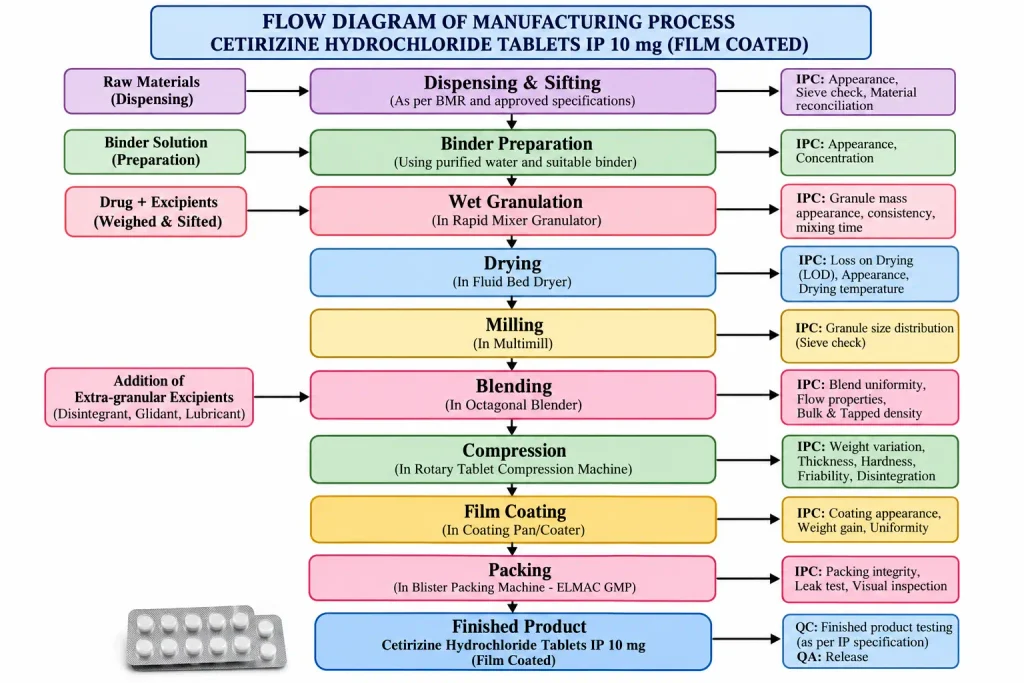
Each manufacturing stage involves defined process parameters and in-process quality control checks. Critical parameters include granule moisture content, blending time, tablet weight variation, hardness, thickness, friability, disintegration time, and coating uniformity. The BMR also incorporates equipment identification, line clearance, material reconciliation, yield calculations, and production documentation. Quality Control testing and Quality Assurance review support the final batch release decision. This structured manufacturing process promotes batch-to-batch consistency, traceability, contamination prevention, and compliance with approved manufacturing procedures and pharmaceutical quality standards.
3. Critical Process Parameters (CPP) and Critical Quality Attributes (CQA) of Cetirizine Hydrochloride Tablets IP 10 mg:
The Batch Manufacturing Record (BMR) for Cetirizine Hydrochloride Tablets IP 10 mg establishes manufacturing controls to maintain product quality, consistency, and compliance with Good Manufacturing Practices (GMP). The CPP and CQA diagram illustrates essential manufacturing stages, including dispensing, sifting, binder preparation, wet granulation, fluid bed drying, milling, blending, lubrication, compression, film coating, and blister packing.
Critical Process Parameters (CPPs) include granulation time, mixing speed, drying temperature, blending duration, lubrication time, compression settings, and coating parameters. These parameters must be monitored and controlled according to approved manufacturing instructions.
Critical Quality Attributes (CQAs) include granule moisture content, blend uniformity, tablet weight variation, hardness, thickness, friability, disintegration, coating appearance, and packaging integrity.
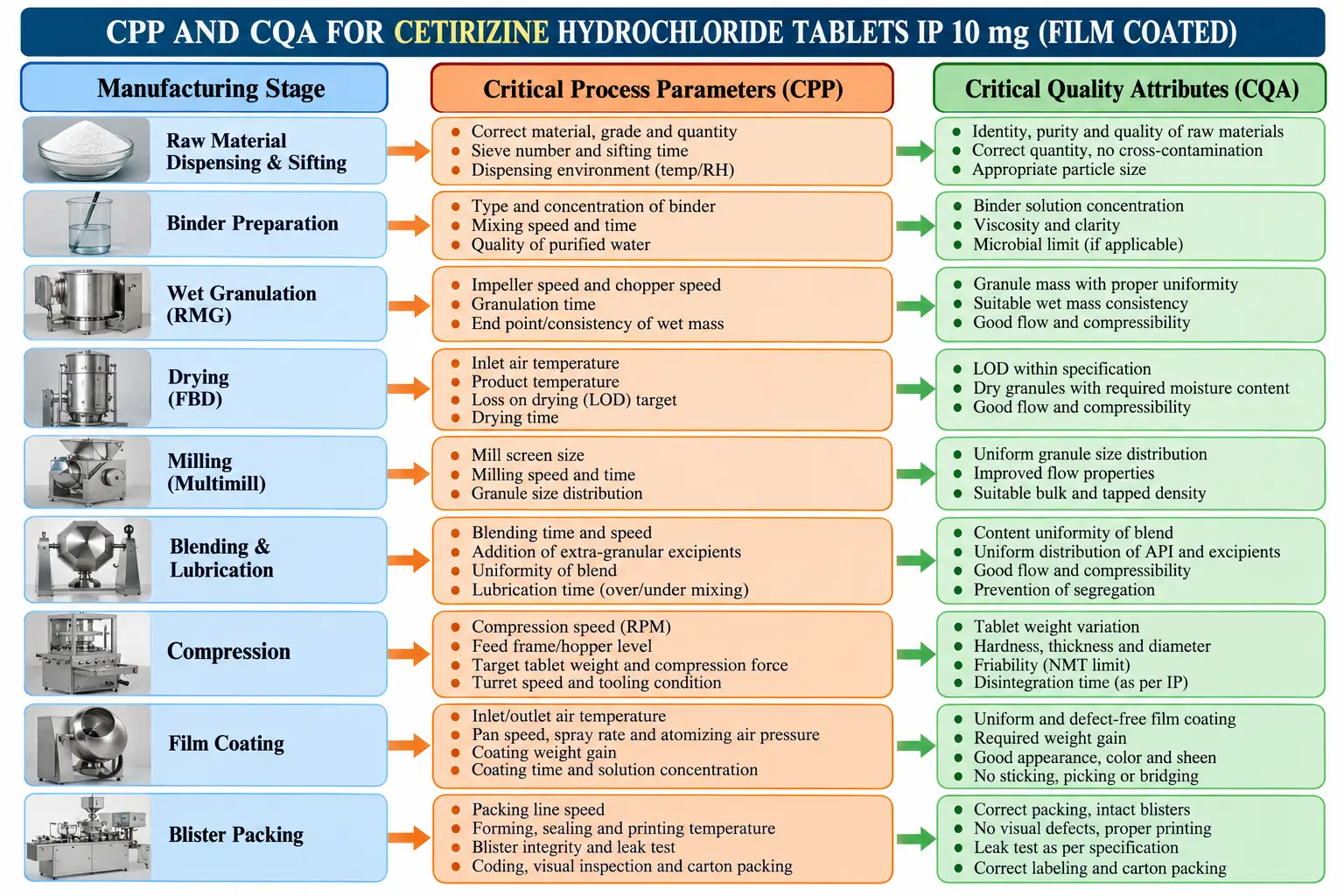
The BMR specifies a granule LOD range of 1.5–3.0%, a target core tablet weight of 120 mg, friability not more than 1%, and disintegration time not more than 15 minutes. Effective monitoring, documentation, and verification of these parameters support consistent batch quality, process traceability, deviation detection, and reliable manufacturing performance.
Note: The diagram presents illustrative CPP and CQA classifications. Final criticality must be established through approved process validation and quality risk assessment.