







CPM Assay / Estimation
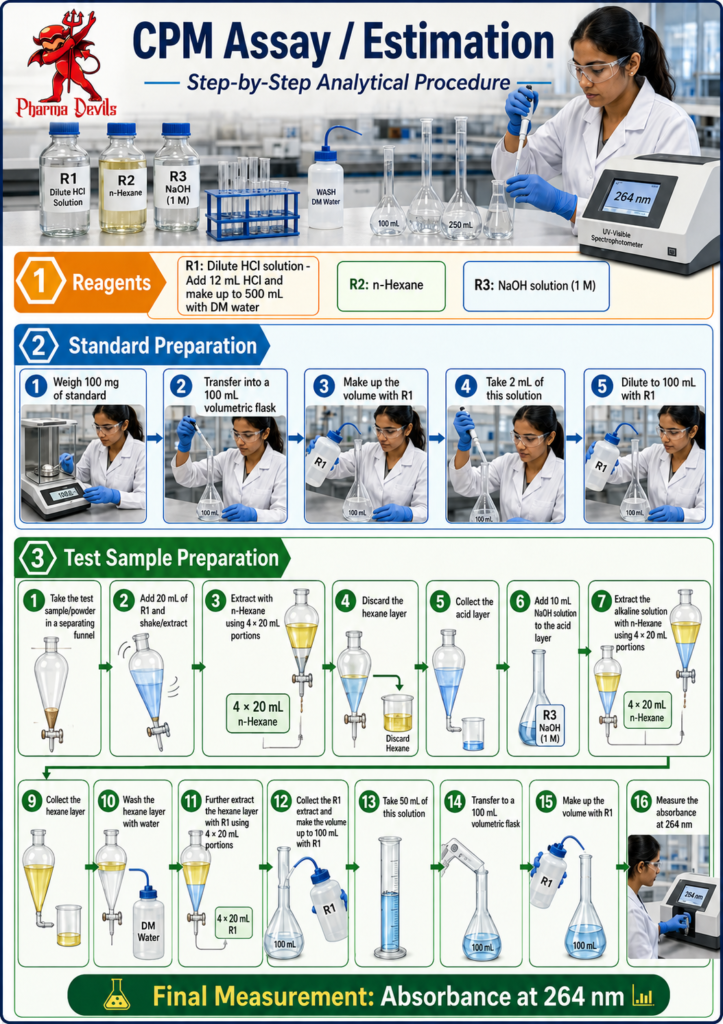
Reagents
R1: Dilute HCl solution
Add 12 mL HCl and make up to 500 mL with DM water.
R2: n-Hexane
R3: NaOH solution (1M)
Concentration is not clearly mentioned in the image.
Standard Preparation
- Weigh 100 mg of standard.
- Transfer into a 100 mL volumetric flask.
- Make up the volume with R1.
- Take 2 mL of this solution.
- Dilute to 100 mL with R1.
Test Sample Preparation
- Take the test sample/powder in a separating funnel.
- Add 20 mL of R1 and shake/extract.
- Extract with n-Hexane, using 4 × 20 mL portions.
- Discard the hexane layer.
- Collect the acid layer.
- Add 10 mL NaOH solution to the acid layer.
- Extract the alkaline solution with n-Hexane, using 4 × 20 mL portions.
- Discard the acid/aqueous layer.
- Collect the hexane layer.
- Wash the hexane layer with water.
- Further extract the hexane layer with R1, using 4 × 20 mL portions.
- Collect the R1 extract and make the volume up to 100 mL with R1.
- Take 50 mL of this solution.
- Transfer to a 100 mL volumetric flask.
- Make up the volume with R1.
- Measure the absorbance at 264 nm.
Chlorpheniramine Maleate assay by UV method is a simple analytical technique used to determine the drug content in pharmaceutical samples. The method is based on measuring the absorbance of Chlorpheniramine Maleate solution at a specific wavelength, commonly around 264 nm, using a UV-Visible spectrophotometer.
In this method, a standard solution is prepared by accurately weighing Chlorpheniramine Maleate standard and dissolving it in dilute hydrochloric acid or another suitable solvent. The solution is further diluted to obtain the required concentration. The sample is prepared by extracting the drug from the dosage form using suitable reagents such as dilute HCl, n-hexane, and sodium hydroxide, depending on the method requirement.
After extraction and dilution, the absorbance of both standard and sample solutions is measured at 264 nm against a reagent blank. The concentration of Chlorpheniramine Maleate in the sample is calculated by comparing the absorbance of the sample with the absorbance of the standard.
This UV method is useful for routine quality control analysis because it is rapid, cost-effective, accurate, and requires simple laboratory equipment. It helps confirm whether the product contains the required amount of active ingredient.