






Brief Description
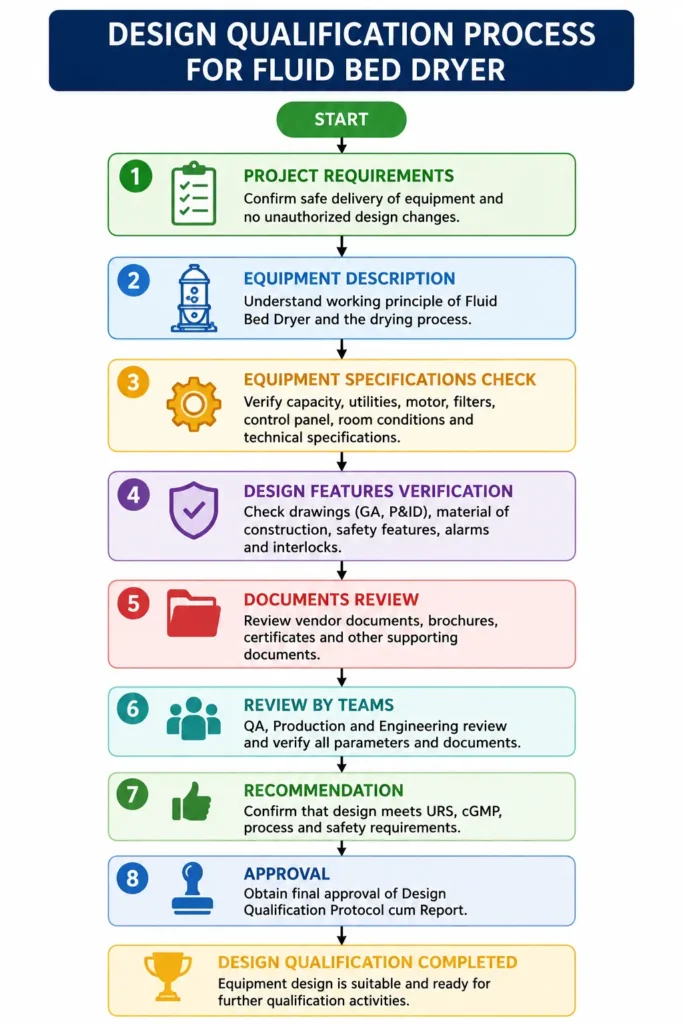
This Design Qualification for Fluid Bed Dryer is prepared for a 300 kg Fluid Bed Dryer (FBD) used for drying wet granules or powder in oral solid dosage manufacturing. The main purpose is to confirm that the equipment design meets the User Requirement Specification (URS), cGMP, process requirements, and safety requirements before routine use. The document checks important details such as equipment capacity, electrical supply, steam, compressed air, room conditions, motor, filters, control panel, material of construction, and safety features. The FBD works by passing clean and heated air through the wet material, which keeps the material in a fluidized condition and helps in fast and uniform drying. The protocol also verifies technical specifications, engineering drawings, vendor details, safety interlocks, and supporting documents. Quality Assurance, Production, and Engineering jointly review the design to ensure the equipment is suitable, safe, reliable, and ready for further qualification activities.
Impact Assessment
The Design Qualification of the Fluid Bed Dryer has a positive impact because it confirms that the equipment is suitable before it is installed and used. The assessment checks whether the dryer meets the User Requirement Specification, cGMP needs, process requirements, and safety expectations. It also verifies important items such as capacity, electrical supply, steam, compressed air, filters, control panel, materials of construction, alarms, and safety interlocks. This helps reduce the chance of design errors, unsafe operation, product contamination, and future breakdowns. The review of drawings, technical details, and vendor documents also makes sure that the equipment has been properly designed and supported. Quality Assurance, Production, and Engineering jointly review the design, which improves control and accountability. Overall, this qualification gives confidence that the Fluid Bed Dryer is safe, reliable, suitable for drying wet material, and ready to move to the next qualification stages without unnecessary risk during routine operation.
Critical Process Parameters (CPP) & Critical Quality Attributes (CQA)
Based on the Design Qualification document for the Fluid Bed Dryer, the following parameters and quality attributes are important for achieving proper and uniform drying. The document describes controlled heated air, fluidization, temperature distribution, utilities, and safety interlocks.
Critical Process Parameters (CPP)
| CPP | Why It Is Critical |
|---|---|
| Inlet Air Temperature | Controls the heat supplied for drying. High or low temperature can affect drying. |
| Outlet Air Temperature | Helps indicate the progress and condition of drying. |
| Bed Temperature | Shows the actual temperature of material during drying. |
| Inlet Air Flow | Proper airflow is required to fluidize and dry the wet granules uniformly. |
| Drying / Process Time | Adequate time is required to achieve the required final drying level. |
| Steam Pressure / Supply | Controls heating of incoming air. The document specifies steam at 2–4 kg/cm². |
| Compressed Air Pressure | Required for pneumatic operation, filter shaking and equipment functions. |
| Negative Pressure / Airflow | Supports proper movement of air through the FBD and controlled drying. |
| Filter Bag Shaking | Prevents blockage and maintains proper airflow during drying. |
The document specifically includes interlocks for high/low inlet temperature, outlet temperature and bed temperature, showing that these are important controlled variables.
Critical Quality Attributes (CQA)
| CQA | Expected Requirement |
|---|---|
| Final Drying Level | Wet granules or powder should reach the required degree of dryness. |
| Moisture Content / LOD | Should meet the approved product specification.* |
| Uniform Drying | All material should be dried evenly without wet or over-dried portions. |
| Product Temperature Uniformity | Uniform temperature distribution should be achieved during drying. |
| Product Cleanliness | Product should not be contaminated during the drying process. |
| Physical Condition of Granules | Granules should remain suitable for further processing. |
The protocol directly states that the FBD must dry wet granulated mass or powder to the final required degree for oral solid dosage manufacturing.
*The document does not specify a numerical LOD/moisture limit; this should be defined in the individual product specification or manufacturing process.
FMEA – Design Qualification of Fluid Bed Dryer
The following FMEA is based on the risks and safety controls described in the Design Qualification document for the Fluid Bed Dryer. The S, O and D ratings below are proposed assessment scores; the protocol itself does not provide numerical FMEA ratings. The document specifically covers temperature controls, air pressure, earthing, overload protection, filter-bag conditions and container locking.
| S.No. | Failure Mode / Risk | Possible Effect | Possible Cause | Existing / Recommended Control | S | O | D | RPN |
|---|---|---|---|---|---|---|---|---|
| 1 | Inlet temperature too high | Product may become over-dried or damaged | Temperature control failure | High-temperature interlock and temperature controller | 4 | 2 | 2 | 16 |
| 2 | Inlet temperature too low | Slow or incomplete drying | Low steam supply or controller issue | Low-temperature alarm/interlock | 3 | 3 | 2 | 18 |
| 3 | Improper airflow | Uneven drying or poor fluidization | Damper or blower problem | Check inlet airflow and blower operation | 4 | 2 | 3 | 24 |
| 4 | Low compressed-air pressure | Pneumatic functions may not operate properly | Air leakage or low supply pressure | Low air-pressure switch; equipment stops below set pressure | 4 | 2 | 2 | 16 |
| 5 | Filter bag leakage | Product loss or dust escape | Damaged bag or poor fitting | Bag pressure check and inspection of filter fitting | 4 | 2 | 3 | 24 |
| 6 | Container not properly locked | Unsafe operation or product leakage | Incorrect container position | Container lock limit switch | 5 | 2 | 2 | 20 |
| 7 | Earthing failure | Electrical/safety hazard | Poor contact with earthing probes | Earth safety relay prevents machine start | 5 | 2 | 2 | 20 |
| 8 | Motor overload | Equipment stoppage or motor damage | Excess load or mechanical problem | Overload relay trips the motor | 4 | 2 | 2 | 16 |
| 9 | Wrong material of construction | Contamination or cleaning difficulty | Incorrect component selection | Verify product-contact parts as AISI 316L | 5 | 2 | 2 | 20 |
| 10 | Unauthorized design change | Equipment may not meet URS/cGMP | Modification without approval | Change control procedure and documented review | 5 | 2 | 3 | 30 |
Scoring: Severity (S), Occurrence (O), Detection (D): 1 = Low, 5 = High.
RPN = Severity × Occurrence × Detection.
The protocol requires product-contact parts such as the product container, retention chamber, duct mesh screen, perforated plate and sampling device to be AISI 316L. It also requires any agreed design change to be managed through documented change control. https://chatgpt.com/backend-api/sentinel/frame.html?sv=20260810913b
Questions & Answers – Design Qualification of Fluid Bed Dryer
1. What is the purpose of Design Qualification of the Fluid Bed Dryer?
The purpose is to confirm that the equipment design meets the URS, cGMP, product/process requirements, and safety requirements before further qualification.
2. What is the capacity of the Fluid Bed Dryer?
The capacity of the FBD is 300 kg.
3. What is the main function of the FBD?
It is used to dry wet granulated mass or powder to the required final degree of dryness.
4. How does the Fluid Bed Dryer work?
Clean, dry, heated air passes upward through the wet material, fluidizes it, and helps achieve rapid and uniform drying.
5. Which departments are responsible for Design Qualification?
Quality Assurance, Production, and Engineering are responsible for review, verification, coordination, and approval activities.
6. What electrical supply is required for the FBD?
The document specifies 415 V, 3 phase, 50 Hz supply.
7. What steam requirement is mentioned?
Steam consumption is specified as 120–150 kg/hr at 2–4 kg/cm².
8. What compressed air pressure is required?
Compressed air pressure is specified as 8–10 kg/cm².
9. What material is used for product-contact parts?
Major product-contact parts such as the product container, retention chamber, perforated plate, and sampling device are specified as AISI 316L.
10. What is the purpose of the filter bag?
The filter bag prevents fine product particles from escaping with the outlet air.
11. Why is filter bag shaking required?
It removes dust attached to the filter bag and helps maintain proper airflow during operation.
12. What happens if air pressure becomes too low?
The low air-pressure switch stops the machine if the pressure drops below the set level.
13. What is the function of the Earth Safety Relay?
If the bowl is not properly in contact with both earthing probes, the machine will not start.
14. What happens if the temperature becomes too high?
The system is designed to shut off when the temperature exceeds the set value.
15. What safety interlocks are checked in the FBD?
The protocol includes interlocks for high/low inlet temperature, outlet temperature, bed temperature, bag tube pressure, and container lock position.
16. What should be done if a design change is required?
Any change from the agreed design should be handled through the approved change control procedure and properly documented.
17. Which documents should be attached with the DQ?
Technical details, engineering drawings, approved design and specifications, purchase order copy, and other relevant documents should be attached.
18. What is the final outcome of successful Design Qualification?
The equipment design is confirmed as suitable for the intended purpose and can proceed to the next stages of qualification.