





Brief Description
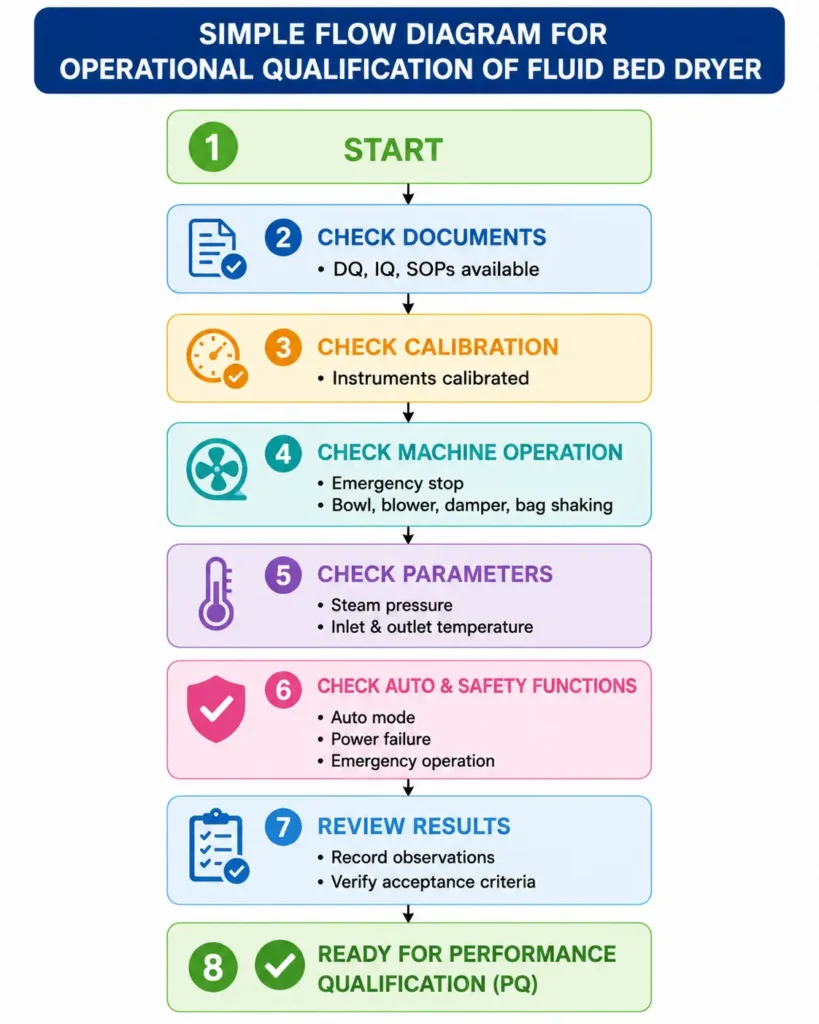
This Operational Qualification (OQ) Protocol Cum Report is prepared to confirm that the Fluid Bed Dryer operates correctly, safely, and as per user and design requirements. The equipment is a 300 kg Fluid Bed Dryer manufactured by Elicon Pharma. During qualification, important documents such as DQ, IQ, operating and cleaning SOPs, and preventive maintenance SOPs are checked for approval and availability. The calibration status of critical instruments is also verified. Operational checks include emergency stop, PLC outputs, motors, pneumatic supply, bowl positioning, finger bag movement, gasket sealing, exhaust blower, damper operation, bag shaking, and temperature control. Steam pressure, inlet temperature, and outlet temperature are checked against defined limits. Auto mode operation, recipe loading, power failure recovery, and emergency functions are also tested. Successful completion of all checks confirms that the Fluid Bed Dryer meets acceptance criteria and is ready for Performance Qualification. Any deviations are documented, reviewed, and resolved properly.
Impact Assessment
The Operational Qualification of the Fluid Bed Dryer will have a positive impact on product quality, equipment safety, and reliable operation. This activity confirms that the machine works as per approved design, user requirements, and defined acceptance criteria. Important checks include availability of DQ, IQ and SOPs, calibration of instruments, emergency stop, PLC functions, bowl positioning, gasket sealing, exhaust blower, damper operation, bag shaking, and temperature control. Steam pressure, inlet temperature, outlet temperature, auto mode, power failure recovery, and emergency functions are also verified during OQ. These checks help identify equipment problems before routine production starts. Proper recording of observations and deviations improves traceability and compliance. Successful completion of OQ gives confidence that the Fluid Bed Dryer is safe, controlled, and suitable for operation. It also confirms that the equipment is ready to proceed for Performance Qualification before routine manufacturing use.
Critical Process Parameters (CPP) & Critical Quality Attributes (CQA)
Based on the Operational Qualification Protocol Cum Report for Fluid Bed Dryer, the following parameters are important during operation. The protocol specifically defines operating checks and limits; it does not formally list product CQAs, so the CQA section below is limited to quality outcomes directly supported by the document.
Critical Process Parameters
| S. No. | Critical Process Parameter | Requirement / Range | Purpose |
|---|---|---|---|
| 1 | Steam Pressure | 2–4 bar | Provides proper heating for drying |
| 2 | Inlet Air Temperature | 50–80°C | Controls heat supplied to the material |
| 3 | Outlet Air Temperature | 35–45°C | Helps monitor drying condition |
| 4 | Bed Temperature | Set in PLC/MMI; no limit specified | Indicates product-bed drying condition |
| 5 | Process Time | Set as per recipe; no limit specified | Controls drying duration |
| 6 | Bag Shaking Interval | Set in MMI/PLC | Prevents excessive powder buildup on filter bags |
| 7 | Exhaust Damper Position | Controlled/adjustable | Regulates airflow through the dryer |
| 8 | Exhaust Blower Operation | Must operate correctly | Maintains airflow and negative pressure |
The defined steam pressure and inlet/outlet temperature checks are specified in the OQ protocol. Auto mode also allows inlet temperature, exhaust temperature, bed temperature, process time, and bag-shaking interval to be entered and controlled through the PLC.
Critical Quality Attributes / Quality Outcomes
| S. No. | Quality Attribute / Outcome | Expected Result |
|---|---|---|
| 1 | Uniform Drying | Material should be dried evenly |
| 2 | Temperature Distribution | Heat should be distributed uniformly through fluidization |
| 3 | Controlled Moisture Removal | Drying should occur properly without uncontrolled heating |
| 4 | Product Fine Retention | Filter bags should prevent fine particles from escaping |
| 5 | Desired Product Quality | Dryer should support the required quality and rated output |
| 6 | Consistent Drying Performance | Equipment should operate according to established parameters |
The protocol explains that clean, dry, heated air fluidizes the moist material so that particle surfaces are exposed to hot air, producing homogeneous temperature distribution and rapid drying. It also states that filter bags prevent product fines from escaping.
Note: Specific pharmaceutical CQAs such as LOD/moisture content, particle size, assay, bulk density, or granule flow are not defined in this OQ document and should not be assigned acceptance limits from this protocol alone.
FMEA – Fluid Bed Dryer Operational Qualification
The OQ protocol checks important functions such as emergency stop, PLC outputs, motors, pneumatic systems, bowl position, exhaust blower, damper, bag shaking, temperature control, auto mode, and power-failure recovery.
Rating Scale: Severity (S), Occurrence (O), Detection (D) = 1 to 5
RPN = S × O × D
Note: The uploaded OQ protocol does not provide FMEA scores. The ratings below are proposed risk ratings and should be reviewed and approved by the site QA/Engineering/Production team.
| S.No. | Failure Mode | Possible Impact | Possible Cause | Existing Control / Detection | S | O | D | RPN | Recommended Action |
|---|---|---|---|---|---|---|---|---|---|
| 1 | Steam pressure outside limit | Improper heating and drying | Steam supply or valve problem | Verify pressure 2–4 bar | 4 | 2 | 2 | 16 | Check steam pressure before operation |
| 2 | Inlet temperature incorrect | Under-drying or overheating | Heater/control failure | Monitor inlet temperature 50–80°C | 5 | 2 | 2 | 20 | Verify temperature controller and sensor |
| 3 | Outlet temperature incorrect | Drying may not be properly controlled | Sensor or airflow problem | Monitor outlet temperature 35–45°C | 4 | 2 | 2 | 16 | Check sensor and airflow |
| 4 | Exhaust blower does not operate | Poor fluidization and drying | Motor/electrical failure | Operational check of blower | 5 | 2 | 2 | 20 | Inspect motor and electrical supply |
| 5 | Exhaust damper fails | Incorrect airflow through FBD | Actuator/regulator problem | Check damper movement and magnehelic indication | 4 | 2 | 3 | 24 | Verify actuator and damper movement |
| 6 | Bag shaking fails | Filter choking and reduced airflow | Pneumatic or PLC problem | Bag-shaking operation checked through MMI/PLC | 4 | 2 | 3 | 24 | Check pneumatic supply and shaking sequence |
| 7 | Finger-bag gasket does not seal | Product leakage or loss of pressure | Low air pressure or damaged gasket | Gasket sealing verification | 4 | 2 | 2 | 16 | Inspect gasket and pneumatic pressure |
| 8 | Bowl not positioned/lifted correctly | Leakage, unsafe operation, poor drying | Improper positioning or lifting mechanism failure | Bowl positioning and lifting check | 4 | 2 | 2 | 16 | Check bowl alignment and lifting mechanism |
| 9 | PLC/Auto mode failure | Incorrect operating sequence or parameters | PLC/software/control failure | Recipe loading and auto-start verification | 5 | 2 | 2 | 20 | Verify PLC program and recipe settings |
| 10 | Unsafe condition after power failure | Equipment or product may be affected | Improper restart logic | Power failure and restoration test | 5 | 2 | 2 | 20 | Confirm safe shutdown and controlled restart |
| 11 | Emergency stop fails | Serious operator/equipment safety risk | Electrical or control failure | Emergency-stop functional test | 5 | 2 | 1 | 10 | Test emergency stop before qualification approval |
The protocol specifically defines steam pressure, inlet temperature and outlet temperature checks. It also requires verification of auto mode, recipe parameters and automatic sequence operation. Power-failure and emergency-operation checks are included to ensure that the Fluid Bed Dryer stops safely and can be restarted without adverse conditions.
Highest proposed risks: Exhaust damper failure and bag-shaking failure have an RPN of 24, so these functions should receive special attention during Operational Qualification.
Questions & Answers
1. What is the purpose of Operational Qualification (OQ) of the Fluid Bed Dryer?
The purpose is to confirm that the Fluid Bed Dryer operates correctly, meets defined acceptance criteria, and complies with cGMP requirements.
2. What is the capacity of the Fluid Bed Dryer mentioned in the protocol?
The capacity of the Fluid Bed Dryer is 300 kg.
3. Who is the manufacturer of the Fluid Bed Dryer?
The manufacturer is Elicon Pharma.
4. Which departments are involved in the OQ activity?
Quality Assurance, Production, and Engineering departments are involved in the qualification activity.
5. Which documents should be available before starting OQ?
DQ Protocol Cum Report, IQ Protocol Cum Report, SOP for Operation & Cleaning, and SOP for Preventive Maintenance should be available and approved.
6. Why is instrument calibration checked during OQ?
Calibration is checked to ensure that critical instruments give reliable and accurate readings during qualification testing.
7. What happens when the emergency stop is pressed?
Pneumatic supplies, PLC outputs, motors, and solenoid indicators should be de-energized as defined in the protocol.
8. What is checked during bowl positioning?
The bowl should be correctly positioned facing the expansion chamber and bottom plenum.
9. What is the purpose of the exhaust blower?
The exhaust blower helps maintain airflow through the Fluid Bed Dryer and operates on a negative-pressure principle.
10. What is the purpose of bag shaking?
Bag shaking removes powder or dust deposited on the filter bags and helps maintain proper airflow.
11. What is the required steam pressure during temperature control checking?
The steam pressure should be 2–4 bar.
12. What is the inlet temperature range mentioned in the protocol?
The inlet temperature is set between 50°C and 80°C.
13. What is the outlet temperature range?
The outlet temperature is set between 35°C and 45°C.
14. Which parameters can be entered in Auto Mode?
Inlet temperature, exhaust temperature, bed temperature, process time, and bag-shaking interval can be entered and saved as a recipe.
15. What should happen during a main power failure?
The equipment should stop in a safe and secure condition. After power is restored, it should be possible to restart the equipment without problems or adverse conditions.
16. What is checked during emergency operation verification?
The ON/OFF push buttons and emergency stop are checked to confirm that the equipment stops, starts, and remains inoperative when the emergency stop is activated.
17. What happens after successful completion of OQ?
Successful completion confirms that the Fluid Bed Dryer meets the defined acceptance criteria and is ready for Performance Qualification (PQ).
18. What should be done if any deviation is observed during OQ?
The deviation should be documented with its reason and approved by an authorized person.