






Brief Description
This Installation Qualification (IQ) Protocol cum Report is prepared for a 300 kg Fluid Bed Dryer supplied by Elicon Pharma. Its main purpose is to confirm that the dryer and all its parts are installed correctly according to the approved design, supplier requirements, and technical specifications.
The document covers equipment details, system description, required documents, installation checks, technical specifications, material of construction, utilities, and safety features. It verifies proper mounting, leveling, welding, working space, electrical supply, compressed air, steam supply, control panel, filters, motors, sensors, and safety devices.
The protocol also checks that important documents such as drawings, calibration certificates, material certificates, and equipment specifications are available and approved. Quality Assurance, Production, and Engineering are responsible for reviewing, executing, and approving the qualification. Any deviation or change found during execution must be recorded, reviewed, and approved before the Fluid Bed Dryer is accepted for further qualification and routine pharmaceutical use.
Impact Assessment
The Installation Qualification of the Fluid Bed Dryer has a positive impact on product quality, equipment safety, and GMP compliance. It confirms that the dryer is installed correctly as per approved design, technical specifications, and supplier requirements.
The assessment covers mounting, leveling, welding, equipment location, working space, technical specifications, material of construction, utilities, and safety features. Proper verification of electricity, compressed air, steam supply, control panel, filters, sensors, and safety devices helps ensure smooth and safe operation.
It also ensures that required documents such as drawings, equipment specifications, calibration certificates, and material certificates are available and approved before use. This reduces the risk of equipment failure, incorrect installation, unsafe operation, and future maintenance problems. Overall, successful IQ provides confidence that the Fluid Bed Dryer is properly installed and ready for the next qualification stage before routine manufacturing use.
Critical Process Parameters & Critical Quality Attributes
The IQ document mainly covers installation and utility requirements. It does not specifically define CPPs or CQAs, so the CPPs below are taken from the equipment parameters mentioned in the protocol, while the CQAs are typical quality attributes associated with fluid-bed drying.
| Critical Process Parameters (CPPs) | Why Critical |
|---|---|
| Inlet Air Temperature | Controls drying rate and prevents overheating |
| Air Flow / Blower Capacity | Ensures proper fluidization and uniform drying |
| Steam Pressure | Controls heating of inlet air |
| Compressed Air Pressure | Required for pneumatic lifting and filter shaking |
| Drying Time | Determines the final moisture level |
| Exhaust Air / Damper Control | Helps maintain correct airflow and drying conditions |
| Filter Condition | Prevents particle loss and contamination |
| Product Load | Affects fluidization and drying efficiency |
The protocol specifies compressed air at 6 bar, steam pressure at 2–4 kg/cm², and equipment airflow/blower-related requirements. It also includes inlet-temperature safety control and low-air-pressure protection.
Critical Quality Attributes (CQAs)
| CQA | Expected Quality Requirement |
|---|---|
| Moisture Content / LOD | Within the approved product specification |
| Drying Uniformity | Material should be uniformly dried |
| Appearance | No discoloration, burning, or abnormal material |
| Particle Size | Should remain within required limits |
| Flow Properties | Suitable for further processing |
| Bulk Density | Within product-specific requirement |
| Assay / Potency | No significant loss due to excessive heat |
| Microbial Quality | Should meet applicable limits |
Note: These CQAs are general FBD-related quality attributes and are not specifically listed in this IQ protocol. Product-specific limits should come from the respective BMR, product specification, or process validation protocol.
FMEA – Installation Qualification of Fluid Bed Dryer
Note: The IQ protocol does not contain an FMEA section. The following suggested FMEA is developed from the installation checks, utilities, MOC verification, documentation requirements, and safety controls specified in the protocol.
Rating: Severity (S), Occurrence (O), Detection (D): 1 = Low, 5 = High
RPN = S × O × D
| Failure Mode | Possible Impact | Possible Cause | Existing / Recommended Control | S | O | D | RPN |
|---|---|---|---|---|---|---|---|
| Improper mounting or grouting | Equipment vibration or unstable operation | Incorrect installation | Verify mounting and grouting during IQ | 4 | 2 | 2 | 16 |
| Improper leveling | Uneven equipment operation | Poor installation | Check equipment balancing and leveling | 3 | 2 | 2 | 12 |
| Incorrect MOC of product-contact parts | Product contamination or quality impact | Wrong material installed | Verify AISI 316L contact parts against certificates | 5 | 2 | 2 | 20 |
| Incorrect electrical supply | Equipment may not operate properly | Wrong voltage, phase or frequency | Verify 415 V, 3-phase, 50 Hz supply | 4 | 2 | 2 | 16 |
| Low compressed-air pressure | Pneumatic functions may fail | Utility pressure below requirement | Verify compressed air at specified pressure | 4 | 2 | 2 | 16 |
| Incorrect steam supply | Poor heating and drying performance | Low or unstable steam pressure | Verify steam pressure and consumption | 4 | 2 | 2 | 16 |
| Filter not properly installed | Dust escape or contamination risk | Damaged/wrong filter installation | Verify filter type, size and installation | 5 | 2 | 2 | 20 |
| Improper earthing | Electrical safety risk; equipment may stop | Faulty earthing connection | Verify earth safety relay and proper grounding | 5 | 2 | 2 | 20 |
| Temperature sensor/control failure | Excessive inlet-air temperature | Sensor or controller malfunction | Verify temperature sensor and steam shut-off control | 5 | 2 | 2 | 20 |
| Emergency switch not available/accessibile | Delayed equipment shutdown during emergency | Incorrect installation | Verify emergency switch at approachable location | 5 | 1 | 2 | 10 |
| Explosion flap malfunction | Excess pressure may not be safely released | Incorrect installation or damaged flap | Verify explosion flap installation and condition | 5 | 1 | 2 | 10 |
| Required documents unavailable | Qualification cannot be properly demonstrated | Missing drawings/certificates | Verify approved DQ, drawings, calibration and MOC certificates | 3 | 2 | 1 | 6 |
The protocol specifically requires verification of utilities such as electricity, compressed air and steam. It also includes safety checks for earthing, emergency switch, motor overload, temperature sensor, explosion flap and air pressure.
Conclusion
The main installation risks are related to MOC, filters, electrical safety, temperature control, utilities, mounting, and safety devices. These risks can be controlled by proper IQ verification, approved documents, calibrated instruments, correct utility connections, and satisfactory safety checks before moving the Fluid Bed Dryer to the next qualification stage.
Questions & Answers
Q1. What is the purpose of Installation Qualification of the Fluid Bed Dryer?
Answer: The purpose is to provide documented evidence that the Fluid Bed Dryer and its components are installed according to approved design specifications and supplier requirements.
Q2. What is the capacity of the Fluid Bed Dryer?
Answer: The capacity of the Fluid Bed Dryer is 300 kg.
Q3. Who is the manufacturer of the Fluid Bed Dryer?
Answer: The manufacturer is Elicon Pharma.
Q4. Which departments are responsible for the IQ activity?
Answer: Quality Assurance, Production, and Engineering are responsible for reviewing, executing, monitoring, and approving the qualification activity.
Q5. Which documents should be available before starting IQ?
Answer: Approved DQ, GA drawing, electrical circuit diagram, technical specifications, calibration certificates, and material-of-construction certificates should be available.
Q6. What installation checks are performed during IQ?
Answer: Checks include grouting, mounting, leveling, sharp edges, welding joints, installation location, room condition, illumination, and working space around the equipment.
Q7. What is the required electrical supply?
Answer: The required supply is 415 V, 3-phase, 50 Hz.
Q8. What compressed-air pressure is required?
Answer: The required compressed-air pressure is 6 bar with a flow rate of 8–10 CFM.
Q9. What is the required steam pressure?
Answer: The specified steam pressure is 2–4 kg/cm², with steam consumption of approximately 120–150 kg/hr.
Q10. What material is specified for product-contact parts?
Answer: Product-contact parts such as the product container, retention chamber, duct mesh screen, perforated plate, and sampling device are specified as AISI 316L.
Q11. Why are filters important in a Fluid Bed Dryer?
Answer: Filters clean the incoming air, while the exhaust filter bag helps prevent product fine particles from escaping with the outlet air.
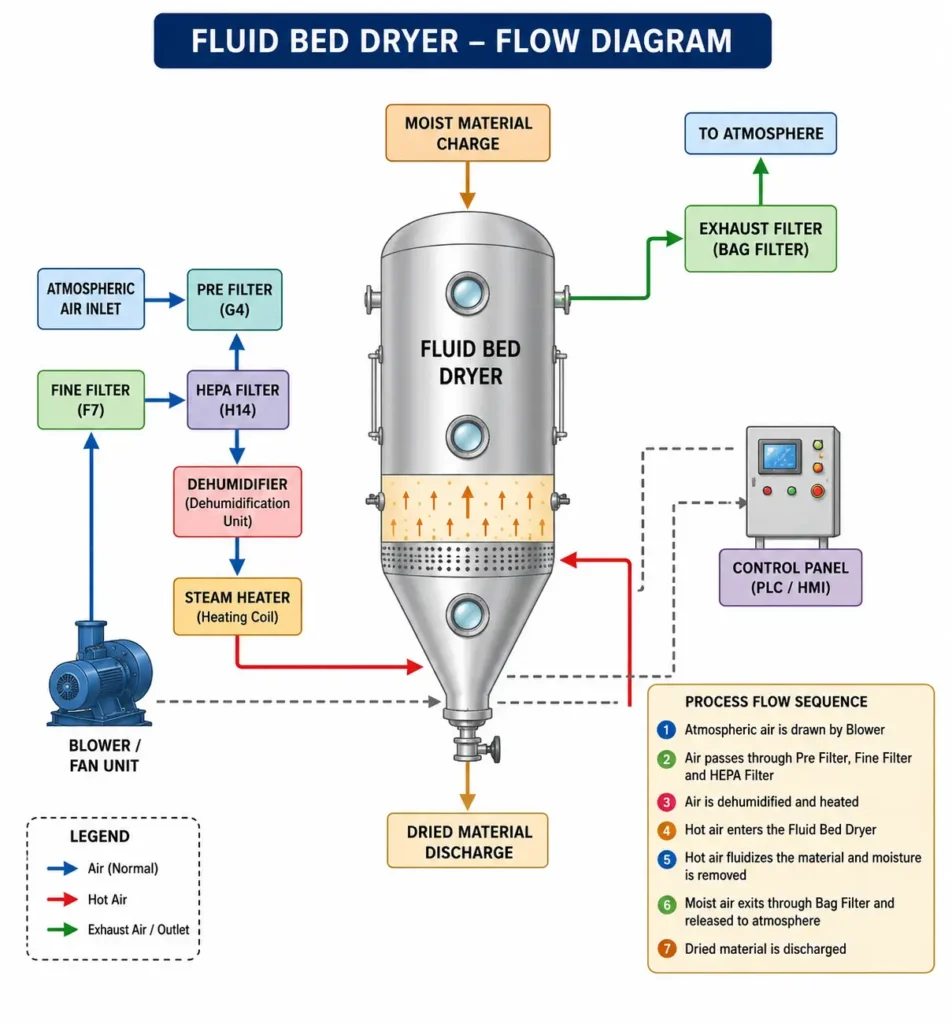
Q12. How does the Fluid Bed Dryer dry the material?
Answer: Clean, dry, heated air passes upward through the moist material, creating a fluidized state. This exposes the particles to hot air and helps achieve uniform and rapid drying.
Q13. What safety devices are checked during IQ?
Answer: Safety checks include the earth safety relay, emergency switch, motor overload relay, inlet temperature sensor, explosion flap, air-pressure control, equipment leveling, and grounding.
Q14. What happens if inlet-air temperature exceeds the set value?
Answer: The steam control valve should close when the inlet temperature rises above the set value.
Q15. What should be done if a deviation is observed during qualification?
Answer: The deviation should be recorded with its reason and approved by an authorized person before the qualification is completed.