







1. Brief Description:
This Design Qualification for Vibro Sifter 30″ is prepared for a 30-inch Vibro Sifter used in pharmaceutical manufacturing. Its purpose is to confirm that the equipment design meets the User Requirement Specification, cGMP, process needs, and safety requirements. The Vibro Sifter is a compact and movable machine mounted on castor wheels. It is used for sifting raw materials, APIs, and excipients during manufacturing. The machine works through vibration, allowing fine material to pass through the selected mesh while coarse material remains above. The document checks important points such as equipment size, electrical supply, motor, screen diameter, materials of construction, room conditions, and safety features. Product-contact parts are mainly stainless steel 316, while non-contact parts are stainless steel 304. Safety features include MCB, mechanical guards, proper earthing, smooth metal surfaces, balancing, noise control, and an emergency switch. The protocol also defines responsibilities of Quality Assurance, Production, and Engineering during qualification.
Skip to PDF content2. Flow Diagram:
The flow diagram represents the Design Qualification (DQ) process for the Vibro Sifter 30”, ensuring that the proposed equipment design meets the User Requirement Specification (URS), cGMP, process, product, technical, and safety requirements before further qualification. The process begins with identification of the equipment requirement, collection of URS and vendor information, preparation of the DQ protocol, and protocol pre-approval by Quality Assurance, Production, and Engineering.
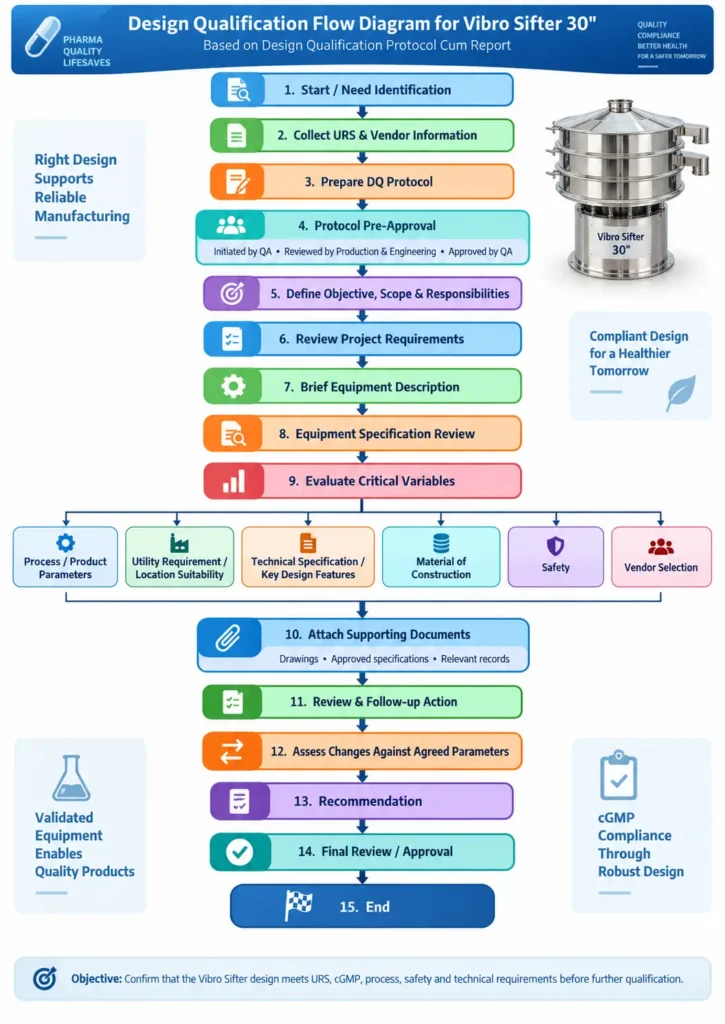
The design is then evaluated against project requirements, equipment specifications, and critical variables such as process/product parameters, utility and location suitability, technical features, material of construction, safety provisions, and vendor selection. Finally, supporting documents are attached, follow-up actions and design changes are reviewed, recommendations are documented, and the DQ is finalized through review and approval.
3. Brainstorming:
The brainstorming diagram identifies potential causes for Design Qualification (DQ) of the Vibro Sifter 30” not being performed. The possible causes are grouped around key areas such as Documentation, People, Method, and Management. Major issues include failure to prepare the DQ protocol, inadequate review of the URS, non-availability of vendor and supporting documents, unclear responsibilities, and lack of coordination between Quality Assurance, Production, and Engineering.
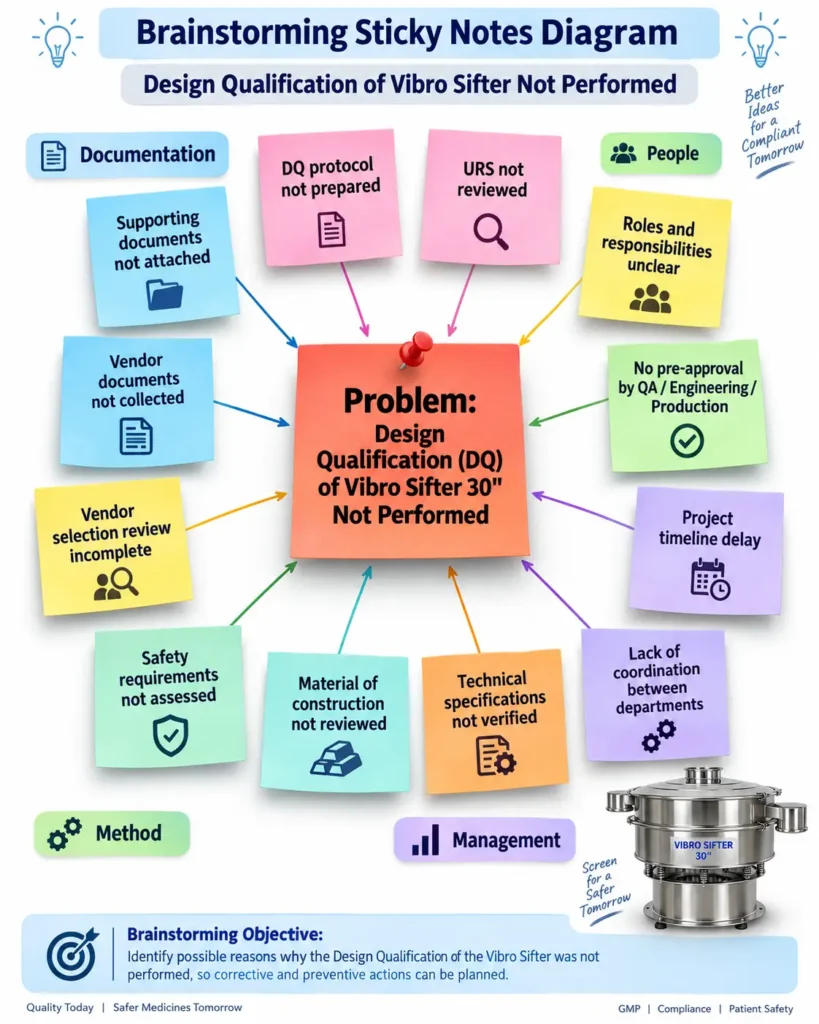
Other potential contributors include delayed project timelines, incomplete vendor evaluation, failure to verify technical specifications, inadequate review of material of construction, and missing assessment of equipment safety requirements. These areas are important because the DQ protocol requires verification of process requirements, technical design features, MOC, utilities, safety, vendor selection, and supporting documentation before final recommendation and approval. The brainstorming exercise helps identify likely gaps so that suitable corrective and preventive actions (CAPA) can be planned.
4. 5 Why Analysis:
The 5 Why Analysis identifies the progressive causes behind the Design Qualification (DQ) of the Vibro Sifter 30” not being performed. The analysis begins with the immediate issue that the DQ activity was not initiated on time and then traces the failure through deeper organizational and documentation gaps. The analysis identifies the following cause chain: DQ activity not initiated on time → DQ protocol not prepared and approved → URS, vendor documents, and technical specifications not fully reviewed → responsibilities of QA, Engineering, and Production not clearly assigned or coordinated → absence of a formal qualification planning and project follow-up system.
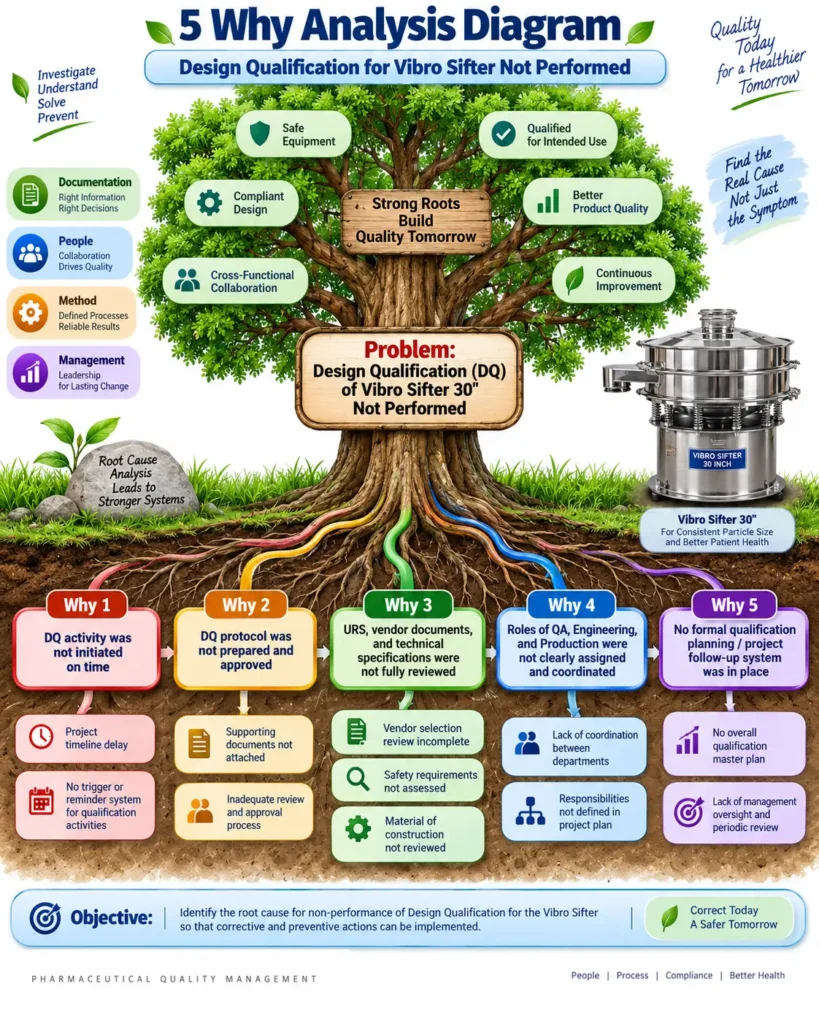
These causes are consistent with the DQ protocol, which requires QA, Production, and Engineering involvement, verification of technical specifications, drawings, utilities, material of construction, safety features, and supporting documentation. The analysis indicates that the likely root cause is inadequate qualification planning, cross-functional coordination, and management follow-up, rather than a single isolated documentation error. It provides a basis for defining appropriate CAPA, responsibilities, timelines, and periodic qualification tracking.
5. Heat Map (FMEA) Analysis:
The Heat Map Diagram evaluates and prioritizes the risks associated with Design Qualification (DQ) of the Vibro Sifter 30” not being performed. Risks are assessed according to Probability (Likelihood) and Severity (Impact) and classified from low risk (green) through moderate (yellow), high (orange), and critical risk (red). The assessment considers key DQ-related gaps such as URS not reviewed, DQ protocol not prepared, technical specifications not verified, material of construction not reviewed, safety features not assessed, utilities/location suitability not checked, incomplete vendor review, missing supporting documents, unclear responsibilities, inadequate cross-functional approval, and lack of qualification planning. These areas correspond to requirements addressed within the Vibro Sifter DQ protocol, including process parameters, utilities, technical design, MOC, safety, and vendor selection.
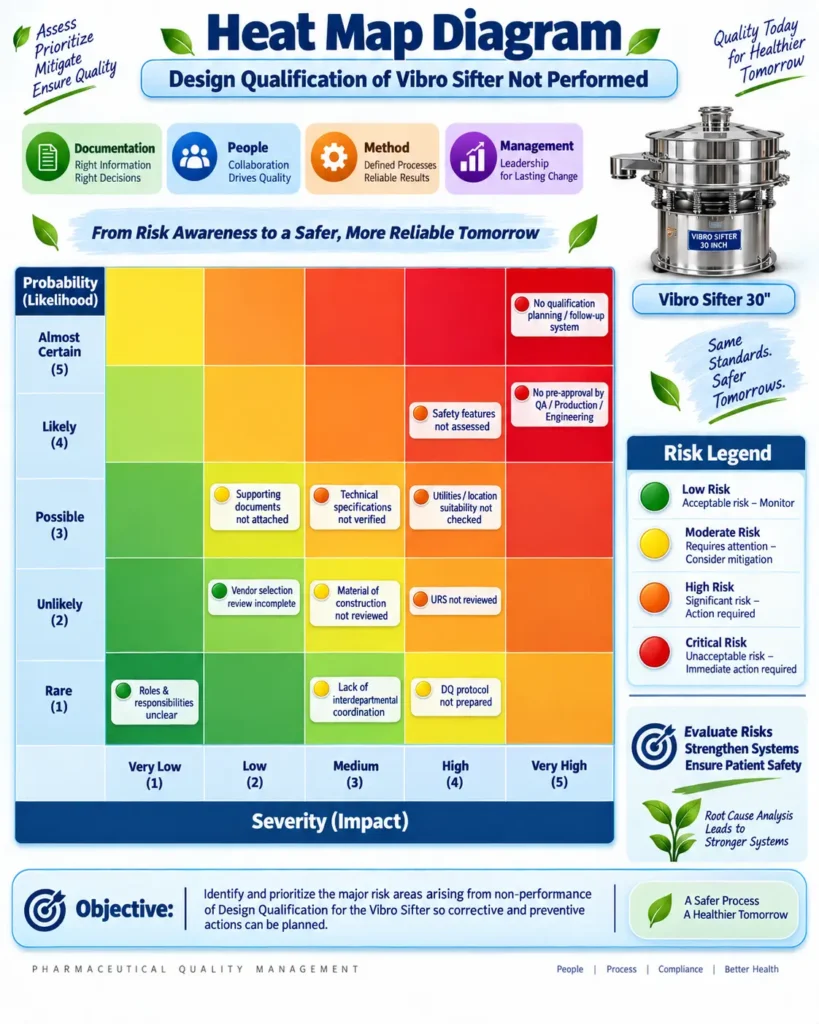
The heat map helps identify higher-priority compliance and qualification risks requiring immediate CAPA, while lower risks can be controlled through monitoring, documentation improvement, defined responsibilities, and systematic qualification follow-up.
6. Impact Assessment:
The non-performance of Design Qualification (DQ) for the Vibro Sifter 30” may impact GMP compliance, equipment suitability, product quality, and the overall qualification lifecycle. DQ is intended to confirm that critical process/product requirements, cGMP requirements, safety aspects, and design specifications are adequately considered before the equipment is accepted for further qualification. If DQ is not performed, important parameters such as sifting capability, electrical requirements, room suitability, technical specifications, material of construction, and safety features may remain formally unverified. This can create gaps in documentation, traceability, regulatory compliance, and assurance that the equipment is suitable for its intended use. Therefore, the issue should be assessed through documented review, appropriate CAPA, and completion of the required DQ activities before the qualification gap is considered closed.
Questions & Answers
- What is Design Qualification (DQ)?
Design Qualification is documented verification that the equipment design meets the User Requirement Specification, cGMP, process, and safety requirements. - Which equipment is covered in this document?
The document covers the 30-inch Vibro Sifter. - What is the main use of a Vibro Sifter?
It is used for sifting raw materials, APIs, and excipients during the manufacturing process. - How does a Vibro Sifter work?
A vibrating motor creates vibration. Fine material passes through the screen mesh, while coarse material remains above the screen. - Can the Vibro Sifter be moved from one area to another?
Yes. It is mounted on castor wheels and may be moved as required without changing its performance. - What material is used for product-contact parts?
Product-contact parts are specified as SS316, with major contact components such as the top lid, decks, and mesh listed as AISI 316L. - What material is used for non-contact parts?
Non-contact parts are specified as SS304. - What is the screen diameter of the Vibro Sifter?
The screen diameter is 750 mm. - What type of motor is used?
A vibratory motor of 0.5 HP and 1440 RPM is specified. - What departments are responsible for Design Qualification?
Quality Assurance, Production, and Engineering are responsible for review, verification, coordination, and qualification activities. - What safety features are checked during DQ?
Safety checks include MCB, mechanical guards, smooth joints, proper balancing, electrical wiring, earthing, noise level, and an emergency switch. - What should be the noise level of the equipment?
The noise level should be below 80 dB. - Why is proper earthing required?
Proper earthing helps provide electrical safety for the machine and operator. - What should be done if the agreed equipment design is changed?
The change should be handled and documented through the change control procedure. - What documents should be attached with the DQ report?
Technical equipment details, engineering drawings, approved design and specifications, and other relevant documents should be attached.
Reference Guidelines:
The following references are suitable for a Design Qualification (DQ) of Vibro Sifter not performed investigation, impact assessment, risk assessment, and CAPA:
- Revised Schedule M – Drugs Rules, 1945, India, Section 12.3.1 (Qualification): Defines DQ as documented verification that the proposed design of facilities, equipment, or systems is suitable for its intended purpose. This is the key Indian regulatory reference.
CDSCO – Drugs Rules / Revised Schedule M - WHO TRS 1019, Annex 3 – GMP: Guidelines on Validation, Appendix 6: Guidelines on Qualification: Sections 4.5–4.12, 5 and 6 address URS, DQ, IQ, OQ and PQ. Section 6.1 states that DQ should demonstrate that the equipment design is appropriate for its intended use as defined in the URS. WHO also states that when a qualification stage is considered unnecessary, the decision should be justified.
WHO TRS 1019 Annex 3 - EU GMP – EudraLex Volume 4, Annex 15: Qualification and Validation: Section 3.3 – Design Qualification requires demonstration and documentation that the equipment/facility/system design complies with GMP and that URS requirements are verified during DQ.
European Commission – EudraLex Volume 4 - PIC/S GMP Guide PE 009, Annex 15 – Qualification and Validation: Sections 3.1–3.3 cover qualification lifecycle, URS and DQ. Section 3.3 specifically requires compliance of the design with GMP to be demonstrated and documented and URS requirements to be verified during DQ.
PIC/S Publications and GMP Guidance - ICH Q9(R1) – Quality Risk Management: Appropriate for evaluating the consequences of the missing DQ through risk identification, probability, severity, risk evaluation and risk control. It also recognizes tools such as FMEA, FTA and risk ranking/filtering, supporting the 5-Why/heat-map/FMEA approach used in the investigation.
ICH Quality Guidelines
Recommended primary citation for your document:
Revised Schedule M + WHO TRS 1019 Annex 3 Appendix 6 + EU/PIC/S GMP Annex 15 + ICH Q9(R1).