







Brief Description
This Performance Qualification (PQ) Protocol is prepared for the 30-inch Vibro Sifter used in pharmaceutical manufacturing. Its purpose is to confirm that the equipment performs consistently, repeatedly, and within the approved operating range. The Vibro Sifter uses a vibrating screen to separate fine material from coarse material and helps achieve uniform grading during the sifting process. The protocol covers equipment details, responsibilities, pre-qualification requirements, tests, acceptance criteria, documents, deviations, and change control. Before PQ, Design Qualification, Installation Qualification, Operational Qualification, and relevant operation, cleaning, and maintenance SOPs should be available. Performance is checked using placebo material and drug products. During testing, the correct sieve is installed, material is loaded, sifting is performed, operation time is recorded, and sieve integrity is checked before and after use. Successful completion provides documented evidence that the Vibro Sifter is suitable for routine production use. It also supports reliable, controlled, and efficient material processing activities.
Skip to PDF content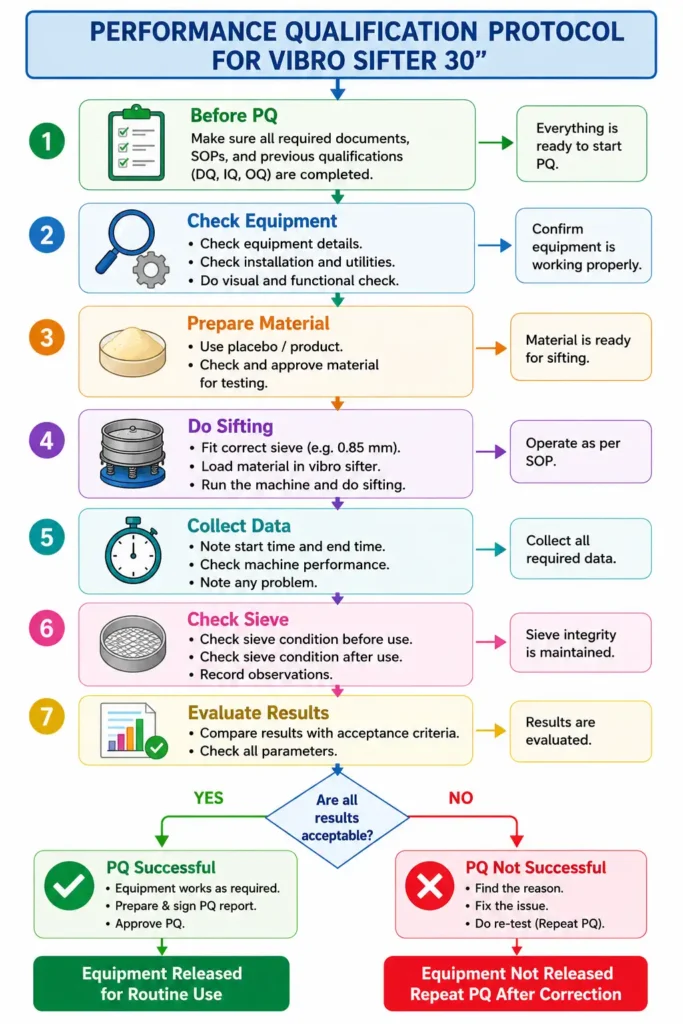
1. Brainstorming Analysis:
The brainstorming analysis evaluates possible reasons why the Performance Qualification (PQ) Protocol for the Vibro Sifter was not performed. Potential contributing factors include lack of awareness or training, insufficient manpower and time, incomplete qualification documentation, equipment-readiness issues, delayed approvals, weak coordination among QA/Production/Engineering, competing production priorities, and external/vendor-related delays.
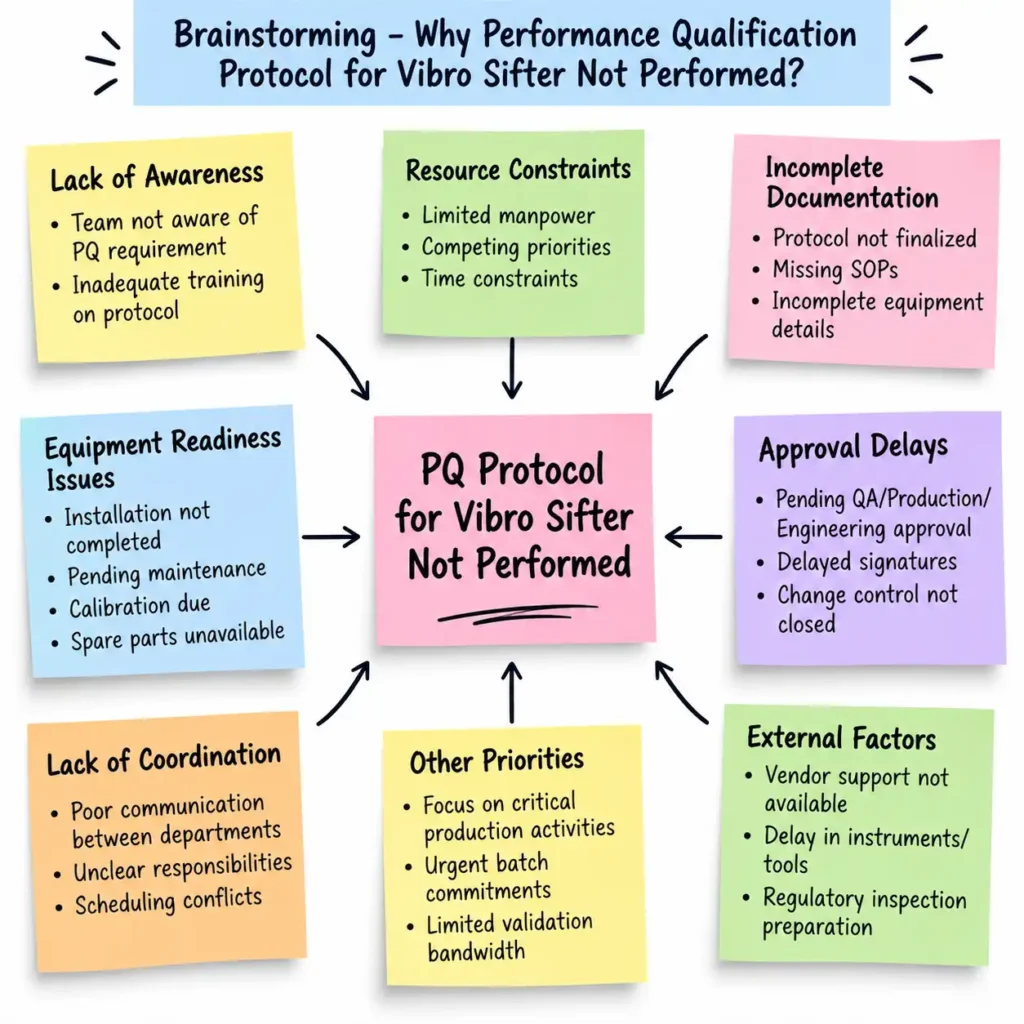
These causes are important because the PQ protocol requires completion of DQ, IQ and OQ, availability of operation/cleaning and preventive-maintenance SOPs, and approved supporting documents before PQ execution. The protocol also requires performance verification using placebo and drug product, including sifting efficiency, operating time and sieve-integrity checks. The brainstorming exercise helps the investigation team identify likely gaps, prioritize root-cause investigation, and establish appropriate CAPA to ensure timely completion and documented evidence of Vibro Sifter performance qualification.
2. 5 Why Analysis:
The 5 Why Analysis identifies the underlying reason why the Performance Qualification (PQ) Protocol for the Vibro Sifter was not performed. The analysis traces the issue from non-initiation of PQ to incomplete prerequisites, delayed documentation/approvals, insufficient coordination and resource planning, and finally to inadequate qualification planning and follow-up as the probable root cause.
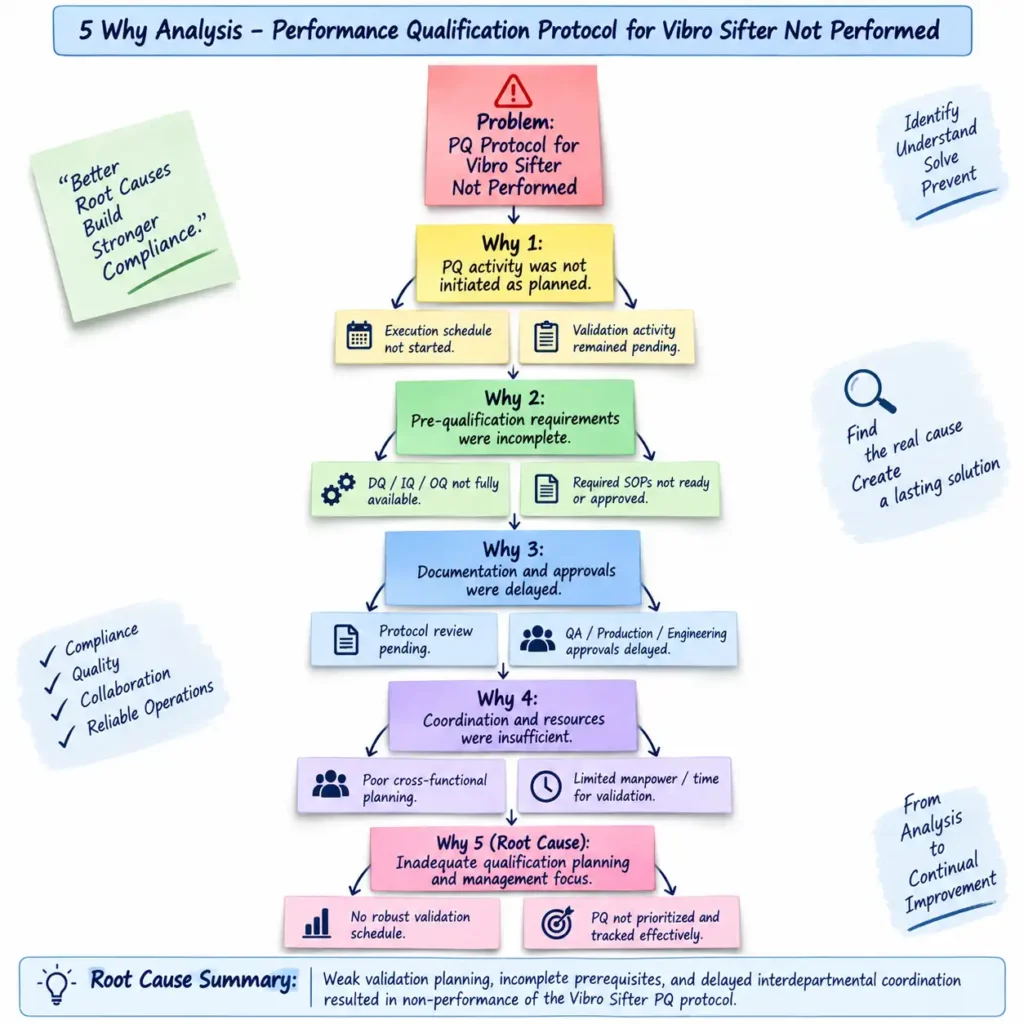
The protocol requires DQ, IQ, OQ, operation/cleaning SOP, and preventive-maintenance SOP to be completed before starting PQ. It also states that PQ should follow OQ to demonstrate that critical variables are controlled and equipment output is satisfactory. The analysis supports CAPA focused on qualification scheduling, clear departmental responsibility, timely approval, prerequisite tracking, and QA monitoring to prevent recurrence.
3. Heat Map Analysis:
The Heat Map Analysis evaluates the risk factors associated with the non-performance of the Performance Qualification (PQ) Protocol for the Vibro Sifter. It classifies contributing causes according to their relative risk level so that the most critical gaps can be addressed first. The major high-risk factors identified are incomplete DQ/IQ/OQ, unavailable or unapproved SOPs, documentation gaps, approval delays, and inadequate PQ planning and scheduling. The medium-risk factors include limited manpower and time, weak cross-functional coordination, and competing production priorities.
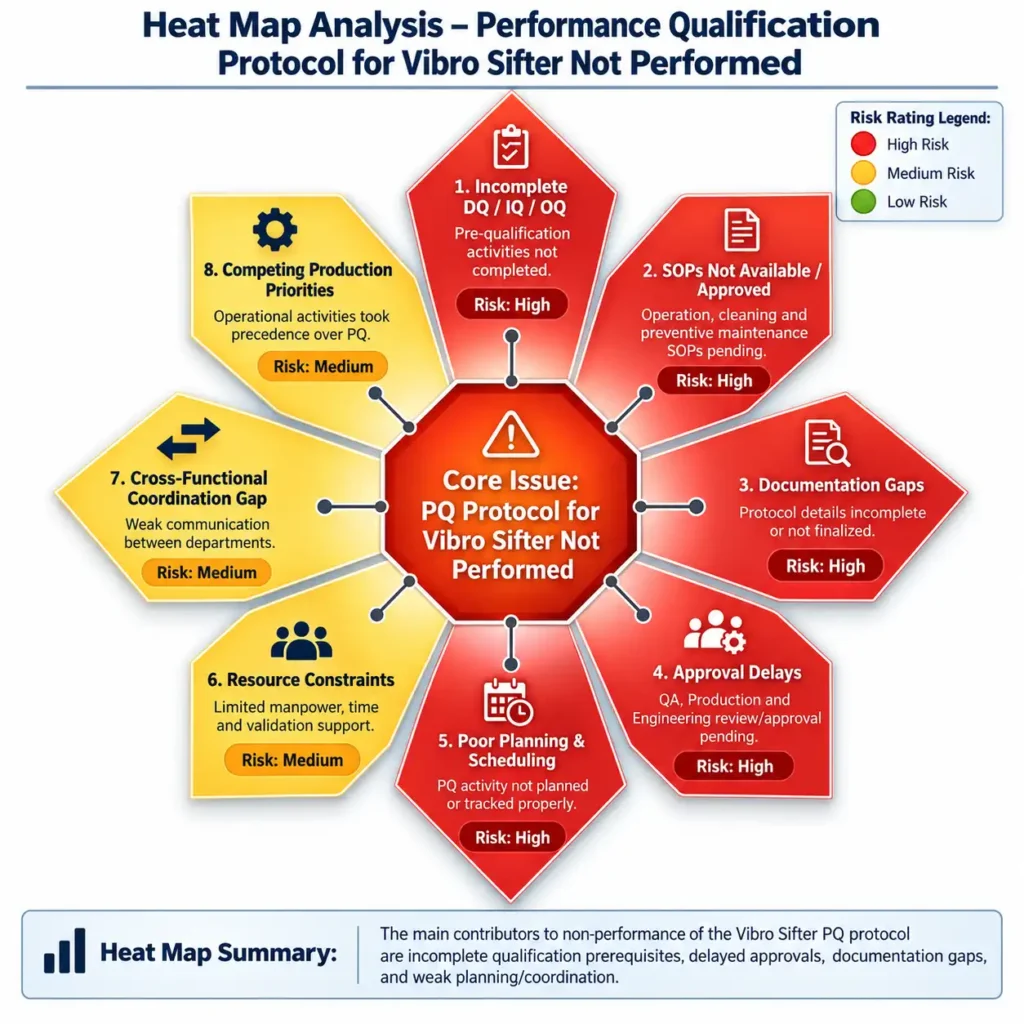
This assessment is consistent with the PQ protocol, which requires completion of DQ, IQ, OQ, operation and cleaning SOP, and preventive-maintenance SOP before commencing PQ activities. The heat map therefore helps prioritize CAPA toward qualification readiness, document completion, timely approvals, resource allocation, and effective QA–Production–Engineering coordination.
Impact Assessment
The Performance Qualification of the 30-inch Vibro Sifter will have a positive impact on the manufacturing process. It will confirm that the equipment is working properly and can perform sifting consistently during routine production. The study checks important points such as equipment condition, correct sieve installation, sifting time, sieve integrity, and overall machine performance. Before starting PQ, required qualifications such as DQ, IQ, OQ, and related SOPs should be completed and approved. Proper qualification will reduce the risk of improper sifting, damaged sieves, uneven material size, and process variation. It also helps ensure that fine material passes through the selected sieve while coarse material is retained as required. Any deviation or non-compliance found during PQ will be recorded, reviewed, and evaluated by Quality Assurance. Overall, successful PQ provides confidence that the Vibro Sifter is suitable for routine pharmaceutical production and supports consistent product quality.
Critical Process Parameters (CPP) & Critical Quality Attributes (CQA)
The protocol does not explicitly label any item as CPP or CQA. However, it identifies the operating checks and acceptance criteria used to demonstrate satisfactory Vibro Sifter performance. Based on those protocol requirements, the following can be considered qualification-critical:
| Type | Parameter / Attribute | Requirement / Importance |
|---|---|---|
| CPP | Sieve mesh size | Use the specified sieve as per BMR. |
| CPP | Material loading quantity | Load approximately 80% of the top-lid volume. |
| CPP | Sifting time | Record and compare with the required standard time. |
| CPP | Equipment operating condition | Operate within the established OQ operating range. |
| CPP | Vibration setting | Should provide effective and uniform sifting; vibration can be adjusted using eccentric weights. |
| CQA | Sifting efficiency | Material should be sifted effectively through the selected sieve. |
| CQA | Sieve integrity | Sieve must remain intact before and after sifting. |
| CQA | Uniform material grading | Material should be separated uniformly according to sieve size. |
| CQA | Absence of coarse material in sifted portion | Oversized particles should remain above the sieve. |
| CQA | Consistent equipment performance | Results should meet predefined acceptance criteria during PQ. |
The protocol specifically identifies sifting efficiency, sieve integrity, and required process time as key performance checks/acceptance criteria.
FMEA – Performance Qualification of Vibro Sifter 30″
The protocol does not contain a ready-made FMEA. The following FMEA is developed from the PQ activities, checks, acceptance criteria, deviation requirements, and equipment description in the protocol. The S/O/D scores are proposed risk-assessment values, not values stated in the source.
Scoring: Severity (S), Occurrence (O), Detection (D): 1–5
RPN = S × O × D
| S.No. | Process / Parameter | Potential Failure Mode | Possible Impact | Possible Cause | Existing / Proposed Control | S | O | D | RPN | Risk |
|---|---|---|---|---|---|---|---|---|---|---|
| 1 | Document verification | DQ/IQ/OQ or SOP not available/approved | PQ may be performed without proper qualification status | Incomplete documentation | Verify availability, completeness and approval before PQ | 4 | 2 | 2 | 16 | Low |
| 2 | Sieve selection | Wrong mesh sieve installed | Incorrect particle-size separation | Wrong sieve selection / BMR not followed | Verify specified mesh size as per BMR | 5 | 2 | 2 | 20 | Medium |
| 3 | Material loading | Excessive or incorrect loading | Poor sifting efficiency or increased sifting time | Overloading of hopper | Load approximately 80% of top-lid volume | 3 | 2 | 2 | 12 | Low |
| 4 | Sifting operation | Improper vibration / poor machine performance | Non-uniform sifting | Incorrect eccentric-weight setting or equipment problem | Operate within established OQ range and observe performance | 4 | 2 | 3 | 24 | Medium |
| 5 | Sieve integrity | Sieve damaged during operation | Coarse particles may pass into sifted material | Worn or damaged sieve | Check sieve integrity before and after operation | 5 | 2 | 2 | 20 | Medium |
| 6 | Sifting time | Sifting takes longer than standard | Process variation and reduced efficiency | Improper loading, sieve condition or equipment performance | Record sifting time and compare with standard | 3 | 2 | 2 | 12 | Low |
| 7 | Sifting efficiency | Material is not sifted properly | Inconsistent material grading | Wrong sieve, poor vibration or excessive load | Verify performance using placebo and drug product | 5 | 2 | 3 | 30 | Medium |
| 8 | Deviation handling | Deviation not recorded or assessed | Unacceptable equipment performance may be overlooked | Inadequate documentation / review | Record deviation and obtain QA assessment | 4 | 2 | 2 | 16 | Low |
Conclusion
The main risks during Vibro Sifter PQ are wrong sieve selection, damaged sieve, poor sifting efficiency, improper loading, and abnormal equipment performance. Controls such as checking the correct sieve, maintaining approximately 80% loading, recording sifting time, checking sieve integrity before and after use, and reviewing deviations through QA help reduce these risks. No high-risk item is identified in this proposed FMEA when the defined controls are properly followed.
Questions & Answers
- What is the purpose of the Performance Qualification of Vibro Sifter 30″?
The purpose is to confirm that the Vibro Sifter performs consistently, repeatedly, and within its established operating range. - What equipment is covered in this PQ protocol?
The protocol covers the Performance Qualification of a 30-inch Vibro Sifter manufactured by Elicon Pharma. - What is the main function of a Vibro Sifter?
It is used to separate and grade material using a vibrating screen. Fine material passes through the sieve, while coarse material remains above it. - Which departments are involved in the PQ activity?
Quality Assurance, Production, and Engineering are involved in the Performance Qualification activity. - What qualifications should be completed before starting PQ?
Design Qualification, Installation Qualification, and Operational Qualification should be completed before PQ. - Which SOPs should be available before PQ?
SOP for Operation & Cleaning and SOP for Preventive Maintenance of the Vibro Sifter should be available. - Why is Performance Qualification performed after OQ?
PQ is performed to establish that operating parameters are followed, critical variables are controlled, and the equipment gives the desired output. - How often should the Vibro Sifter be qualified?
Qualification is required once every two years and also after a major breakdown or major modification. - What documents are verified during PQ?
DQ, IQ, OQ documents and the relevant operation, cleaning, and preventive maintenance SOPs are verified. - What is checked during performance testing?
Sifting efficiency is checked during performance testing. - What type of material is used for PQ testing?
The protocol includes performance evaluation using both placebo formulation and drug products. - How much material should be loaded into the Vibro Sifter?
The protocol states that material should be loaded to approximately 80% of the total volume of the top lid. - What should be checked before and after sifting?
The integrity of the sieve should be visually checked before and after the sifting operation. - What is the acceptance criterion for sieve integrity?
The sieve should remain intact before and after the operation. - What is checked regarding sifting time?
The sifting operation time is recorded and should be relevant to the established standard. - What happens if a deviation is observed during PQ?
The deviation should be reported to the Head of Quality Assurance, documented, and its impact on equipment operation and performance should be evaluated. - What happens if change control is required during PQ?
The Head QA should be informed, details should be documented, and the impact of the change on equipment operation and performance should be assessed. - When is the Vibro Sifter considered successfully qualified?
It is considered successfully qualified when all required checks are completed and the test results meet the predefined acceptance criteria.
Reference Guidelines – Vibro Sifter Performance Qualification
- Revised Schedule M, Drugs Rules, 1945 – India (G.S.R. 922(E), 28 Dec 2023): Requires a pharmaceutical quality system with appropriate qualification and validation of premises, utilities, systems and equipment.
CDSCO Gazette Notifications – Schedule M - WHO Technical Report Series No. 1019, Annex 3 – Good Manufacturing Practices: Guidelines on Validation (2019): Supports a risk-based, lifecycle approach to qualification and validation and is directly relevant to equipment PQ.
WHO TRS 1019 Annex 3 - EU GMP, EudraLex Volume 4, Annex 15 – Qualification and Validation: Requires qualification activities to be planned, documented, approved and executed, covering stages such as DQ, IQ, OQ and PQ as applicable.
EU GMP Annex 15 – Qualification and Validation - US FDA – Process Validation: General Principles and Practices, January 2011: Describes a lifecycle approach requiring documented evidence that processes and associated equipment can consistently perform as intended.
FDA Process Validation Guidance