







1. Brief Description:
This Installation Qualification (IQ) Protocol cum Report is prepared for a 30-inch Vibro Sifter used in pharmaceutical manufacturing. Its main purpose is to confirm that the equipment and all its parts are installed correctly as per approved specifications, design documents, and supplier requirements. The Vibro Sifter is a movable, self-contained machine used for separating fine and coarse materials through a vibrating screen. During qualification, important checks are performed for equipment location, leveling, electrical connections, earthing, working space, illumination, safety guards, and proper installation. The material of construction of product-contact parts, machine dimensions, motor details, screen size, and other components are also verified. Required documents such as design qualification, technical specifications, drawings, and material certificates are checked before execution. Production, Engineering, and Quality Assurance departments jointly perform and review the qualification. Any deviation or change is recorded, reviewed, and approved before final conclusion and recommendation for safe and reliable routine operation.
Skip to PDF content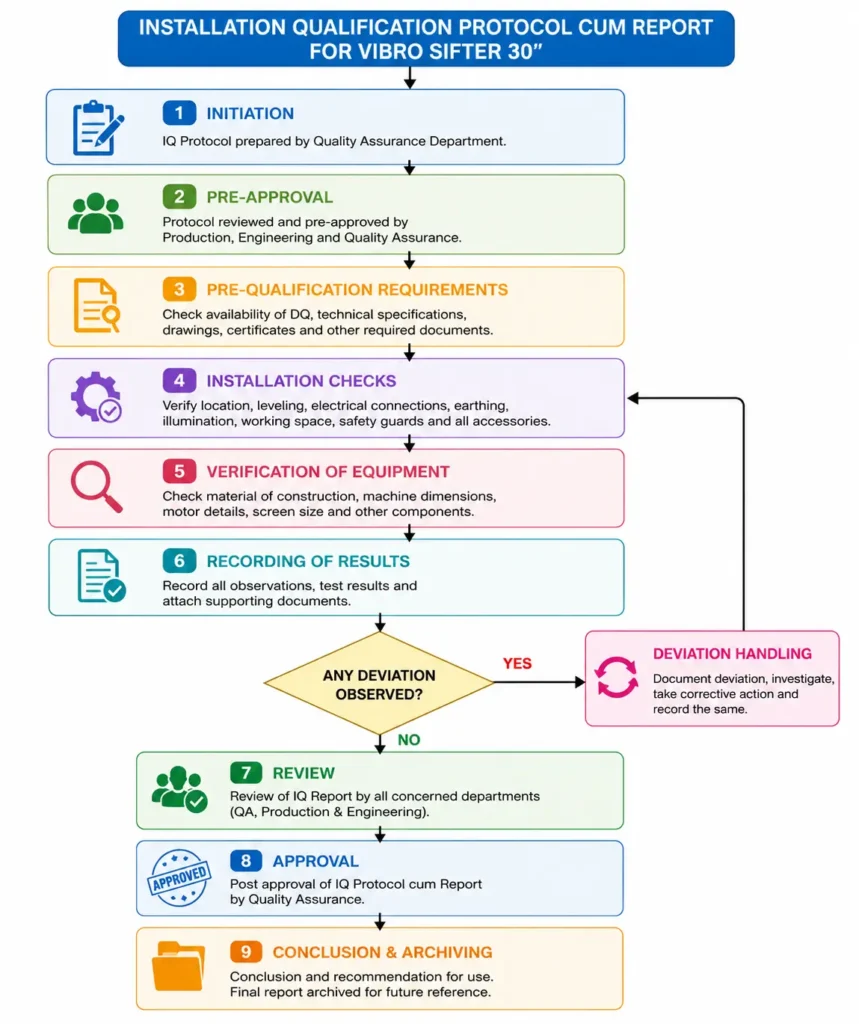
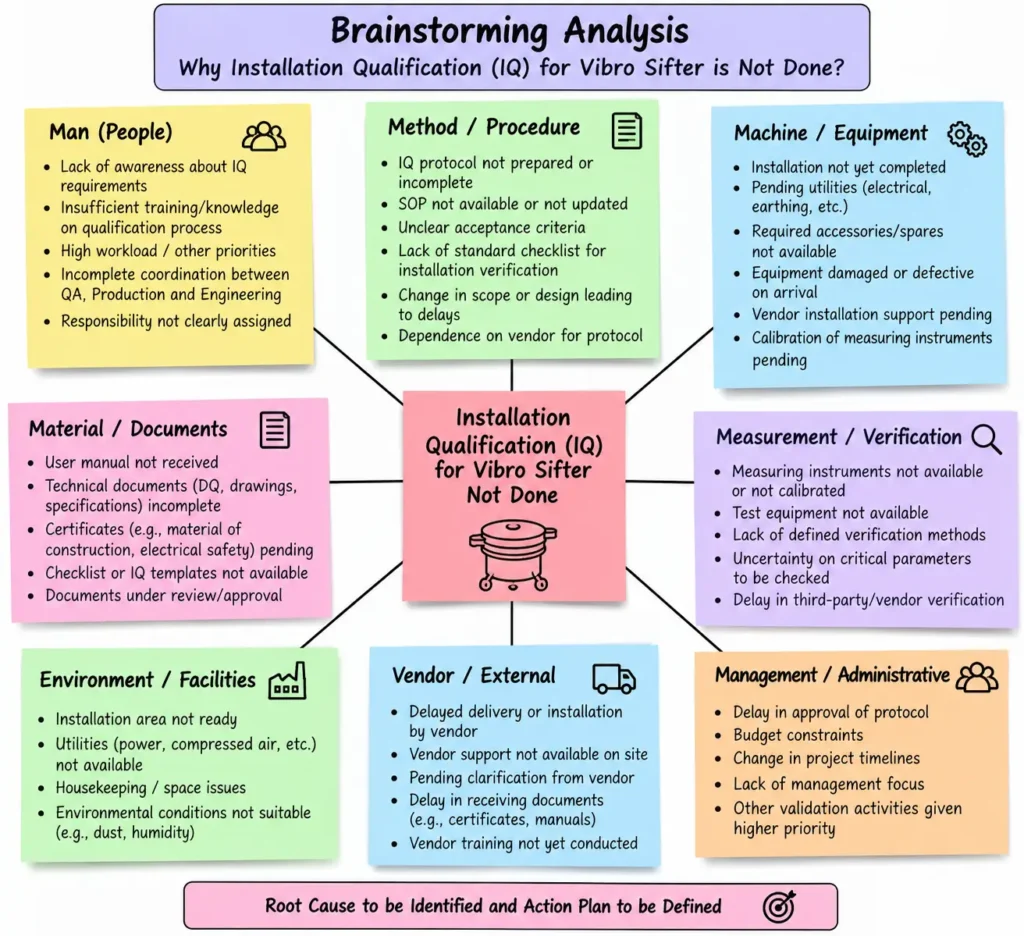
1. Brainstorming:
The brainstorming analysis identifies possible reasons why Installation Qualification (IQ) for the Vibro Sifter was not performed. The discussion focuses on potential gaps related to personnel, procedures, equipment readiness, documentation, utilities, verification activities, vendor support, and management controls. Possible causes include inadequate awareness of qualification requirements, incomplete or unapproved IQ protocol, missing technical documents, pending electrical or mechanical installation, unavailable calibrated instruments, delayed vendor support, and weak coordination among QA, Production, and Engineering. The exercise helps organize all probable causes before selecting the most likely root cause. The identified factors should be evaluated using supporting evidence, and appropriate corrective and preventive actions should be established to ensure completion of IQ and prevent recurrence.
2. 5 Why Analysis:
The 5 Why Analysis was performed to identify the underlying reason why Installation Qualification (IQ) of the Vibro Sifter was not completed. The analysis begins with the immediate issue—IQ was not performed—and progressively evaluates contributing factors such as delayed preparation or approval of the IQ protocol, incomplete availability of required documents and drawings, insufficient coordination among QA, Engineering, Production, and the vendor, and lack of defined responsibility and follow-up.
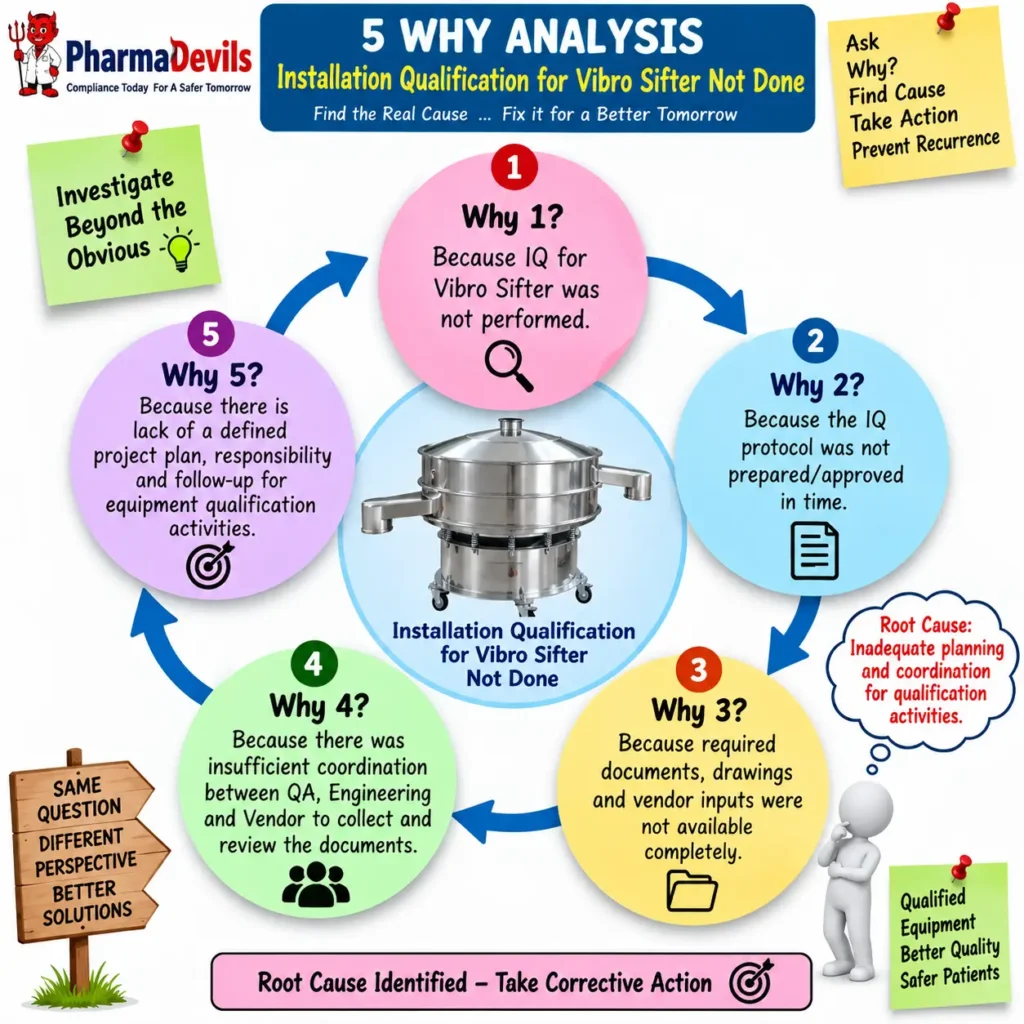
The analysis indicates that the likely root cause is inadequate planning, coordination, and ownership of equipment qualification activities. By identifying this systemic cause, suitable CAPA can be established, including defined responsibilities, qualification scheduling, timely document collection, protocol approval, and periodic follow-up. This approach helps ensure that the Vibro Sifter is properly qualified before routine GMP use and reduces the risk of recurrence.
3. Heat Map (FMEA):
The circular heat map provides a visual assessment of the potential risks associated with non-completion of Installation Qualification (IQ) for the Vibro Sifter. The identified risk factors are categorized as High, Medium, or Low risk according to their potential impact on equipment qualification and GMP compliance. High-risk areas include non-preparation or delayed approval of the IQ protocol, incomplete technical documents and drawings, incomplete mechanical/electrical installation, inadequate qualification planning, and insufficient management oversight. Medium-risk factors include utilities and site readiness, vendor support, coordination, and unclear responsibilities. Training and awareness gaps may be comparatively lower risk but still require monitoring and corrective action.
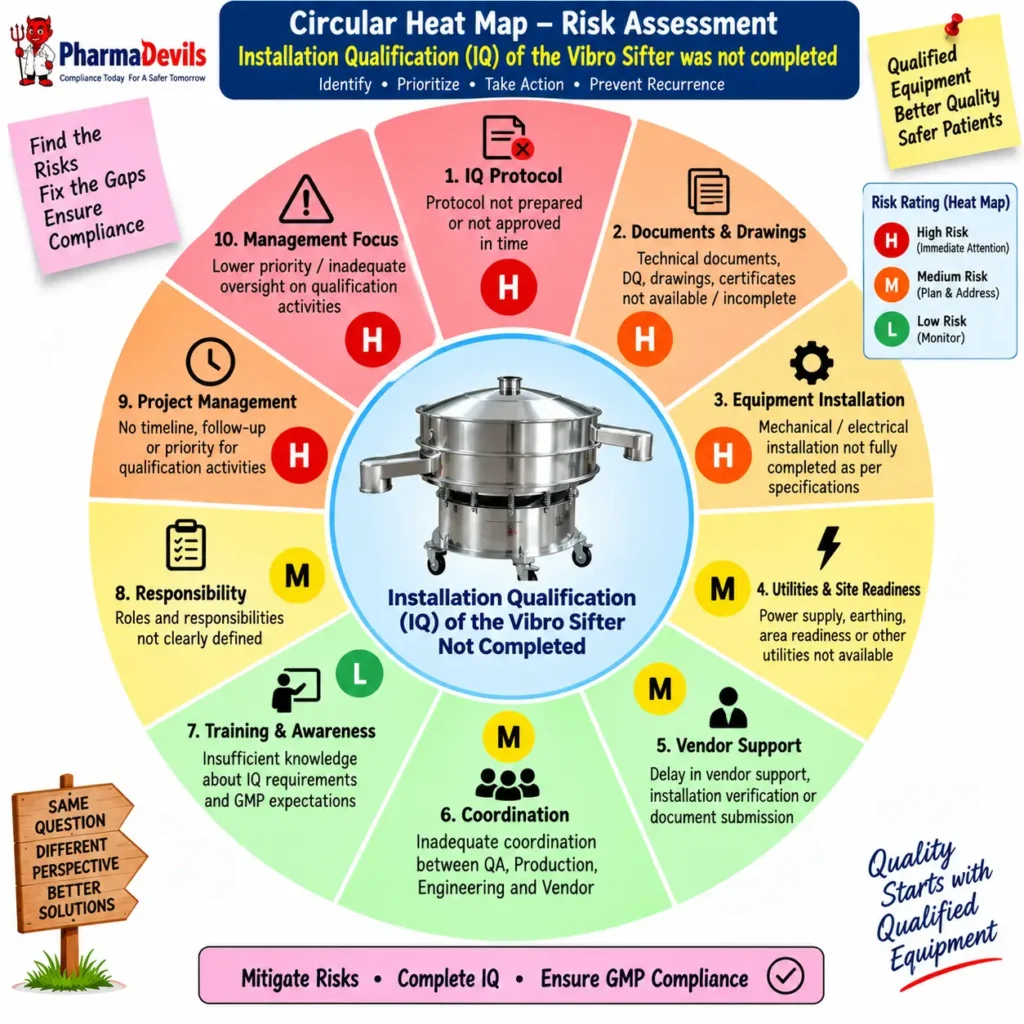
The heat map helps prioritize actions based on risk severity. High-risk gaps should receive immediate attention, followed by completion of required documentation, installation verification, defined responsibilities, CAPA, and formal execution and approval of the Vibro Sifter IQ before routine GMP operation.
4. Impact Assessment:
The Installation Qualification of the 30-inch Vibro Sifter will have a positive impact on equipment reliability, product quality, and operator safety. The qualification confirms that the Vibro Sifter is installed correctly as per approved specifications and supplier requirements. Important items such as machine location, leveling, electrical connections, earthing, illumination, working space, and safety guards are checked during qualification. The material of construction, equipment dimensions, motor details, screen size, and other components are also verified to ensure that they meet the required specifications. Proper verification helps identify installation problems before routine use. Any deviation found during qualification can be recorded, reviewed, and corrected. This reduces the risk of equipment failure, unsafe operation, and improper sifting. Overall, the IQ activity provides documented evidence that the Vibro Sifter is properly installed and suitable to proceed for further qualification and routine pharmaceutical manufacturing activities.
Questions & Answers:
- What is the purpose of Installation Qualification (IQ) for the Vibro Sifter?
The purpose is to confirm with documented evidence that the Vibro Sifter and its components are installed according to approved specifications and supplier requirements. - Which equipment is covered in this IQ protocol?
The protocol covers the 30-inch Vibro Sifter, manufactured/supplied by Elicon Pharma. - What is the main function of a Vibro Sifter?
It separates material according to particle size using a vibrating screen. Fine material passes through the mesh, while coarse material remains above the screen. - Which departments are involved in the qualification?
Quality Assurance, Production, and Engineering are involved in reviewing, executing, monitoring, and approving the qualification activity. - Which documents should be checked before qualification?
Design Qualification documents, P&ID, electrical diagrams, equipment technical specifications, and material-of-construction certificates should be checked. - What installation conditions are checked?
Leveling, smooth edges, proper welding, installation location, room condition, illumination, and sufficient working space are checked. - What electrical requirements are verified?
Voltage, phase, frequency, secured electrical connections, tightened terminals, and proper earthing are verified. - What is the required electrical supply?
The equipment requires 415 V, 3-phase, 50 Hz electrical supply. - What material is used for major product-contact parts?
Major product-contact parts such as the top lid, top deck, bottom deck, mesh, base, and clamp are specified as AISI 316 stainless steel. - What safety items are checked during IQ?
Proper equipment installation, electrical wiring, earthing, guards for moving parts, and the Start/On-Off switch are checked for safety. - What should be done if a deviation is found?
The deviation should be recorded and handled through the defined deviation section of the IQ report before final review and conclusion. - What happens after completion of Installation Qualification?
The qualification results are reviewed, a conclusion and recommendation are recorded, and the protocol is finally approved by the concerned departments. - Why is Installation Qualification important?
It provides documented evidence that the Vibro Sifter has been installed correctly and that required installation, component, electrical, and safety checks have been completed before further use. - What is the screen diameter of the Vibro Sifter?
The specified screen diameter is 750 mm. - What is the minimum illumination requirement around the equipment?
The illumination should be not less than 300 Lux.
Reference Guidelines:
For Installation Qualification (IQ) of a Vibro Sifter, the following guidelines are appropriate references:
- WHO TRS 1019, Annex 3 – Good Manufacturing Practices: Guidelines on Validation: Qualification is part of validation and should be applied throughout the lifecycle of equipment and systems. Risk management should determine the extent of qualification.
WHO TRS 1019 Annex 3 - WHO TRS 1019, Annex 3, Appendix 6 – Guidelines on Qualification: Provides principles for qualification of premises, systems, utilities, and equipment, including documented verification that equipment is installed appropriately.
- EU GMP Annex 15 – Qualification and Validation: Requires qualification and validation activities to demonstrate control over facilities, equipment, utilities, and processes, with the scope based on quality risk management.
EU GMP Annex 15 - US FDA – Process Validation: General Principles and Practices (2011): States that equipment and utilities should be verified as being properly installed according to design specifications, with correct materials, capacity, connections, and calibration before routine commercial manufacture.
FDA Process Validation Guidance - WHO Quality Assurance of Pharmaceuticals, Volume 2 – GMP and Inspection: Covers GMP expectations including equipment qualification, validation, documentation, and inspection principles.
For an investigation where Vibro Sifter IQ was not completed, the strongest primary references would be EU GMP Annex 15, WHO TRS 1019 Annex 3/Appendix 6, applicable Schedule M requirements, and the approved site Validation Master Plan/IQ SOP.