







1. Brief Description:
Design Qualification (DQ) of a Walk-In Stability Chamber is a documented process used to confirm that the proposed chamber design is suitable for its intended purpose and meets the User Requirement Specification (URS), GMP requirements, and applicable regulatory guidelines. The DQ review covers chamber capacity, construction materials, insulation, temperature and humidity control systems, HVAC arrangement, sensors, alarms, data recording, electrical systems, safety features, and utility requirements. The design is checked to ensure that required stability conditions, such as controlled temperature and relative humidity, can be maintained uniformly throughout the chamber. Drawings, technical specifications, layouts, components, and control systems are reviewed before procurement or installation. Any design gaps or risks identified during the review are documented and corrected. After satisfactory verification and approval by QA and concerned departments, the DQ is considered complete and the chamber can proceed to installation and subsequent qualification stages such as IQ, OQ, and PQ.
Skip to PDF content2. Flow Diagram:
The flow diagram for Design Qualification (DQ) of a Walk-In Stability Chamber shows the systematic steps followed to confirm that the proposed chamber design meets the User Requirement Specification (URS), GMP expectations, and applicable regulatory requirements. The process starts with defining requirements, including chamber capacity, temperature and humidity conditions, utilities, safety, and facility needs.
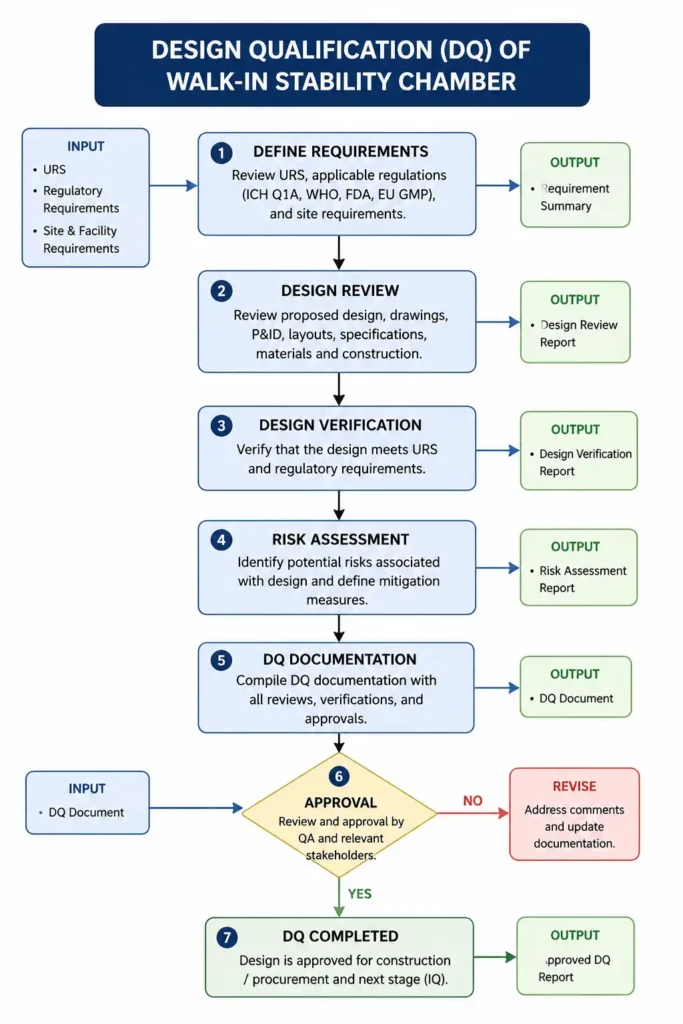
The proposed design, drawings, specifications, construction materials, control systems, sensors, alarms, and data recording arrangements are then reviewed. Design verification is performed to confirm that all user and regulatory requirements are properly addressed. A risk assessment is conducted to identify possible design-related failures and suitable control measures. All findings and reviews are compiled in the DQ documentation and submitted for approval by QA and relevant departments. If any deficiencies are identified, the design is revised. Once approved, the DQ is completed and the chamber can proceed to installation and subsequent IQ, OQ, and PQ activities.
3. Brainstorming:
Brainstorming during the Design Qualification of a Walk-In Stability Chamber is used to collect ideas, requirements, risks, and technical considerations from different departments before finalizing the chamber design. Representatives from QA, Engineering, Validation, Production, and other concerned functions review important aspects such as chamber capacity, temperature and humidity range, construction materials, HVAC design, air circulation, sensors, alarms, utilities, safety features, data recording, and regulatory requirements.
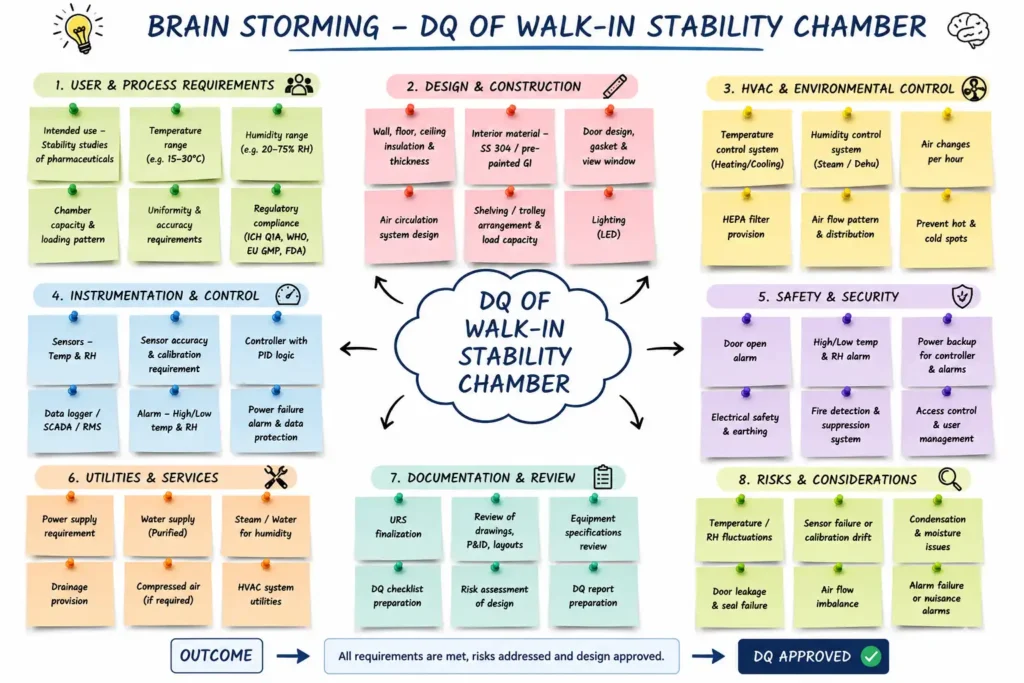
The team also identifies possible design risks such as temperature or humidity fluctuations, sensor failure, door leakage, poor air distribution, power failure, and alarm malfunction. These points are discussed and recorded so that suitable controls can be incorporated into the design. Brainstorming helps ensure that all user requirements and operational needs are considered at an early stage. It supports better risk control, reduces design gaps, and helps develop a compliant, reliable, and practical Walk-In Stability Chamber before final DQ approval.
4. 5-Why Analysis:
The 5-Why Analysis is a simple root cause investigation tool used to identify the underlying reason for failure of the Design Qualification (DQ) of a Walk-In Stability Chamber. The analysis begins with the main problem, such as the chamber design not meeting the User Requirement Specification (URS). The question “Why?” is then asked repeatedly to move from the visible problem to the deeper cause.
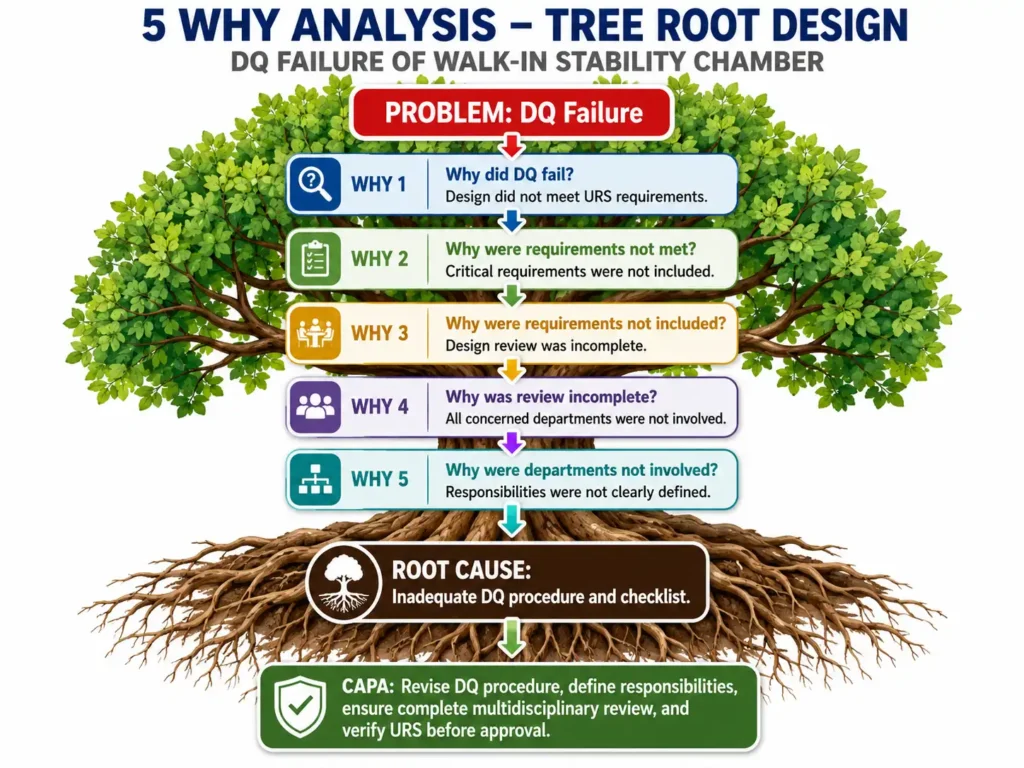
In this case, the analysis may show that critical requirements were missed because the design review was incomplete, all concerned departments were not involved, and responsibilities were not clearly defined. The final root cause may be an inadequate DQ procedure or checklist. Based on the identified root cause, suitable CAPA can be implemented, such as revising the DQ procedure, defining departmental responsibilities, strengthening multidisciplinary review, and verifying all URS requirements before approval. This helps prevent recurrence and improves the reliability of the DQ process.
5. Heat Map (FMEA):
A Heat Map in Failure Mode and Effects Analysis (FMEA) is a visual risk assessment tool used to identify, evaluate, and prioritize potential failures during the Design Qualification of a Walk-In Stability Chamber. Each failure mode is assessed based on Severity (S), Occurrence (O), and Detection (D), and the Risk Priority Number (RPN) is calculated.
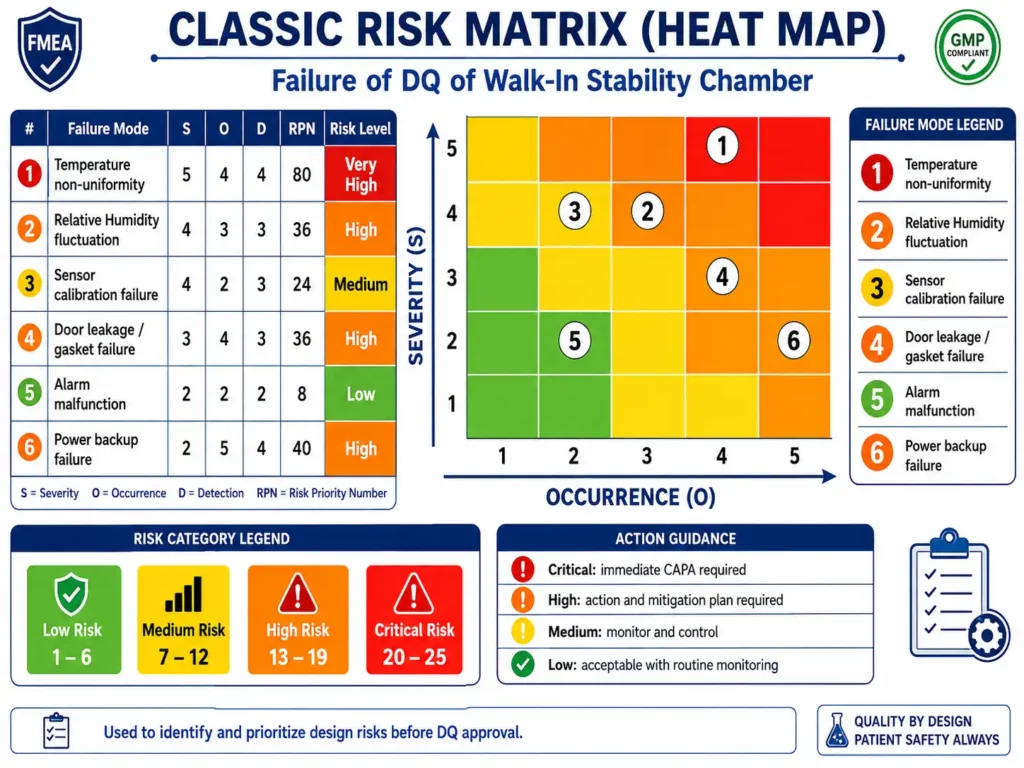
Typical risks may include temperature non-uniformity, relative humidity fluctuation, sensor calibration failure, door leakage, alarm malfunction, and power backup failure. These risks are plotted on a color-coded matrix to indicate their level of concern. Green represents low risk, yellow indicates medium risk, orange shows high risk, and red represents critical risk. High and critical risks require suitable mitigation or CAPA before DQ approval. The Heat Map makes risk prioritization simple, supports effective decision-making, and helps ensure the chamber design is reliable, compliant, and suitable for stability studies.
Critical Process Parameters (CPP) & Critical Quality Attributes (CQA) – Walk-In Stability Chamber
| Critical Process Parameters (CPPs) | Critical Quality Attributes (CQAs) |
|---|---|
| Temperature set point | Temperature accuracy |
| Relative humidity set point | Relative humidity accuracy |
| Heating and cooling performance | Temperature uniformity |
| Humidification/dehumidification control | Humidity uniformity |
| Airflow rate and circulation pattern | Absence of hot and cold spots |
| Air change / circulation rate | Stable environmental conditions |
| Sensor location and calibration | Accurate temperature/RH monitoring |
| Controller/PID settings | Consistent control without excessive fluctuation |
| Door opening frequency and duration | Rapid recovery after door opening |
| Alarm set points and delay time | Reliable high/low temperature and RH alarms |
| Data logging frequency | Complete and traceable environmental records |
| Power supply and backup system | Continuity of chamber operation |
| Chamber loading pattern | Uniform conditions under loaded state |
| Insulation and door-seal integrity | Minimum temperature/RH loss or leakage |
| Preventive maintenance frequency | Reliable long-term chamber performance |
Questions & Answers – Design Qualification of Walk-In Stability Chamber
1. What is Design Qualification (DQ)?
Design Qualification is documented evidence that the proposed design meets the User Requirement Specification (URS), GMP requirements, and intended use.
2. Why is DQ required for a Walk-In Stability Chamber?
DQ ensures that the chamber is properly designed to maintain the required temperature and relative humidity conditions.
3. What documents are reviewed during DQ?
URS, technical specifications, drawings, layouts, equipment details, control philosophy, utility requirements, and vendor documents are reviewed.
4. Which parameters are most critical in a stability chamber?
Temperature, relative humidity, airflow, sensor accuracy, alarm performance, and data recording are critical parameters.
5. Why is temperature uniformity important?
Uniform temperature ensures that all stability samples are exposed to the same controlled environmental conditions.
6. Why is relative humidity control important?
Proper humidity control helps maintain the specified stability storage condition throughout the chamber.
7. What is the role of HVAC in a Walk-In Stability Chamber?
HVAC provides proper air circulation and helps maintain uniform temperature and humidity.
8. What alarms should be considered during DQ?
High/low temperature, high/low humidity, door-open, power failure, and system fault alarms should be considered.
9. Why are sensors reviewed during DQ?
Sensors are reviewed to ensure suitable range, accuracy, location, calibration, and reliable monitoring.
10. What is the purpose of risk assessment during DQ?
Risk assessment identifies potential design failures and helps establish suitable preventive controls.
11. What are common DQ failure risks?
Temperature variation, humidity fluctuation, poor airflow, sensor failure, door leakage, alarm failure, and power failure are common risks.
12. Who is responsible for DQ review and approval?
QA, Engineering, Validation, User Department, and other concerned functions generally participate in review and approval.
13. What happens if the design does not meet the URS?
The design is revised, deficiencies are corrected, and the design is re-reviewed before approval.
14. When is DQ considered complete?
DQ is complete when all design requirements, risks, drawings, specifications, and supporting documents are satisfactorily reviewed and approved.
15. What qualification stages follow DQ?
After DQ approval, the Walk-In Stability Chamber proceeds to Installation Qualification (IQ), Operational Qualification (OQ), and Performance Qualification (PQ).