







1. Introduction for Installation Qualification (IQ) of Walk-In Stability Chamber:
Installation Qualification (IQ) of a Walk-In Stability Chamber is a documented procedure performed to verify that the equipment is installed correctly in accordance with approved design specifications, manufacturer recommendations, and Good Manufacturing Practices (GMP). The qualification involves verification of equipment identification, construction materials, chamber dimensions, electrical connections, utilities, temperature and humidity sensors, control panels, safety features, calibration certificates, and technical documentation. It ensures that all critical components are properly installed and comply with predefined acceptance criteria. Successful completion of IQ provides documented evidence of installation compliance and establishes the foundation for Operational Qualification (OQ) and Performance Qualification (PQ) activities.
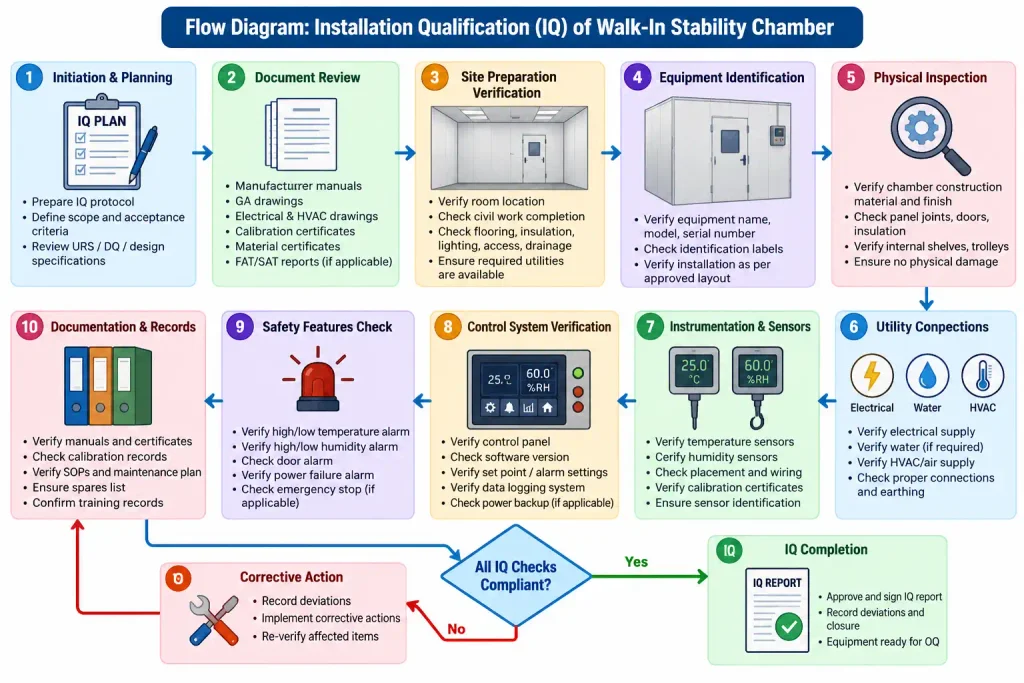
Skip to PDF content2. Flow Diagram for Installation Qualification (IQ) of Walk-In Stability Chamber:
The flow diagram illustrates the systematic procedure for Installation Qualification (IQ) of a Walk-In Stability Chamber in accordance with GMP requirements. The process begins with IQ planning, protocol preparation, and document review, followed by site verification and equipment identification. Physical inspection ensures proper installation, construction, and component integrity. Utility verification covers electrical connections, HVAC systems, and other applicable services. Instrumentation checks include temperature and humidity sensors, calibration certificates, and control systems. Safety features, alarms, and documentation are verified against predefined acceptance criteria. Any deviations require corrective actions and re-verification before final IQ report approval and progression to Operational Qualification (OQ).
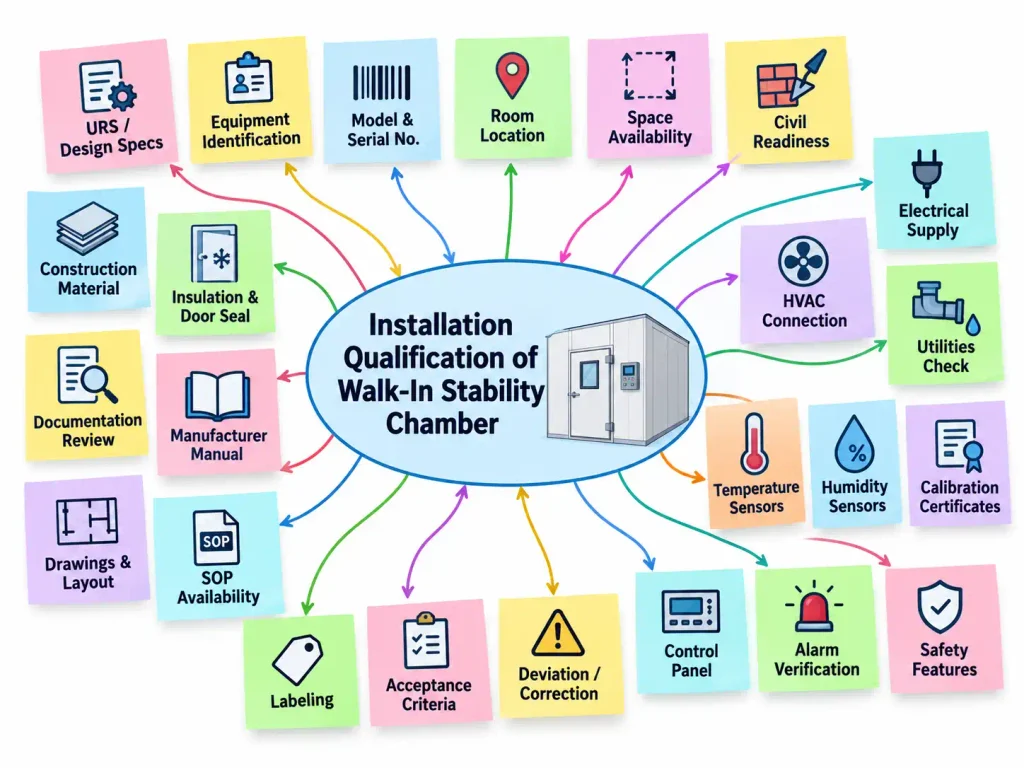
3. Brainstorming Analysis for Installation Qualification (IQ) of Walk-In Stability Chamber:
The brainstorming analysis identifies critical aspects requiring verification during Installation Qualification (IQ) of a Walk-In Stability Chamber. Key considerations include equipment identification, design specifications, installation location, space availability, construction materials, insulation, door sealing, and utility connections. Additional checkpoints cover electrical supply, HVAC connections, temperature and humidity sensors, calibration certificates, control panels, alarms, and safety features. Documentation review includes manufacturer manuals, approved drawings, SOPs, and acceptance criteria. Potential installation deficiencies, deviations, and corrective actions are evaluated to ensure GMP compliance. This structured brainstorming approach supports effective risk identification, comprehensive installation verification, and successful completion of qualification activities.
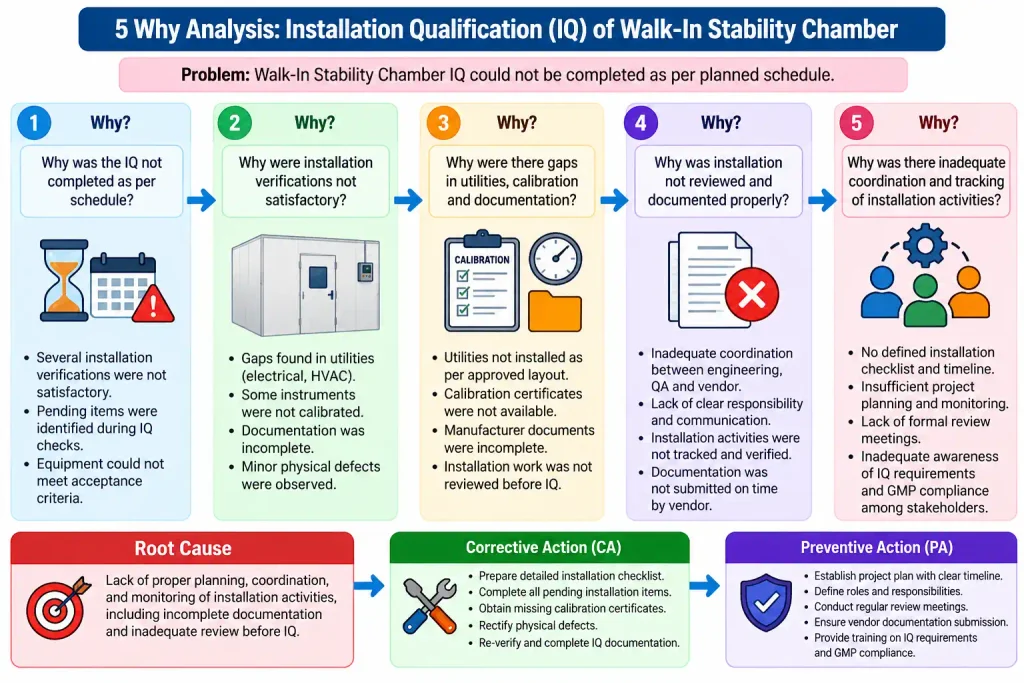
4. 5 Why Analysis for Installation Qualification (IQ) of Walk-In Stability Chamber:
The 5 Why Analysis identifies potential root causes of delays or deficiencies during Installation Qualification (IQ) of a Walk-In Stability Chamber. The investigation examines incomplete installation verification, utility deficiencies, missing calibration certificates, inadequate documentation, and insufficient coordination between Engineering, Quality Assurance, and vendors. Repeated questioning helps identify underlying causes, including poor planning, unclear responsibilities, and inadequate monitoring of installation activities. Corrective actions include completing pending installations, obtaining calibration records, rectifying deficiencies, and verifying documentation. Preventive actions focus on standardized checklists, defined responsibilities, personnel training, and periodic reviews to ensure successful qualification and compliance with GMP requirements.
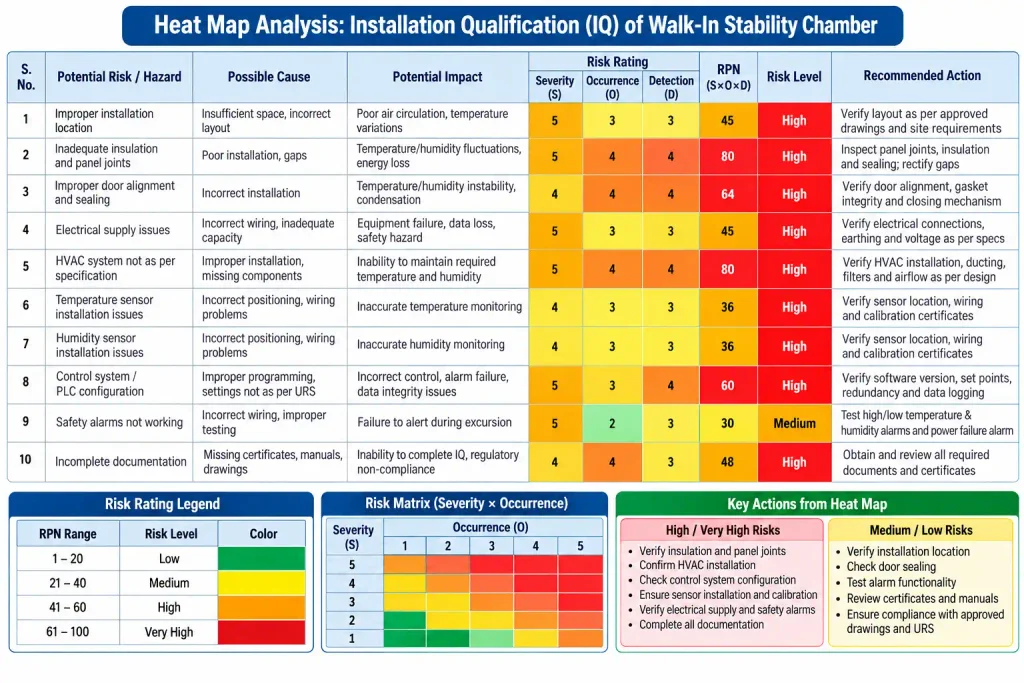
5. Heat Map Analysis for Installation Qualification (IQ) of Walk-In Stability Chamber:
The Heat Map Analysis evaluates potential risks associated with Installation Qualification (IQ) of a Walk-In Stability Chamber using Failure Mode and Effects Analysis (FMEA). Identified risks include improper installation, inadequate insulation, electrical deficiencies, HVAC malfunction, sensor inaccuracies, control system failures, and incomplete documentation. Each risk is assessed based on Severity (S), Occurrence (O), and Detection (D), with Risk Priority Number (RPN) calculated accordingly. Colour-coded risk levels help prioritize corrective and preventive actions. High-risk issues require immediate attention, while medium- and low-risk issues undergo appropriate controls. This approach supports systematic risk mitigation, equipment reliability, and GMP compliance.
6. Fishbone Analysis for Installation Qualification (IQ) of Walk-In Stability Chamber:
The Fishbone (Ishikawa) Analysis identifies potential causes of deficiencies during Installation Qualification (IQ) of a Walk-In Stability Chamber. The analysis categorizes contributing factors into six major areas: Man, Machine, Method, Material, Measurement, and Environment. Key issues include inadequate personnel training, equipment defects, incomplete IQ protocols, missing calibration certificates, improper sensor installation, and unsuitable environmental conditions. This systematic approach helps identify potential root causes of installation failures and GMP non-compliance. Appropriate corrective and preventive actions include personnel training, equipment verification, documentation review, calibration checks, and improved installation procedures to ensure successful qualification and reliable chamber operation.
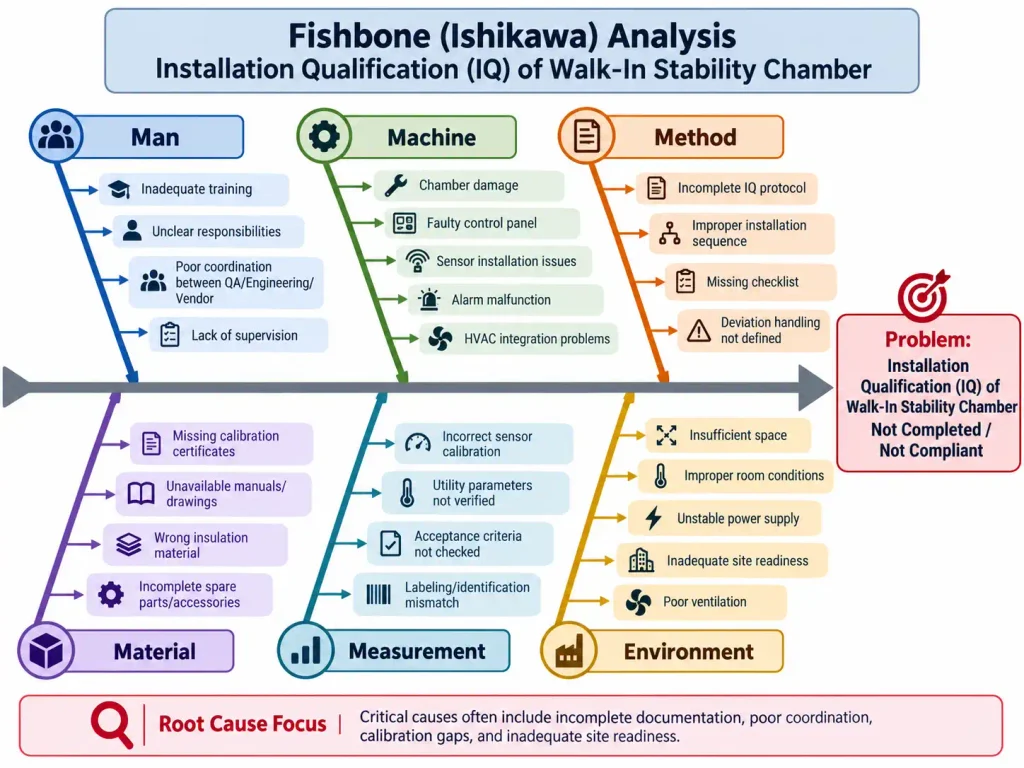
7. Fault Tree Analysis for Installation Qualification (IQ) of Walk-In Stability Chamber:
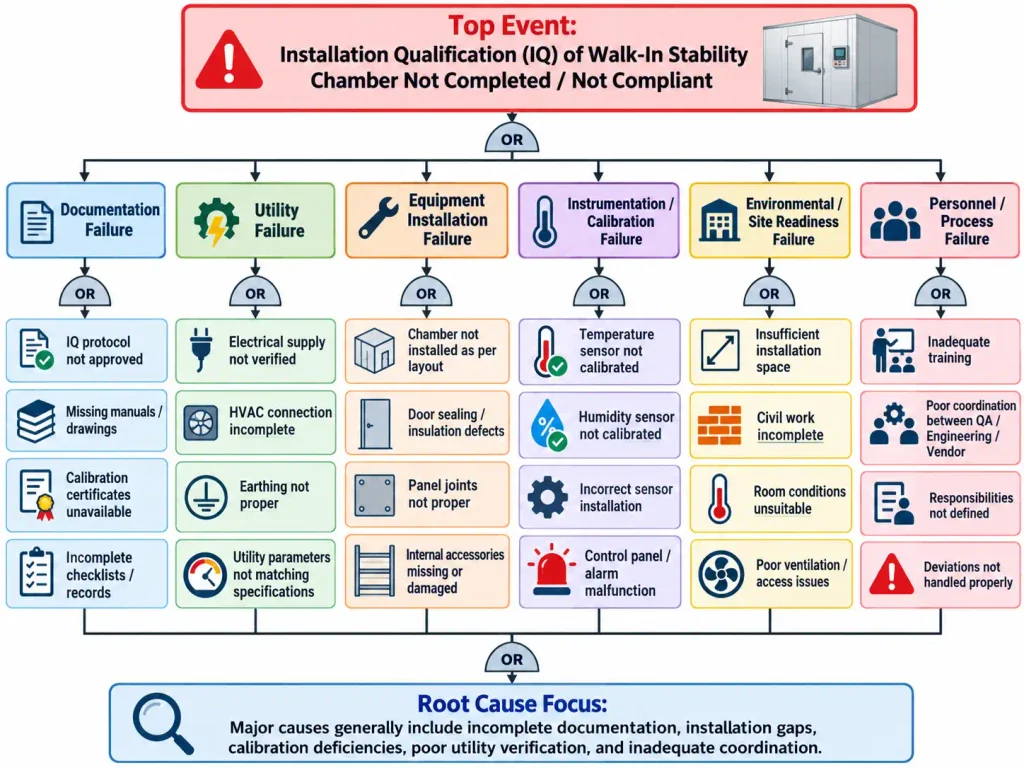
The Fault Tree Analysis (FTA) identifies potential causes of failure during Installation Qualification (IQ) of a Walk-In Stability Chamber. The analysis evaluates critical factors, including incomplete documentation, utility failures, improper equipment installation, calibration deficiencies, unsuitable environmental conditions, and personnel-related errors. Each failure category is systematically examined to identify contributing factors such as electrical issues, sensor inaccuracies, inadequate training, and missing qualification records. The analysis supports root cause identification, risk prioritization, and implementation of appropriate corrective and preventive actions (CAPA). This structured approach helps ensure successful installation qualification, equipment reliability, regulatory compliance, and adherence to Good Manufacturing Practices (GMP).
8. Pareto Chart Analysis for Installation Qualification (IQ) of Walk-In Stability Chamber:
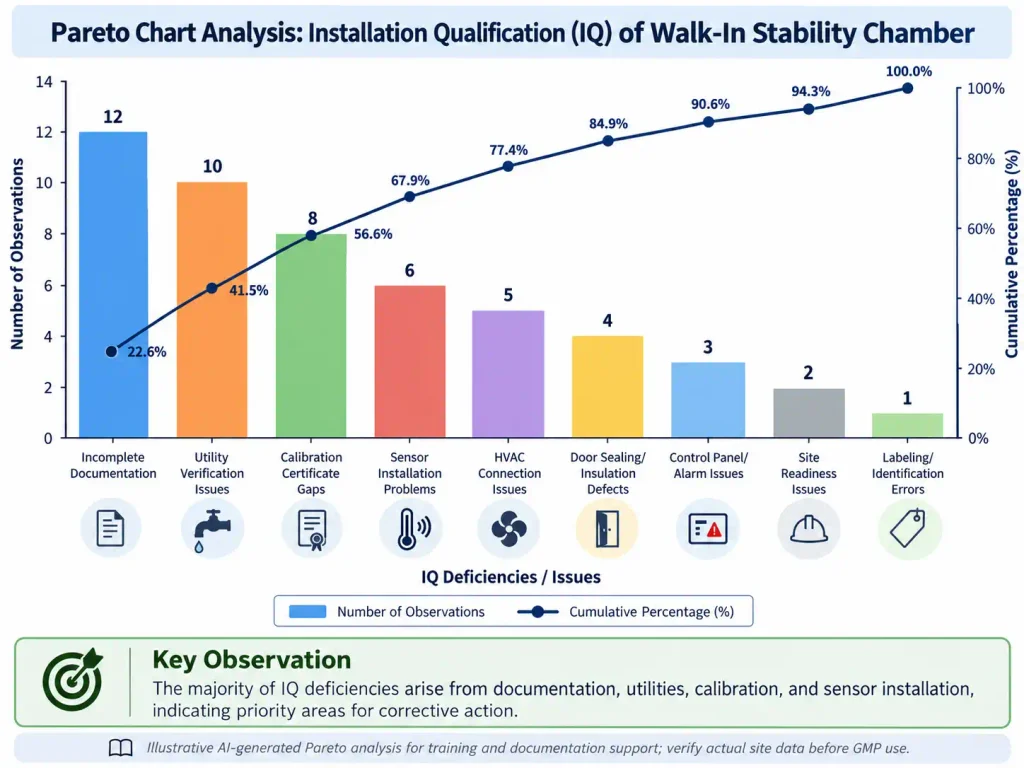
The Pareto Chart Analysis identifies and prioritizes potential deficiencies during Installation Qualification (IQ) of a Walk-In Stability Chamber. It highlights major issues, including incomplete documentation, utility verification failures, missing calibration certificates, sensor installation problems, HVAC connection deficiencies, and inadequate door sealing. The chart applies the Pareto principle to identify frequently occurring problems and their cumulative contribution to qualification failures. This approach supports effective root cause investigation, resource allocation, and implementation of corrective and preventive actions (CAPA). By prioritizing significant deficiencies, the analysis improves installation reliability, strengthens GMP compliance, and supports successful completion of qualification activities.
9. Corrective Action and Preventive Action (CAPA) with Effectiveness Review for Installation Qualification (IQ) of Walk-In Stability Chamber:
1. Introduction
Corrective Action and Preventive Action (CAPA) is an essential component of the Installation Qualification (IQ) of a Walk-In Stability Chamber. It ensures that identified installation deficiencies, documentation gaps, utility failures, calibration issues, and equipment-related nonconformities are systematically investigated, corrected, and prevented from recurring.
The CAPA process involves identifying deviations, conducting Root Cause Analysis (RCA), implementing corrective and preventive measures, and verifying their effectiveness. The objective is to ensure that the Walk-In Stability Chamber is installed according to approved design specifications, manufacturer recommendations, and Good Manufacturing Practices (GMP).
2. Corrective and Preventive Action (CAPA) Plan
The following table provides an illustrative CAPA plan for potential observations identified during Installation Qualification.
| S. No. | Potential Observation | Corrective Action (CA) | Preventive Action (PA) |
|---|---|---|---|
| 1 | Incomplete IQ documentation | Obtain missing drawings, manuals, certificates, and installation records. | Implement a QA-approved IQ documentation checklist. |
| 2 | Improper equipment installation | Correct installation according to approved layout and specifications. | Introduce installation verification before IQ execution. |
| 3 | Electrical supply deficiencies | Rectify wiring, earthing, voltage, and electrical connection issues. | Implement preventive electrical inspection and verification procedures. |
| 4 | Inadequate chamber insulation | Repair damaged panels, insulation joints, and defective door gaskets. | Establish installation inspection and preventive maintenance checklists. |
| 5 | Temperature sensors improperly installed | Correct sensor positioning, identification, and wiring according to approved drawings. | Introduce documented sensor installation verification. |
| 6 | Humidity sensor calibration certificates unavailable | Obtain valid calibration certificates and arrange calibration where required. | Establish an instrument calibration schedule and tracking system. |
| 7 | HVAC or refrigeration installation deficiencies | Rectify installation defects and verify components against approved specifications. | Introduce vendor inspection and engineering verification before qualification. |
| 8 | Control panel configuration discrepancies | Correct installed configuration and verify the documented software/firmware version. | Introduce approved configuration verification and change control. |
| 9 | Alarm system installation deficiencies | Correct wiring, connections, and configuration discrepancies. | Include alarm installation checks in IQ and functional challenge testing in OQ. |
| 10 | Inadequate installation space or access | Rectify layout deficiencies and ensure required maintenance access. | Review room dimensions and equipment placement during design qualification. |
| 11 | Missing equipment identification labels | Apply approved equipment and instrument identification labels. | Establish an equipment identification and labeling procedure. |
| 12 | Incomplete personnel training | Train responsible personnel on approved IQ procedures. | Establish role-specific qualification training and competency assessment. |
3. Effectiveness Review of CAPA
The effectiveness review determines whether implemented corrective and preventive actions have adequately addressed identified root causes and minimized the likelihood of recurrence.
| CAPA Area | Effectiveness Verification Method | Acceptance Criteria |
|---|---|---|
| Documentation | Review completed IQ records and supporting documents. | All required documents available, reviewed, and approved. |
| Equipment installation | Repeat affected installation verification checks. | Installation meets approved IQ acceptance criteria. |
| Electrical connections | Review electrical inspection and verification records. | All electrical parameters comply with approved specifications. |
| Chamber insulation | Inspect panels, joints, insulation, and door gaskets. | No unacceptable physical defects or installation gaps. |
| Sensors | Verify sensor installation and calibration records. | Correct installation and valid calibration status confirmed. |
| HVAC/refrigeration components | Verify installed components against approved drawings. | All applicable components installed correctly. |
| Control system | Review configuration records and identification details. | Installed configuration matches approved specifications. |
| Alarm system | Verify installation records and subsequent OQ test results. | All applicable alarms successfully verified during OQ. |
| Personnel training | Review training records and competency assessments. | All assigned personnel trained and qualified. |
| Deviation closure | Review approved deviation reports and CAPA evidence. | All critical IQ deviations resolved and formally closed. |
4. CAPA Effectiveness Review Procedure
- CAPA implementation: Ensure that all approved corrective and preventive actions are completed with supporting evidence.
- Re-verification: Repeat affected IQ checks to confirm that installation deficiencies have been satisfactorily corrected.
- Documentation review: QA verifies the completed IQ protocol, deviation reports, calibration certificates, and supporting records.
- Effectiveness monitoring: Review applicable OQ results, maintenance records, and recurring installation-related deviations over a risk-based period.
- Final CAPA closure: QA approves closure only after verifying implementation, effectiveness, and acceptable residual risks.
5. CAPA Effectiveness Review Format
| Parameter | Details |
|---|---|
| Equipment | Walk-In Stability Chamber |
| Qualification Stage | Installation Qualification (IQ) |
| CAPA Reference No. | __________ |
| Deviation Reference No. | __________ |
| Root Cause | __________ |
| Corrective Action Completed | Yes / No |
| Preventive Action Completed | Yes / No |
| Supporting Evidence | __________ |
| IQ Re-verification Result | Pass / Fail |
| Effectiveness Review Date | __________ |
| Recurrence Observed | Yes / No |
| Effectiveness Status | Effective / Ineffective / Pending |
| Reviewed By | QA / Engineering |
| Approved By | Head QA |
6. CAPA Effectiveness Conclusion
CAPA shall be considered effective when identified installation deficiencies have been corrected, affected IQ acceptance criteria are satisfactorily met, preventive controls are implemented, and supporting documentation is verified. Where appropriate, evidence from subsequent Operational Qualification (OQ) and monitoring activities shall support the effectiveness assessment. If any CAPA is found ineffective, the investigation shall be reopened or a new CAPA initiated according to the approved site procedure. The effectiveness review should follow a risk-based approach consistent with ICH Q9(R1), including continued review when new information becomes available.
10. Questions and Answers (Q&A) on Installation Qualification (IQ) of Walk-In Stability Chamber:
Q1. What is Installation Qualification (IQ) of a Walk-In Stability Chamber?
Answer: Installation Qualification is a documented process that verifies whether the Walk-In Stability Chamber has been installed according to approved design specifications, manufacturer recommendations, and GMP requirements.
Q2. What is the main objective of IQ?
Answer: The primary objective is to ensure that the equipment, utilities, instrumentation, safety systems, and associated components are installed correctly before proceeding with Operational Qualification (OQ).
Q3. Which documents are required during IQ?
Answer: Important documents include the approved IQ protocol, User Requirement Specification (URS), design documents, equipment manuals, layout drawings, electrical diagrams, calibration certificates, component lists, and installation records.
Q4. What are the critical components verified during IQ?
Answer: Critical components include the chamber panels, insulation, doors, gaskets, refrigeration system, humidification system, temperature and humidity sensors, control panel, electrical connections, and safety devices.
Q5. Why is temperature sensor verification important?
Answer: Temperature sensor verification ensures that sensors are correctly installed, identified, positioned, and calibrated for reliable monitoring and subsequent qualification testing.
Q6. Why is humidity sensor calibration necessary?
Answer: Humidity sensor calibration provides documented evidence that the instruments meet specified measurement accuracy requirements, supporting reliable relative humidity monitoring.
Q7. What utilities are verified during IQ?
Answer: Utilities may include electrical supply, earthing, water supply, drainage, HVAC interfaces, and other services specified in the approved equipment design.
Q8. What are the typical stability conditions used in pharmaceutical stability studies?
Answer: Common ICH Q1A(R2) long-term conditions include 25°C ± 2°C/60% RH ± 5% RH or 30°C ± 2°C/65% RH ± 5% RH, while accelerated conditions commonly use 40°C ± 2°C/75% RH ± 5% RH. Other conditions may apply depending on the product, market, and regulatory requirements.
Q9. What is the difference between IQ, OQ, and PQ?
Answer:
| Qualification | Purpose |
|---|---|
| IQ | Verifies correct equipment installation and documentation. |
| OQ | Verifies equipment operation against predefined operating specifications. |
| PQ | Demonstrates consistent performance under defined, representative operating conditions. |
Q10. Is temperature and humidity mapping performed during IQ?
Answer: Generally, detailed temperature and humidity distribution mapping is performed during OQ and/or PQ according to the approved qualification strategy. IQ primarily verifies the correct installation and calibration status of associated instruments.
Q11. What is the importance of door gasket verification?
Answer: Door gasket verification ensures proper installation, alignment, and sealing integrity, helping prevent uncontrolled air exchange and supporting stable chamber conditions.
Q12. What are the acceptance criteria for IQ?
Answer: Acceptance criteria are established in the approved IQ protocol based on the URS, approved design specifications, manufacturer recommendations, and applicable GMP requirements.
Q13. What happens if an IQ acceptance criterion is not met?
Answer: The failure must be documented as a deviation, investigated, and assessed for impact. Appropriate corrections or CAPA must be implemented, followed by re-verification of affected installation requirements.
Q14. What is the role of Quality Assurance during IQ?
Answer: Quality Assurance reviews and approves qualification documents, evaluates deviations, verifies compliance with approved procedures, and authorizes qualification closure according to the site quality management system.
Q15. What is the role of Engineering during IQ?
Answer: Engineering verifies equipment installation, utility connections, component specifications, technical drawings, instrument installation, and rectification of technical deficiencies.
Q16. Why are calibration certificates required during IQ?
Answer: Calibration certificates demonstrate the calibration status and traceability of measuring instruments and help confirm their suitability for subsequent qualification activities.
Q17. What are the common deficiencies identified during IQ?
Answer: Common deficiencies include incomplete documentation, incorrect equipment installation, missing calibration certificates, improper electrical connections, defective insulation, incorrect sensor placement, and incomplete equipment identification.
Q18. What is the purpose of risk assessment during IQ?
Answer: Risk assessment identifies installation-related hazards, evaluates their potential impact on product quality and equipment reliability, and establishes appropriate risk control measures.
Q19. How is CAPA effectiveness verified?
Answer: CAPA effectiveness is verified through reinspection, document review, repeated IQ checks, subsequent qualification evidence, and risk-based monitoring to confirm that identified causes have been adequately addressed.
Q20. What is the purpose of the IQ final report?
Answer: The IQ final report summarizes qualification activities, observations, deviations, corrective actions, verification results, and conclusions regarding compliance with approved installation requirements.
Q21. Who approves the IQ report?
Answer: The IQ report is reviewed and approved by designated authorized personnel, typically involving Engineering, Validation, and Quality Assurance, according to the company’s approved procedures.
Q22. Can the Walk-In Stability Chamber be used immediately after IQ completion?
Answer: No. Successful IQ completion establishes installation compliance but does not demonstrate operational or performance suitability. Required OQ, PQ, and other applicable activities must be completed and approved before routine stability-study use.
Q23. What is the importance of a data logging system?
Answer: The data logging system supports recording and monitoring of chamber conditions. During IQ, applicable hardware installation, connections, software identification, and system documentation are verified. Functional performance and data integrity controls are evaluated during subsequent qualification.
Q24. What is the importance of alarm verification?
Answer: Alarm verification helps ensure that the installed alarm system can notify personnel of abnormal conditions. Installation and configuration are checked during IQ, while functional challenges are generally performed during OQ.
Q25. Which regulatory guidelines are applicable to Walk-In Stability Chamber qualification?
Answer: Applicable references may include EU GMP Annex 15, WHO GMP qualification guidance, ICH Q1A(R2), ICH Q9(R1), and relevant national GMP regulations. The specific requirements depend on the intended use, product, and regulatory market.
Conclusion
Installation Qualification of a Walk-In Stability Chamber establishes documented evidence that the equipment and its associated systems are installed according to approved specifications. Proper documentation, verification of utilities and instruments, risk assessment, deviation management, and CAPA effectiveness reviews help ensure GMP compliance and readiness for subsequent Operational Qualification and Performance Qualification activities.
11. Reference Guidelines for Installation Qualification (IQ) of Walk-In Stability Chamber:
The following regulatory guidelines and technical standards provide references for Installation Qualification (IQ), stability testing, equipment calibration, risk assessment, documentation, and GMP compliance.
| S. No. | Reference Guideline | Relevance to IQ |
|---|---|---|
| 1 | EU GMP Annex 15 – Qualification and Validation | IQ protocols, installation verification, acceptance criteria, deviation handling, and qualification reporting. |
| 2 | ICH Q1A(R2) – Stability Testing of New Drug Substances and Products | Stability study conditions, storage requirements, and temperature/humidity specifications. |
| 3 | ICH Q9(R1) – Quality Risk Management | FMEA, risk assessment, root cause analysis, risk control, and risk review. |
| 4 | WHO TRS No. 992, Annex 5, Supplement 7 | Qualification of temperature-controlled storage areas, including installation verification. |
| 5 | US FDA 21 CFR 211.160(b)(4) | Calibration of measuring instruments, gauges, and recording devices. |
| 6 | US FDA 21 CFR 211.166 | Written stability testing programs and defined storage conditions. |
| 7 | 21 CFR Part 11 | Electronic records and electronic signatures, where applicable to computerized chamber systems. |
| 8 | ISO/IEC 17025:2017 | Competence of testing and calibration laboratories; relevant to calibration service providers. |
| 9 | Indian GMP – Schedule M, Drugs and Cosmetics Rules, 1945, as amended | Equipment qualification, maintenance, calibration, validation, and documentation requirements. |
| 10 | Manufacturer’s Technical Manual and Approved URS/DQ | Equipment-specific installation requirements, technical specifications, drawings, and utilities. |