Introduction for Operational Qualification (OQ) of Walk-In Stability Chamber:
Operational Qualification (OQ) of a Walk-In Stability Chamber is a documented verification process designed to ensure that the chamber operates according to predefined functional specifications and GMP requirements. The qualification protocol includes verification of temperature and humidity controllers, PLC operations, safety alarms, temperature overshoot and undershoot protection, low-water-level cutoffs, and time-delay mechanisms. It also evaluates standby refrigeration and humidity systems, HMI functionality, software access controls, personnel training, and SOP availability. All operational tests are performed against established acceptance criteria, with deviations documented and corrective actions reviewed. Successful qualification provides evidence of reliable chamber operation for pharmaceutical stability studies.
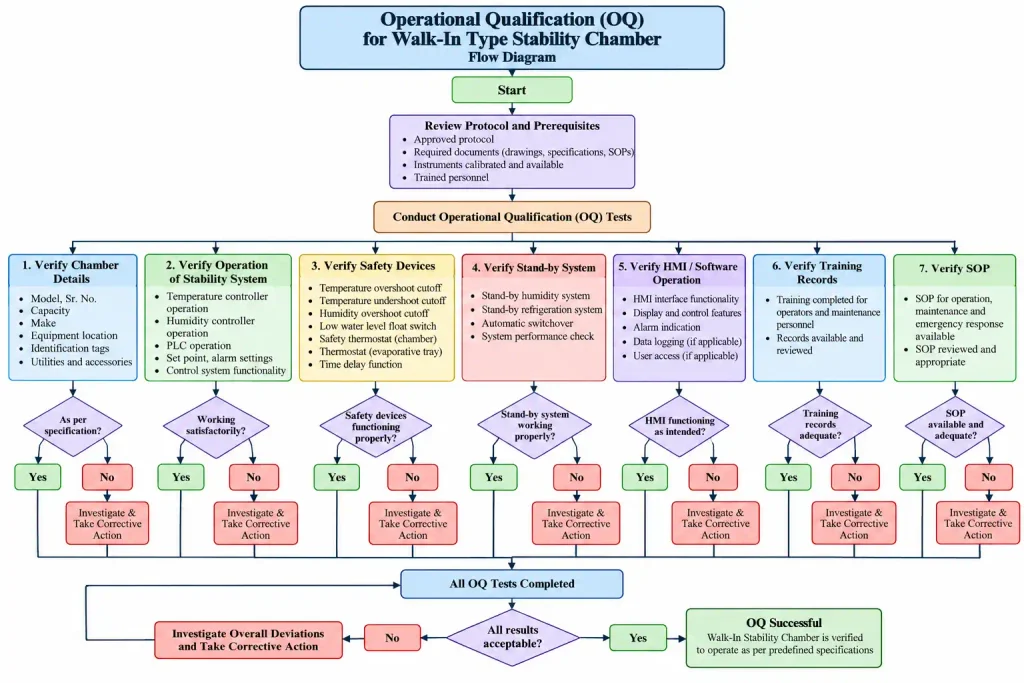
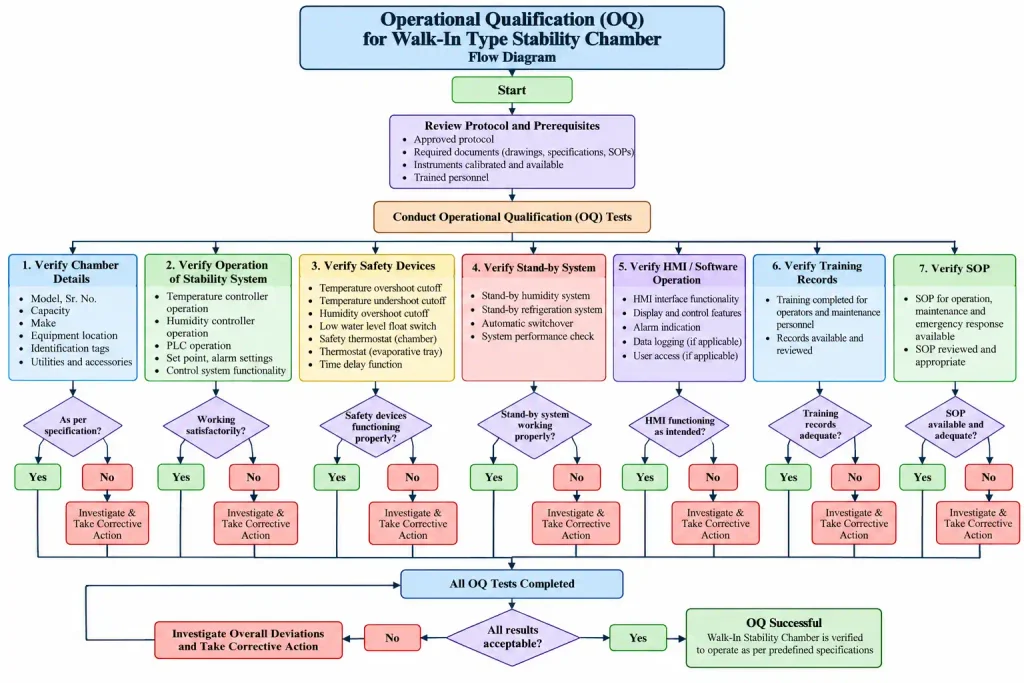
Skip to PDF content2. Flow Diagram for Operational Qualification (OQ) of Walk-In Stability Chamber:
The flow diagram illustrates the systematic approach for Operational Qualification (OQ) of a Walk-In Stability Chamber in accordance with GMP requirements. The process begins with protocol review, document verification, and confirmation of trained personnel. Qualification activities include verification of chamber specifications, temperature and humidity controllers, PLC functionality, safety devices, standby systems, HMI software, training records, and SOP availability. Each test is evaluated against predefined acceptance criteria. Any discrepancies are investigated, documented, and addressed through corrective actions and retesting. Successful completion of all qualification tests provides documented evidence that the chamber operates reliably according to its approved functional specifications.
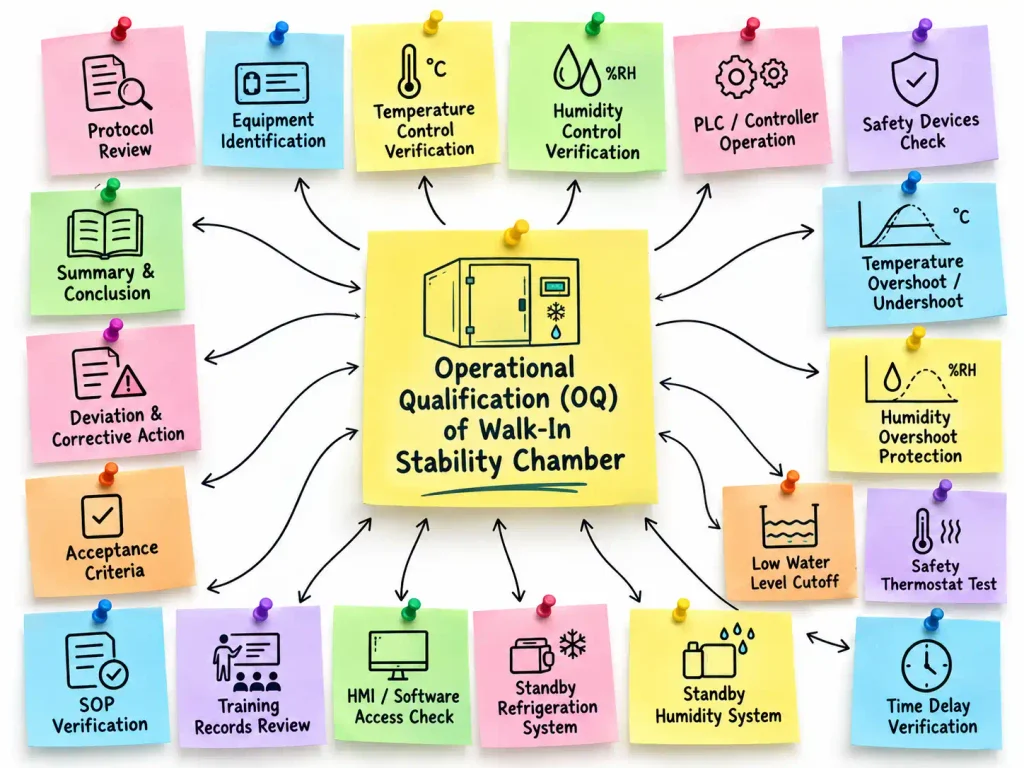
3. Brainstorming Sticky Notes Diagram for Operational Qualification (OQ) of Walk-In Stability Chamber:
The brainstorming sticky notes diagram highlights critical activities involved in the Operational Qualification (OQ) of a Walk-In Stability Chamber. It covers protocol review, equipment identification, temperature and humidity control verification, PLC functionality, and safety device testing. Key considerations include temperature overshoot and undershoot protection, humidity alarms, low-water-level cutoff, safety thermostats, and time-delay verification. Additional activities involve standby refrigeration and humidity systems, HMI software access, SOP verification, and personnel training records. The diagram emphasizes predefined acceptance criteria, deviation management, corrective actions, and final qualification review to ensure reliable chamber operation and compliance with pharmaceutical GMP requirements.
4. 5 Why Analysis for Operational Qualification (OQ) of Walk-In Stability Chamber:
The 5 Why Analysis identifies potential root causes of temperature and humidity deviations during Operational Qualification (OQ) of a Walk-In Stability Chamber. The analysis investigates malfunctioning heating, cooling, and humidification systems, incorrect PLC settings, sensor calibration failures, inadequate testing procedures, and insufficient personnel training. It highlights weaknesses in qualification planning, equipment configuration, and GMP compliance. Corrective actions include recalibration, verification of control parameters, SOP revision, personnel training, and equipment retesting. Preventive measures focus on scheduled maintenance, routine monitoring, change control, and qualification oversight to ensure reliable chamber performance and compliance with predefined operational acceptance criteria.
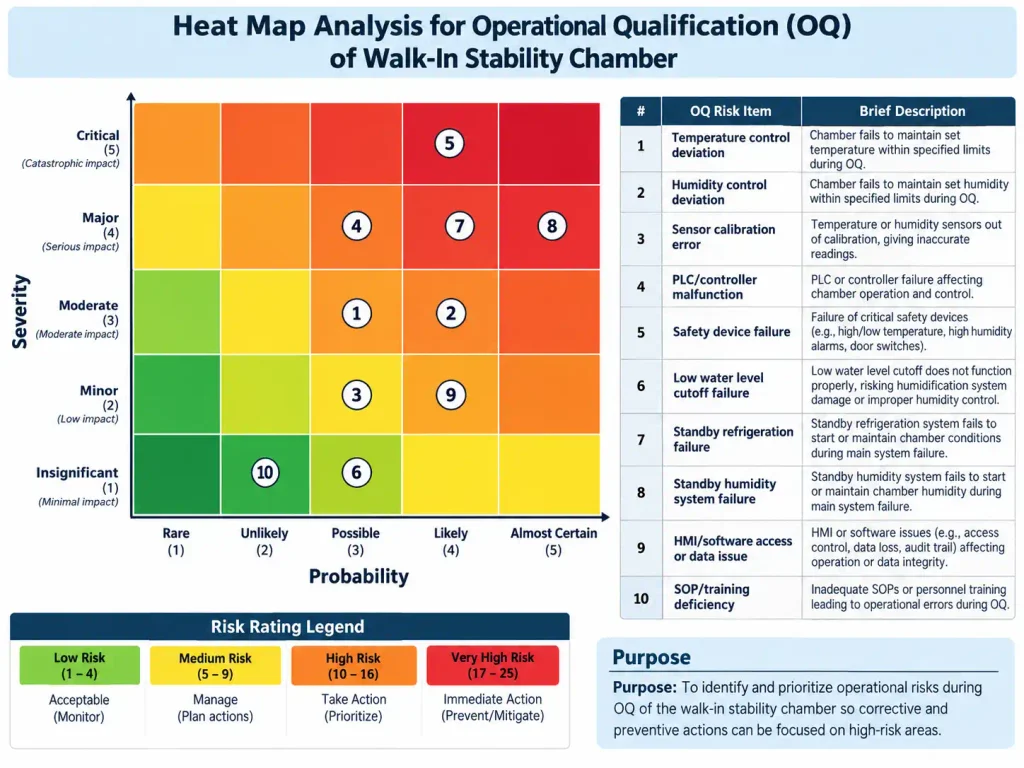
5. Heat Map Analysis for Operational Qualification (OQ) of Walk-In Stability Chamber:
The Heat Map Analysis identifies and prioritizes potential operational risks associated with the Operational Qualification (OQ) of a Walk-In Stability Chamber. It evaluates risks based on probability and severity using a five-point scoring matrix. Critical risks include temperature and humidity deviations, PLC malfunctions, sensor calibration errors, safety device failures, and standby system deficiencies. Risks are categorized as low, medium, high, or very high to determine appropriate mitigation measures. The analysis supports corrective and preventive actions, equipment maintenance, calibration, personnel training, and SOP compliance. Effective risk management ensures reliable chamber performance, product stability, and GMP compliance requirements.
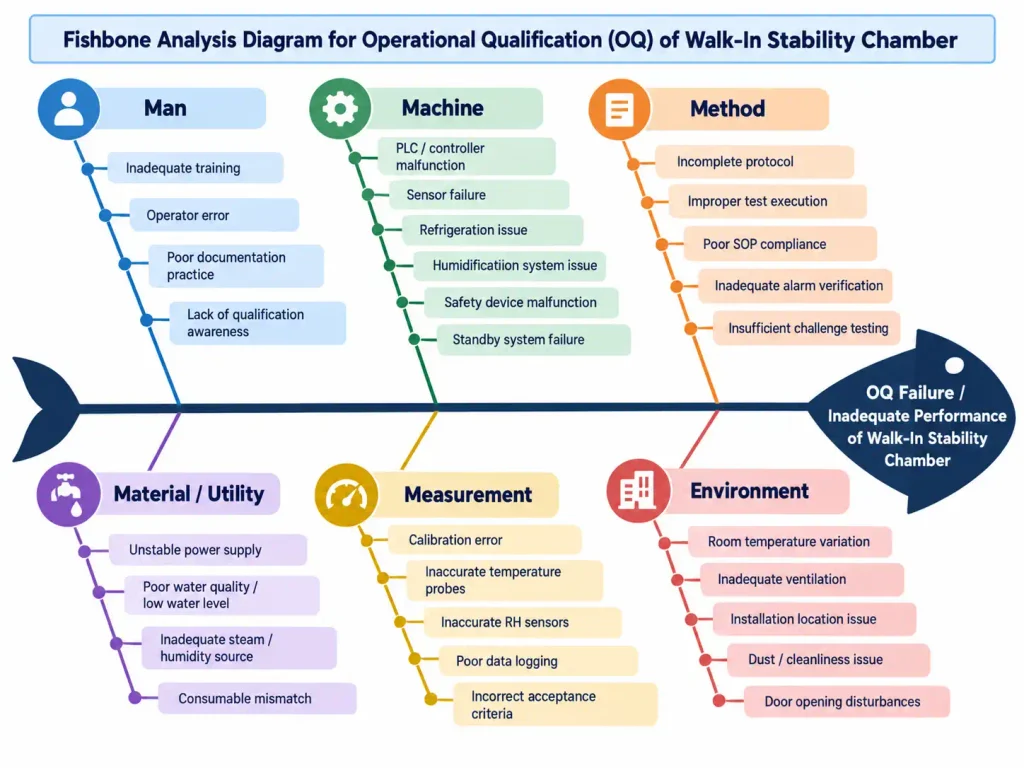
6. Fishbone Analysis for Operational Qualification (OQ) of Walk-In Stability Chamber:
The Fishbone Analysis identifies potential causes of Operational Qualification (OQ) failures in a Walk-In Stability Chamber using the 6M approach. Major categories include Man, Machine, Method, Material, Measurement, and Environment. Key contributing factors involve inadequate personnel training, PLC malfunctions, sensor failures, improper testing procedures, unstable power supply, calibration errors, and environmental fluctuations. The analysis systematically evaluates issues affecting temperature control, humidity regulation, safety devices, and standby systems. It supports root cause investigation, corrective and preventive actions, improved maintenance, SOP compliance, and effective qualification practices, ensuring consistent chamber performance, reliable stability testing, and pharmaceutical GMP compliance.
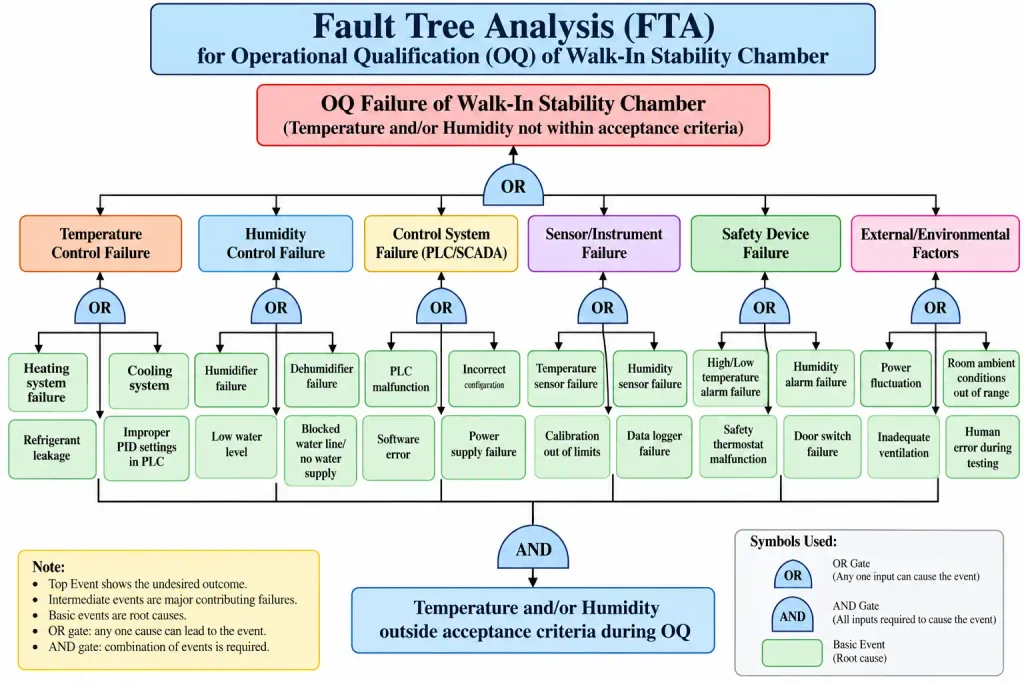
7. Fault Tree Analysis (FTA) for Operational Qualification (OQ) of Walk-In Stability Chamber:
Fault Tree Analysis (FTA) systematically identifies potential causes of Operational Qualification (OQ) failures in a Walk-In Stability Chamber. The analysis focuses on temperature and humidity deviations caused by heating, cooling, humidification, PLC, and sensor malfunctions. Additional contributing factors include calibration errors, safety device failures, power fluctuations, inadequate ventilation, and human errors. Using AND and OR logic gates, the diagram illustrates relationships between equipment failures and operational risks. This structured approach supports root cause identification, corrective and preventive actions, improved maintenance, and effective qualification testing, ensuring reliable chamber performance, accurate environmental control, and compliance with pharmaceutical GMP requirements.
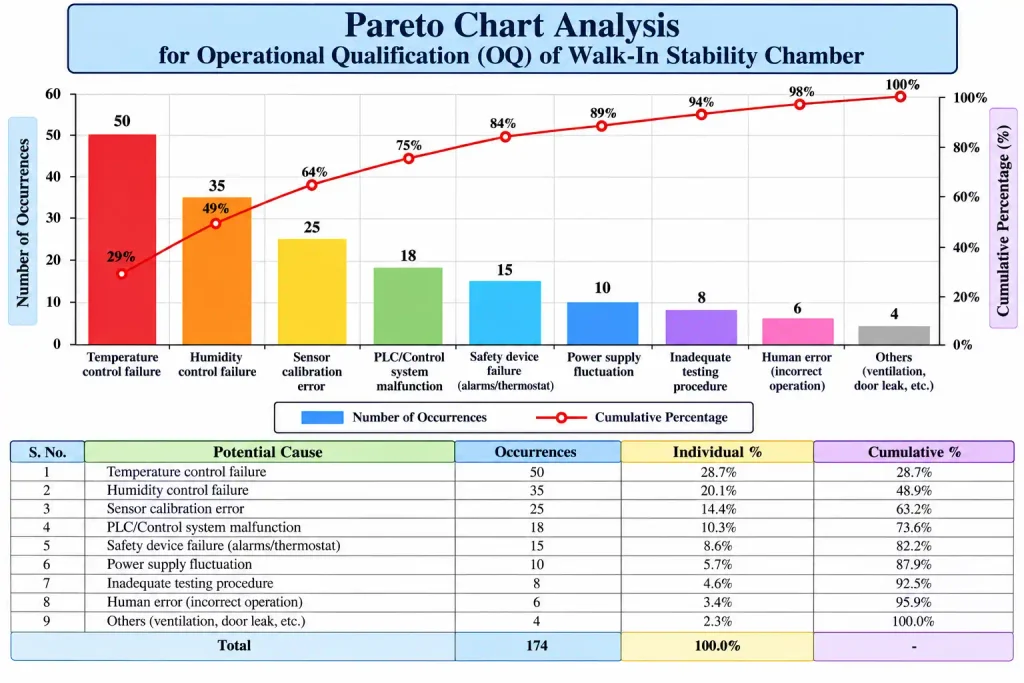
8. Pareto Chart Analysis for Operational Qualification (OQ) of Walk-In Stability Chamber
The Pareto Chart Analysis identifies and prioritizes potential failures during Operational Qualification (OQ) of a Walk-In Stability Chamber. It highlights major issues, including temperature control failures, humidity deviations, sensor calibration errors, PLC malfunctions, and safety device failures. The chart ranks these problems according to occurrence frequency and cumulative percentage, helping identify critical areas requiring corrective actions. Using the Pareto principle, the analysis supports targeted maintenance, calibration, operator training, and improved qualification procedures. Effective implementation strengthens preventive measures, minimizes operational deviations, enhances chamber reliability, and supports consistent environmental control and pharmaceutical GMP compliance.