






Brief Description
This SOP describes the procedure for the destruction and disposal of expired reference samples maintained by the Quality Control Department. Its objective is to ensure that reference samples are systematically collected and disposed of after the specified retention period. The SOP assigns responsibilities to the QC Chemist, Assistant Manager-QC, and Head-QA/QC for proper execution and supervision of the activity. As described in the procedure, expired reference samples are collected and transferred to QC for destruction. Materials such as tablets, capsules, raw materials, liquids, and ointments are dissolved in hot water and disposed of through the drainage system. The SOP also describes flushing the drainage line with specified hydrochloric acid and sodium hydroxide solutions. Remaining packaging materials are cut into pieces, while bottles are crushed before being sent to the scrap yard. The SOP additionally defines training, document distribution, abbreviations, and revision-history requirements for controlled implementation.
Skip to PDF content1. Flow Diagram:
The flow diagram illustrates the step-by-step process for destruction of expired reference samples in the laboratory. It begins with identification and collection of reference samples after completion of the specified retention period, followed by transfer to the Quality Control Department for destruction.
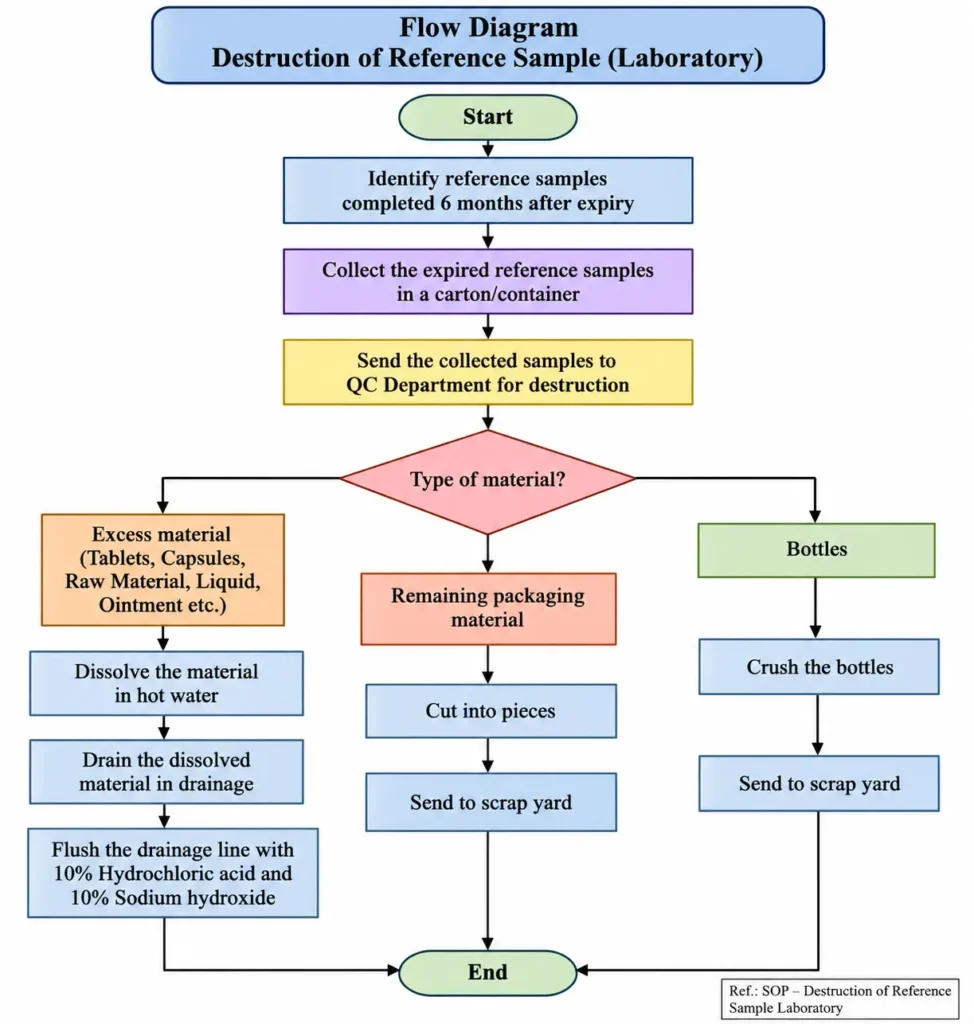
The process then separates the samples according to material type. Tablets, capsules, raw materials, liquids, ointments, and other excess materials are dissolved in hot water and discharged through the drainage system, followed by flushing of the drainage line with 10% hydrochloric acid and 10% sodium hydroxide. Remaining packaging materials are cut into pieces and sent to the scrap yard, while bottles are crushed before being transferred to the scrap yard.The diagram provides a clear visual sequence to support controlled and consistent execution of the reference-sample destruction procedure.
2. Brainstorming for SOP Failure:
The brainstorming diagram presents potential reasons for failure in implementing the SOP for destruction of reference samples, illustrated against an injection manufacturing area. The source SOP requires expired reference samples to be collected and transferred to QC for destruction, with defined methods for disposal of pharmaceutical materials, packaging materials, and bottles.
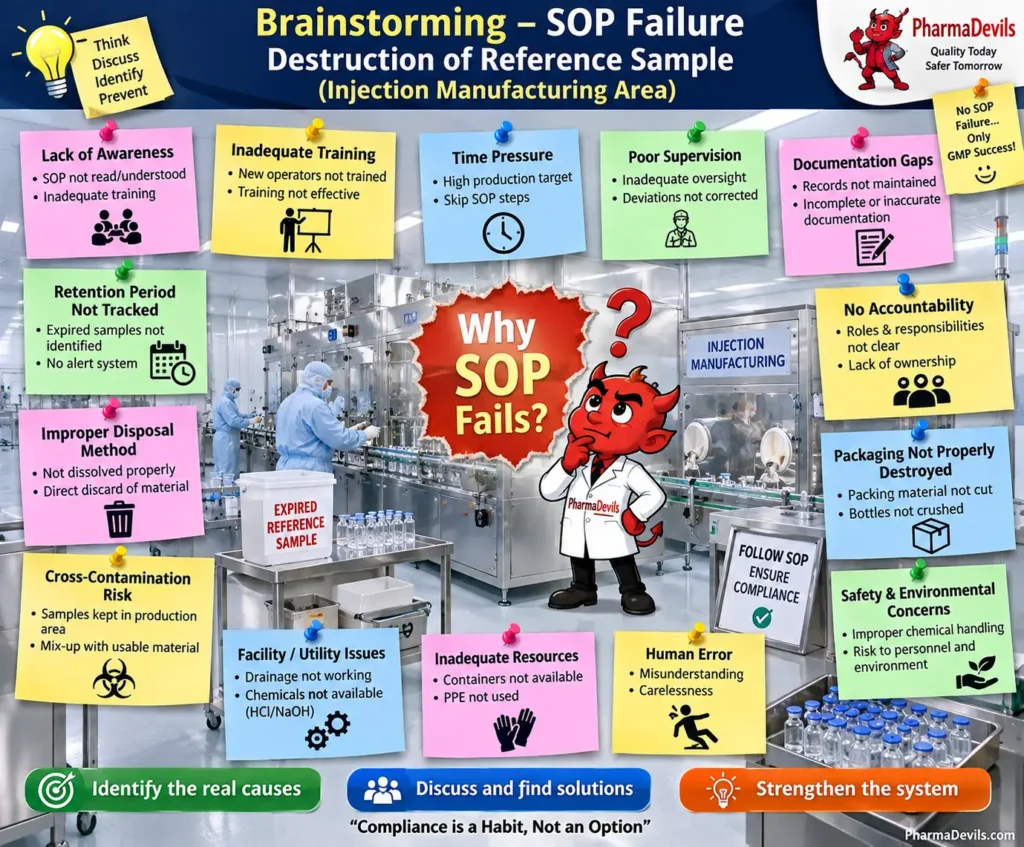
The diagram explores possible failure factors such as inadequate training, lack of awareness, poor supervision, documentation gaps, failure to track the retention period, unclear accountability, improper disposal practices, insufficient resources, human error, facility or utility problems, cross-contamination risk, and safety or environmental concerns. These are brainstorming-derived potential causes rather than causes explicitly stated in the SOP. The purpose is to help the investigation team identify system weaknesses, determine likely root causes, and establish appropriate corrective and preventive actions (CAPA) to ensure consistent SOP compliance in a controlled pharmaceutical manufacturing environment.
3. 5-Why Analysis for SOP Failure:
The 5-Why diagram evaluates the failure to properly identify, collect, and transfer expired reference samples for destruction from the manufacturing area. The SOP requires expired reference samples to be collected after the specified retention period and sent to the Quality Control Department for destruction.
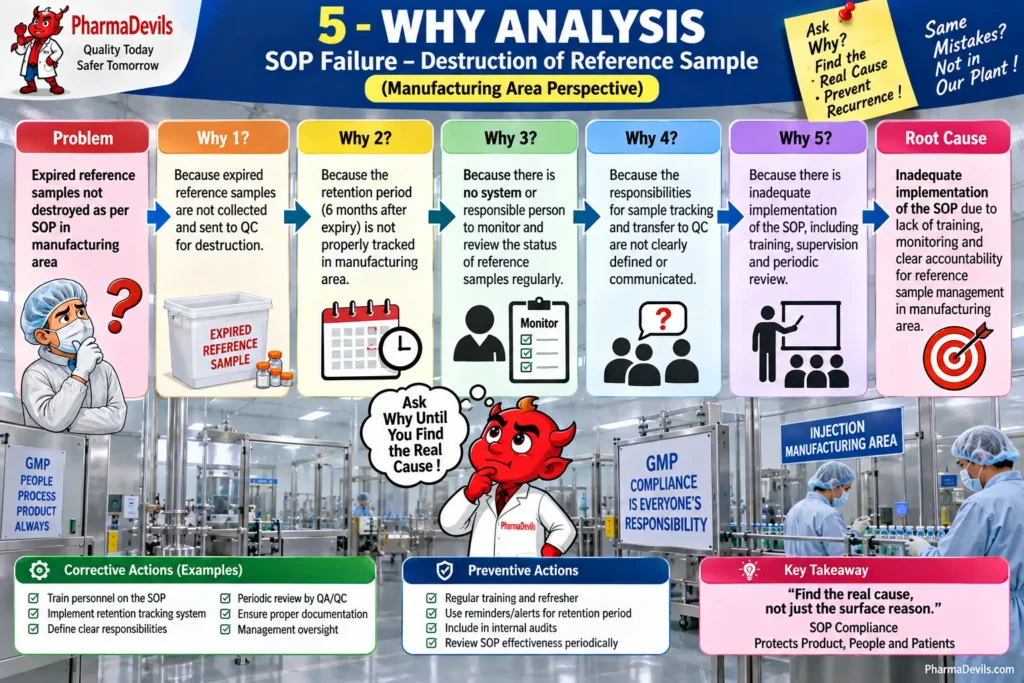
The analysis progressively examines why this activity may fail: expired samples may not be collected, the retention period may not be tracked, no responsible person may routinely monitor sample status, responsibilities may be unclear, and training or periodic supervision may be inadequate. These points are investigative causes developed from the 5-Why exercise and are not explicitly listed in the SOP. The resulting probable root cause is inadequate SOP implementation supported by weak training, monitoring, supervision, and accountability. The diagram therefore emphasizes corrective actions such as establishing a retention tracking system, defining responsibilities, training personnel, maintaining proper documentation, and conducting periodic QA/QC review to prevent recurrence.
4. Fishbone Analysis for SOP Failure:
The Fishbone (Ishikawa) Analysis identifies potential causes for failure to properly destroy expired reference samples in the pharmaceutical manufacturing area. The source SOP requires expired reference samples to be collected after the defined retention period, transferred to QC, processed according to sample type, and packaging materials or bottles destroyed before disposal.
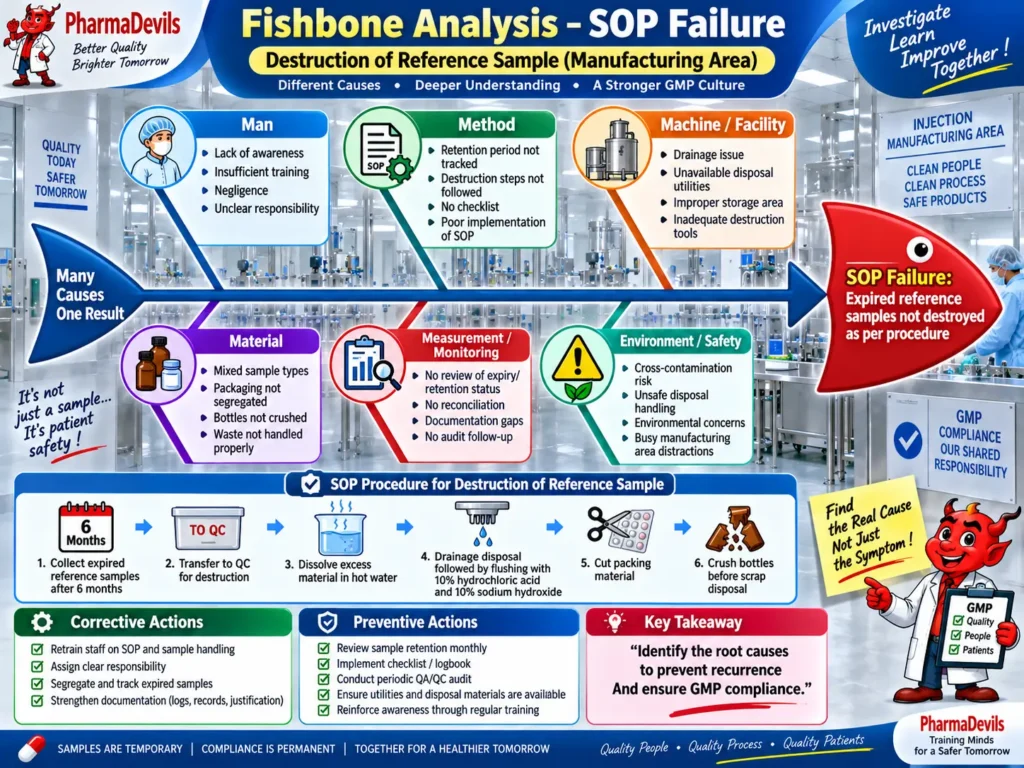
The diagram organizes possible failure causes under six major categories: Man, Method, Machine/Facility, Material, Measurement/Monitoring, and Environment/Safety. Potential contributors include inadequate training, unclear responsibilities, missed retention-period tracking, incomplete documentation, unavailable disposal facilities, improper segregation, lack of periodic review, and unsafe disposal practices. These causes are investigative possibilities developed through fishbone analysis rather than causes explicitly stated in the SOP. The analysis helps the investigation team systematically evaluate contributing factors, identify the most probable root cause, and establish suitable corrective and preventive actions (CAPA) to strengthen SOP compliance and prevent recurrence.
5. Fault Tree Analysis for SOP Failure:
The Fault Tree Analysis illustrates the possible pathways that can lead to failure of the reference-sample destruction SOP in an injection manufacturing environment. The top event is defined as reference samples not being destroyed as per the prescribed procedure. The source SOP requires expired reference samples to be collected after the defined retention period, sent to the QC Department, and destroyed according to the material type.
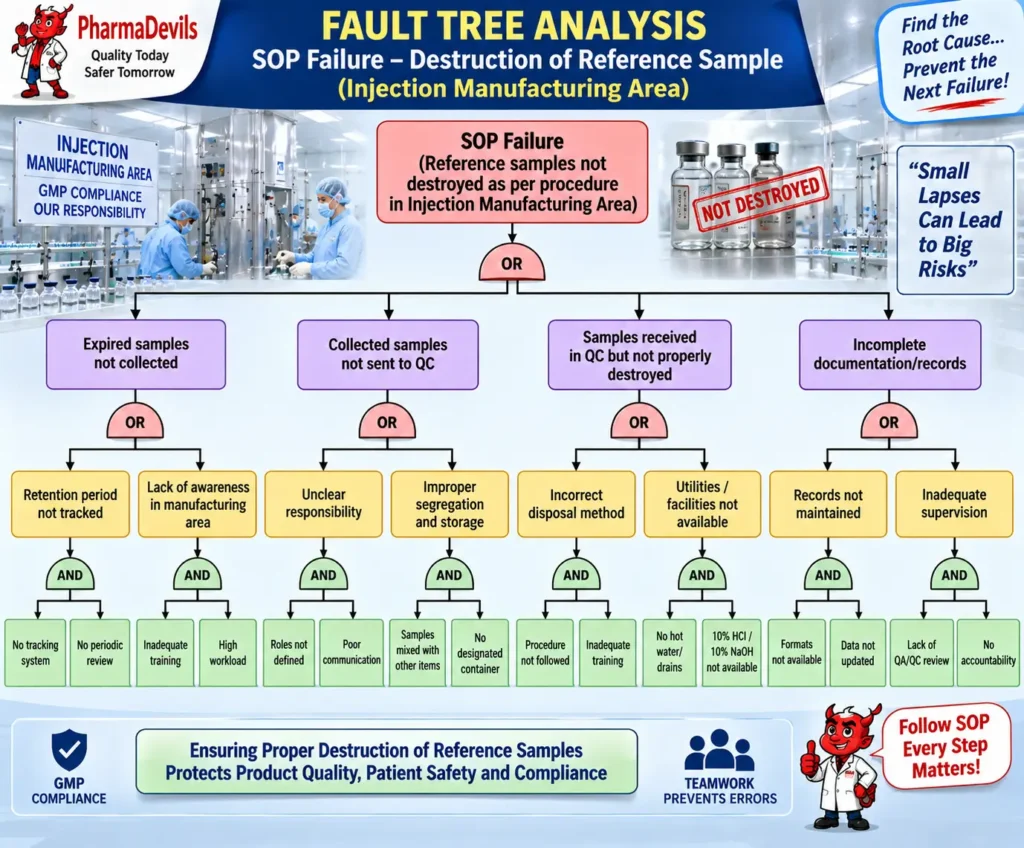
The diagram breaks the failure into major branches such as expired samples not collected, collected samples not transferred to QC, samples received in QC but not properly destroyed, and incomplete documentation or records. These branches are further linked to possible contributing factors including poor retention tracking, inadequate awareness, unclear responsibility, improper segregation, incorrect disposal methods, unavailable utilities, weak documentation, and insufficient supervision. The fault tree helps identify how individual weaknesses can combine to create an SOP failure, supporting root-cause investigation, CAPA development, stronger accountability, and improved GMP compliance.
Questions & Answers – SOP for Destruction of Reference Samples
- What is the objective of this SOP?
The objective is to define the procedure for destruction of reference samples. - What is the scope of the SOP?
The SOP is applicable to the destruction of reference samples. - Who is responsible for implementation of this SOP?
The responsibilities are assigned to the QC Chemist, Assistant Manager-QC, and Head-QA/QC. - When should expired reference samples be collected for destruction?
According to the SOP, reference samples are collected after completion of six months after expiry. - Where are expired reference samples sent for destruction?
They are sent to the Quality Control Department for destruction. - Which types of materials are covered in the destruction procedure?
The SOP mentions tablets, capsules, raw materials, liquids, ointments, and other excess materials. - How are excess pharmaceutical materials destroyed according to the SOP?
They are dissolved in hot water before disposal. - How is the dissolved material disposed of?
The SOP states that the dissolved material is drained into the drainage system. - How is the drainage line flushed after disposal?
The SOP specifies flushing with 10% hydrochloric acid and 10% sodium hydroxide. - How is remaining packaging material handled?
Remaining packaging material is cut into pieces and sent to the scrap yard. - How are bottles disposed of?
Bottles are crushed and sent to the scrap yard. - Who conducts training on this SOP?
Training is conducted by the Executive – Quality Control for Quality Control personnel. - What is the specified training duration?
The training period mentioned in the SOP is half an hour. - Who holds the controlled and master copies of the SOP?
The controlled copy is assigned to the Head of Quality Control, while the master copy is maintained by the Head of Quality Assurance. - What reference guideline is mentioned in the SOP?
The SOP lists the reference as “In House.”
Reference Guidelines:
- CDSCO – Revised Schedule M, Drugs Rules, 1945, G.S.R. 922(E), 28 December 2023 — applicable Indian GMP framework for pharmaceutical manufacturing and Quality Control systems. (CDSCO)
- WHO Technical Report Series No. 986, Annex 2 – WHO GMP for Pharmaceutical Products: Main Principles, particularly section 17.21 on retention samples. WHO specifies retention of finished-product samples for at least one year after expiry. (World Health Organization)
- EU GMP, EudraLex Volume 4, Annex 19 – Reference and Retention Samples — dedicated GMP guidance covering reference/retention sample management. A revised Annex 19 has been published and becomes applicable 24 September 2026. (Public Health)
- US FDA – 21 CFR 211.170, Reserve Samples — requirements for representative reserve samples, quantity, storage conditions, retention, and examination. (U.S. Food and Drug Administration)
- CPCB / MoEFCC environmental and hazardous-waste requirements should be considered when defining the actual destruction/disposal route for pharmaceutical materials. CPCB guidance addresses pharmaceutical-industry effluent and hazardous-waste treatment, including authorized treatment/incineration where applicable. (Central Pollution Control Board)