







Method 1: Non-Aqueous Titration Method
Principle
Diclofenac sodium is titrated in a non-aqueous medium using 0.1 M perchloric acid. This Diclofenac Sodium Assay (Titration) method 1 is suitable because diclofenac sodium behaves properly in non-aqueous solvent systems.
Reagents Required
- Glacial acetic acid or suitable non-aqueous solvent
- 0.1 M perchloric acid
- Indicator such as crystal violet, or potentiometric endpoint
- Diclofenac sodium sample
Procedure
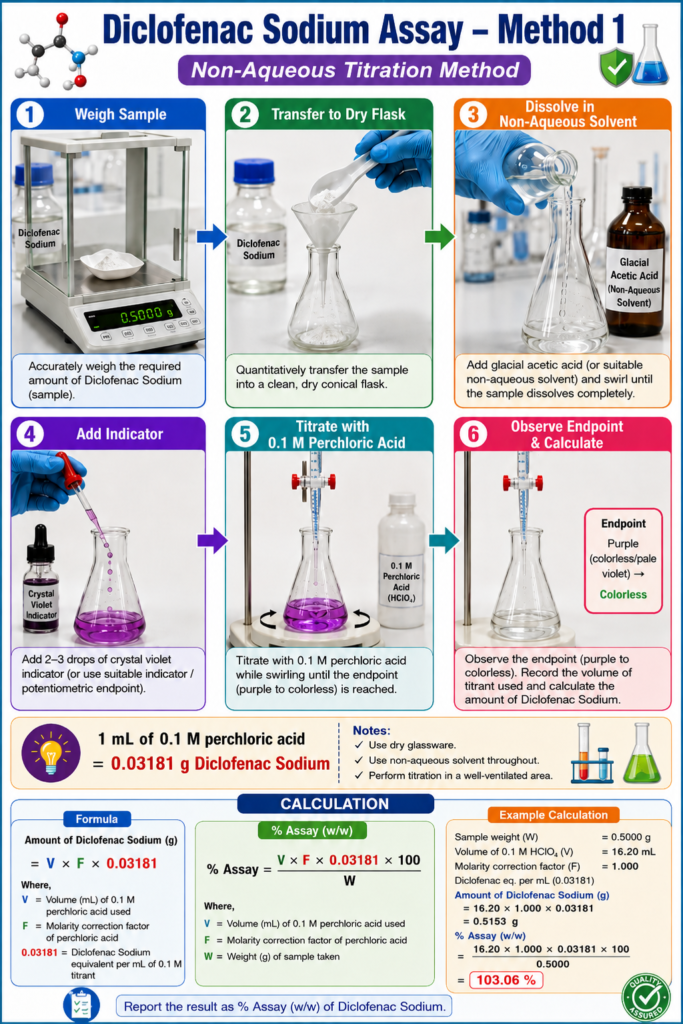
- Accurately weigh the required quantity of Diclofenac sodium sample.
- Transfer it into a dry conical flask.
- Add sufficient non-aqueous solvent, such as glacial acetic acid, and dissolve completely.
- Add 2–3 drops of suitable indicator, or use potentiometric titration.
- Titrate with 0.1 M perchloric acid.
- Continue titration until the endpoint is reached.
- Note the burette reading.
Calculation
Amount of Diclofenac Sodium=V×0.03181
Where:
V = Volume of 0.1 M perchloric acid used in mL
Diclofenac Sodium assay by titration method is a common analytical procedure used to determine the content of Diclofenac Sodium in raw material or pharmaceutical dosage forms. Diclofenac Sodium is a weakly acidic drug and can be assayed by titrimetric methods using suitable solvents and titrants. One commonly used method is non-aqueous titration.
In this method, an accurately weighed quantity of Diclofenac Sodium is transferred into a clean and dry conical flask. The sample is dissolved in a suitable non-aqueous solvent such as glacial acetic acid. The use of a dry flask and non-aqueous medium is important because moisture may affect the accuracy of the titration. After complete dissolution, a suitable indicator such as crystal violet may be added. Alternatively, the endpoint may be detected potentiometrically.
The solution is then titrated with 0.1 M perchloric acid with continuous swirling. During titration, the colour change of the indicator is observed carefully. The endpoint is generally indicated by a change from violet or purple to colourless or pale colour, depending on the indicator used. The volume of 0.1 M perchloric acid consumed is recorded.