







Brief Description
This SOP describes the controlled entry and exit procedure for the Laminar Air Flow (LAF) room of the Microbiology Laboratory. Its purpose is to maintain cleanliness and reduce the risk of contamination during microbiological activities. The procedure requires personnel to check personal hygiene and record entry details before entering the room.During entry, personnel pass through designated air locks, remove outside garments and slippers, sanitize hands using filtered 70% IPA, use the IPA-containing foot pad, and wear pre-sterilized gloves and a sterilized gown. Hands are sanitized again before starting work, and the LAF is cleaned with filtered 70% IPA before and after use.During exit, used gloves and gowns are discarded in designated bins, personnel pass through the air locks, and exit time is recorded. An annexure provides a log book for recording date, person name, purpose, entry time, exit time, verification and remarks.
Skip to PDF content1. Flow Diagram:
The superhero-style flow diagram presents the step-by-step Entry and Exit Procedure for the LAF Room of the Microbiology Laboratory in an easy and attractive format. The entry process begins with checking personal hygiene and recording the date and entry time in the log book. Personnel then enter through the air locks, remove outside clothing and slippers, sanitize hands with filtered 70% IPA, use the IPA foot pad, and wear pre-sterilized gloves and a sterilized gown before starting microbiology work.
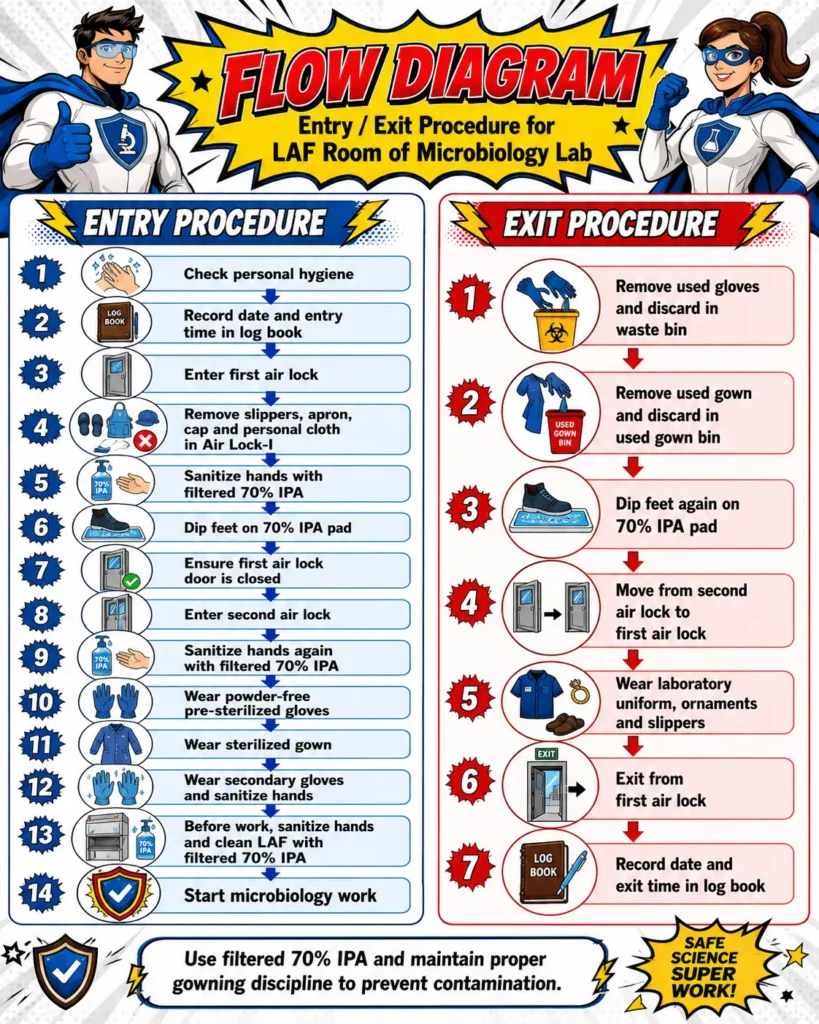
The exit sequence shows removal and proper disposal of used gloves and gowns, use of the 70% IPA foot pad, movement through the air locks, wearing laboratory uniform and slippers, and recording the exit details in the log book.The superhero theme makes the procedure more engaging while emphasizing cleanliness, controlled movement, proper gowning, sanitation, and contamination prevention.
2. Brainstorming for SOP Failure:
The projector-style brainstorming diagram with a teacher guide explains how a team can identify, discuss, and control possible SOP failures in an easy and interactive manner. The session begins when an SOP step is missed, performed incorrectly, or a deviation is observed. The team is guided to stop and secure the activity, inform the supervisor or QA, assess the impact, identify the root cause, take corrective action, implement preventive action, and review effectiveness before closure.
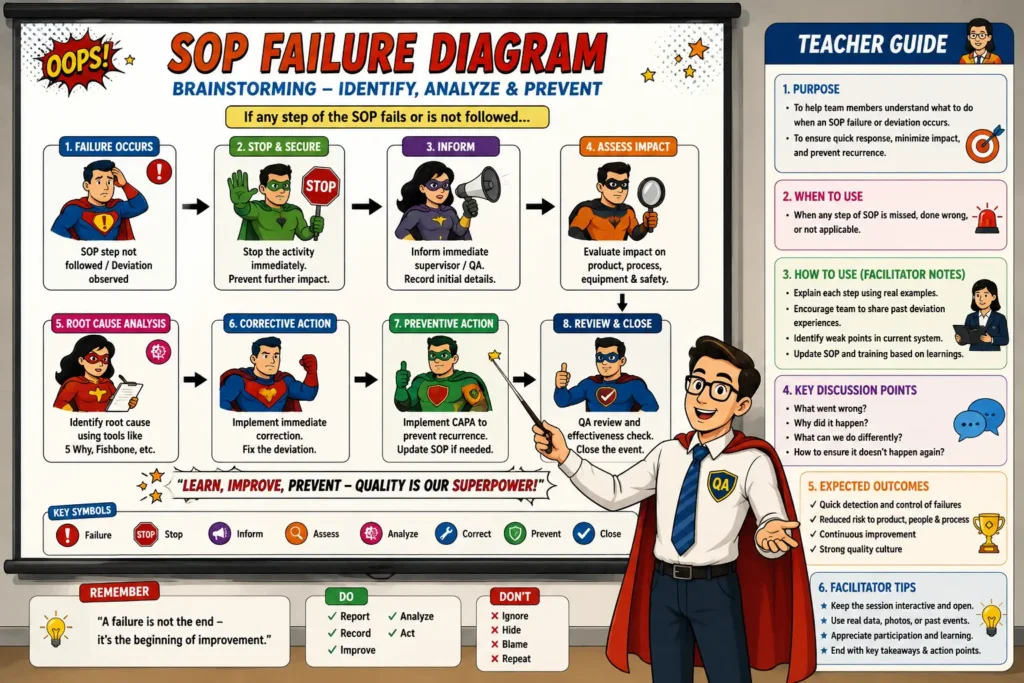
The teacher or facilitator guides the discussion using questions such as “What went wrong?”, “Why did it happen?”, “What is the impact?”, and “How can recurrence be prevented?” Root-cause tools such as 5-Why and Fishbone Analysis can be used during brainstorming. The approach encourages employees to report problems openly, record observations, participate in investigation, and suggest practical CAPA actions. The overall objective is to strengthen SOP compliance, contamination control, employee awareness, continuous improvement, and quality culture.
3. 5-Why Analysis for SOP Failure:
The 5-Why Analysis is used to identify the underlying cause of failure in the Entry/Exit Procedure in the Microbiology Lab. The SOP requires personnel to wear a nose mask while handling incubated plates, tubes, media preparation, or other critical activities.
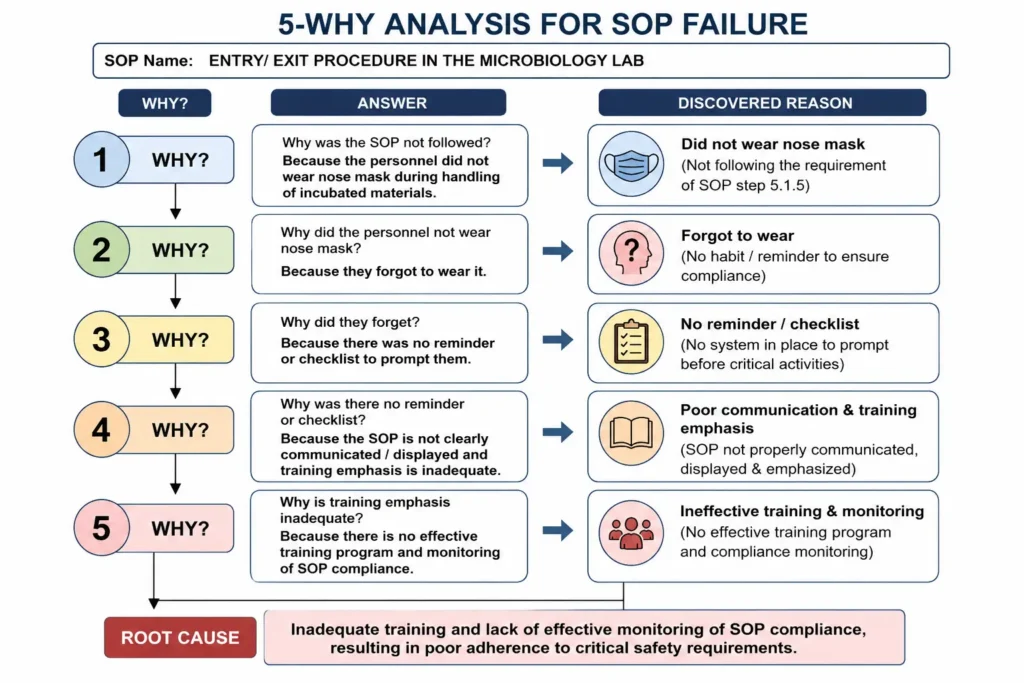
In the illustrated investigation, the problem starts with an operator not wearing the required nose mask. Repeatedly asking “Why?” traces the possible reasons from forgetting the mask, to the absence of reminders or checklists, inadequate communication of critical SOP requirements, and finally insufficient training emphasis and compliance monitoring. The resulting root cause is considered to be ineffective reinforcement and monitoring of SOP compliance.This 5-Why method helps convert an observed SOP deviation into a structured root-cause investigation and supports appropriate CAPA, such as retraining, visual reminders, checklists, and periodic compliance verification.
4. Fishbone Analysis for SOP Failure:
The Fishbone (Ishikawa) Diagram is used to systematically identify possible causes of failure in the Entry/Exit Procedure in the Microbiology Lab. The SOP describes specific entry and exit activities and requires personnel to wear a nose mask during handling of incubated plates, tubes, media preparation, and other critical activities.
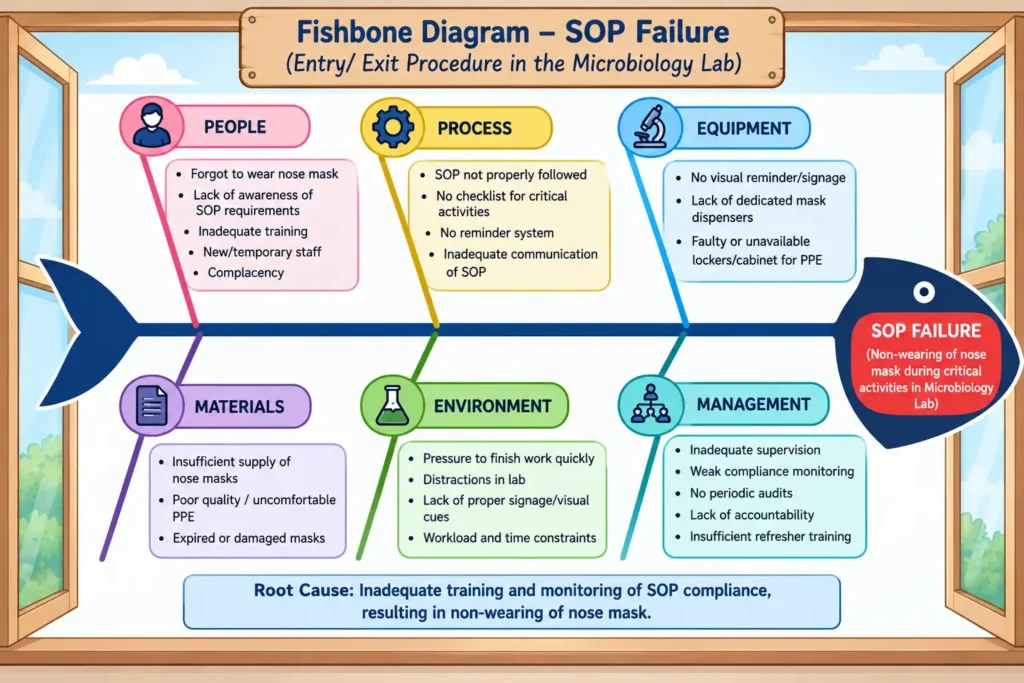
The fishbone diagram groups possible causes under major categories such as People, Process, Equipment, Materials, Environment, and Management. Potential causes include forgetting to wear the nose mask, inadequate training, lack of awareness, absence of reminders or checklists, insufficient PPE availability, workplace distractions, weak supervision, and inadequate compliance monitoring. By arranging these contributing factors in a structured visual format, the diagram helps the investigation team identify the most probable causes of SOP non-compliance. The analysis indicates that inadequate training, poor reinforcement of SOP requirements, and weak monitoring of compliance may be key root causes requiring corrective and preventive actions.
5. Fault Tree Analysis for SOP Failure:
The Fault Tree Analysis (FTA) identifies possible causes that may lead to failure of the Entry/Exit Procedure in the Microbiology Lab. The SOP requires defined entry and exit practices, including wearing appropriate protective items and following specific precautions during critical microbiology activities.
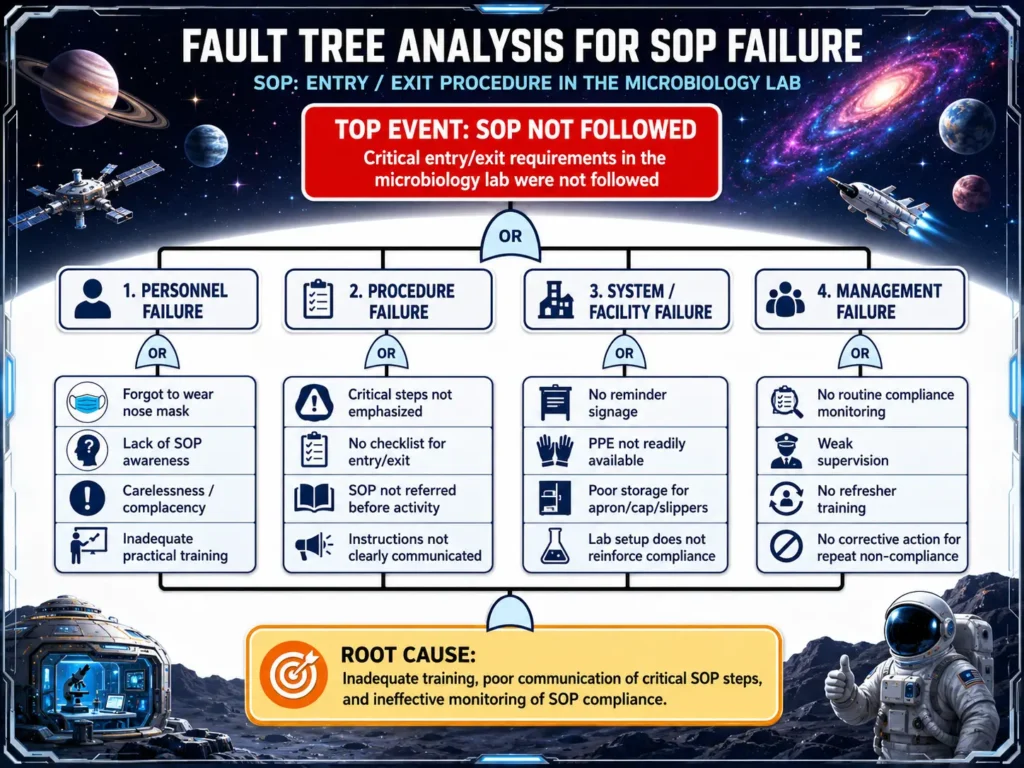
In the diagram, the top event is “SOP Not Followed.” This failure is further divided into major branches such as Personnel Failure, Procedure Failure, System/Facility Failure, and Management Failure. Possible causes include forgetting to wear a nose mask, lack of SOP awareness, inadequate practical training, absence of entry/exit checklists, poor communication of critical steps, lack of reminders, inadequate PPE availability, weak supervision, and insufficient refresher training.FTA helps show how several individual failures can combine to produce overall SOP non-compliance. It supports systematic root-cause investigation and helps define suitable CAPA, including retraining, improved communication, visual reminders, checklists, supervision, and routine compliance monitoring.
Questions & Answers – Entry/Exit Procedure in the Microbiology Lab
Q1. What is the objective of this SOP?
Answer: The objective is to define the procedure for proper entry and exit in the microbiology laboratory.
Q2. Who is responsible for executing this SOP?
Answer: The Microbiologist is responsible for execution of the SOP.
Q3. Who is responsible for review and effective implementation of the SOP?
Answer: Manager-QC and Head-QA/QC are responsible for review and effective implementation.
Q4. What should be done before entering through the crossover bench?
Answer: The slippers should first be removed and placed in the slipper cupboard before entering through the stainless-steel crossover bench.
Q5. What should personnel wear in the common change room?
Answer: Personnel should wear an apron, cap, and dedicated slippers in the common change room.
Q6. What should be done after entering the QC laboratory?
Answer: The microbiology laboratory door should be unlocked before entering the microbiology laboratory.
Q7. What should be checked before starting daily routine work?
Answer: Lights, instruments, and other laboratory conditions should be checked before starting daily routine work.
Q8. When is wearing a nose mask required according to the SOP?
Answer: A nose mask is required while handling incubated plates, tubes, incubated materials, during media preparation, and during other critical activities.
Q9. What should be done after completion of laboratory work?
Answer: All items should be checked and the lights should be switched off.
Q10. What should be done with the microbiology laboratory door during exit?
Answer: The microbiology laboratory door should be closed and locked.
Q11. Where should the apron, cap, and slippers be kept after use?
Answer: They should be removed and placed in the dedicated locker.
Q12. Who provides training for this SOP?
Answer: The Manager-QC is the trainer for this SOP.
Q13. Who are the trainees for this SOP?
Answer: Microbiologists are the trainees.
Q14. What is the training duration?
Answer: The training duration is one hour.
Q15. What does QC stand for?
Answer: QC stands for Quality Control.
Q16. What does QA stand for?
Answer: QA stands for Quality Assurance.
Q17. What does SOP stand for?
Answer: SOP stands for Standard Operating Procedure.