






1. Introduction – SOP for Excess Material Return Memo:
The SOP for Excess Material Return Memo (EMRM) defines the controlled procedure for returning excess materials from the Production Department to the Stores/Warehouse after completion of manufacturing or packing activities. Its objective is to ensure that returned materials are properly identified, labeled, quantified, verified, authorized, and received into stores under documented control. The SOP assigns responsibility to Production for returning excess material with the EMRM, Quality Assurance for authorization, and Stores personnel for verification against the return memo and material labels. Returned materials must carry the required “Excess Material Return” or “Material Returned” label, including material name/code, QC reference number, MRN number, quantity, product, batch number, reason for return, and the required signatures. The quantity must be checked against the EMRM before acceptance.This system supports accurate inventory control, material traceability, reconciliation, prevention of mix-ups, and proper handling of unused packaging and production materials.
Skip to PDF content2. Flow Diagram – SOP for Excess Material Return Memo:
The Flow Diagram for Excess Material Return Memo (EMRM) describes the systematic movement of excess materials from the Production Department back to Stores/Warehouse. After completion of the batch, Production identifies the unused material and prepares the EMRM. The returned material is properly labeled with details such as material name and code, QC reference number, MRN number, quantity, product, batch number, reason for return, and required signatures. QA then verifies and authorizes the EMRM before the material is transferred to Stores.
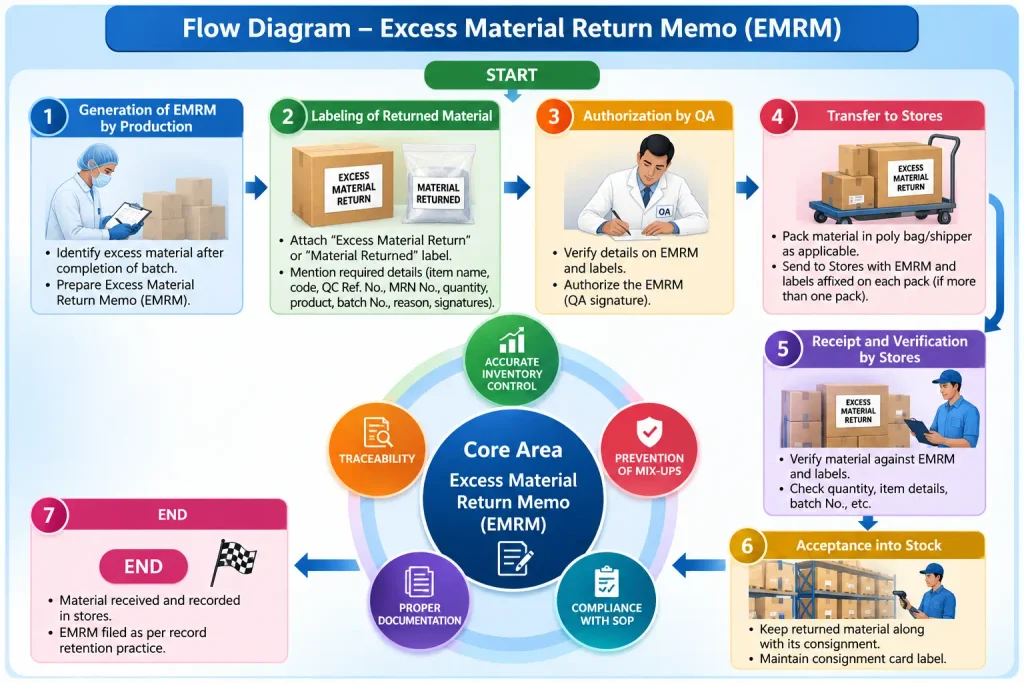
Stores personnel verify the returned material against the EMRM and labels, including quantity and item details. Accepted material is kept with its original consignment and properly identified for stock control. The process supports traceability, accurate inventory control, prevention of mix-ups, proper documentation, and compliance with the SOP.
3. Benefits of Following SOP – Excess Material Return Memo (EMRM):
Following the SOP for Excess Material Return Memo ensures that excess materials returned from Production are handled in a controlled and documented manner before being accepted by Stores. Proper labeling with material details, quantity, batch information, reason for return, and required signatures improves identification and traceability. QA authorization provides an additional verification step before the material is returned to stock.
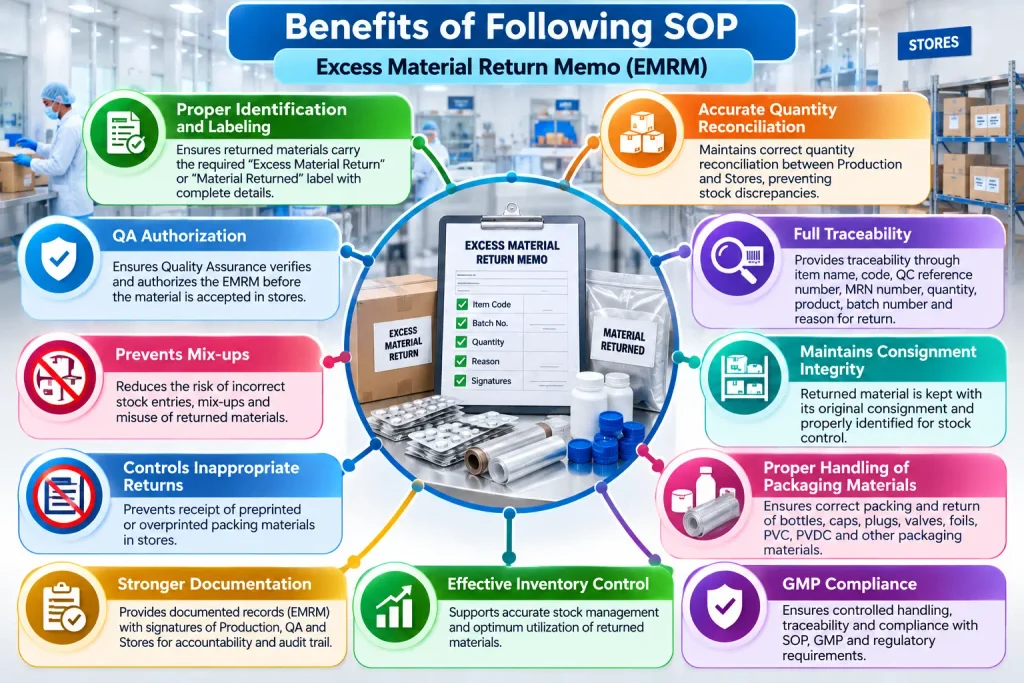
The SOP also supports accurate quantity reconciliation, prevention of material mix-ups, proper segregation, and maintenance of returned material with its original consignment wherever practical. EXCESS MATERIAL RETURN MEMO It further controls the return of packaging materials by restricting preprinted or overprinted materials and requiring suitable packing and labeling for items such as bottles, caps, plugs, valves, foils, PVC, and PVDC. EXCESS MATERIAL RETURN MEMO Overall, the procedure strengthens inventory control, accountability, documentation, material traceability, and GMP compliance.
4. Brainstorming for SOP Failure – Excess Material Return Memo (EMRM):
The Brainstorming for SOP Failure of Excess Material Return Memo (EMRM) identifies potential causes that may lead to improper return, verification, and acceptance of excess materials from Production to Stores. Major failure points include incomplete EMRM details, missing item code, QC reference number, MRN number, quantity, batch details, reason for return, or required signatures. Improper or missing “Excess Material Return” labels can further reduce traceability.
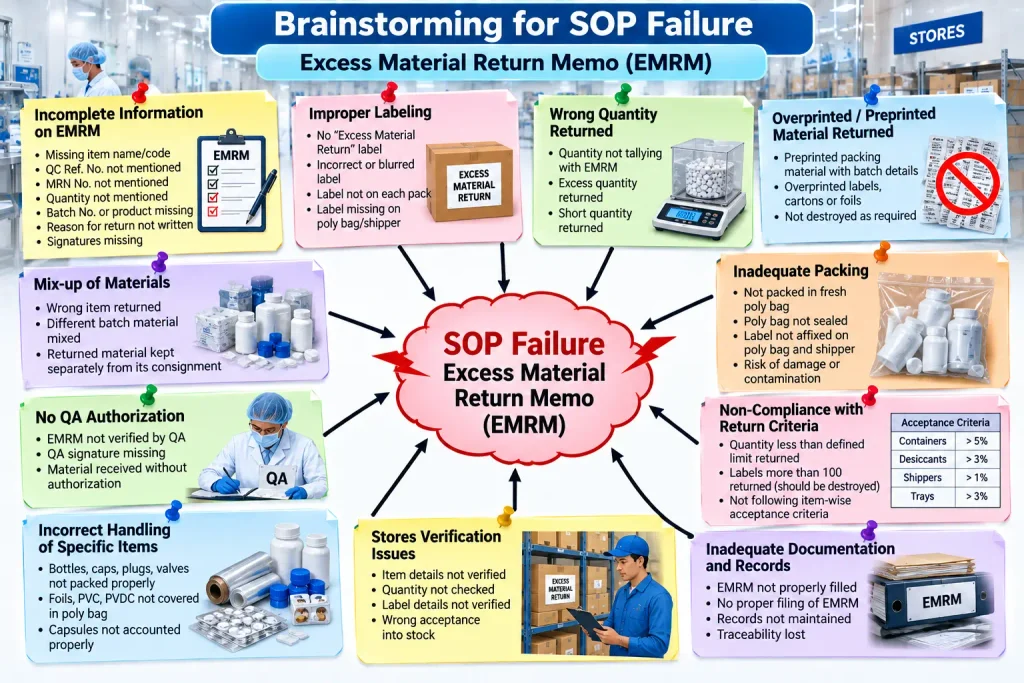
Other possible causes include incorrect quantity reconciliation, return of preprinted or overprinted packaging materials, inadequate packing of bottles, caps, plugs, valves, foils, PVC or PVDC, absence of QA authorization, and insufficient verification by Stores. Such failures may result in material mix-ups, inventory discrepancies, loss of traceability, incorrect stock acceptance, documentation gaps, and GMP non-compliance.
5. 5-Why Analysis for SOP Failure – Excess Material Return Memo (EMRM):
The 5-Why Analysis for SOP Failure of Excess Material Return Memo (EMRM) helps identify the underlying reason for failure in properly returning excess materials from Production to Stores. A typical failure may begin when the returned material is not accepted because the EMRM is incomplete or the material is not properly labeled. The SOP specifically requires details such as item/material name and code number, QC reference number, MRN number, quantity, product, batch number, reason for return, and the required signatures on the return documentation and labels.
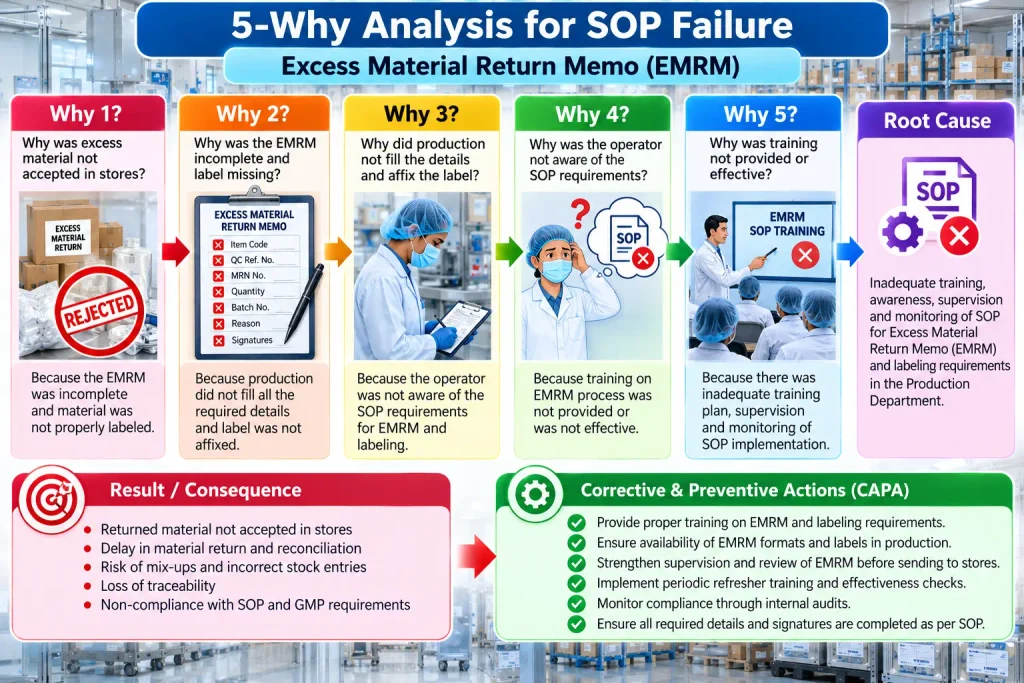
Further analysis may reveal that Production personnel did not complete the required details or affix the proper labels before sending the material to Stores. The deeper root cause may be inadequate awareness, training, supervision, or monitoring of the SOP requirements. This can lead to rejection of returned material, reconciliation delays, incorrect stock entries, loss of traceability, material mix-ups, and GMP non-compliance. Appropriate CAPA should therefore focus on effective SOP training, verification of EMRM completion, proper labeling, QA authorization, and periodic compliance checks.
6. Fishbone Analysis for SOP Failure – Excess Material Return Memo (EMRM):
The Fishbone Analysis for SOP Failure of Excess Material Return Memo (EMRM) helps identify possible causes of failure by grouping them into major categories such as Man, Method, Machine/Equipment, Material, Measurement, and Environment. Personnel-related causes may include inadequate training, lack of SOP awareness, missing signatures, or poor supervision. Method-related failures may involve incomplete EMRM preparation, incorrect labeling, or failure to follow the defined return procedure. The SOP requires proper labeling, verification of quantity, QA approval, and Stores verification before acceptance.
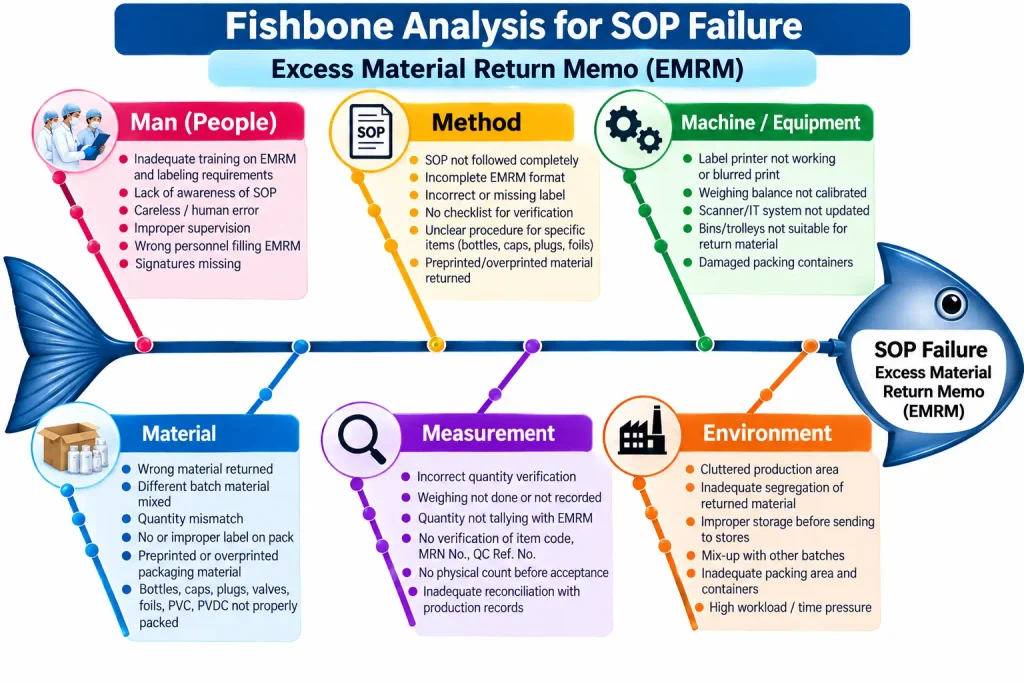
Material and measurement causes may include wrong material return, quantity mismatch, improper packing, or incomplete reconciliation. The SOP also specifies controls for preprinted or overprinted materials and proper packing of items such as bottles, caps, plugs, valves, foils, PVC, and PVDC. The Fishbone approach therefore supports structured identification of contributing factors that can lead to mix-ups, stock discrepancies, traceability loss, documentation gaps, and GMP non-compliance.
7. Fault Tree Analysis for SOP Failure – Excess Material Return Memo (EMRM):
The Fault Tree Analysis for SOP Failure of Excess Material Return Memo (EMRM) systematically identifies the combinations of failures that can lead to ineffective return of excess material from Production to Stores. The top event, SOP Failure, may result from incomplete or incorrect EMRM documentation, improper or missing labeling, non-compliant material return, or inadequate verification and authorization. The SOP requires returned material to carry complete details such as item/material name and code, QC reference number, MRN number, quantity, product, batch number, reason for return, and the required signatures.It also requires QA authorization and Stores verification before acceptance.
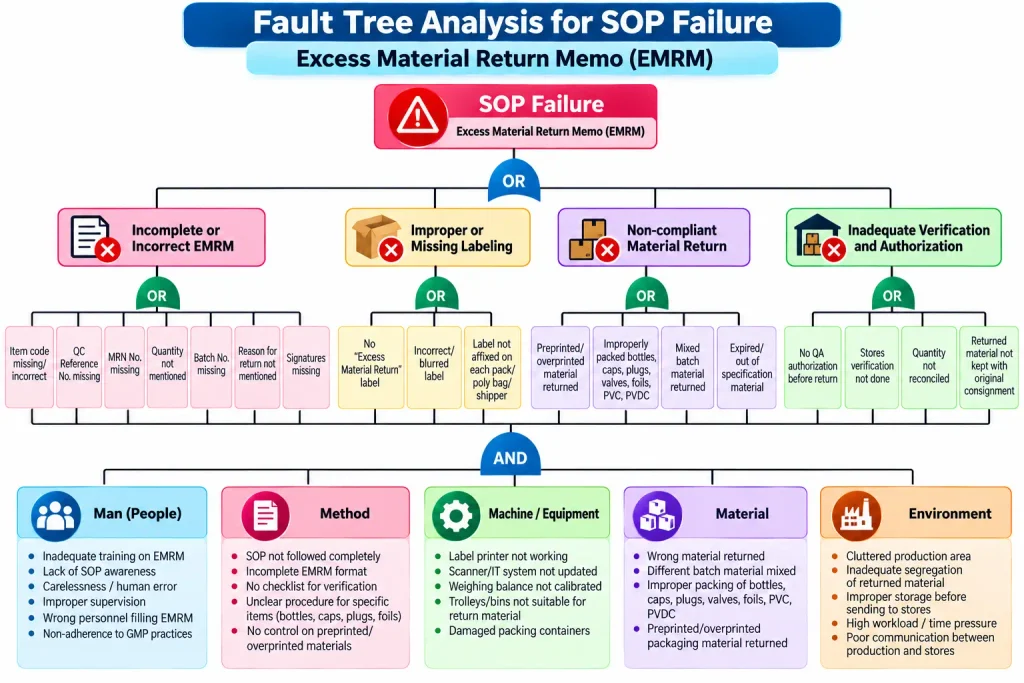
Additional failure branches may include return of overprinted or preprinted materials, incorrect packing of bottles, caps, plugs, valves, foils, PVC or PVDC, quantity mismatch, or returned material not being maintained with its consignment. Fault Tree Analysis therefore helps identify critical failure pathways that can result in mix-ups, stock discrepancies, loss of traceability, documentation errors, and GMP non-compliance.
8. Impact Assessment – SOP Failure of Excess Material Return Memo (EMRM):
Failure to follow the SOP for Excess Material Return Memo (EMRM) can directly affect material control, traceability, documentation, inventory accuracy, and GMP compliance. If the EMRM is incomplete, incorrectly labeled, or not properly authorized, Stores may receive material without adequate identification or verification. The SOP specifically requires details such as material name/code, QC reference number, MRN number, quantity, product, batch number, reason for return, and required signatures.
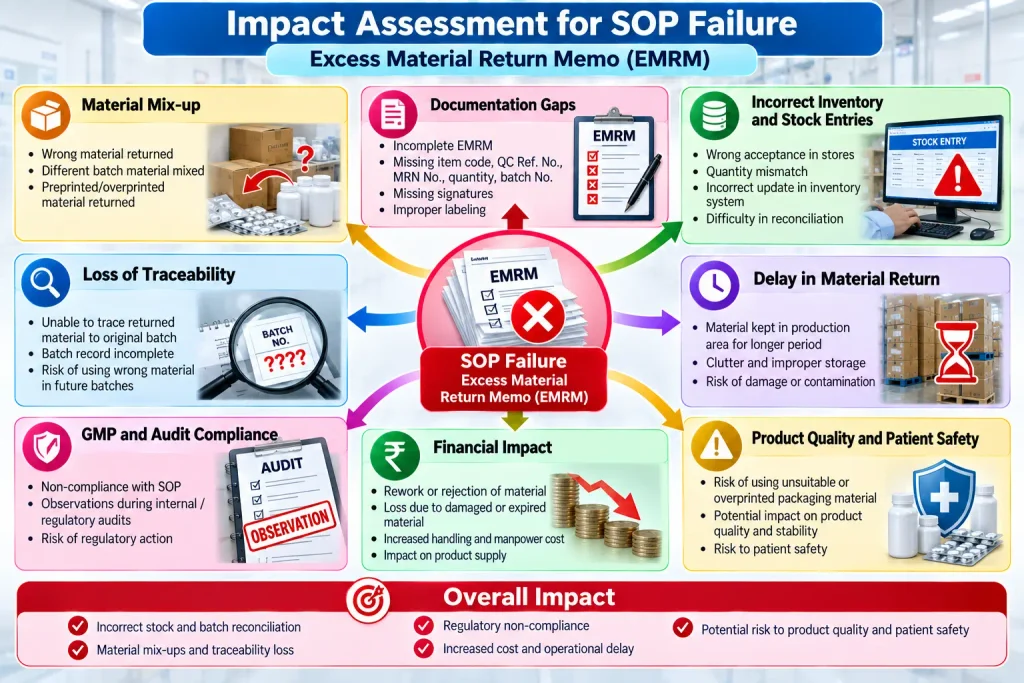
Potential impacts include incorrect stock entries, material mix-ups, loss of traceability, reconciliation discrepancies, delayed material return, improper reuse of packaging materials, and documentation gaps. Failure to control preprinted or overprinted packaging materials may also increase the risk of using unsuitable or wrongly coded components.The impact can therefore extend to Production, Stores, Quality Assurance, batch reconciliation, inventory management, audit readiness, and overall GMP compliance. Effective verification, QA authorization, correct labeling, quantity reconciliation, and proper storage of returned material help minimize these risks.
9. CAPA – SOP for Excess Material Return Memo (EMRM):
The Corrective and Preventive Action (CAPA) for SOP Failure of Excess Material Return Memo (EMRM) is intended to eliminate existing deficiencies and prevent recurrence during the return of excess materials from Production to Stores. Corrective actions should focus on completing the EMRM with all required details, applying the correct return labels, rechecking material identity and quantity, obtaining QA authorization, and ensuring Stores receives and records the material correctly. The SOP requires Production to return excess material with EMRM, QA to authorize it, and Stores to verify the returned material against the memo and labels.
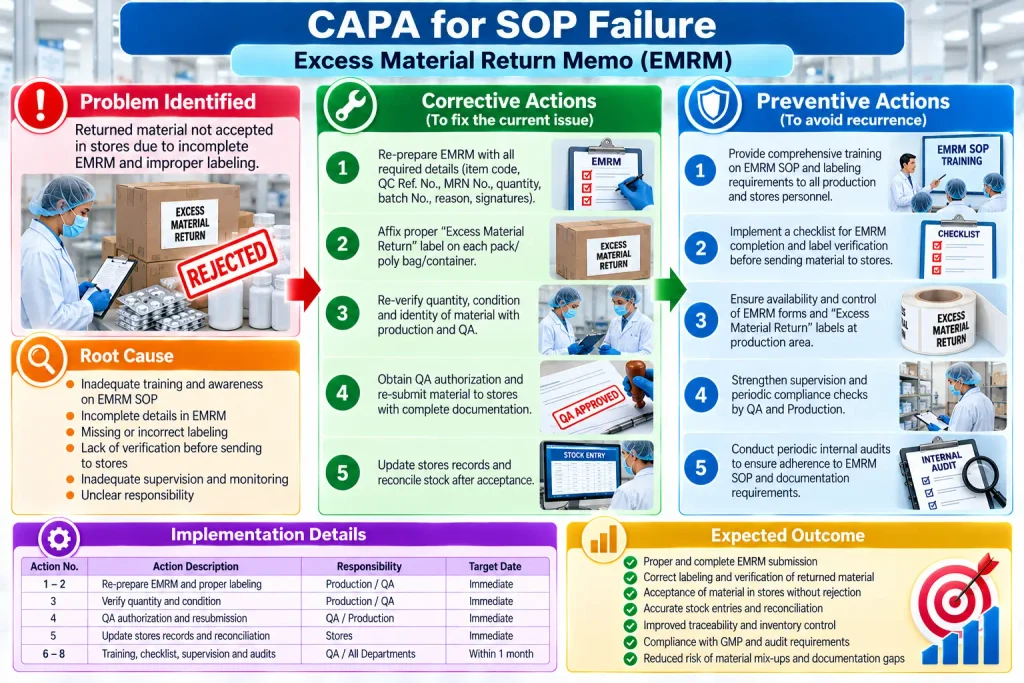
Preventive actions should include effective personnel training, availability of controlled EMRM formats and labels, use of verification checklists, stronger supervision, and periodic compliance reviews. Returned material should carry complete information such as item/material name and code, QC reference number, MRN number, quantity, product, batch number, reason, and required signatures. Proper implementation of CAPA helps improve traceability, stock reconciliation, documentation accuracy, accountability, prevention of mix-ups, and consistent SOP compliance.
Question & Answer – SOP for Excess Material Return Memo (EMRM):
Q1. What is the objective of the SOP for Excess Material Return Memo?
The objective is to provide guidance for receiving excess materials returned from Production.
Q2. Where is this SOP applicable?
It is applicable to the receipt of excess material from Production into Stores.
Q3. Who is responsible for returning excess material?
Production personnel are responsible for returning excess material to Stores along with the Excess Material Return Memo.
Q4. Who authorizes the EMRM?
Quality Assurance personnel are responsible for authorizing the EMRM.
Q5. What is the responsibility of Stores personnel?
Stores personnel verify the returned material against the Excess Material Return Memo and the applicable labels.
Q6. What label should be present on returned material?
The material should be received with an “Excess Material Return” or “Material Returned” label.
Q7. What information should be mentioned on the return label?
The label should include material name and code number, QC reference number, MRN number, quantity, product, batch number, reason for return, Production signature, QA approval, and Stores receipt details.
Q8. How is the returned quantity verified?
The actual returned quantity should tally with the quantity mentioned on the return label and EMRM.
Q9. How should returned material be stored after acceptance?
The returned material should be kept along with its consignment and, where practical, secured with the original pack while maintaining the consignment identification.
Q10. Can overprinted material be received back into Stores?
No. The SOP states that overprinted or preprinted packing materials carrying batch details should not be received back into Stores.
Q11. How should bottles, caps, plugs, valves, and aluminum cans be returned?
They should be packed in a fresh poly bag and shipper, with EMRM labels affixed on both the poly bag and the shipper.
Q12. What should be done if more than one pack of an item is returned?
One return label should be affixed to each pack.
Q13. How should excess capsules be handled after completion of the run?
Production should account for the excess capsules and return them to the warehouse with the Excess Material Return Memo label.
Q14. How should printed foils, PVC, and PVDC be returned?
They should be covered in a poly bag and provided with the coded-side “Excess Material Return” label.
Q15. What is EMRM?
EMRM stands for Excess Material Return Memo.
Reference Guideline – SOP for Excess Material Return Memo (EMRM):
- WHO Good Manufacturing Practices (GMP) – requirements for material handling, documentation, reconciliation, storage, and prevention of mix-ups.
- EU GMP, Part I, Chapter 4 – Documentation – expectations for controlled records, traceability, and complete documentation.
- EU GMP, Part I, Chapter 5 – Production – controls for materials, packaging components, reconciliation, and prevention of cross-contamination or mix-ups.
- PIC/S Guide to GMP (PE 009) – principles for material control, production documentation, reconciliation, and warehouse practices.
- Schedule M of Drugs Rules, India – GMP requirements for storage, production controls, documentation, and handling of materials.
- 21 CFR Part 211 – particularly provisions relating to component control, labeling and packaging materials, production records, and documentation.