







1. Introduction – Handling & Control of Sieves & Screens:
The Handling & Control of Sieves & Screens SOP describes the systematic procedure for procurement, receipt, identification, inspection, usage, cleaning, storage, inventory control, and disposal of sieves and screens used in pharmaceutical production activities. The SOP applies to sieves used for sifting operations and screens used in milling processes within the Production Department. Proper control of sieves and screens is essential because their mesh size, pore size, physical condition, integrity, welding quality, and cleanliness can directly influence material particle size, uniformity, processing efficiency, and product quality. The procedure requires incoming sieves and screens to be appropriately identified and inspected before use. Sieves are checked for mesh size, diameter, appearance, integrity, and welding or silicone molding condition, while screens are checked for dimensions and pore or screen size using suitable calibrated measuring devices. Before and after production use, sieves and screens are checked for intactness. Any damaged component is reported for appropriate action, while cleaned components are stored in fresh polybags with suitable status identification. Proper receipt, usage, cleaning, inventory, and disposal records are maintained to provide traceability throughout their lifecycle. Following this SOP helps ensure that only clean, intact, correctly identified, and suitable sieves and screens are used during manufacturing, thereby reducing the risk of contamination, incorrect particle-size distribution, equipment-related defects, and potential product quality failures.
Skip to PDF content2. Flow Diagram – Handling & Control of Sieves & Screens:
The Handling & Control of Sieves & Screens SOP provides a controlled system for managing sieves and screens throughout their lifecycle in the Production Department. The process starts with procurement of suitable sieves and screens, followed by receipt verification, identification, inspection, approval, usage, cleaning, storage, inventory control, and disposal. The SOP requires checks for important attributes such as mesh size, dimensions, physical appearance, integrity, welding quality, silicone molding, and pore or screen size before the items are released for use.
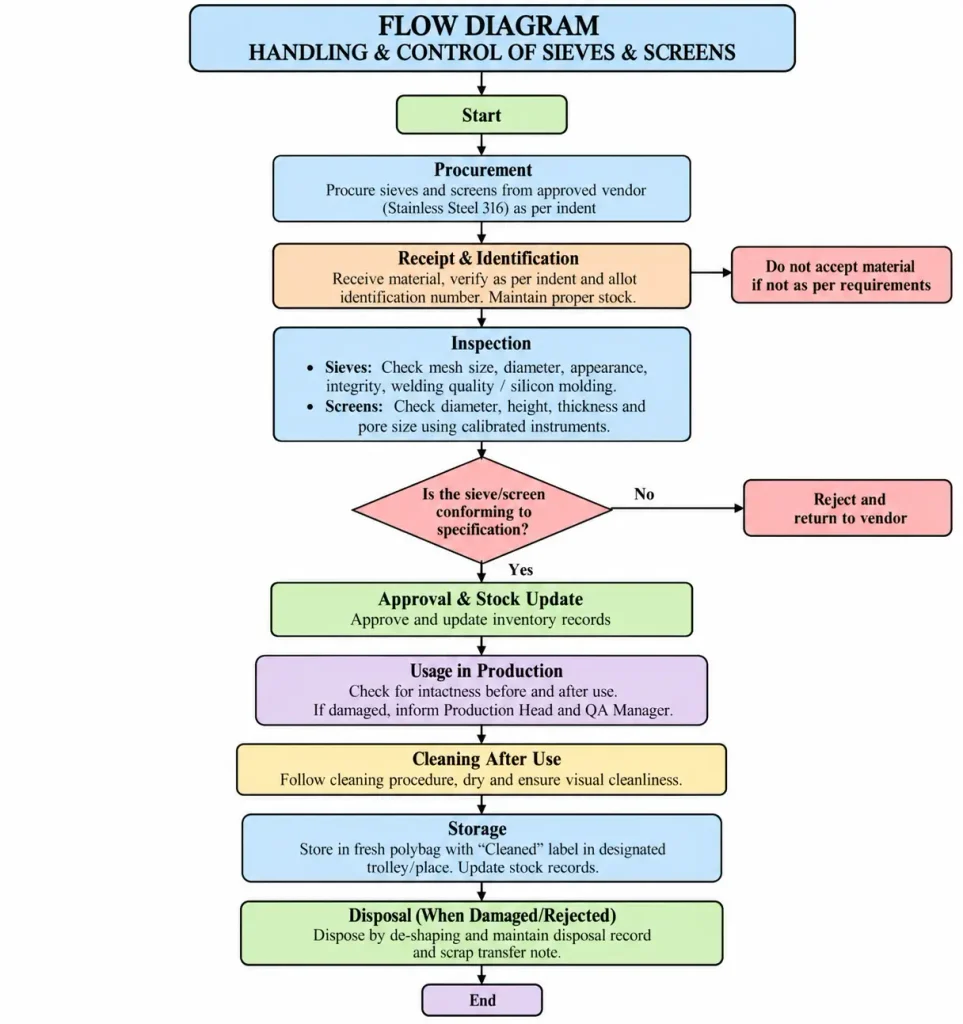
During production, the Handling & Control of Sieves & Screens procedure requires verification of sieve and screen integrity before and after use. Any damaged item must be reported to responsible Production and Quality personnel for appropriate action. After use, sieves and screens are cleaned, dried, visually checked for cleanliness, packed in fresh polybags, appropriately labeled, and stored in designated locations. Proper receipt, usage, cleaning, inventory, and disposal records are maintained to ensure traceability and effective control.
3. Benefits of Following SOP – Handling & Control of Sieves & Screens:
Following the Handling & Control of Sieves & Screens SOP helps ensure that only properly identified, inspected, clean, intact, and suitable sieves and screens are used during pharmaceutical manufacturing operations. The SOP requires checks of important attributes such as mesh size, diameter, physical appearance, integrity, welding quality, silicone molding, and screen pore size before use. Effective implementation of this SOP supports consistent sifting and milling operations, improves control over particle size, and helps reduce the risk of contamination or process-related defects. The requirement to check sieve and screen intactness before and after use also helps detect damage at an early stage and prevents unsuitable components from continuing in production.
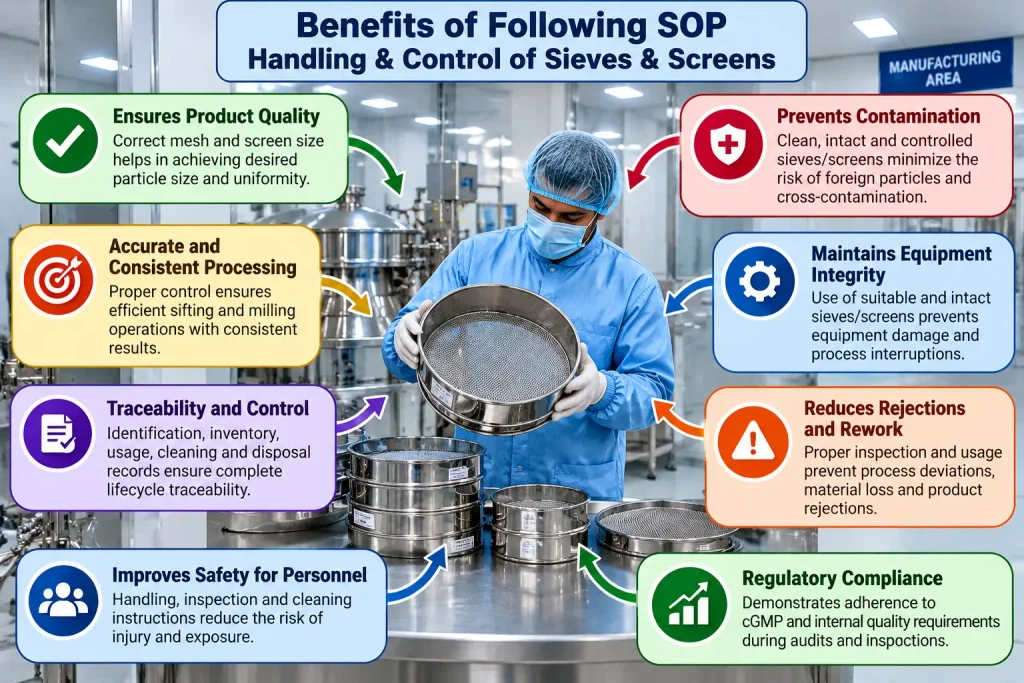
The Handling & Control of Sieves & Screens SOP also strengthens traceability through receipt checklists, inventory records, usage and cleaning records, and disposal documentation. Proper cleaning, drying, labeling, and storage further support good housekeeping and controlled reuse of the components. Overall, following this SOP helps improve product quality, operational consistency, equipment control, documentation compliance, and GMP readiness in the manufacturing area.
4. Brainstorming Analysis – Handling & Control of Sieves & Screens:
The Brainstorming Analysis for SOP Failure – Handling & Control of Sieves & Screens is used to identify possible causes that may lead to ineffective control of sieves and screens in the pharmaceutical manufacturing area. The analysis focuses on key failure areas such as procurement, identification, inspection, usage, cleaning, storage, documentation, damage, disposal, and operator training.
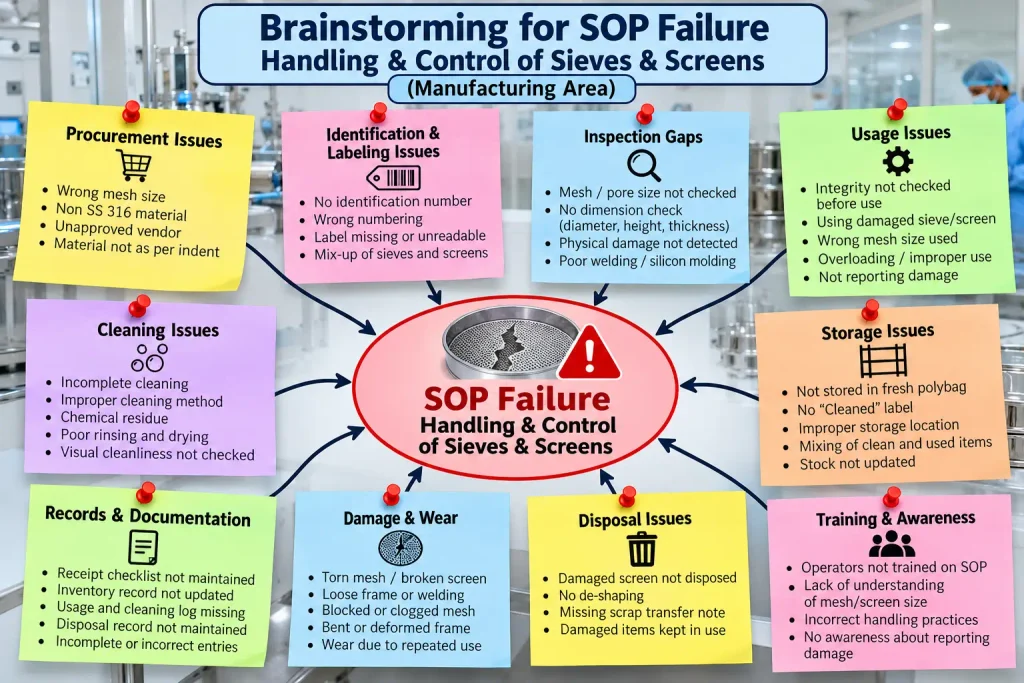
Potential causes include procurement of incorrect mesh size or unsuitable material, missing identification numbers, inadequate inspection, use of damaged sieves, improper cleaning, poor drying, incorrect storage, incomplete usage and cleaning records, failure to update inventory, and improper disposal of rejected screens. The SOP itself requires inspection of mesh size, dimensions, integrity, welding quality, and pore size, along with intactness checks before and after use. This brainstorming exercise helps the Production and Quality teams systematically recognize weaknesses in SOP implementation, identify areas requiring stronger controls, and support subsequent root-cause analysis and CAPA. Proper attention to these potential failure points improves traceability, product quality, process consistency, GMP compliance, and overall control of sieves and screens.
5. 5-Why Analysis – Handling & Control of Sieves & Screens:
The 5-Why Analysis for SOP Failure – Handling & Control of Sieves & Screens is used to identify the underlying causes of failures associated with the selection, inspection, usage, cleaning, storage, and documentation of sieves and screens in the manufacturing area. Typical problems may include use of the wrong mesh or screen size, use of damaged sieves, contamination due to inadequate cleaning, mix-up of sieves and screens, and incomplete traceability records.The SOP requires sieves to be checked for mesh size, diameter, physical appearance, integrity, and welding or silicone molding quality, while screens are checked for dimensions and pore size. It also requires intactness checks before and after use, appropriate reporting of damage, proper cleaning and storage, and updating of stock records.
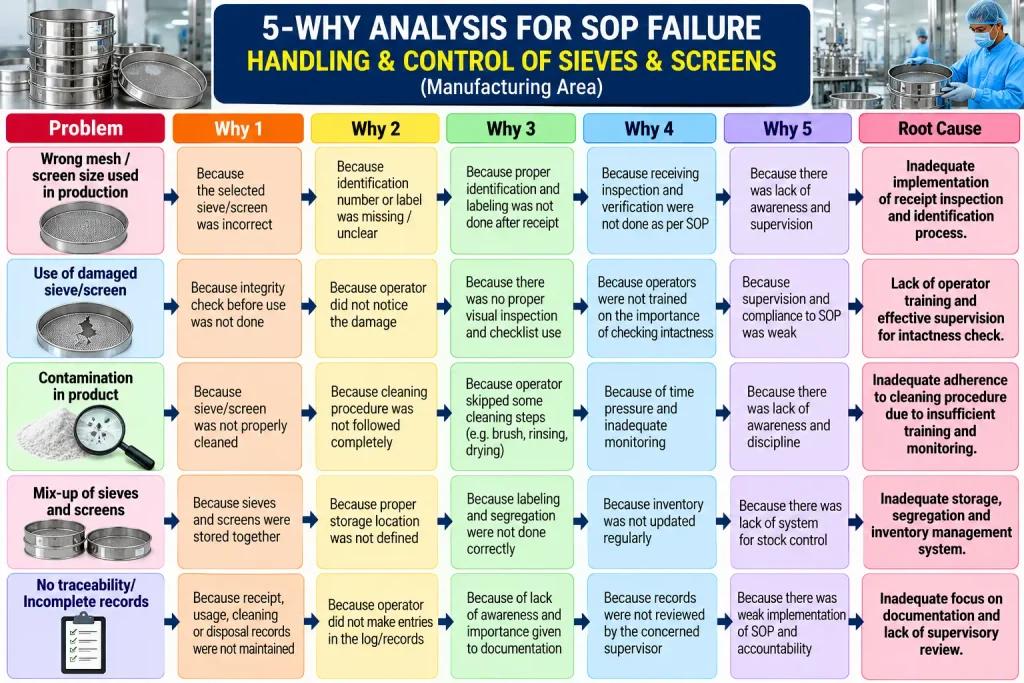
Through repeated “Why?” questioning, the analysis can trace visible problems back to deeper causes such as inadequate identification, missed receipt inspection, insufficient operator awareness, weak supervision, incomplete adherence to cleaning steps, improper storage segregation, and poor documentation control. The SOP also specifies maintenance of receipt, inventory, usage and cleaning, and disposal records, which are important for lifecycle traceability. Overall, the 5-Why Analysis for Handling & Control of Sieves & Screens helps the Production and Quality teams move beyond the immediate failure and identify the root cause so that suitable corrective and preventive actions can be implemented.
6. Fishbone Analysis – Handling & Control of Sieves & Screens:
The Fishbone Analysis for SOP Failure – Handling & Control of Sieves & Screens helps identify the possible causes of failure in the manufacturing area by grouping them into major categories such as Man, Machine, Material, Method, Measurement, and Environment. This structured approach supports systematic root-cause identification when problems occur during procurement, inspection, usage, cleaning, storage, or documentation of sieves and screens. Under Man, causes may include inadequate SOP training, poor awareness, improper handling, and failure to report damage. Machine factors may include damaged sieves, loose welding, improper fitting, or lack of routine inspection. Material causes can involve wrong mesh size, incorrect dimensions, defective pores, or material not meeting the required specification. The SOP specifically requires checks of mesh size, diameter, physical appearance, integrity, welding quality, silicone molding, and screen dimensions or pore size.
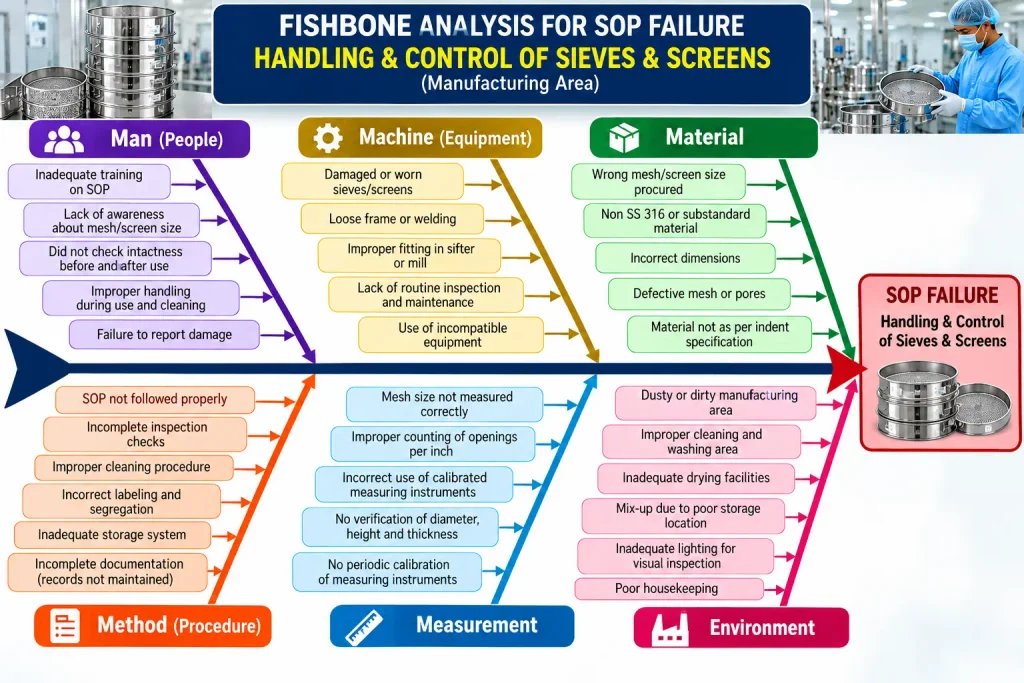
Method failures may involve incomplete inspection, improper cleaning, incorrect labeling, inadequate storage, or incomplete records. Measurement issues can arise from incorrect mesh counting or improper use of calibrated measuring devices. Environment factors may include unsuitable cleaning, drying, storage, housekeeping, or inspection conditions. The SOP also requires intactness checks before and after use, proper storage after cleaning, and stock updating. Overall, the Fishbone Analysis for Handling & Control of Sieves & Screens provides a clear framework for identifying potential contributors to SOP failure and supports the development of focused corrective and preventive actions.
7. Fault Tree Analysis – Handling & Control of Sieves & Screens:
The Fault Tree Analysis for SOP Failure – Handling & Control of Sieves & Screens evaluates how different lower-level failures can combine to result in the top event of ineffective sieve and screen control in the pharmaceutical manufacturing area. The analysis considers major failure branches such as use of a wrong or non-conforming sieve or screen, use of damaged components, contamination during production, and loss of traceability or documentation. The SOP requires incoming sieves and screens to be properly identified and inspected for mesh size, dimensions, physical appearance, integrity, welding quality, silicone molding, and pore size before use. Failure in procurement, identification, or inspection may therefore lead to selection of an unsuitable sieve or screen. Another branch of the fault tree involves use of damaged sieves or screens. The SOP specifically requires intactness checks before and after production use, and any damage identified during production is to be reported for necessary action. Cleaning and storage failures may also contribute to contamination risk, because the SOP requires cleaning, rinsing, drying, visual cleanliness verification, proper labeling, and controlled storage after use.
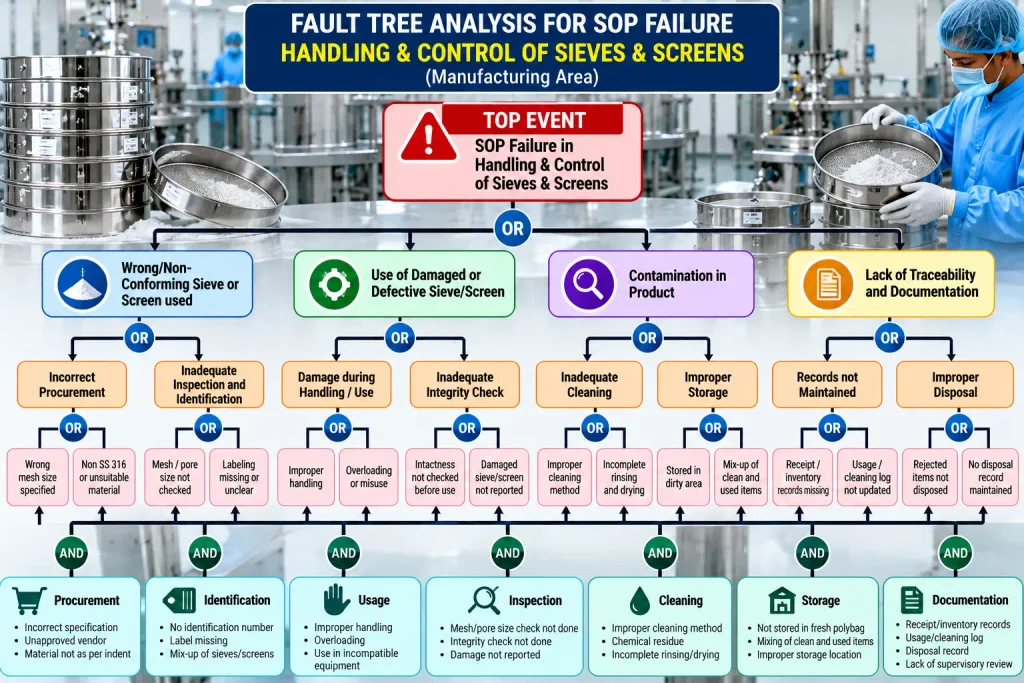
The documentation branch includes failures in maintaining receipt, inventory, usage, cleaning, and disposal records. These records are specifically required under the sieve and screen management system.Overall, the Fault Tree Analysis for Handling & Control of Sieves & Screens helps identify the logical pathways that can lead to SOP failure and provides a structured basis for root-cause investigation, CAPA, stronger controls, and improved GMP compliance.
8. Impact Assessment – Handling & Control of Sieves & Screens:
The Impact Assessment for SOP Failure – Handling & Control of Sieves & Screens evaluates the potential consequences of inadequate control over sieves and screens used in the pharmaceutical manufacturing area. Failure to follow the defined procedure can affect product quality, process consistency, documentation, production efficiency, and GMP compliance. The SOP requires sieves and screens to be checked for parameters such as mesh size, dimensions, physical appearance, integrity, welding quality, silicone molding, and pore size before acceptance and use. Failure of these controls may result in use of an unsuitable or damaged sieve or screen, which can affect the intended sifting or milling operation and may lead to process deviations or non-uniform material characteristics.
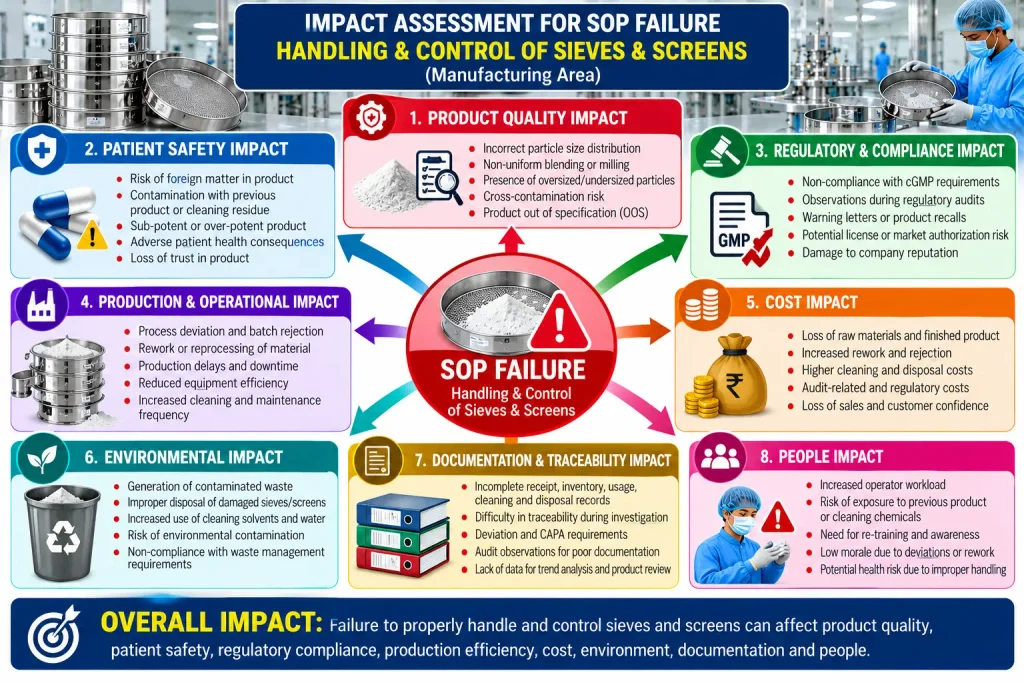
The procedure also requires integrity checks before and after production use and appropriate action when damage is detected. Inadequate compliance with these requirements can increase the risk of damaged mesh being used, potential foreign-particle contamination, production interruption, investigation, or batch impact. Improper cleaning, drying, labeling, or storage may also compromise the condition of sieves and screens. The SOP specifies cleaning, rinsing, visual cleanliness verification, drying, packing in polybags, and status labeling before storage. Documentation impact may occur when receipt, inventory, usage, cleaning, or disposal records are incomplete, reducing traceability and making investigation more difficult. Overall, the Impact Assessment for Handling & Control of Sieves & Screens indicates that SOP failure may lead to reduced process control, product quality concerns, additional cleaning or rework, production delays, documentation gaps, and regulatory observations. Proper implementation of the SOP helps maintain reliable operations, traceability, and consistent GMP compliance.
9. CAPA – Handling & Control of Sieves & Screens:
The Corrective and Preventive Action (CAPA) for SOP Failure – Handling & Control of Sieves & Screens is intended to eliminate identified causes of failure and prevent recurrence during pharmaceutical manufacturing operations. Corrective actions may include segregation of affected sieves or screens, replacement of damaged or non-conforming items, re-inspection of mesh size, dimensions and integrity, re-cleaning of inadequately cleaned components, correction of identification or labeling, and completion of missing receipt, usage, cleaning, inventory, or disposal records. The SOP requires sieves and screens to be inspected for mesh size, dimensions, physical appearance, integrity, welding quality, silicone molding, and pore size before use.It also requires intactness checks before and after production use, reporting of damage, and proper storage after cleaning.
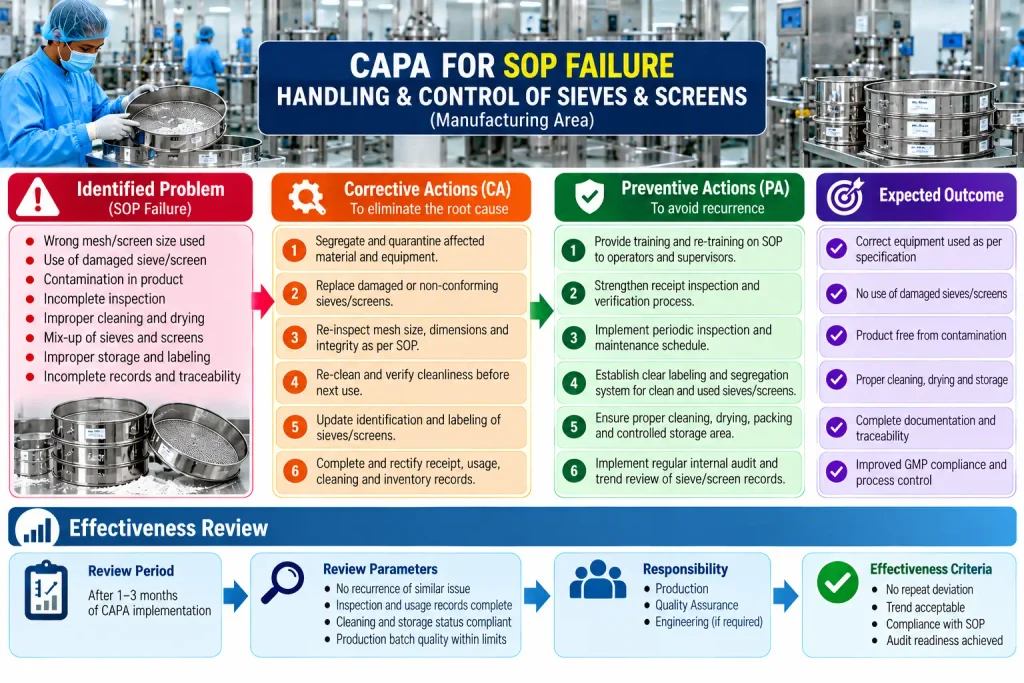
Preventive actions under the Handling & Control of Sieves & Screens SOP should focus on operator training, stronger receipt inspection, periodic integrity checks, clear identification and segregation, proper cleaning and drying practices, controlled storage, and regular review of records. The SOP specifically requires maintenance of receipt, inventory, usage and cleaning, and disposal records for effective traceability. An effectiveness review should confirm that similar failures have not recurred, records are complete, integrity checks are consistently performed, cleaning and storage requirements are followed, and only suitable sieves and screens are used in production. Successful CAPA implementation improves process control, product quality, traceability, and overall GMP compliance.
10. CPP and CQA – Handling & Control of Sieves & Screens:
The Critical Process Parameters (CPP) and Critical Quality Attributes (CQA) for Handling & Control of Sieves & Screens help ensure that sifting and milling operations are performed in a controlled and reproducible manner. Based on the SOP, important process controls include verification of mesh or screen size, sieve dimensions, physical appearance, integrity, welding quality, silicone molding, and pore size before use. Other critical operational controls include correct identification, intactness checks before and after production use, proper cleaning, drying, labeling, storage, and maintenance of usage records. The SOP specifically requires damaged sieves or screens to be reported and suitable action taken, while cleaned components are stored in fresh polybags with appropriate status labeling.
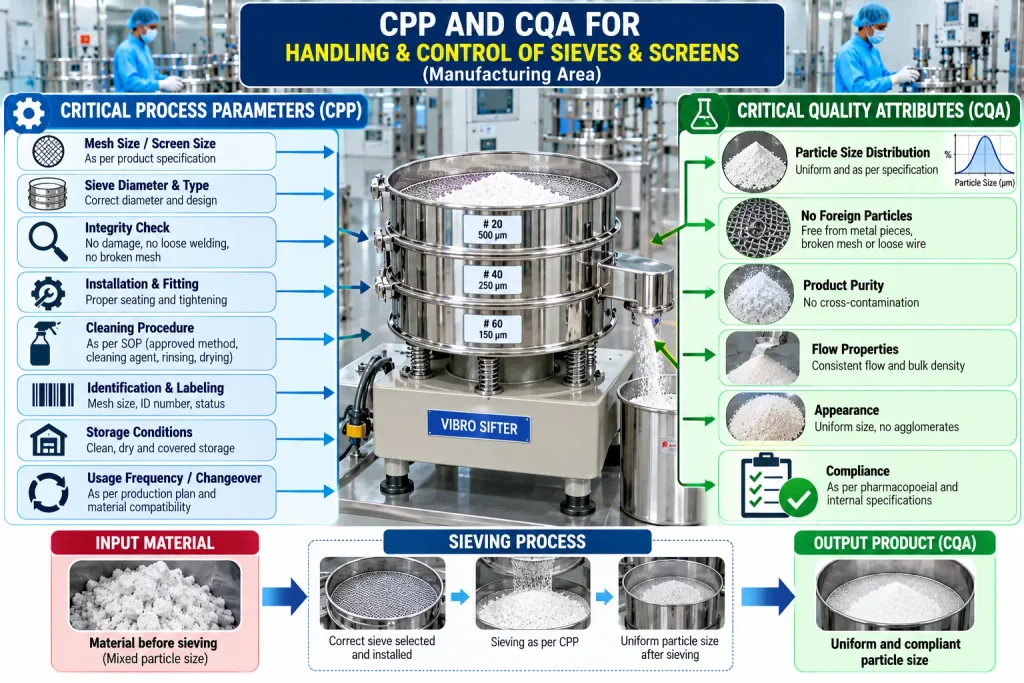
These process controls influence quality-related outcomes such as consistent particle-size control, absence of foreign matter from damaged mesh, prevention of cross-contamination, cleanliness, and overall suitability of material after sifting or milling. The SOP also requires cleaning with water and nylon brush, detergent cleaning, rinsing with purified water, drying, visual cleanliness verification, and recording of cleaning activities. Overall, proper control of the CPPs associated with the Handling & Control of Sieves & Screens supports consistent processing, reliable sieve performance, product quality, traceability, and GMP compliance.
Questions & Answers – Handling & Control of Sieves & Screens:
- What is the objective of the SOP for Handling & Control of Sieves & Screens?
The objective is to define the procedure for proper handling and control of sieves and screens used in the Production Department. - Which department is responsible for execution of this SOP?
The Production Department is responsible for execution of the SOP, with concerned production personnel and the Production Chemist responsible for carrying out the procedure. - What material should sieves and screens be made of?
The SOP specifies that sieves and screens should be procured in Stainless Steel 316. - What should be done when received sieves or screens do not meet the indent requirements?
They should not be accepted if they do not meet the specified requirements. - What checks are required during inspection of sieves?
Sieves are checked for mesh size, diameter, physical appearance, integrity, welding quality or silicone molding, and the number of openings per linear inch using a calibrated measuring scale. - What acceptance criterion is specified for sieve mesh verification?
The sieve is considered acceptable when readings at all three checked locations are within ±10% of the required value. Otherwise, it is rejected. - What checks are required for screens?
Screens are checked for diameter, height, thickness, and pore or screen size using a calibrated Vernier caliper. - When should sieve and screen integrity be checked?
Integrity should be checked before and after use in production. - What action should be taken if a sieve or screen is found damaged during production?
The damage should be reported to the Production Head and Quality Assurance Manager for necessary action. - How should rejected screens be disposed of?
Rejected screens are to be disposed of by de-shaping. - How should cleaned sieves be stored?
Cleaned sieves should be placed in a fresh polybag, labeled as “Cleaned,” and stored in the sieve trolley. - How should cleaned screens be stored?
Cleaned screens should be packed in a fresh polybag, given a “Cleaned” status label, and stored at the respective designated location. - Which records are required under the sieve and screen management system?
The SOP requires a Receipt Checklist, Inventory Record, Equipment Usage and Cleaning Record, and Disposal Record/Scrap Transfer Note. - When can a newly received sieve or screen be used?
It can be used after the required records are completed, cleaning is performed, and clearance is received from QC. - What should be done before issuing a sieve or screen for a batch?
An entry should be made in the usage log, and the integrity of the sieve or screen should be checked and recorded in the BMR. - What happens if a sieve or screen fails the integrity check?
The failure should be recorded in the Disposal Record, a Scrap Disposal Note should be prepared, and the item should be sent for destruction. - How are sieves and screens cleaned?
They are cleaned with water and a nylon brush, rinsed, visually inspected for cleanliness, cleaned with 0.1% v/v Teepol solution, rinsed again with process and purified water, and then dried using compressed air and a lint-free cloth. - What should be done if visual cleanliness is not satisfactory?
The cleaning steps should be repeated until satisfactory visual cleanliness is achieved. - Where is cleaning activity recorded?
Cleaning details are recorded in Annexure III – Usage and Cleaning Record (Sieve/Screen). - What annexures are included in this SOP?
The SOP includes the Sieve Receipt Checklist, Screen Receipt Checklist, Usage & Cleaning Record, Inventory Record, and Disposal Record.
Reference Guidelines – Handling & Control of Sieves & Screens:
- WHO Good Manufacturing Practices (GMP) for Pharmaceutical Products – requirements for equipment cleanliness, maintenance, prevention of contamination, and documentation.
- Schedule M of the Drugs Rules, 1945 (India) – GMP requirements for premises, equipment, production controls, sanitation, and records.
- PIC/S Guide to Good Manufacturing Practice for Medicinal Products – PE 009 – requirements for equipment, production operations, cleaning, and documentation.
- EU Guidelines for Good Manufacturing Practice, Volume 4, Part I – particularly chapters covering premises and equipment, documentation, and production.
- US FDA – 21 CFR Part 211, Current Good Manufacturing Practice for Finished Pharmaceuticals – especially requirements related to equipment construction, cleaning, maintenance, production controls, and records.
- ICH Q9 – Quality Risk Management – useful when evaluating risks related to damaged sieves, incorrect mesh selection, contamination, or inadequate control.
- ASTM E11 – Standard Specification for Woven Wire Test Sieve Cloth and Test Sieves – applicable for sieve mesh/opening specifications and verification where adopted by the site.
.