







1. Introduction – SOP for Handling of Loose Shipper:
The SOP for Handling of Loose Shipper defines the controlled procedure for managing partially packed or loose shippers during packing-line breakdowns, scheduled intervals, or temporary stoppages. The objective is to prevent product mix-up, quantity discrepancies, improper identification, and loss of traceability during packaging operations. The SOP specifies that not more than one loose shipper should remain on the packing line at a time. When packing is interrupted, the concerned production personnel must record the shipper number, stoppage time, and packer details in the Batch Packing Record (BPR). The loose shipper is identified using half tape and must be completed first when packing resumes. Before final taping, the Production Officer verifies and certifies the required fill quantity. The shipper is subsequently checked and signed by the QA Officer and transferred to the Bonded Store Room (BSR). All verification and certification activities must be appropriately documented in the BPR to ensure accountability, traceability, and GMP compliance.
Skip to PDF content2. Flow Diagram – Handling of Loose Shipper:
The flow diagram for Handling of Loose Shipper describes the systematic control of partially packed shippers during packing-line interruptions or breakdowns. During normal packing operations, not more than one loose shipper should remain on the packing line. If the packing line is stopped for an interval or breakdown, the concerned Production Officer records the shipper number, stoppage time, and packer details in the Batch Packing Record (BPR). The loose shipper is identified using half tape to maintain clear status identification.
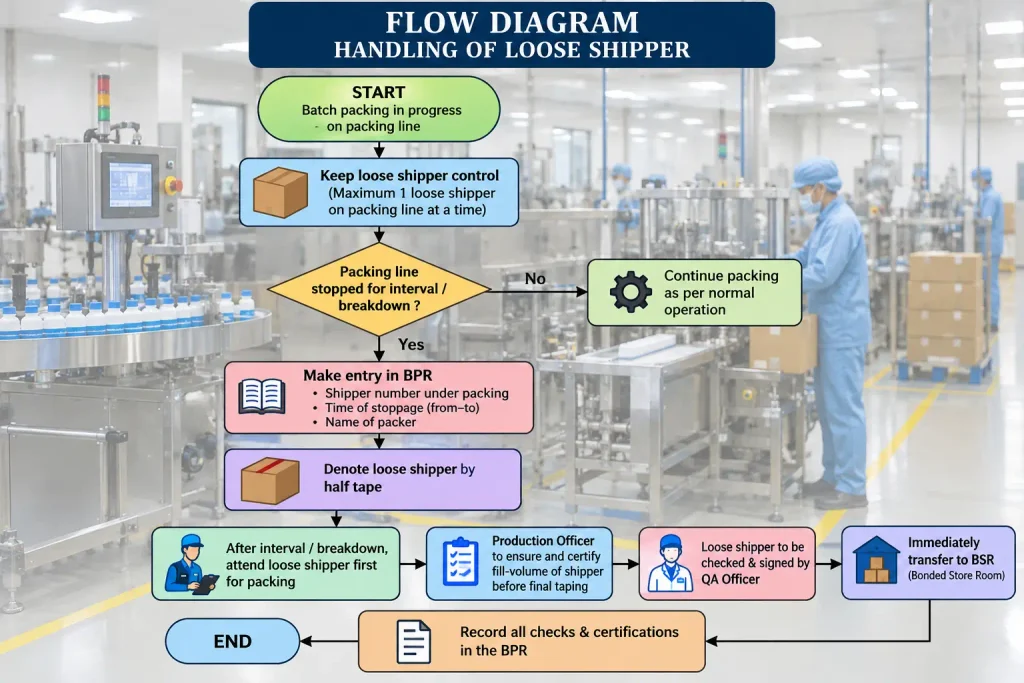
After resumption of operations, the loose shipper is taken up first for completion of packing. The Production Officer verifies and certifies the fill quantity before final taping. The completed shipper is then checked and signed by the QA Officer and immediately transferred to the Bonded Store Room (BSR). All checks, verifications, and certifications are documented in the BPR to ensure traceability, accountability, and controlled handling throughout the packing process.
3. Shipper Verification – Handling of Loose Shipper:
The Shipper Verification activity under the SOP for Handling of Loose Shipper is performed to ensure that the shipper used during packing meets the approved packaging specifications. The shipper should be checked for its length, width, and height using a suitable calibrated measuring scale or measuring device. These dimensional checks confirm that the shipper is of the correct size and is suitable for accommodating the specified packed units without excessive space, compression, or deformation.
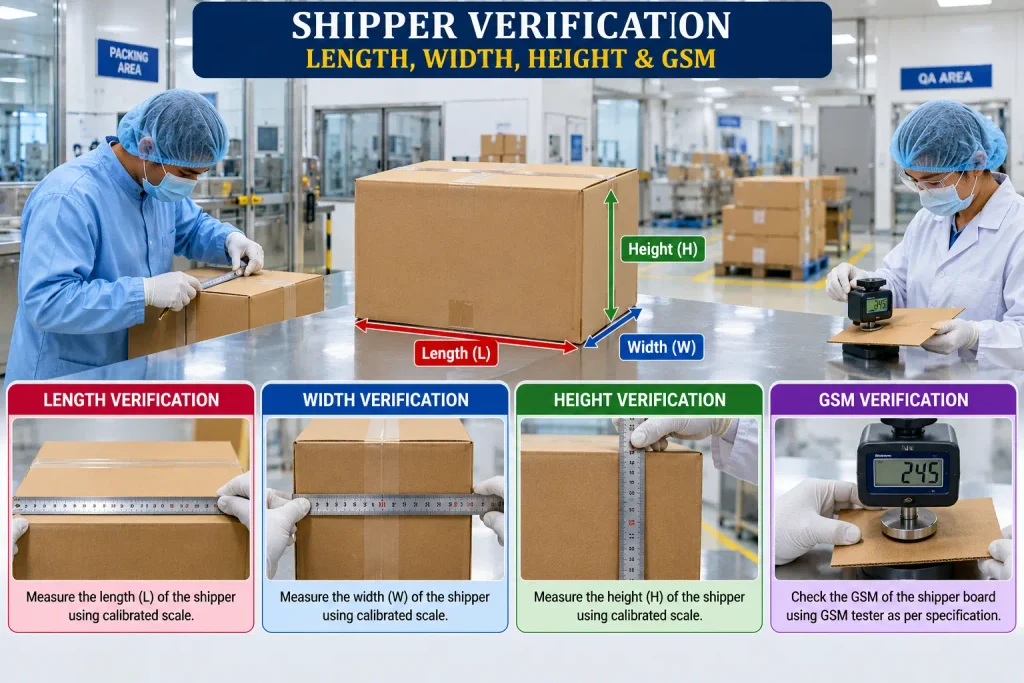
The GSM (grams per square metre) of the shipper board should also be verified as per the approved specification to confirm the required strength and quality of the packaging material. Proper verification of dimensions and GSM helps maintain packing integrity, prevents use of incorrect or weak shippers, and supports safe handling, storage, and transportation. All observations should be recorded in the relevant packing or inspection record, and any shipper not meeting the approved specification should be segregated and handled according to the applicable procedure.
4. Brainstorming Analysis for SOP Failure – Handling of Loose Shipper:
The Brainstorming Analysis for SOP Failure – Handling of Loose Shipper identifies potential reasons that may lead to loss of control during packing-line interruptions or breaks. Major failure possibilities include keeping more than one loose shipper on the packing line, incomplete or incorrect entries in the Batch Packing Record (BPR), failure to identify the loose shipper with half tape, and not attending the loose shipper first after resumption of packing.
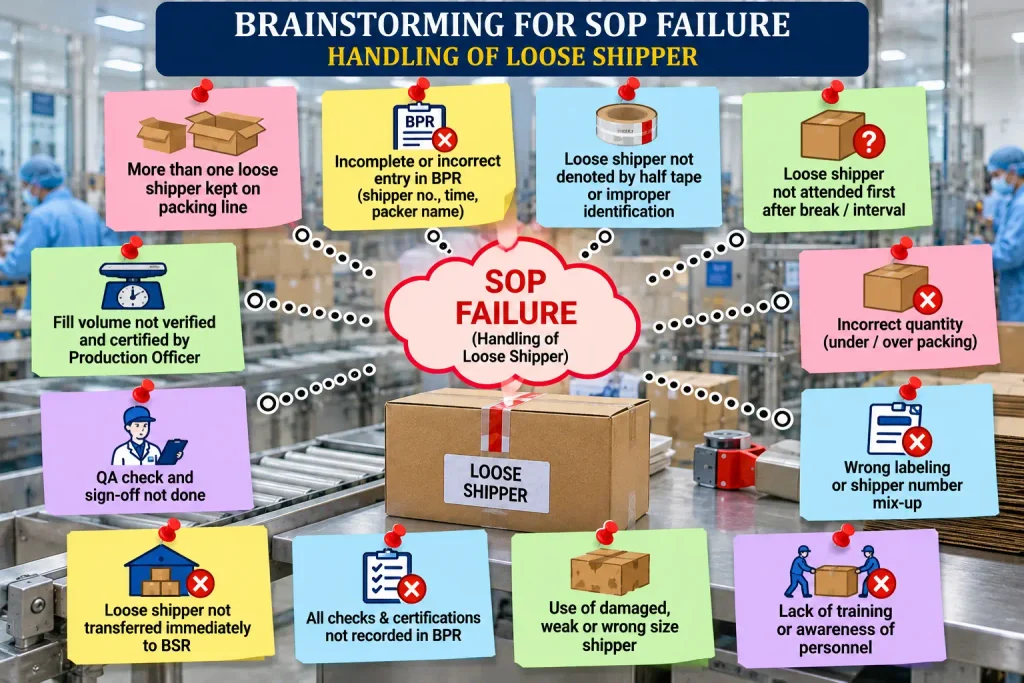
Other causes may include non-verification of fill quantity by the Production Officer, missing QA check and sign-off, incorrect quantity, wrong labeling or shipper-number mix-up, delayed transfer to the Bonded Store Room (BSR), and incomplete documentation of checks and certifications. Use of damaged, weak, or incorrect-size shippers and insufficient personnel training can further increase the risk. Brainstorming these possible failures helps identify vulnerable steps, supports root-cause evaluation, and enables implementation of effective preventive controls.
5. Fishbone Analysis for SOP Failure – Handling of Loose Shipper:
The Fishbone Analysis for SOP Failure – Handling of Loose Shipper identifies the possible causes that can lead to failure in controlling loose shippers during packing operations. The analysis groups potential causes under Man, Method, Material, Measurement, Machine/Line, and Environment. Man-related causes include inadequate training, carelessness, missed QA sign-off, and failure to record packer details.
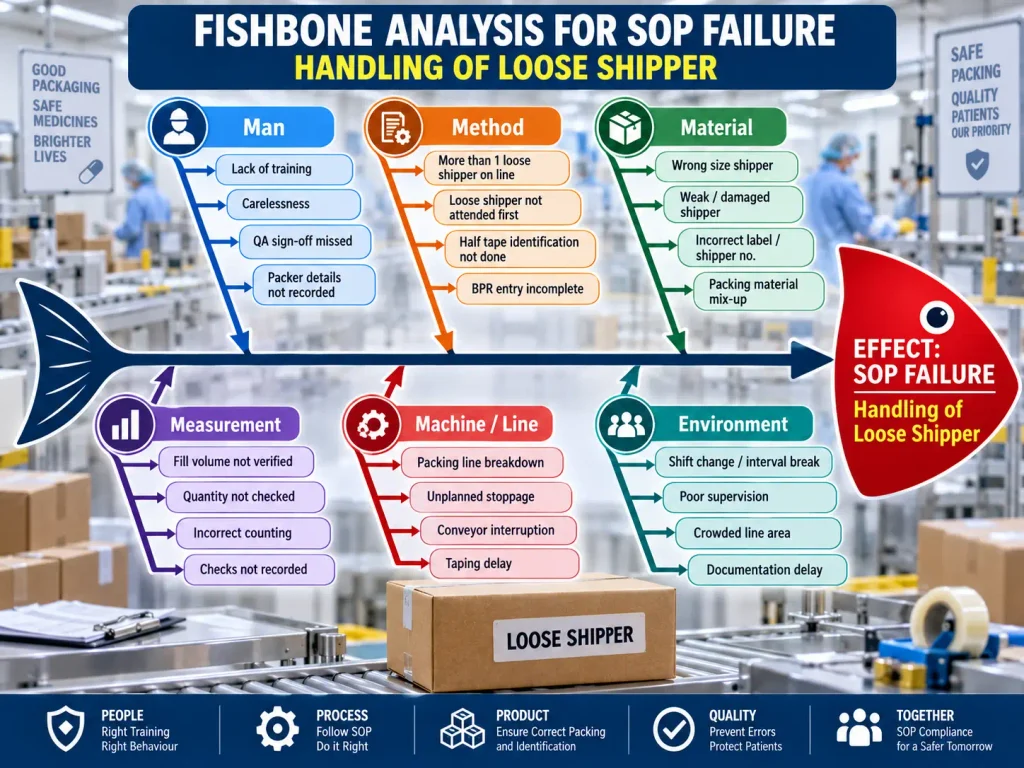
Method-related causes include keeping more than one loose shipper on the line, incomplete BPR entries, failure to identify the shipper with half tape, and not attending the loose shipper first after a break. Material causes may include incorrect, damaged, weak, or wrongly labeled shippers. Measurement failures include non-verification of fill volume, quantity errors, and unrecorded checks. Machine or line interruptions, unplanned stoppages, and taping delays may also contribute. Environmental factors such as shift changes, poor supervision, and documentation delays can further increase the risk of SOP failure.
6. 5-Why Analysis for SOP Failure – Handling of Loose Shipper:
The 5-Why Analysis for SOP Failure – Handling of Loose Shipper is used to identify the underlying reason for improper control of a loose shipper during packing-line breaks, intervals, or stoppages. The first cause may be that more than one loose shipper is retained on the line or the shipper is not properly identified. Further investigation may reveal that half-tape identification and required BPR entries are not completed at the time of stoppage. This can occur when the Production Officer or packer does not follow the defined SOP requirements during busy packing operations.
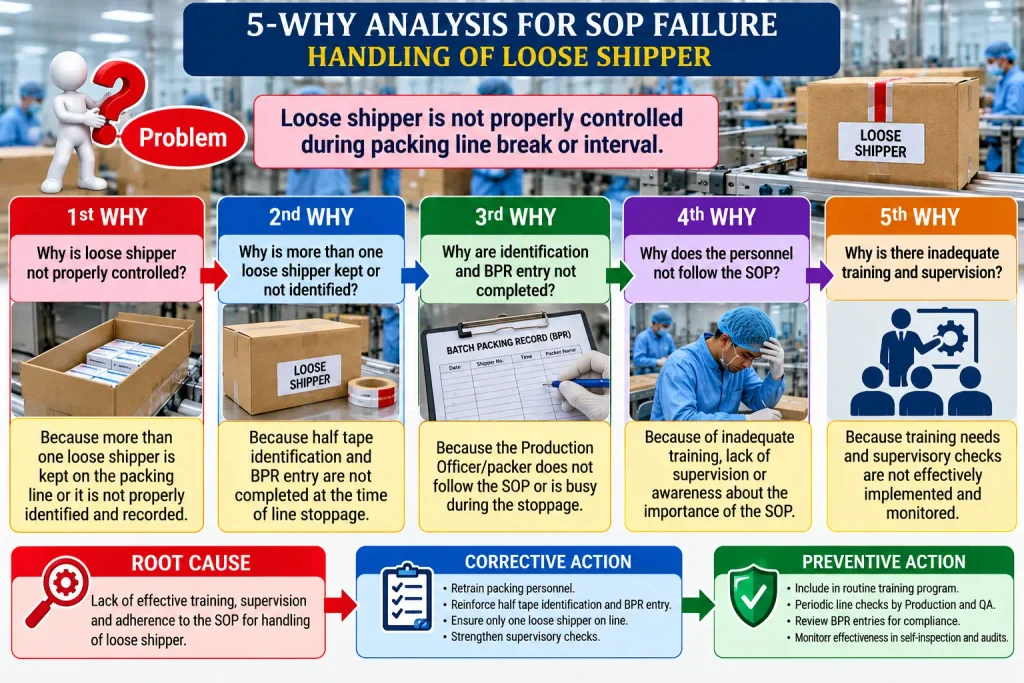
The analysis may further identify inadequate training, insufficient supervision, or poor awareness of the importance of proper loose-shipper control. The root cause may therefore relate to ineffective training, supervision, and SOP compliance. Appropriate actions include retraining personnel, reinforcing BPR documentation and identification requirements, ensuring only one loose shipper remains on the line, and strengthening routine supervisory and QA checks.
7. Fault Tree Analysis for SOP Failure – Handling of Loose Shipper:
The Fault Tree Analysis for SOP Failure – Handling of Loose Shipper systematically evaluates the events that may lead to improper control of a loose shipper during packing operations. The top event may result in product mix-up, quantity discrepancy, incorrect identification, or loss of traceability. Immediate causes can include keeping more than one loose shipper on the packing line, failure to apply half-tape identification, incomplete BPR entries, incorrect quantity packing, failure to attend the loose shipper first after a break, missing QA verification, and delayed transfer to the Bonded Store Room (BSR).
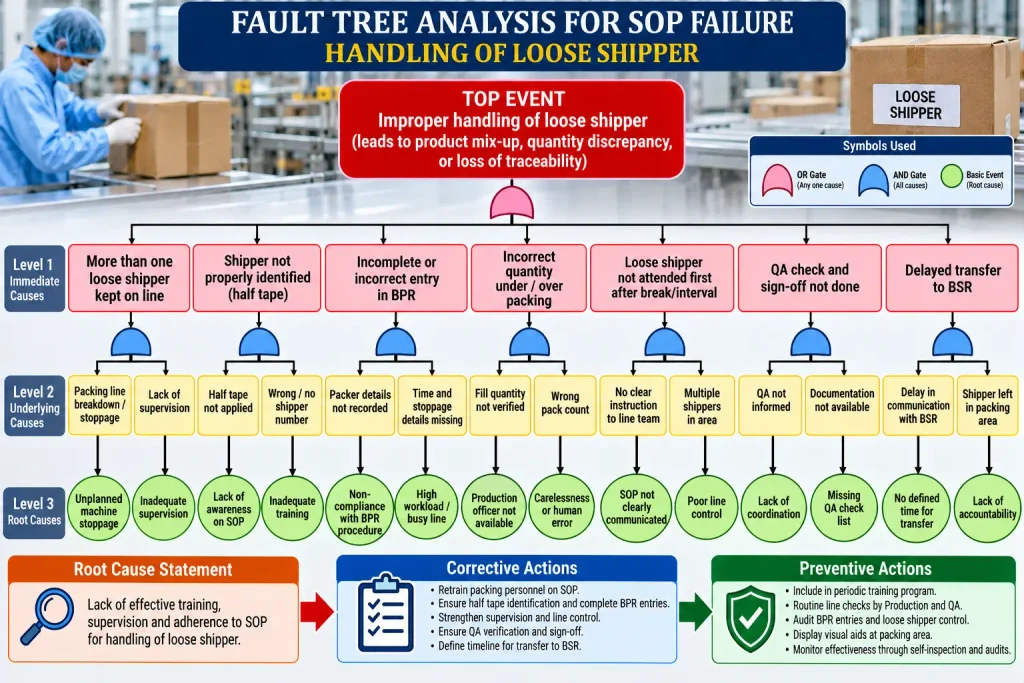
These failures may arise from packing-line stoppage, inadequate supervision, lack of SOP awareness, incomplete training, high workload, poor communication, and human error. The analysis helps identify the combination of process and personnel failures contributing to the event. Corrective and preventive actions should therefore focus on retraining, strengthened supervision, complete documentation, QA verification, defined transfer timelines, and routine monitoring of SOP compliance.
8. CAPA for SOP Failure – Handling of Loose Shipper:
The Corrective and Preventive Action (CAPA) for SOP Failure – Handling of Loose Shipper is intended to eliminate observed deficiencies and prevent recurrence during packing operations. Corrective actions include immediate removal of excess loose shippers from the packing line, proper identification of the retained loose shipper with half tape, completion of required BPR entries, verification of product details and fill quantity, QA checking and sign-off, and timely transfer of the shipper to the Bonded Store Room (BSR). Retraining of concerned packing personnel should also be performed.
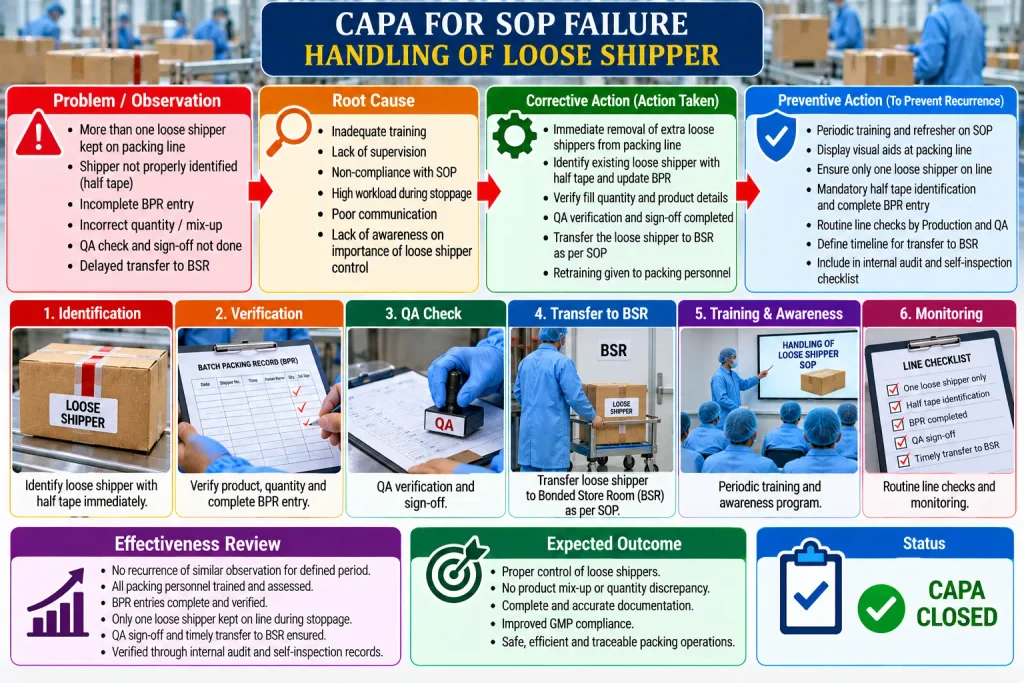
Preventive actions include periodic SOP refresher training, routine Production and QA line checks, mandatory half-tape identification, verification of complete BPR documentation, defined timelines for BSR transfer, and inclusion of loose-shipper controls in self-inspection or internal audit checklists. CAPA effectiveness should be verified through review of BPR records, training assessment, line observations, and confirmation that similar deviations have not recurred within the defined monitoring period.
Questions & Answers – Handling of Loose Shipper:
- What is the objective of the SOP for Handling of Loose Shipper?
The objective is to define the procedure for proper handling and control of loose shippers during packing-line breakdowns or intervals. - When is this SOP applicable?
It applies when a loose or partially packed shipper remains on the packing line during a breakdown, interval, or temporary stoppage. - How many loose shippers are permitted on the packing line?
Not more than one loose shipper should be kept on the packing line at a time. - What should be recorded in the BPR when packing stops?
The shipper number, stoppage time, and name of the concerned packer should be recorded in the Batch Packing Record. - How should a loose shipper be identified?
The loose shipper should be identified using half tape. - What should be done with the loose shipper after the break or interval?
It should be attended and completed first when packing operations resume. - Who verifies the fill quantity of the loose shipper?
The Production Officer verifies and certifies the fill quantity before final taping. - Who performs the final quality check of the loose shipper?
The QA Officer checks and signs the loose shipper. - Where is the verified loose shipper transferred?
It is immediately transferred to the Bonded Store Room (BSR). - Why is proper identification of the loose shipper important?
Proper identification helps prevent mix-ups, incorrect packing, and loss of traceability. - Why is BPR documentation important?
BPR documentation provides traceability and evidence that required checks and certifications were performed. - What may happen if more than one loose shipper is kept on the line?
It can increase the risk of product mix-up, quantity errors, and incorrect identification. - What is the role of QA in loose shipper handling?
QA verifies the shipper, provides sign-off, and ensures that the defined controls have been followed. - What should be done if the fill quantity is incorrect?
The discrepancy should be investigated and corrected before the shipper is finally taped and transferred. - What is the full form of BSR?
BSR – Bonded Store Room. - What is the key GMP benefit of following this SOP?
It ensures controlled handling, complete documentation, traceability, accountability, and prevention of packing errors.
Reference Guidelines – Handling of Loose Shipper:
- WHO Good Manufacturing Practices (GMP) for Pharmaceutical Products – requirements for controlled packaging operations, documentation, prevention of mix-ups, and reconciliation.
- Schedule M, Drugs Rules, India – GMP requirements for pharmaceutical manufacturing and packaging operations.
- EU Guidelines for Good Manufacturing Practice, EudraLex Volume 4 – Chapter 5: Production – controls for packaging operations, line clearance, identification, and prevention of mix-ups.
- US FDA 21 CFR Part 211 – Subpart G: Packaging and Labeling Control – requirements for packaging-line control, labeling, inspection, and prevention of mix-ups.
- PIC/S Guide to GMP – PE 009, Chapter 5: Production – requirements for controlled packaging operations and handling of packaging materials.
- Approved Batch Packing Record (BPR) – for recording shipper number, stoppage details, packer information, verification, and QA sign-off.
- Site SOP for Line Clearance and Packaging Operations – where applicable, for supporting control of loose or partially packed shippers.