







1. Introduction – Operation, Cleaning of Shipper Label Weighing Machine:
The Operation, Cleaning of Shipper Label Weighing Machine SOP describes the standardized procedure for handling, operating, cleaning, maintaining, and controlling the shipper label weighing and printing system used during pharmaceutical packing operations. The SOP is intended to ensure that shipper weighing and label generation activities are performed accurately, consistently, and under controlled conditions.The procedure includes cleaning of the printer exterior, media compartment, sensors, print head, and platen roller, along with instructions for power supply, battery charging, login, zero setting, tare functions, weighing, counting, accumulation, record handling, label printing, and deletion of records. The SOP also requires the production chemist to obtain approval of the initial printed label from IPQA and Production before routine shipper labeling begins. Subsequent shipper labels are generated during packing, while damaged or loose labels are controlled and documented appropriately. Proper implementation of this SOP helps maintain label accuracy, weight verification, traceability, data integrity, GMP compliance, and effective control of finished-product shipper identification throughout the packing process.
Skip to PDF content2. Flow Diagram – Operation, Cleaning of Shipper Label Weighing Machine:
The Operation, Cleaning of Shipper Label Weighing Machine SOP defines the controlled method for cleaning, operating, weighing, printing, and handling shipper labels during pharmaceutical packing activities. The procedure includes cleaning of the printer exterior, media compartment, sensors, print head, and platen roller to keep the equipment in suitable working condition.
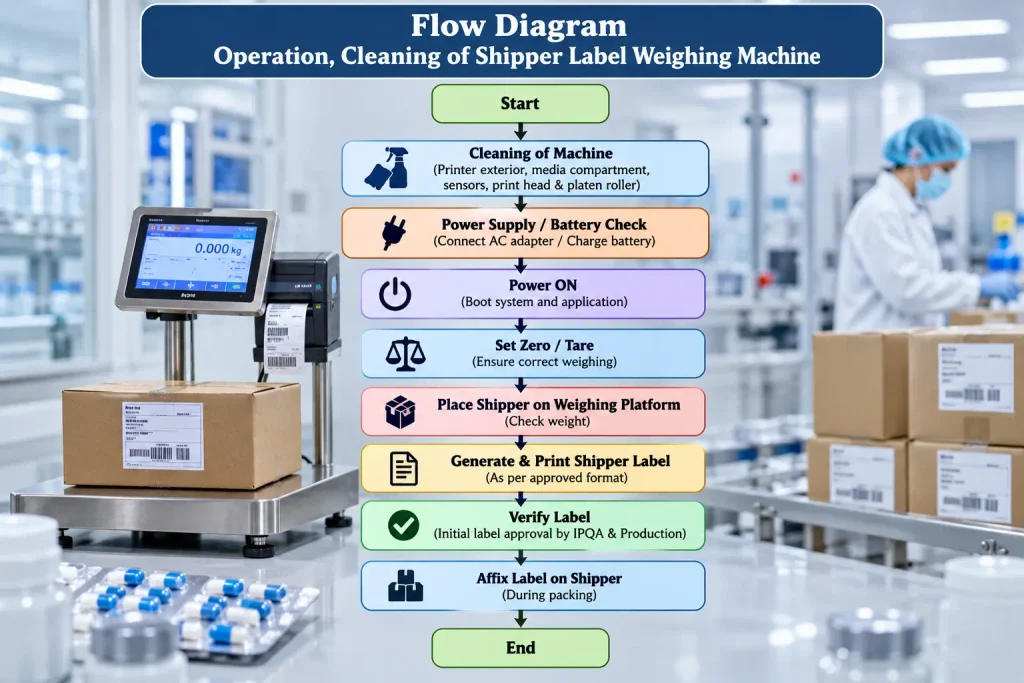
The SOP also covers power supply and battery charging, system login, zero setting, tare functions, weighing, counting, accumulation, record review, record export, and printing of shipper labels. During routine packing, the production chemist obtains approval of the initial printed label from IPQA and Production. After approval, labels are printed and affixed to individual shippers. Damaged or loose labels are checked and controlled through appropriate documentation in the BPR.Following this SOP supports accurate shipper identification, correct weighing, label control, traceability, documentation, and consistent execution of packing operations.
3. Benefits of Following SOP – Operation, Cleaning of Shipper Label Weighing Machine:
Following the Operation, Cleaning of Shipper Label Weighing Machine SOP ensures that weighing, label printing, cleaning, and record-handling activities are carried out in a standardized and controlled manner. The SOP requires proper cleaning of the printer exterior, media compartment, sensors, print head, and platen roller, helping keep the equipment in suitable operating condition and reducing the possibility of malfunction or contamination.
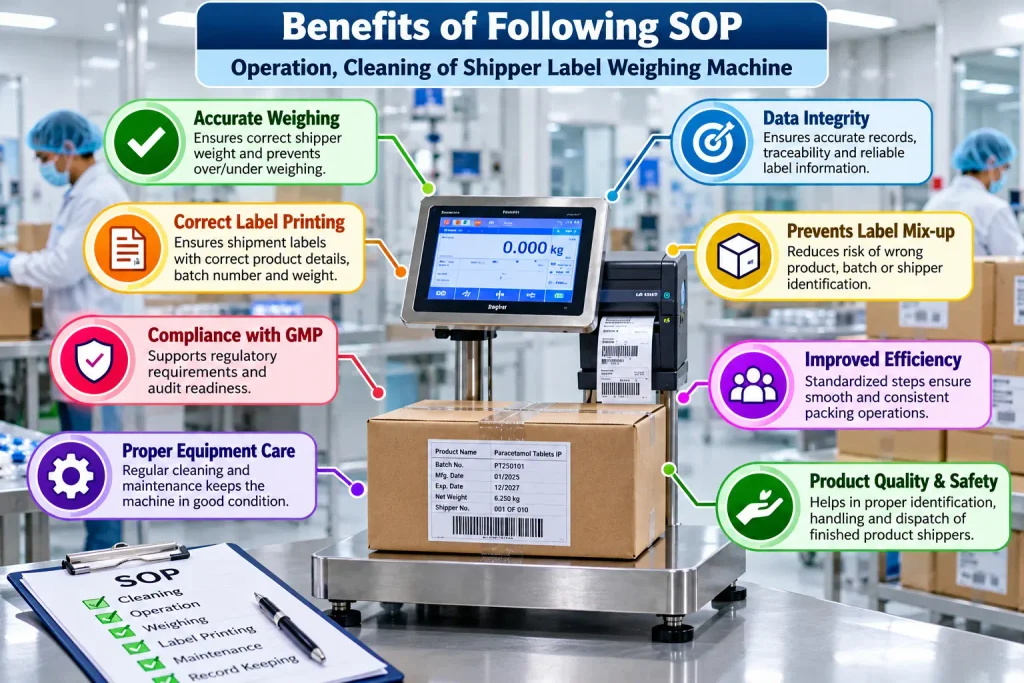
Correct use of zero and tare functions supports accurate weighing, while controlled product and client selection, counting, accumulation, record review, and printing improve traceability and consistency of shipper identification.The SOP also requires verification and approval of the initial shipper label before routine use. Damaged labels are reported and documented, while loose shipper labels are physically checked before application. These controls help reduce label mix-ups, incorrect identification, and documentation errors. Overall, adherence to this SOP supports accurate weighing, correct labeling, equipment reliability, record traceability, GMP compliance, product identification, and smooth packing operations.
4. Brainstorming for SOP Failure – Operation, Cleaning of Shipper Label Weighing Machine:
The Brainstorming for SOP Failure – Operation, Cleaning of Shipper Label Weighing Machine identifies possible causes that may lead to errors during weighing, label printing, cleaning, verification, and documentation activities. Major causes include inadequate cleaning of the printer exterior, media compartment, sensors, print head, and platen roller, which can affect equipment performance and print quality. Operational failures may also occur due to incorrect zero or tare setting, improper product selection, low battery or unstable power supply, incorrect label format, printer malfunction, or inaccurate weighing. The SOP specifically includes controls for power, charging, zero setting, tare, weighing, counting, accumulation, record review, and printing.
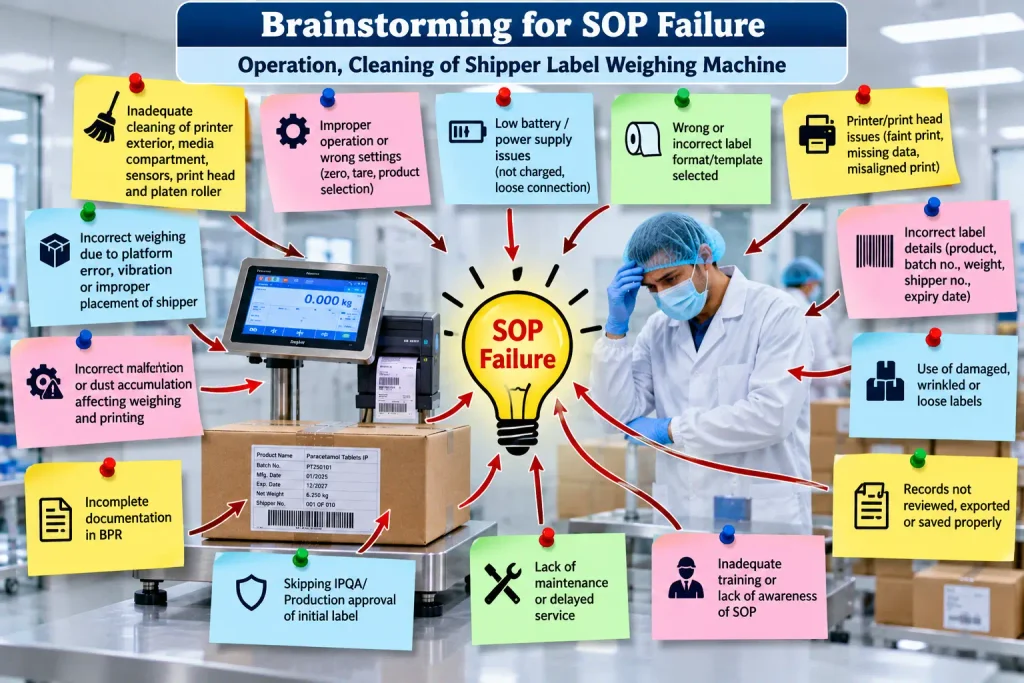
Other potential failure points include incorrect product or client information, damaged labels, incomplete BPR documentation, skipped initial label approval, inadequate operator understanding, and poor maintenance. The SOP requires initial label approval by IPQA and Production and control of damaged or loose labels. Brainstorming these possible causes helps identify weaknesses before they result in wrong labeling, incorrect weight, traceability failure, documentation errors, or packing-line deviations.
5. 5-Why Analysis for SOP Failure – Operation, Cleaning of Shipper Label Weighing Machine:
The 5-Why Analysis for SOP Failure – Operation, Cleaning of Shipper Label Weighing Machine is used to identify the underlying cause of errors such as incorrect, unclear, or improperly printed shipper labels. The investigation begins with the immediate problem and progressively asks “Why?” until the basic system weakness is identified. A typical failure may start with incorrect label details being printed because the wrong product, batch, weight, or shipper information was selected or entered. This can occur when the operator does not verify the selected information before printing. The SOP requires product selection, weighing, record handling, and label printing to be performed through controlled steps.
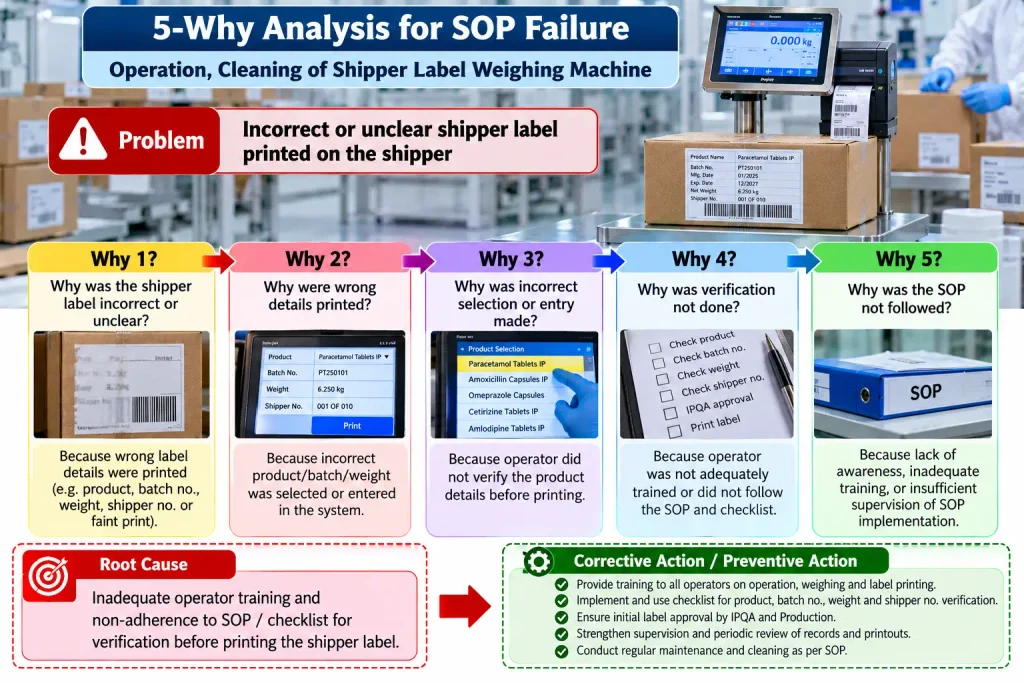
Further analysis may show that verification was skipped due to inadequate training, poor adherence to the SOP, or insufficient supervision. The SOP specifically requires the first printed label to be approved by IPQA and Production before routine shipper labeling starts. Therefore, the likely root cause is inadequate operator training and failure to follow the prescribed verification process. Corrective and preventive measures should focus on operator retraining, checklist-based verification, strengthened supervision, initial-label approval, proper cleaning, and periodic review of weighing and printing records.
6. Fishbone Analysis for SOP Failure – Operation, Cleaning of Shipper Label Weighing Machine:
The Fishbone Analysis for SOP Failure – Operation, Cleaning of Shipper Label Weighing Machine is used to systematically identify possible causes that can lead to incorrect weighing, unclear labels, wrong label information, printing problems, or failure to follow the approved process.The analysis groups potential causes under six major categories: Man, Machine, Method, Material, Measurement, and Environment. Human-related causes may include inadequate training, incorrect product selection, skipped verification, and poor supervision. Machine-related causes may involve dirty sensors, print-head problems, low battery, loose connections, or weighing-machine malfunction. The SOP itself requires cleaning of the printer exterior, media compartment, sensors, print head, and platen roller, showing the importance of equipment cleanliness and condition.
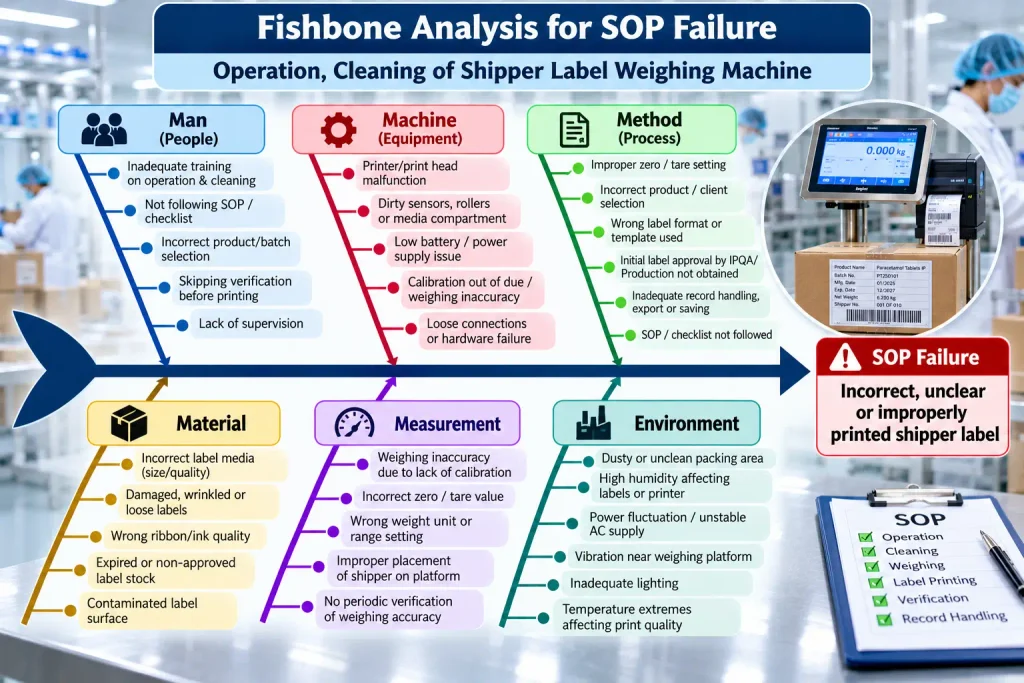
Method-related causes can include incorrect zero or tare setting, wrong product or client selection, improper record handling, or failure to obtain the required initial label approval. Material, measurement, and environmental factors may also contribute through damaged labels, unsuitable label media, incorrect weighing values, unstable power, dust, vibration, or poor working conditions. Overall, fishbone analysis helps the investigation team identify the most probable causes and supports selection of appropriate CAPA to prevent recurrence of SOP failure.
7. Fault Tree Analysis for SOP Failure – Operation, Cleaning of Shipper Label Weighing Machine:
The Fault Tree Analysis for SOP Failure – Operation, Cleaning of Shipper Label Weighing Machine evaluates how different individual failures can combine to result in the top event of incorrect, unclear, or improperly printed shipper labels. The analysis starts with the final failure and breaks it down into major contributing branches such as weighing errors, printing errors, process errors, and verification or approval failures. Weighing-related failures may arise from incorrect zero or tare setting, unstable weighing conditions, or machine-related problems. Printing failures can result from dirty or damaged print heads, sensor or roller contamination, unsuitable label media, or poor print quality. The SOP specifically requires cleaning of the printer exterior, media compartment, sensors, print head, and platen roller.
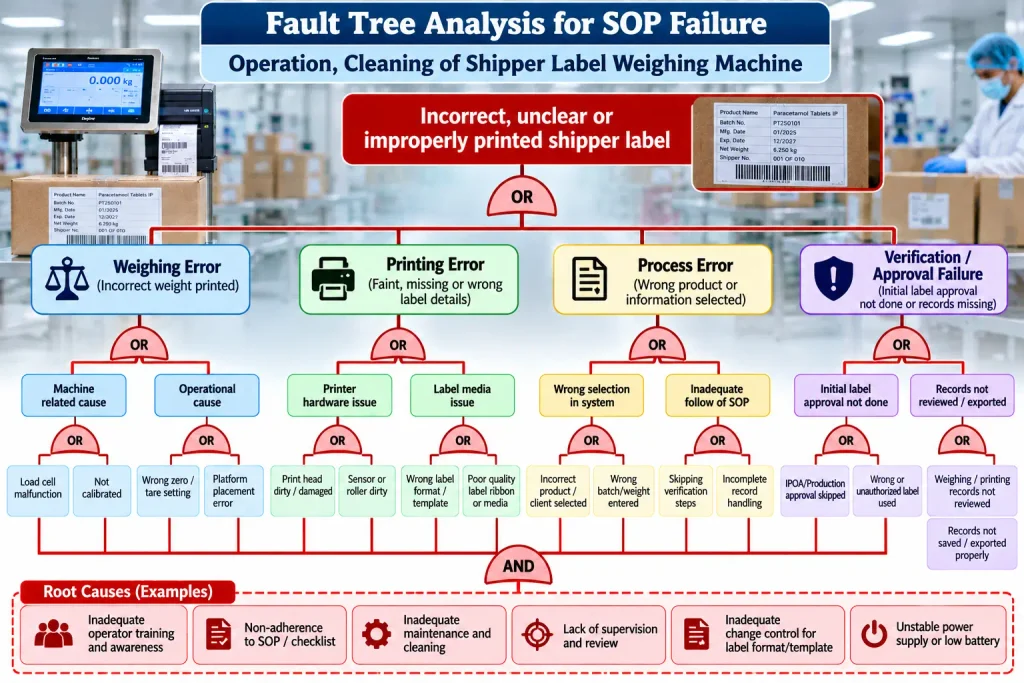
Process-related failures may include wrong product or client selection, incorrect entry of information, incomplete record handling, or failure to follow the defined weighing and printing sequence. The SOP also requires review, printing, and control of records. A key verification failure is omission of the initial label approval step. The SOP requires the first printed label to be approved by IPQA and Production before routine shipper labeling begins. Overall, the fault tree helps trace the failure back to root causes such as inadequate training, poor SOP adherence, insufficient cleaning or maintenance, weak supervision, incorrect system selection, or incomplete verification, thereby supporting focused CAPA and recurrence prevention.
8. Impact Assessment for SOP Failure – Operation, Cleaning of Shipper Label Weighing Machine:
The Impact Assessment for SOP Failure – Operation, Cleaning of Shipper Label Weighing Machine evaluates the possible consequences if weighing, label printing, verification, cleaning, or record-handling activities are not performed according to the approved procedure. Since the SOP controls weighing, printing, approval, and handling of shipper labels, failure in these activities can affect product identification and packing traceability. Potential quality impacts include wrong product or batch identification, incorrect shipper weight, label mix-up, or use of damaged labels. Operational impacts may include packing-line interruption, reprinting, relabeling, investigation, and delay in dispatch. The SOP specifically requires approval of the first printed label before routine shipper labeling begins.
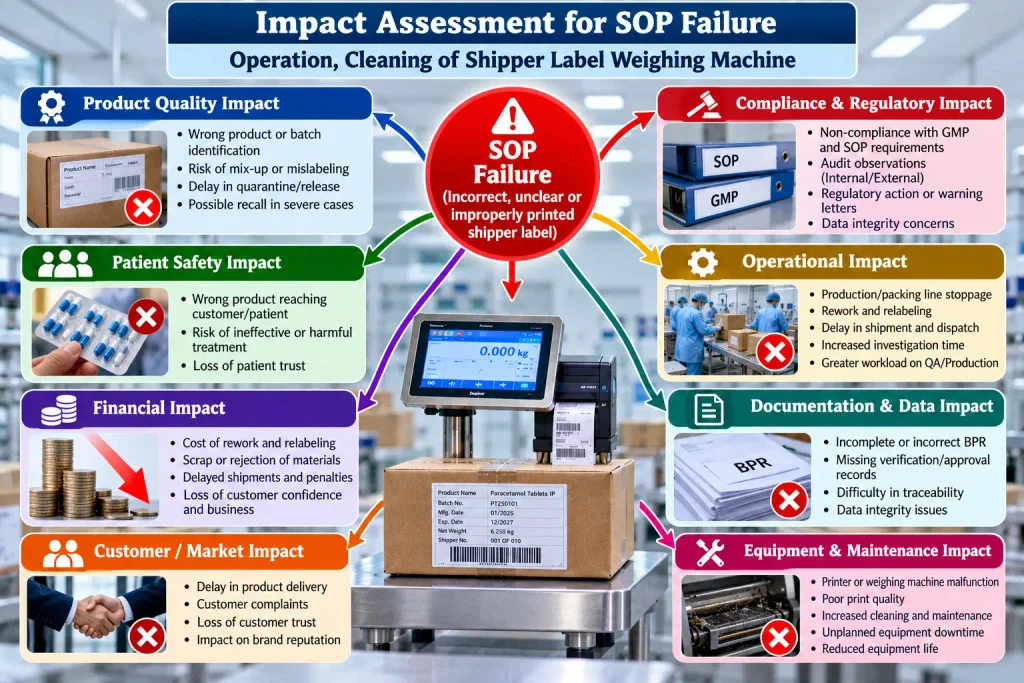
Documentation and data impacts may include incomplete BPR entries, missing verification records, poor traceability, or incorrect weighing and printing records. The SOP includes controls for record review, printing, exporting, and deletion of records. Failure may also result in GMP non-compliance, audit observations, customer complaints, rework, increased operating cost, equipment downtime, and loss of confidence in the labeling process. Therefore, the overall impact can range from moderate to critical depending on whether the failure is detected before or after product dispatch.
9. CAPA for SOP Failure – Operation, Cleaning of Shipper Label Weighing Machine:
The CAPA for SOP Failure – Operation, Cleaning of Shipper Label Weighing Machine is intended to correct identified failures and prevent recurrence of errors related to weighing, label printing, cleaning, verification, and record handling. The SOP requires defined cleaning of the printer exterior, media compartment, sensors, print head, and platen roller, making equipment cleanliness an important control point.
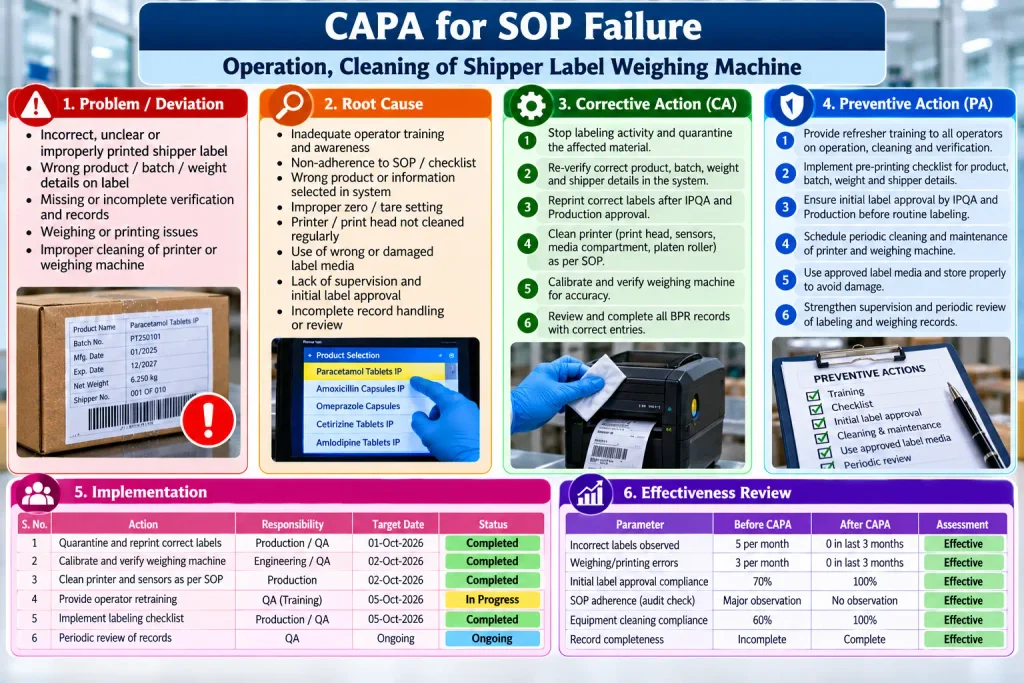
Corrective actions may include stopping the affected labeling activity, identifying and segregating incorrectly labeled shippers, verifying product and batch details, correcting zero or tare settings, cleaning the printer components, rechecking weighing accuracy, and reprinting the correct shipper labels. The first printed label should be approved by IPQA and Production before routine labeling is continued. Preventive actions should focus on operator retraining, use of a pre-print verification checklist, periodic cleaning and maintenance, strengthening supervision, ensuring correct product and client selection, and reviewing weighing and printing records. The SOP provides controls for record review, export, printing, and deletion, which should also be periodically checked for compliance. CAPA effectiveness should be verified through absence of recurring labeling errors, complete BPR entries, 100% initial-label approval compliance, satisfactory equipment performance, and documented adherence to the SOP during periodic QA review.
Questions & Answers – Operation, Cleaning of Shipper Label Weighing Machine:
Q1. What is the objective of this SOP?
Answer: The objective is to define the procedure for handling, operation, cleaning, maintenance, and control of the shipper label printer used for shipper labeling.
Q2. Who is responsible for execution of the SOP?
Answer: The QA Chemist is responsible for execution, while the Sr. Manager-QA and Head-QA/QC are responsible for effective implementation.
Q3. Which parts of the printer are cleaned under this SOP?
Answer: The printer exterior, media compartment, sensors, print head, and platen roller are cleaned as defined in the procedure.
Q4. What should be used for cleaning the printer exterior?
Answer: A lint-free cloth with a small amount of mild detergent, if required. Harsh or abrasive cleaning agents or solvents should not be used.
Q5. How should dust be removed from the media compartment and sensors?
Answer: Dust and paper lint should be removed using a brush, lint-free cloth, air blow, or vacuum as applicable.
Q6. How long should the battery be charged before first use?
Answer: The battery should be charged for at least 5 hours before first use.
Q7. What happens when the machine is powered on?
Answer: The power key is pressed and held until a beep is heard, after which the operating system and application software start.
Q8. What is the purpose of the zero-setting function?
Answer: Zero setting allows the scale display to be returned to zero when the load receptor is stable and not in motion.
Q9. What is the purpose of tare?
Answer: Tare allows the container weight to be subtracted so that the display shows only the net weight of the material being weighed.
Q10. What types of tare are described in the SOP?
Answer: The SOP describes semi-automatic tare, automatic tare, and multi-tare functions.
Q11. What information can be selected before weighing?
Answer: The operator can select or enter product information and client information before performing the weighing operation.
Q12. Why is a larger sample size useful in counting mode?
Answer: The SOP notes that using a greater number of samples improves the accuracy of counting large quantities.
Q13. Can weighing records be exported?
Answer: Yes. Records can be exported after inserting a USB disk into the USB port.
Q14. Can single and multiple weighing records be printed?
Answer: Yes. The scale supports printing of individual records as well as all records from the record list.
Q15. What is required before routine shipper label printing begins?
Answer: The Production Chemist takes one print of the label and obtains approval from IPQA and Production before routine shipper labeling begins.
Q16. What should be done if a shipper label is damaged?
Answer: The Production Chemist should report the damaged label to IPQA, and the issue should be checked and documented in the BPR.
Q17. How are loose shipper labels handled?
Answer: Loose shipper labels are personally checked by the Production Chemist and IPQA Chemist before being pasted on the shipper.
Q18. What information is included in the shipper label format?
Answer: The format includes product name, batch number, manufacturing date, expiry date, quantity, gross weight, storage condition, manufacturer details, marketed-by details, and case number.
Q19. Why is cleaning of the print head and platen roller important?
Answer: The SOP requires them to be cleaned as per the cleaning schedule to support proper printer performance and reliable label printing.
Q20. What is the main GMP benefit of following this SOP?
Answer: Following the SOP helps ensure controlled weighing, correct shipper labeling, traceable records, proper verification, and consistent execution of packing activities.