







Brief Description
The SOP for Handling of Poisonous Chemicals defines the controlled procedure for the safe handling, use, issuance, storage, and documentation of poisonous chemicals in the Quality Control laboratory. Its main objective is to prevent accidents and protect personnel while working with hazardous chemicals. Before using any chemical, personnel must verify its label and identify whether it is poisonous. Poisonous chemicals are to be handled according to the applicable Material Safety Data Sheet (MSDS) and under supervisory presence. Appropriate personal protective equipment such as hand gloves, safety goggles, masks, and other protective measures must be used. Opening and transferring poisonous chemicals or their solutions must be carried out only in a fuming hood, and pipetting should be performed using a solution bulb or vacuum device. Poisonous chemicals must be stored in a designated locked area, with the key controlled by the responsible person. Stock and consumption records must be maintained and v erified using the prescribed annexures. provides the status record of poisons present in the laboratory, while page 4 contains the Poison Consumption Record for documenting quantities received, used, balance quantity, and verification details.
Skip to PDF content1. Flow Diagram:
The flow diagram presents the Handling of Poisonous Chemicals in a simple, easy-to-understand sequence using the PharmaDevils theme. The process begins with checking the chemical label to identify whether the material is poisonous. Personnel must then follow the applicable Material Safety Data Sheet (MSDS) and handle the chemical under supervision. Appropriate PPE, including gloves, safety goggles, and a mask, must be worn before handling.
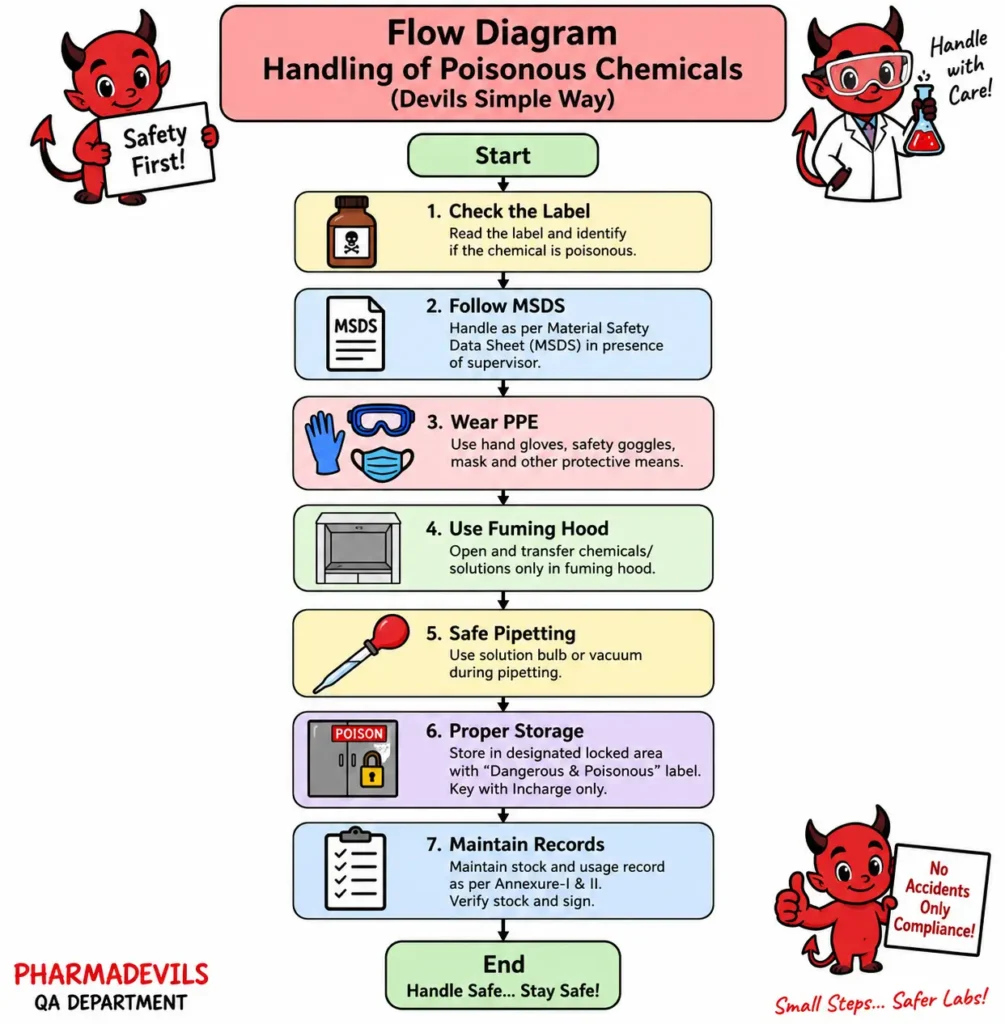
Poisonous chemicals and their solutions should be opened or transferred only inside a fuming hood. Pipetting must be performed using a solution bulb or vacuum device. After use, chemicals are stored in a designated locked area, with key control maintained by the responsible person. Finally, stock and consumption records are maintained, verified, and signed according to the prescribed annexures.The diagram emphasizes safe handling, controlled storage, proper documentation, and accident prevention.
2. Brainstorming for SOP Failure:
The brainstorming diagram presents possible reasons why the SOP for Handling of Poisonous Chemicals may not be followed properly. In a classroom-style PharmaDevils theme, a professor guides personnel to identify common failure causes such as not reading chemical labels, lack of awareness about poisonous chemicals, MSDS not being available or reviewed, improper use of PPE, working outside the fuming hood, unsafe pipetting practices, and inadequate supervision.
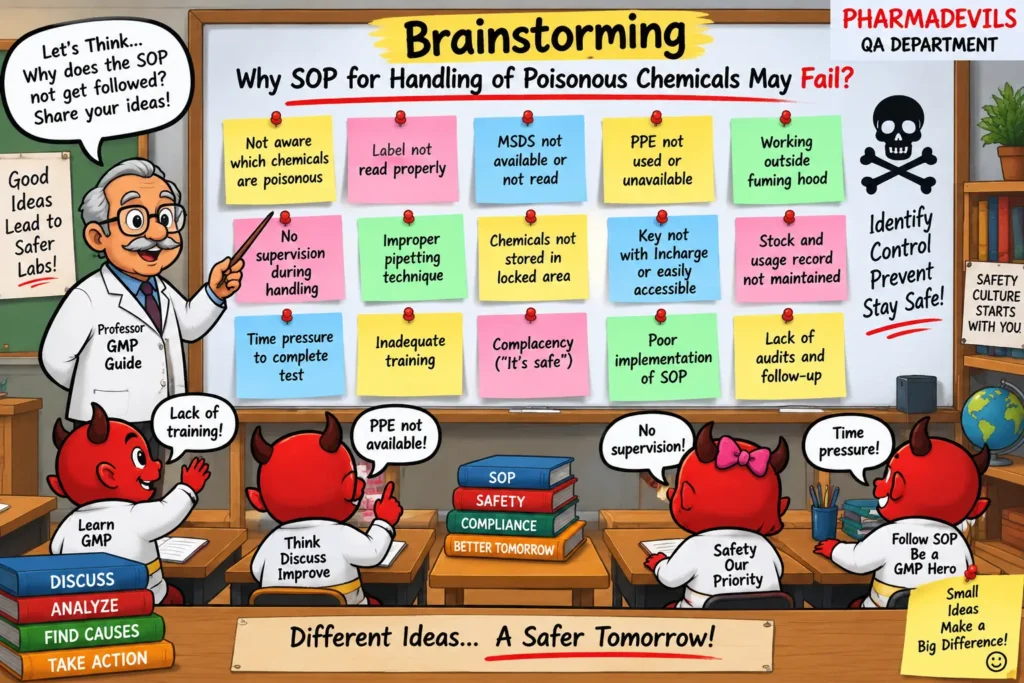
The diagram also highlights management and system-related causes including poor training, time pressure, complacency, improper storage of poisonous chemicals, uncontrolled access to storage keys, incomplete stock and usage records, weak SOP implementation, and insufficient audits or follow-up. These brainstorming points are based on the SOP requirements for label verification, MSDS-based handling, PPE use, fume-hood operation, controlled storage, and stock documentation.Overall, the diagram encourages teams to discuss, identify causes, improve controls, strengthen GMP awareness, and prevent safety incidents.
3. 5-Why Analysis for SOP Failure:
The 5-Why Analysis diagram uses a beach-themed PharmaDevils training concept to explore why the SOP for Handling of Poisonous Chemicals may not be followed. It traces a possible chain from unsafe chemical handling to lack of awareness of requirements such as label verification, MSDS review, PPE use, fuming-hood handling, safe pipetting, controlled storage, and proper stock documentation. These are key controls required by the SOP.
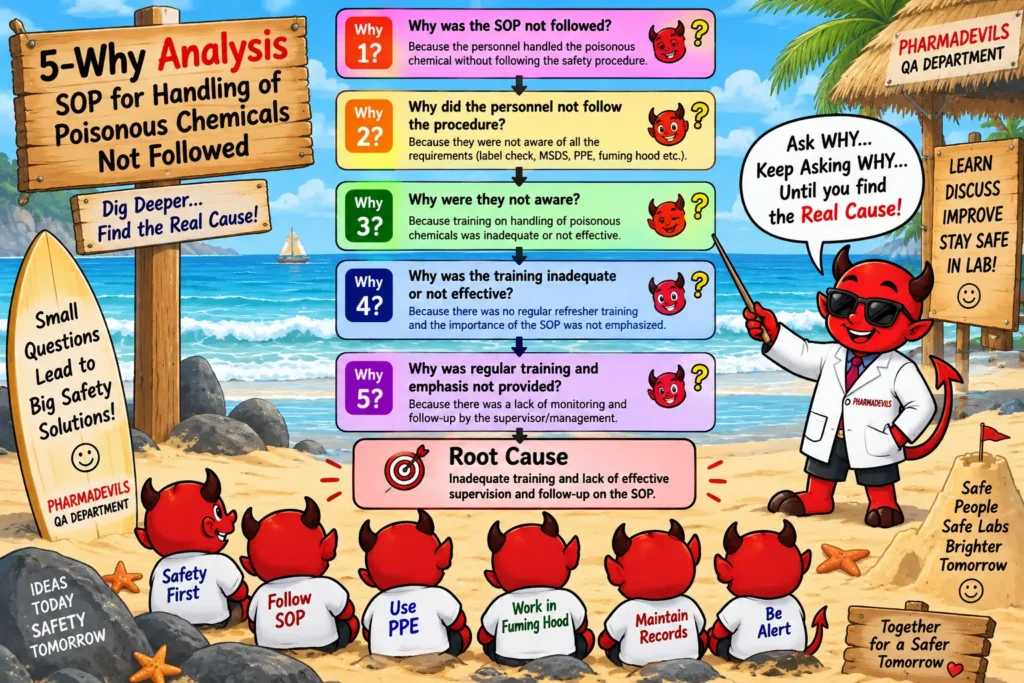
The diagram then digs deeper into possible contributing causes such as inadequate training, lack of refresher training, insufficient emphasis on SOP importance, and weak supervision or follow-up. The SOP itself assigns training to Quality Control personnel and specifies a training period, supporting the importance of competency and awareness.Overall, the diagram demonstrates how repeated “Why?” questioning can help identify underlying causes and support stronger training, supervision, and SOP compliance.
4. Fishbone Analysis for SOP Failure:
The Fishbone Analysis diagram presents the possible causes for failure to follow the SOP for Handling of Poisonous Chemicals in a simple and engaging snake-themed design. The diagram uses the major cause categories—Man (People), Method, Equipment, Material, Storage & Records, and Management/Environment—to show how different factors can contribute to non-compliance. These causes are linked to the SOP requirements such as checking chemical labels, following the MSDS, using PPE, handling chemicals in a fuming hood, using safe pipetting methods, storing poisonous chemicals in a locked area, and maintaining stock and usage records.
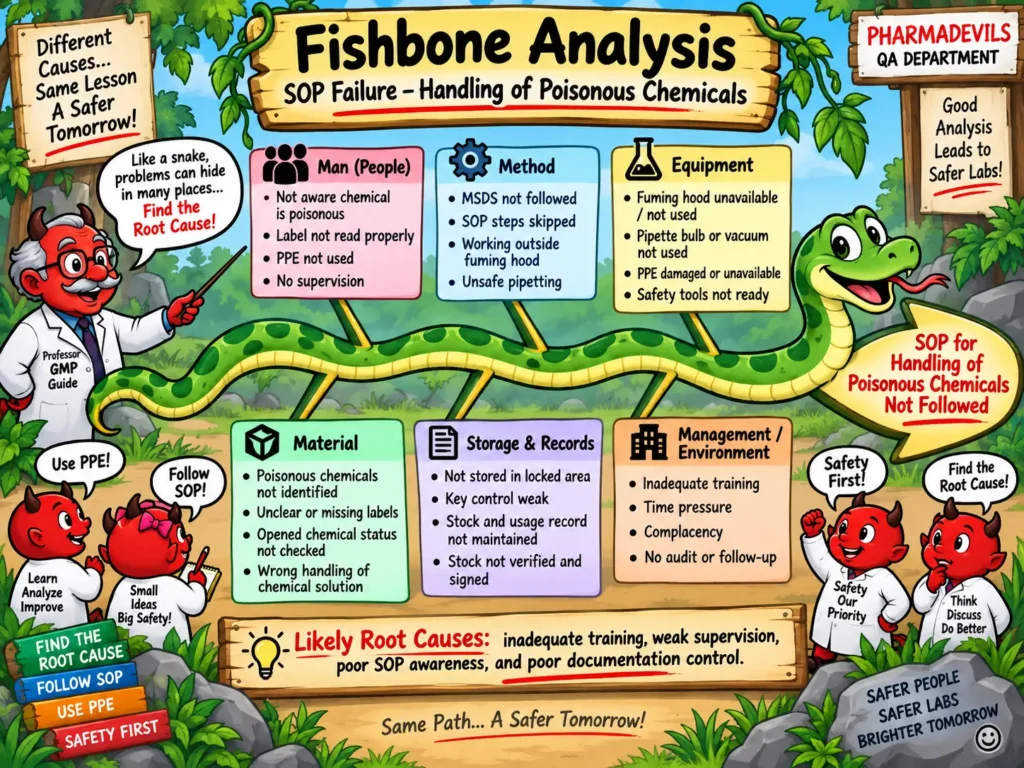
Under People, the diagram highlights issues such as lack of awareness, failure to read labels, not using PPE, and poor supervision. Under Method and Equipment, it points to skipped SOP steps, unsafe handling practices, non-use of the fuming hood, and unavailability of safety tools. Under Storage & Records, it identifies weak key control, improper storage, and incomplete stock documentation. Under Management/Environment, the likely causes include inadequate training, time pressure, complacency, and poor follow-up. These points are supported by the SOP’s defined responsibilities and training requirements.Overall, the diagram helps teams visually identify root causes, improve SOP compliance, strengthen safety practices, and prevent accidents during the handling of poisonous chemicals.
5. Fault Tree Analysis for SOP Failure:
The Fault Tree Analysis (FTA) diagram identifies the possible causes leading to the top event: “SOP for Handling of Poisonous Chemicals Not Followed.” The analysis groups the failure causes into major categories such as Personnel Failure, Procedure/Method Failure, Equipment/Safety Tool Failure, Storage/Documentation Failure, and Management/System Failure.
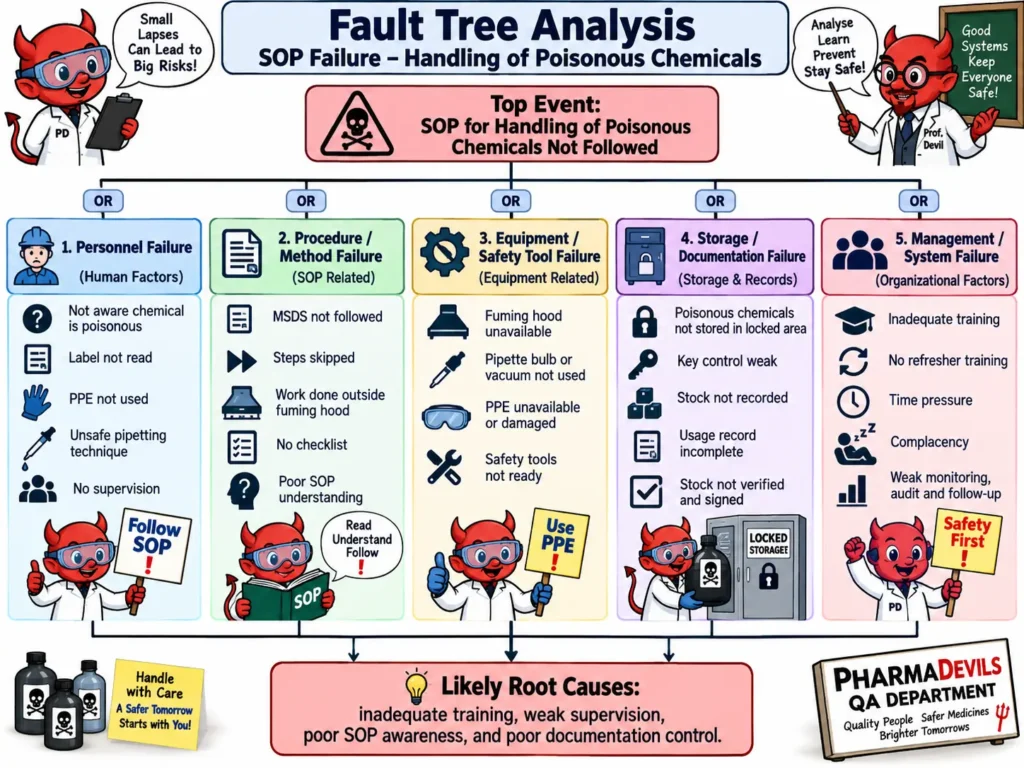
The diagram highlights factors including lack of awareness, failure to read labels, non-use of PPE, unsafe pipetting, poor supervision, non-compliance with MSDS requirements, working outside the fuming hood, unavailable safety tools, improper locked storage, weak key control, incomplete stock records, inadequate training, time pressure, complacency, and weak monitoring. These causes directly relate to the SOP requirements for safe handling, supervision, PPE, fume-hood use, controlled storage, and stock verification.Overall, the FTA helps visualize how multiple individual and system failures can combine to result in SOP non-compliance, supporting identification of root causes and development of stronger preventive controls.
Questions & Answers – SOP for Handling of Poisonous Chemicals
1. What is the objective of the SOP for Handling of Poisonous Chemicals?
The objective is to define the procedure for handling and issuance of poisonous chemicals to avoid accidents in the laboratory.
2. Where is this SOP applicable?
It is applicable to poisonous chemicals present in the laboratory that may be harmful during use and storage.
3. Who is responsible for execution of this SOP?
The Executive-QC is responsible for execution of the SOP.
4. Who is responsible for effective implementation of this SOP?
The Manager-QC and Head QC/QA are responsible for effective implementation.
5. What should be checked before using any chemical?
The chemical label should be read to determine whether the chemical is poisonous.
6. How should poisonous chemicals be handled?
They should be handled according to the Material Safety Data Sheet (MSDS) and in the presence of a supervisor.
7. What PPE should be used while handling poisonous chemicals?
Hand gloves, safety goggles, masks, and other protective means should be used.
8. Where should poisonous chemicals or solutions be opened and transferred?
They should be opened and transferred only in a fuming hood.
9. What should be used for pipetting poisonous solutions?
A solution bulb or vacuum should be used during pipetting.
10. How should poisonous chemicals be stored?
They should be stored in a designated locked and key area indicating that they are dangerous and poisonous.
11. Who should control the key of the poisonous chemical storage area?
The key should remain under the control of the person Incharge.
12. Where is the list of poisonous chemicals maintained?
The list of poisonous chemicals is maintained as per Annexure-I.
13. How is the usage of poisonous chemicals recorded?
Stock and usage are recorded as per Annexure-II, and the stock is verified and signed.
14. Who provides training for this SOP?
The trainer is the Assistant Manager – Quality Control.
15. Who are the trainees for this SOP?
The trainees are Quality Control personnel.
16. What is the training duration specified in the SOP?
The training period is half an hour.
17. What is Annexure-I used for?
Annexure-I is used to maintain the status of poisons present in the laboratory, including poison name, opening date, validity, and remarks.
18. What information is recorded in Annexure-II?
Annexure-II records poison name, batch number, quantity received, date received, opening date, use-before date, quantity used, test details, balance quantity, done by, checked by, and remarks.
19. Why is stock verification important?
As per the SOP, stock should be verified and signed to maintain control over poisonous chemical usage and balance quantity.
20. What is the key safety message of this SOP?
Poisonous chemicals should be identified, handled under supervision, used with proper PPE, processed in a fuming hood, stored securely, and fully documented.