







Brief Description
This SOP describes the procedure for controlling the shelf life, storage, labelling, usage, and disposal of chemicals and reagents used in the Quality Control department. All received containers must be labelled with the receipt date and expiry date. After opening, the opening date, valid-up-to date, and user’s signature must be recorded. The SOP defines different usage periods for sealed chemicals, solid and liquid chemicals, hygroscopic materials, indicators, culture media, HPLC solvents, and purified water. These details must be written on a separate label without covering the manufacturer’s original label. Chemicals and reagents must be stored under the temperature and environmental conditions stated by the manufacturer. Poisonous chemicals must be stored separately with safety precautions according to their MSDS. Expired chemicals must be destroyed following the applicable SOP. Stock registers, solution-preparation records, and solvent-consumption logs must be maintained. Overall, this procedure prevents the use of expired materials and supports safe, traceable, and reliable QC testing.
Skip to PDF content1. Flow Diagram:
The flow diagram explains the step-by-step control of chemicals and reagents in the Quality Control department. The process begins when chemicals and reagents are received. Each container is checked for damage, correct identification, and the manufacturer’s expiry date.
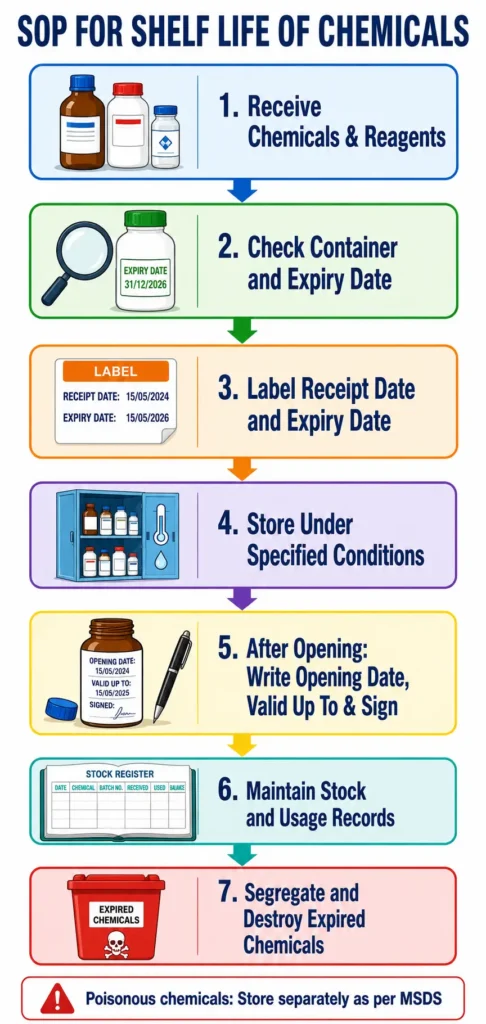
A separate label showing the receipt date and expiry date is then attached to the container. The chemicals are stored under the temperature and environmental conditions specified by the manufacturer. When a container is opened, the opening date, valid-up-to date, and user’s signature are recorded on the label. All chemicals must be used only within their approved shelf life. Stock and usage records are maintained to ensure proper tracking and accountability. Expired chemicals are identified, separated from usable materials, and destroyed according to the applicable SOP. Poisonous chemicals are stored separately with appropriate safety precautions as per the MSDS. This flow helps prevent the use of expired chemicals and ensures safe, accurate, and reliable laboratory testing.
2. Brainstorming for SOP Failure:
Brainstorming is used to identify all possible reasons for the failure of the SOP for Shelf Life of Chemicals. A team consisting of QC analysts, supervisors, QA personnel, and laboratory managers discusses the problem openly. Possible causes may include inadequate training, failure to record the opening date, an incorrect valid-up-to date, unsuitable storage conditions, use of expired chemicals, incomplete stock records, covering the manufacturer’s label, and poor supervision. Each suggested cause is written on a separate sticky note and placed around the main problem.
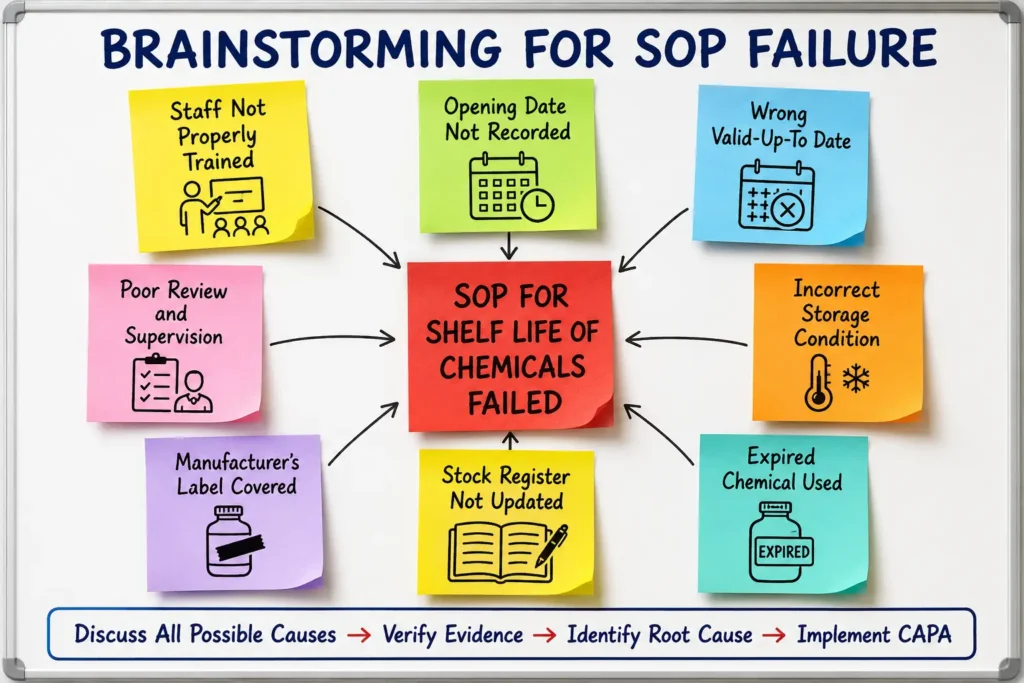
At this stage, every relevant idea is accepted without criticism. After collecting the possible causes, the investigation team reviews SOPs, labels, registers, training records, storage data, and other available evidence. Unsupported causes are removed, while confirmed causes are studied further using tools such as Fishbone Analysis and 5-Why Analysis. Brainstorming helps the team identify the most likely root cause and develop suitable corrective and preventive actions to avoid recurrence.
3. 5-Why Analysis for SOP Failure:
The 5-Why Analysis is used to identify the root cause of failure in the SOP for Shelf Life of Chemicals. The identified problem was that an expired chemical was used during Quality Control testing. The first “Why” showed that the analyst did not notice the expiry date. The second “Why” found that the container label was incomplete or unclear. The third “Why” identified that the opening date and valid-up-to date were not recorded on the label.
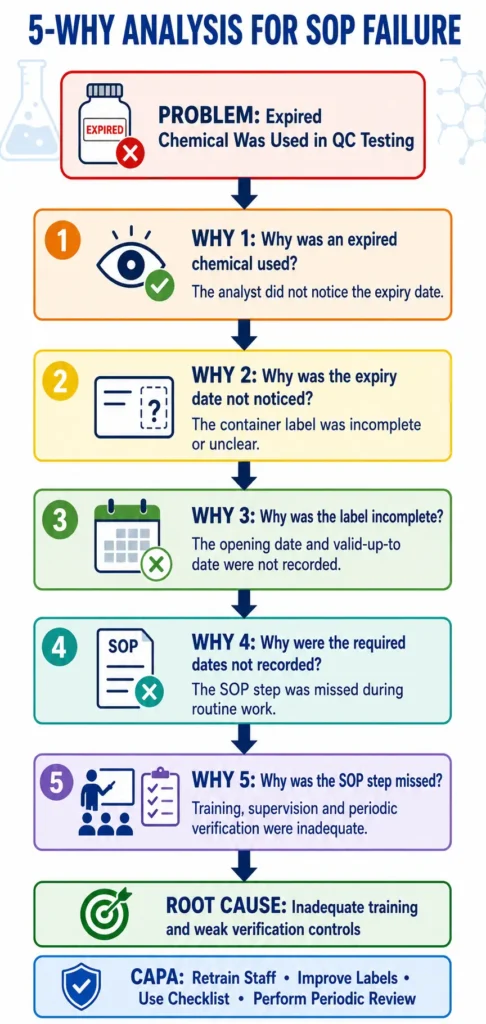
The fourth “Why” showed that the required SOP step was missed during routine work. The fifth “Why” determined that staff training, supervision, and periodic verification were inadequate. Therefore, the root cause was identified as insufficient training and weak verification controls. Recommended CAPA includes retraining QC personnel, improving the chemical identification label, introducing a checklist, strengthening supervisory review, and conducting periodic verification of chemical containers and records. These actions will help prevent the use of expired chemicals and avoid recurrence.
4. Fishbone Analysis for SOP Failure:
Fishbone Analysis is used to identify the possible causes of failure in the SOP for Shelf Life of Chemicals. The main problem identified is the use of an expired chemical during Quality Control testing. Possible causes are grouped into six categories. Under Man, causes include inadequate training and operator oversight. Method includes missed SOP steps and the absence of a container-checking checklist.
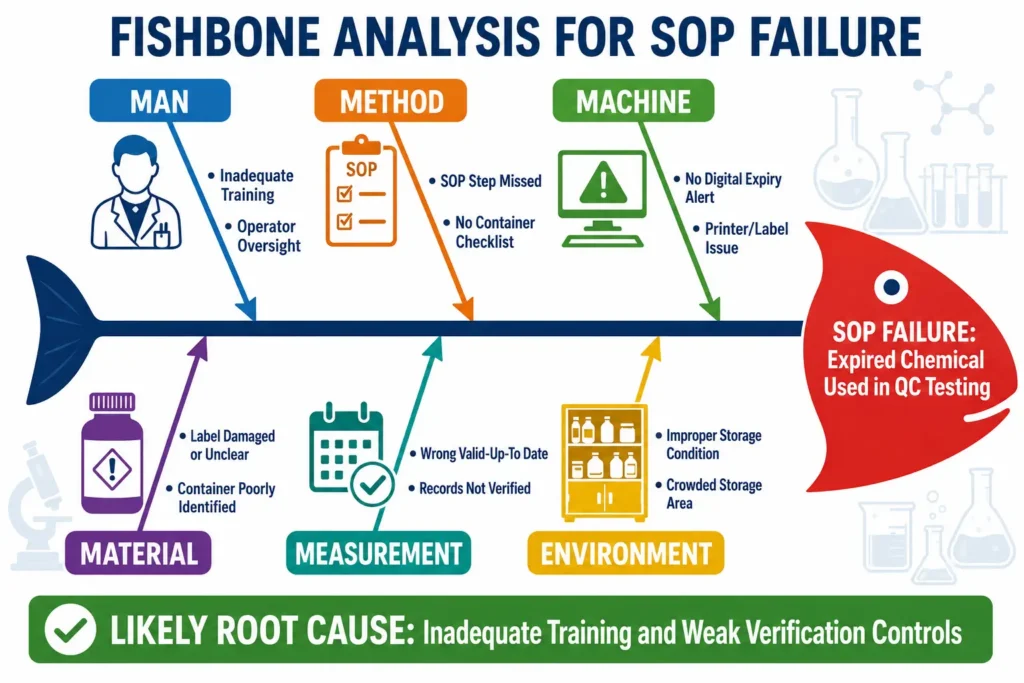
Machine covers the lack of digital expiry alerts and label-printer problems. Material includes damaged, unclear, or poorly identified container labels. Measurement covers an incorrect valid-up-to date and failure to verify records. Environment includes improper storage conditions and a crowded chemical-storage area. The investigation team must verify each possible cause using labels, registers, training records, storage data, interviews, and direct observation. Based on the available evidence, inadequate training and weak verification controls may be the most likely root causes. Appropriate CAPA should then be implemented to prevent recurrence.
5. Fault Tree Analysis (FTA) for SOP Failure:
Fault Tree Analysis (FTA) is used to identify the possible causes leading to the failure of the SOP for Shelf Life of Chemicals. The top event is the use of an expired or unsuitable chemical during Quality Control testing. This failure may occur due to incorrect labelling, improper storage, incomplete records, human error, or weak supervision. Labelling failure may include missing opening dates, incorrect valid-up-to dates, damaged labels, or labels covering the manufacturer’s information.
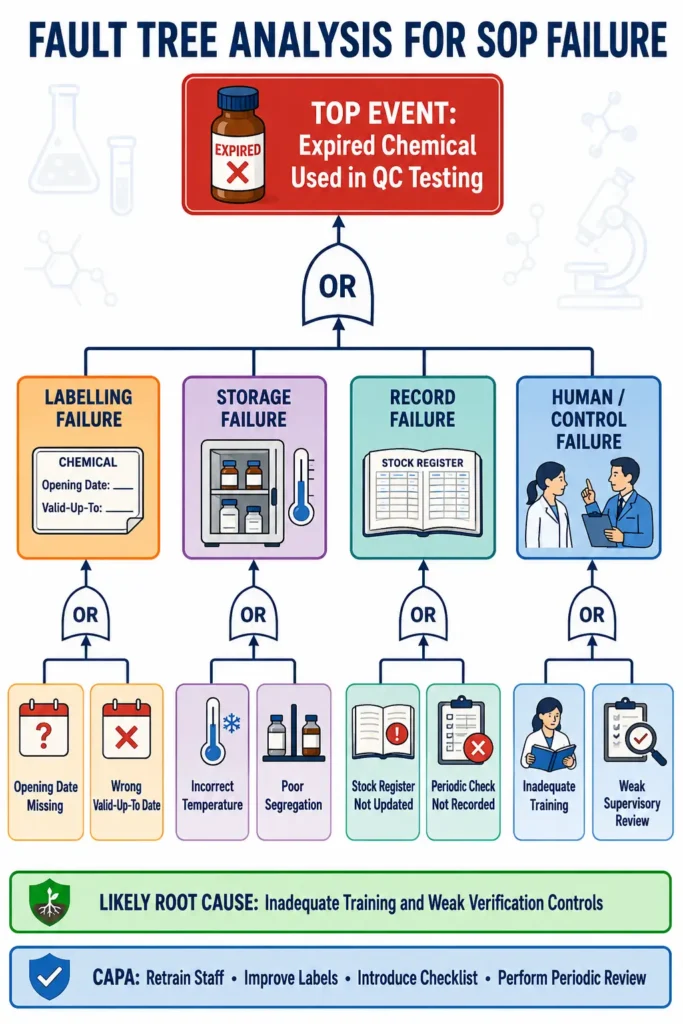
Storage failure may result from incorrect temperature, poor segregation, or overcrowded storage areas. Record-related causes include an outdated stock register or missing solvent-consumption entries. Human factors may include inadequate training, failure to follow the SOP, workload, or oversight. Supervisory failures may include missing periodic checks and ineffective record review. The investigation team verifies each possible cause using evidence. FTA helps identify the root cause and supports suitable CAPA, such as retraining, improved labels, checklists, alerts, and periodic verification.