







1. Introduction to Batch Packing Record (BPR) for Ibuprofen and Paracetamol Suspension:
The Batch Packing Record (BPR) for Ibuprofen and Paracetamol Suspension is an essential pharmaceutical documentation system designed to ensure proper packaging, product identification, traceability, and compliance with Good Manufacturing Practices (GMP). It provides comprehensive instructions and records for packaging operations, ensuring that every batch meets established quality standards and regulatory requirements. Ibuprofen and Paracetamol Suspension is a combination formulation containing Ibuprofen IP 100 mg and Paracetamol IP 162.5 mg per 5 mL, commonly used for managing pain, fever, and inflammation. Proper packaging is crucial for maintaining product quality, preventing contamination, and ensuring accurate labeling throughout the product’s shelf life. The BPR includes documentation of packaging material dispensing, line clearance, bottle filling, sealing, labeling, batch coding, in-process quality checks, and reconciliation of packaging materials. It also records critical details such as batch number, manufacturing date, expiry date, packaging quantities, and equipment identification. Quality Assurance (QA) personnel verify packaging activities to ensure compliance with approved procedures and specifications. Accurate documentation supports batch traceability, deviation investigation, and regulatory inspections. A properly maintained Batch Packing Record helps prevent packaging errors, product mix-ups, and labeling discrepancies while ensuring patient safety, product integrity, regulatory compliance, and consistent pharmaceutical quality throughout the packaging process.
Skip to PDF content2. Flow Diagram of Ibuprofen and Paracetamol Suspension – Batch Packing Process (BPR):
The flow diagram of Ibuprofen and Paracetamol Suspension Batch Packing Record (BPR) illustrates the systematic sequence of packaging operations performed in accordance with Good Manufacturing Practices (GMP). It ensures product identification, packaging integrity, accurate labeling, and complete batch traceability throughout the packaging process. The process begins with the receipt and verification of bulk suspension, ensuring that the material has been approved for packaging. Packaging materials, including bottles, caps, labels, and cartons, are dispensed and verified against approved specifications and quantities.
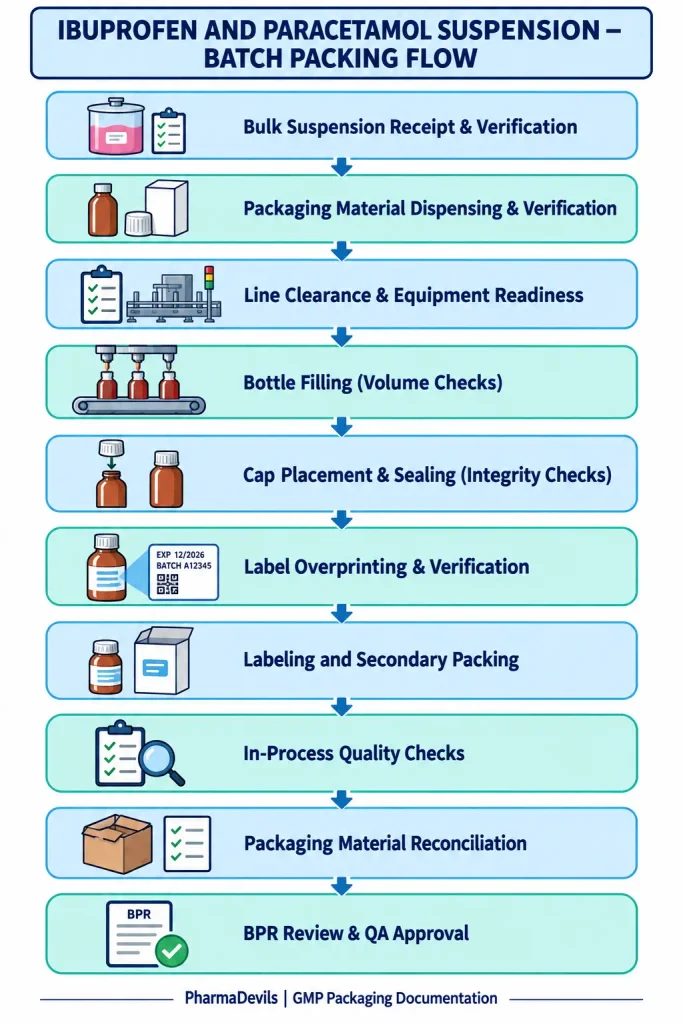
Before initiating packaging activities, line clearance and equipment readiness checks are performed to prevent contamination, product mix-ups, and labeling errors. The suspension is subsequently filled into bottles, with routine in-process checks to verify fill volume accuracy. Following filling, bottles undergo capping and sealing operations, where closure integrity is evaluated. Label overprinting, labeling, and secondary packaging are performed according to approved packaging instructions. Critical in-process quality checks include fill volume, sealing integrity, label correctness, batch coding, and packaging appearance. Packaging material reconciliation is conducted to identify discrepancies and ensure accountability. Finally, the completed BPR undergoes Quality Assurance (QA) review and approval, ensuring documentation completeness, regulatory compliance, product quality, and packaging consistency before batch disposition.
3. Critical Process Parameters (CPP) and Critical Quality Attributes (CQA) of Ibuprofen and Paracetamol Suspension – Batch Packing:
The Critical Process Parameters (CPP) and Critical Quality Attributes (CQA) of Ibuprofen and Paracetamol Suspension are essential elements of pharmaceutical packaging operations, ensuring product quality, packaging integrity, patient safety, and compliance with Good Manufacturing Practices (GMP). Critical Process Parameters (CPPs) represent operating conditions that may influence packaging quality. These include filling machine speed, fill-volume settings, capping torque, sealing parameters, labeling machine settings, and batch coding controls. Proper monitoring and control of these parameters help prevent packaging defects, leakage, incorrect filling, and labeling discrepancies.
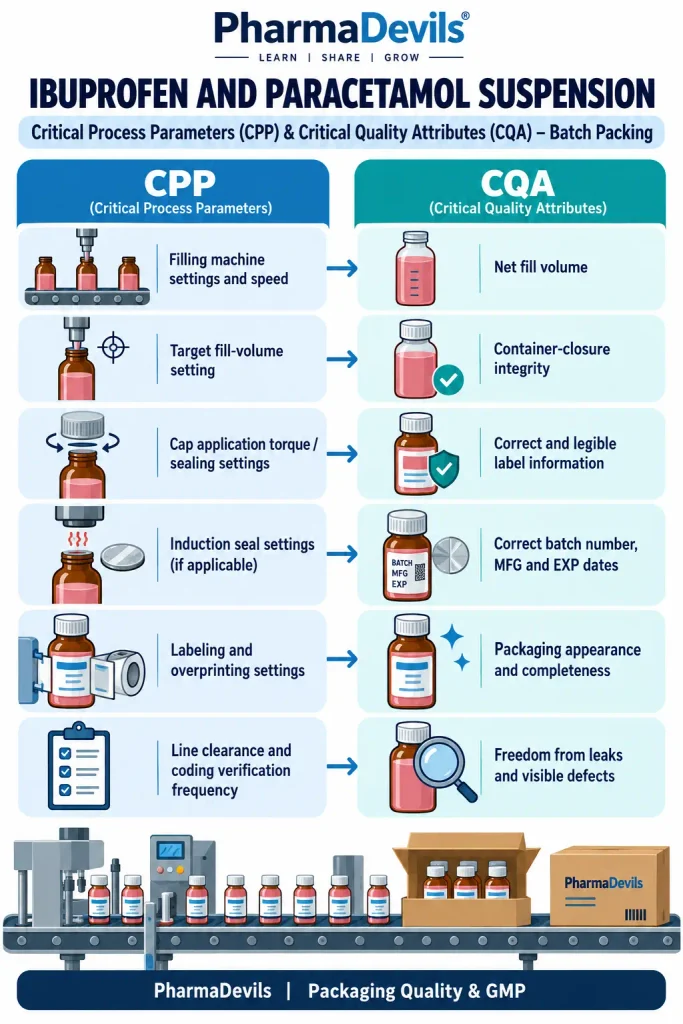
Critical Quality Attributes (CQAs) are measurable product characteristics that must meet predetermined specifications. Important packaging quality attributes include accurate fill volume, container-closure integrity, correct labeling information, legible batch numbers, manufacturing and expiry dates, and acceptable packaging appearance. During packaging operations, in-process quality control checks are performed to verify compliance with approved specifications. Any deviations from established limits must be investigated and documented according to applicable procedures. The relationship between CPPs and CQAs supports quality risk management, process validation, and continuous improvement. Effective control of packaging parameters ensures consistent product quality, regulatory compliance, batch traceability, and patient safety, while minimizing packaging defects and maintaining product integrity throughout its shelf life.