







1. Introduction to Ibuprofen & Paracetamol Tablets IP:
Ibuprofen & Paracetamol Tablets IP is a combination pharmaceutical formulation containing two active pharmaceutical ingredients (APIs): Ibuprofen IP 400 mg and Paracetamol IP 325 mg per uncoated tablet. Ibuprofen is a non-steroidal anti-inflammatory drug (NSAID) that provides analgesic, anti-inflammatory, and antipyretic effects, while Paracetamol primarily exhibits analgesic and antipyretic properties. This combination is used for the symptomatic management of pain and fever in accordance with approved prescribing information. The Batch Manufacturing Record (BMR) provides a systematic and documented approach to manufacturing Ibuprofen & Paracetamol Tablets IP in compliance with Good Manufacturing Practices (GMP). It includes raw material dispensing, assay-based quantity adjustments, sifting, binder preparation, wet granulation, drying, milling, blending, lubrication, compression, and batch reconciliation. The manufacturing process involves controlled granulation and drying operations to achieve the required granule characteristics before tablet compression. Critical process parameters, including mixing time, drying temperature, moisture content, blending conditions, tablet weight, hardness, thickness, friability, and disintegration time, are monitored to maintain consistent product quality. The BMR also incorporates equipment clearance, in-process quality checks, material reconciliation, production documentation, and Quality Assurance verification to ensure traceability and manufacturing accountability. Proper implementation of the BMR supports batch-to-batch consistency, product quality, regulatory compliance, and patient safety. The finished tablets should be stored at a temperature not exceeding 30°C, protected from light and moisture.
Skip to PDF content2. Flow Diagram of Ibuprofen & Paracetamol Tablets IP Manufacturing Process (BMR):
The Flow Diagram of Ibuprofen & Paracetamol Tablets IP illustrates the systematic manufacturing process of uncoated tablets containing Ibuprofen IP 400 mg and Paracetamol IP 325 mg. The diagram highlights the major production stages, including raw material dispensing, sifting, binder preparation, wet granulation, drying, milling, blending, lubrication, compression, in-process quality control, and packaging. The manufacturing process begins with the dispensing and verification of approved raw materials according to the Batch Manufacturing Record (BMR). The materials are sifted, mixed, and granulated using the prepared starch binder. Wet granules undergo controlled drying, followed by sizing and blending with suitable excipients and lubricants to achieve the required granule characteristics.
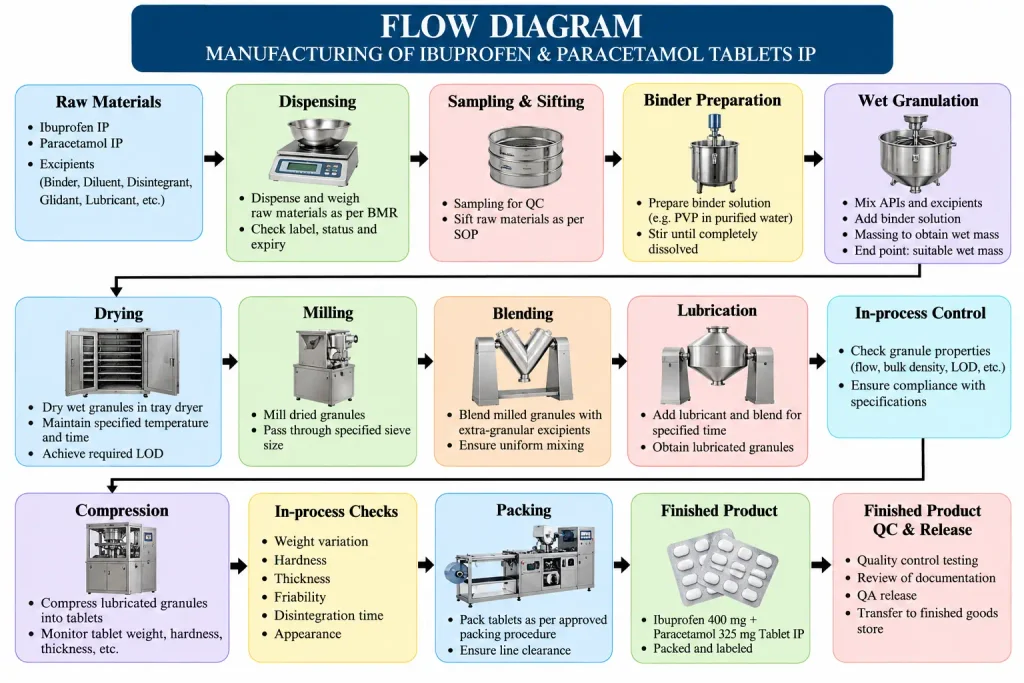
During tablet compression, critical quality parameters such as tablet weight, hardness, thickness, friability, and disintegration time are monitored to ensure consistent product quality. The flow diagram also emphasizes Good Manufacturing Practices (GMP), equipment cleanliness, line clearance, material reconciliation, and documentation throughout the manufacturing process. This visual representation helps production personnel, Quality Assurance professionals, and trainees understand the manufacturing sequence, process controls, and quality requirements necessary to produce Ibuprofen & Paracetamol Tablets IP consistently and in compliance with approved specifications.
3. Critical Process Parameters (CPP) and Critical Quality Attributes (CQA) of Ibuprofen & Paracetamol Tablets IP:
The Critical Process Parameters (CPP) and Critical Quality Attributes (CQA) of Ibuprofen & Paracetamol Tablets IP play an essential role in ensuring consistent product quality, safety, and efficacy throughout the manufacturing process. Each uncoated tablet contains Ibuprofen IP 400 mg and Paracetamol IP 325 mg.

Critical Process Parameters (CPP) are manufacturing variables that require appropriate monitoring and control to maintain the desired quality of the finished product. These include raw material dispensing accuracy, binder preparation, granulation time, mixing speed, drying temperature, loss on drying (LOD), milling screen size, blending time, lubrication conditions, and tablet compression settings. Proper control of these parameters helps maintain granule uniformity, powder flow, compressibility, and batch-to-batch consistency.
Critical Quality Attributes (CQA) are the physical, chemical, biological, and microbiological properties that must remain within approved specifications. Important quality attributes include tablet appearance, average weight, weight variation, hardness, thickness, friability, disintegration time, dissolution, assay, content uniformity, related substances, and microbial quality, as applicable. The Batch Manufacturing Record (BMR) specifies key in-process controls, including a target tablet weight of 900 mg, thickness of 7.0 ± 0.3 mm, friability not more than 1%, and disintegration time not more than 15 minutes. Effective monitoring of CPPs and verification of CQAs support Good Manufacturing Practices (GMP), process validation, regulatory compliance, and consistent pharmaceutical product quality.