







1. Introduction to Luliconazole Cream 1% w/w:
The Batch Manufacturing Record (BMR) for Luliconazole Cream 1% w/w is a comprehensive pharmaceutical document designed to ensure consistent manufacturing, quality control, traceability, and compliance with Good Manufacturing Practices (GMP). Luliconazole Cream is a topical antifungal formulation manufactured using a controlled emulsification process to achieve uniform drug distribution, stability, and product quality. The formulation contains Luliconazole IP 1.0% w/w, Methyl Paraben IP 0.14% w/w, Benzyl Alcohol IP 1.0% w/w, and a suitable cream base. The manufacturing process involves raw material dispensing, water phase preparation, oil phase preparation, active pharmaceutical ingredient dispersion, emulsification, homogenization, cooling, pH verification, and final weight adjustment. The BMR provides detailed instructions for equipment cleaning, line clearance, material verification, manufacturing parameters, environmental controls, and in-process quality checks. Critical manufacturing parameters include mixing temperature, homogenization time, vacuum application, stirring speed, and pH control within the specified range of 5.0–7.0. Proper documentation of manufacturing activities, equipment identification, operator signatures, and quality assurance verification ensures batch traceability and accountability. The finished cream should exhibit a white to off-white appearance and must be stored at temperatures not exceeding 25°C, protected from direct sunlight and freezing, ensuring product integrity throughout its shelf life.
Skip to PDF content1. Flow Diagram – Luliconazole Cream 1% w/w (BMR):
The manufacturing flow diagram for Luliconazole Cream 1% w/w illustrates the sequential stages involved in producing a uniform, stable, and high-quality topical antifungal formulation under Good Manufacturing Practices (GMP). The process begins with raw material dispensing, verification, and line clearance, followed by separate preparation of the water phase, oil phase, and Luliconazole dispersion. The phases are combined through controlled emulsification, stirring, and homogenization to achieve uniform consistency.
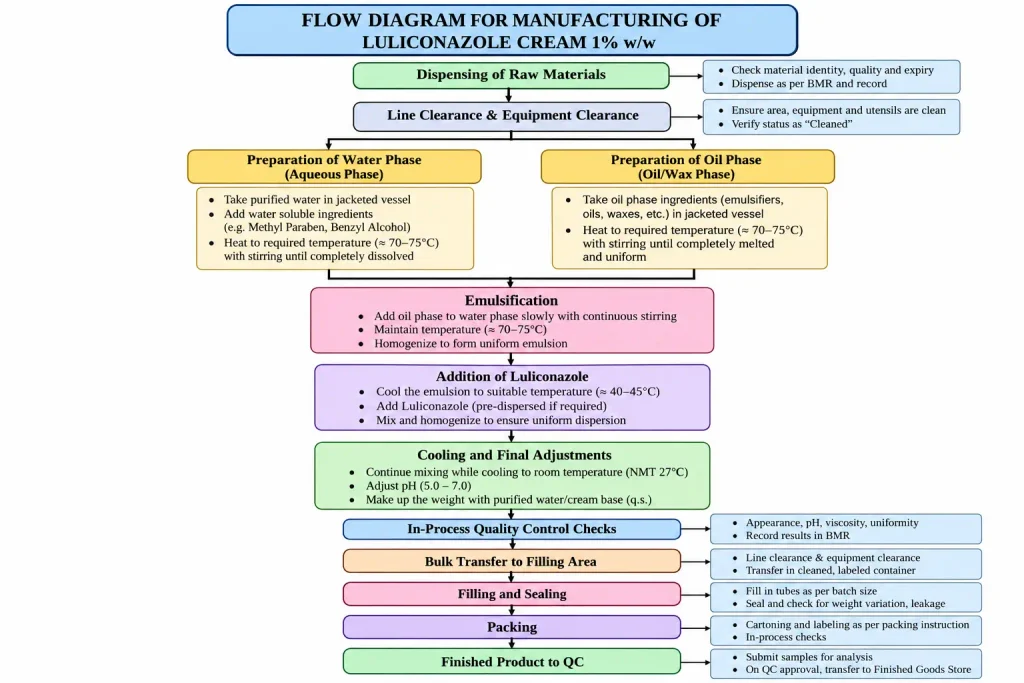
Subsequently, benzyl alcohol is incorporated, followed by pH verification, final weight adjustment using purified water, and controlled cooling. Critical process parameters include temperature, mixing time, homogenization, vacuum application, and pH. In-process quality control checks ensure compliance with approved specifications before bulk transfer, filling, sealing, and packaging. Proper documentation and Quality Assurance verification support product quality, batch traceability, and regulatory compliance.
2. Critical Process Parameters (CPP) and Critical Quality Attributes (CQA) of Luliconazole Cream 1% w/w (BMR):
The Critical Process Parameters (CPP) and Critical Quality Attributes (CQA) of Luliconazole Cream 1% w/w are essential for ensuring consistent manufacturing, product quality, safety, and efficacy in accordance with Good Manufacturing Practices (GMP). Critical Process Parameters include water phase heating at 75–80°C, oil phase preparation at 60–65°C, Luliconazole dispersion for a minimum of 90 minutes, emulsification for 20–30 minutes, controlled homogenization, vacuum application, and cooling. These parameters influence emulsion formation, drug distribution, consistency, and overall product stability.
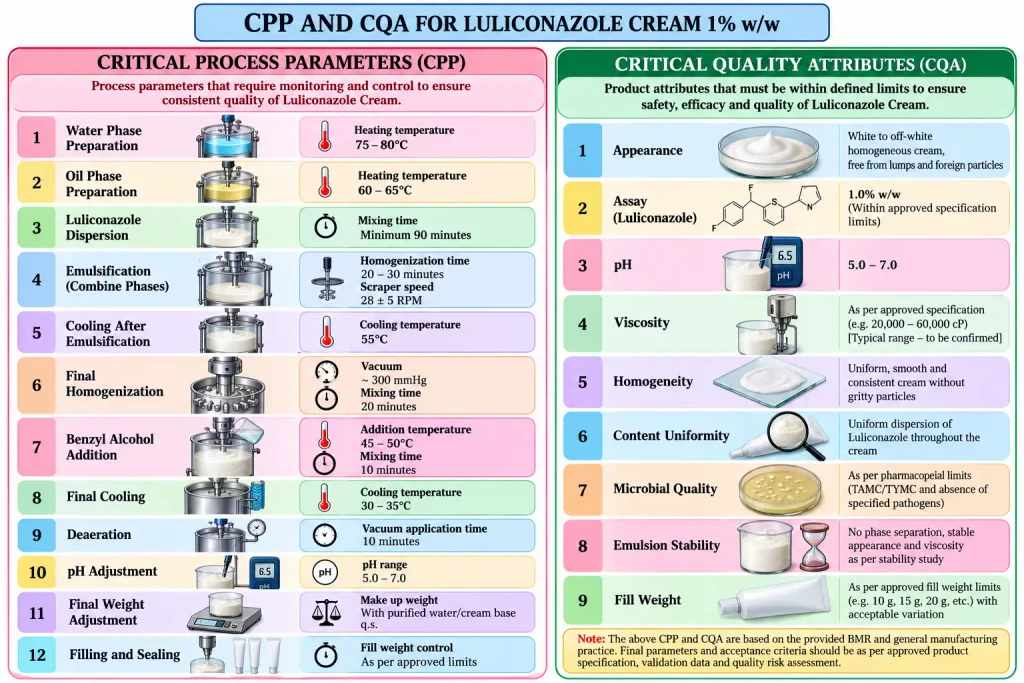
Critical Quality Attributes include appearance, Luliconazole assay, pH (5.0–7.0), viscosity, homogeneity, microbial quality, emulsion stability, and fill weight. These attributes help establish whether the manufactured cream meets its approved quality specifications. Effective monitoring, documented in-process checks, validated manufacturing procedures, and Quality Assurance verification support batch-to-batch consistency, regulatory compliance, and reliable product performance.