







1. Introduction – Beclomethasone Dipropionate, Phenylephrine Hydrochloride & Lignocaine Hydrochloride Cream:
The Batch Production Record (BPR) of Beclomethasone Dipropionate, Phenylephrine Hydrochloride & Lignocaine Hydrochloride Cream is an essential pharmaceutical documentation system designed to ensure the consistent manufacturing, quality control, traceability, and compliance of this topical cream formulation with Good Manufacturing Practices (GMP). The formulation contains three active pharmaceutical ingredients: Beclomethasone Dipropionate IP (0.025% w/w), Phenylephrine Hydrochloride IP (0.1% w/w), and Lignocaine Hydrochloride IP (2.5% w/w). Chlorocresol IP (0.1% w/w) is included as a preservative. The ingredients are incorporated into a suitable cream base to produce a uniform semisolid preparation. The BPR provides detailed documentation of raw material dispensing, material verification, equipment cleaning, line clearance, environmental controls, water-phase preparation, oil-phase preparation, emulsification, homogenization, cooling, and incorporation of active ingredients. During manufacturing, critical process parameters such as temperature, mixing speed, homogenization time, and pH are monitored and recorded. The manufacturing procedure specifies an emulsion-processing temperature of 70–75°C, homogenization at 2800 ± 100 rpm for 20–25 minutes, and a finished bulk pH range of 4.0–5.5. The record also incorporates in-process quality control checks, bulk sampling, yield reconciliation, equipment identification, manufacturing dates, operator signatures, and Quality Assurance verification. Proper implementation of the BPR supports batch-to-batch consistency, product quality, process accountability, deviation management, and regulatory inspection readiness. It provides documented evidence that each manufacturing stage has been performed according to approved instructions and established quality requirements.
Skip to PDF content2. Flow Diagram – Beclomethasone Dipropionate, Phenylephrine Hydrochloride & Lignocaine Hydrochloride Cream:
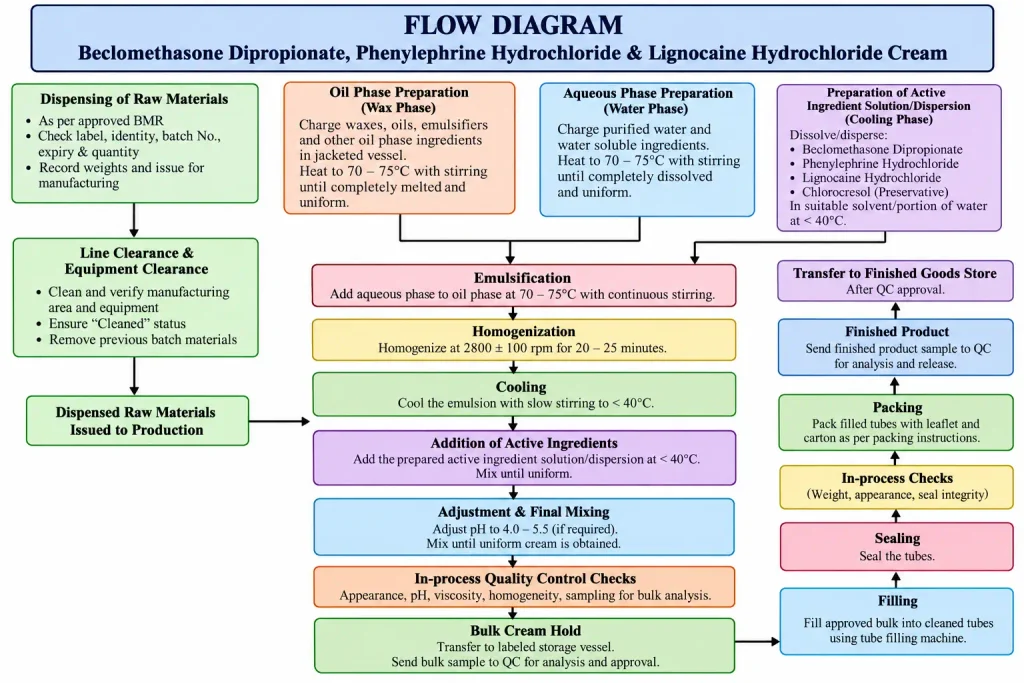
The flow diagram illustrates the step-by-step manufacturing process of Beclomethasone Dipropionate, Phenylephrine Hydrochloride & Lignocaine Hydrochloride Cream, highlighting critical manufacturing operations, process parameters, and quality control activities in accordance with Good Manufacturing Practices (GMP). The manufacturing process begins with raw material dispensing, verification, line clearance, and equipment cleaning. The water phase and oil phase are prepared separately using the specified ingredients and controlled heating at approximately 70–75°C. Both phases are transferred into the main manufacturing vessel for emulsification, followed by homogenization at 2800 ± 100 rpm for 20–25 minutes to obtain a uniform cream base.
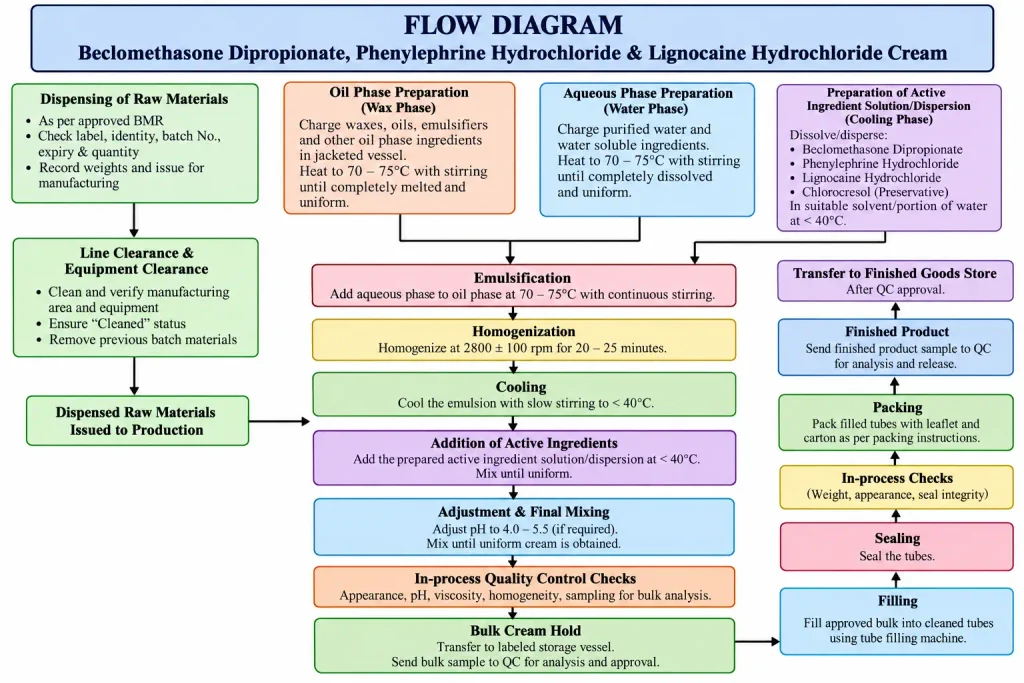
The emulsion is gradually cooled, and the active pharmaceutical ingredients—Beclomethasone Dipropionate, Phenylephrine Hydrochloride, and Lignocaine Hydrochloride—are incorporated at their respective manufacturing stages under controlled stirring conditions. The cream undergoes final mixing, with the pH maintained between 4.0 and 5.5. In-process quality control checks include appearance, pH, and bulk sampling as per approved specifications. The manufactured bulk is transferred into labelled stainless-steel storage containers. Following bulk approval, the subsequent operations include tube filling, sealing, in-process packing checks, finished-product testing, Quality Control release, and transfer to the finished-goods store. The flow diagram provides a systematic representation of the manufacturing sequence, supporting process consistency, quality assurance, product traceability, and GMP documentation compliance.
3. Critical Process Parameters (CPP) and Critical Quality Attributes (CQA) for Beclomethasone Dipropionate, Phenylephrine Hydrochloride & Lignocaine Hydrochloride Cream (BPR):
The Critical Process Parameters (CPP) and Critical Quality Attributes (CQA) diagram illustrates the essential manufacturing controls and product quality characteristics associated with Beclomethasone Dipropionate, Phenylephrine Hydrochloride & Lignocaine Hydrochloride Cream. Critical Process Parameters (CPP) include water-phase and oil-phase preparation temperatures, stirring speed, mixing time, homogenization conditions, cooling temperature, active ingredient addition, and final pH adjustment. The manufacturing record specifies emulsification at 70–75°C, homogenization at 2800 ± 100 rpm for 20–25 minutes, and a final pH range of 4.0–5.5. These process parameters help achieve consistent emulsification, uniform mixing, and appropriate cream characteristics.
Critical Quality Attributes (CQA) include appearance, pH, viscosity, active ingredient assay, content uniformity, microbial quality, preservative content, spreadability, fill weight, seal integrity, and stability. These attributes are important for ensuring the finished product meets its approved quality specifications. The relationship between CPPs and CQAs supports effective process monitoring, quality risk management, and consistent product manufacturing in accordance with Good Manufacturing Practices (GMP). Effective control of these parameters helps minimize manufacturing variability, maintain batch-to-batch consistency, and ensure the quality of the finished cream.