







1. Introduction -Batch Packing Record (BPR) for Nimesulide & Paracetamol Tablets:
The Standard Operating Procedure (SOP) for Batch Packing Record (BPR) of Nimesulide & Paracetamol Tablets provides a systematic and documented approach for controlling, monitoring, and recording pharmaceutical packaging operations in accordance with Good Manufacturing Practices (GMP). Each uncoated tablet contains Nimesulide BP 100 mg and Paracetamol IP 325 mg, with Sunset Yellow FCF as a colouring agent. The specified packaging configuration is 25 × 2 × 10 using Golden PVC. The Batch Packing Record ensures complete traceability of packaging activities, beginning with the receipt of inspected tablets from the manufacturing department and continuing through packaging material dispensing, verification, overprinting, line clearance, machine setup, blister packing, secondary packaging, and finished product transfer. Critical packaging parameters, including forming and sealing temperatures, machine speed, leak testing, environmental conditions, and packaging integrity, are monitored and documented. In-process quality checks are performed to verify correct batch details, manufacturing and expiry dates, printed information, carton quantities, and shipper contents. The procedure also establishes controls for packaging material reconciliation, rejection analysis, destruction of rejected materials, yield calculations, and documentation review. Production personnel perform packaging activities, while Quality Assurance verifies compliance with approved procedures and applicable quality requirements. Proper implementation of this SOP minimizes the risks of product mix-ups, incorrect labelling, packaging defects, and documentation discrepancies. The primary objective is to ensure consistent packaging quality, accurate batch traceability, regulatory compliance, and documented assurance that finished pharmaceutical products meet established packaging specifications before release and distribution.
Skip to PDF content2. Flow Diagram – Batch Packing Record for Nimesulide & Paracetamol Tablets:
The flow diagram illustrates the systematic sequence of activities involved in the Batch Packing Record (BPR) for Nimesulide & Paracetamol Tablets in accordance with Good Manufacturing Practices (GMP). The process begins with receiving inspected tablets from the manufacturing department, followed by dispensing approved packaging materials. Line clearance and machine setup are performed to prevent contamination, product mix-ups, and packaging errors. Blister packing operations include forming, tablet filling, and sealing under controlled conditions. In-process quality checks verify packaging appearance, sealing integrity, overprinting accuracy, weight, and tablet count.
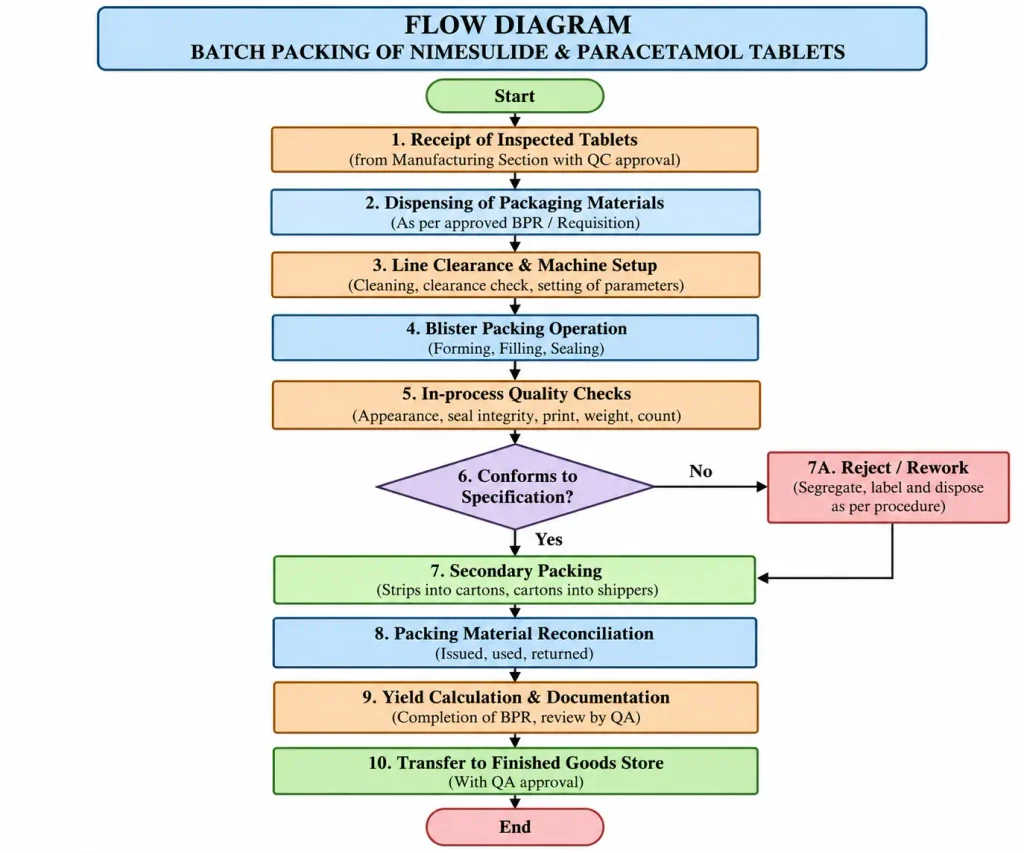
Nonconforming materials are segregated and handled according to approved procedures. Accepted blister packs proceed to secondary packaging, including carton and shipper packing. Packaging materials are reconciled to account for issued, utilized, rejected, and returned quantities. Finally, yield calculations, batch documentation, and Quality Assurance review are completed before authorized transfer of finished products to the finished goods store, ensuring product traceability, packaging integrity, and regulatory compliance.
3. Batch Packing Record for Nimesulide & Paracetamol Tablets – CPP and CQA:
The infographic illustrates the Critical Process Parameters (CPPs) and Critical Quality Attributes (CQAs) associated with batch packing of Nimesulide 100 mg and Paracetamol 325 mg Tablets. CPPs include blister forming temperature, sealing temperature, machine speed, tablet feeding, packaging material specifications, overprinting parameters, carton packing count, and environmental conditions. Proper control of these parameters ensures consistent packaging performance and minimizes defects during operations. CQAs include tablet appearance, blister seal integrity, printing accuracy, tablet count, packaging integrity, correct labelling, regulatory compliance, and product stability. These attributes are monitored through in-process quality checks, visual inspections, leak testing, and packaging verification.
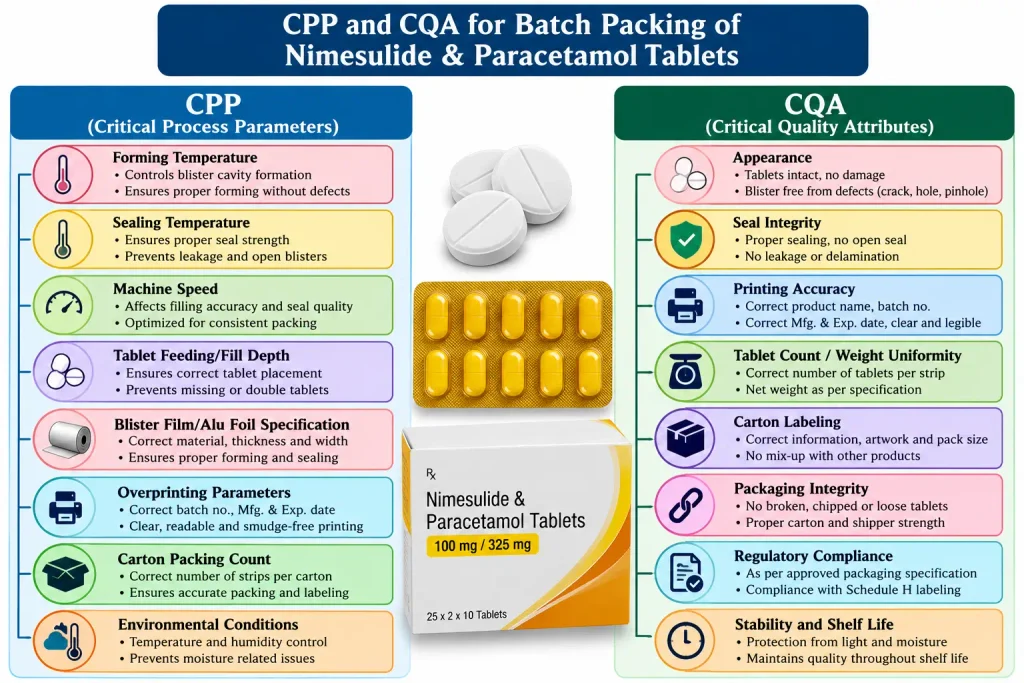
Maintaining appropriate CPPs helps achieve the required CQAs by preventing leakage, incorrect printing, missing tablets, damaged packaging, and product mix-ups. Effective monitoring, documentation, and Quality Assurance verification ensure compliance with Good Manufacturing Practices (GMP), product traceability, packaging quality, and patient safety throughout the packaging process.
Note: CPP criticality and CQA acceptance criteria should be established through approved specifications and documented risk assessment.