







1. Introduction to Nimesulide, Phenylephrine Hydrochloride & Cetirizine Hydrochloride Tablets (BPR):
The Batch Packing Record (BPR) for Nimesulide, Phenylephrine Hydrochloride & Cetirizine Hydrochloride Tablets is an essential pharmaceutical document designed to ensure systematic documentation, monitoring, and control of packaging operations in accordance with Good Manufacturing Practices (GMP). It provides comprehensive information regarding packaging materials, equipment, operating parameters, in-process quality checks, reconciliation, and final product release. Each uncoated tablet contains Nimesulide BP 100 mg, Phenylephrine Hydrochloride IP 5 mg, and Cetirizine Dihydrochloride IP 5 mg. The product requires appropriate packaging and storage conditions to maintain its quality, identity, and integrity throughout its shelf life. The BPR includes packaging material dispensing, overprinting verification, line clearance, machine setup, blister packing, carton filling, shipper packing, and finished goods transfer. Critical packaging parameters, including sealing temperature, forming temperature, machine speed, leak testing, and environmental conditions, are recorded and monitored. Additionally, the document covers packaging material reconciliation, rejection analysis, destruction records, yield calculations, and Quality Assurance verification. Proper execution of the BPR ensures batch traceability, minimizes packaging errors, prevents product mix-ups, and supports regulatory compliance. It also establishes documented evidence that packaging activities have been performed according to approved procedures and quality requirements.
Skip to PDF content2. Flow Diagram Description for Packing of Nimesulide, Phenylephrine Hydrochloride & Cetirizine Hydrochloride Tablets (BPR):
The flow diagram illustrates the systematic packaging process of Nimesulide, Phenylephrine Hydrochloride & Cetirizine Hydrochloride Tablets, ensuring compliance with Good Manufacturing Practices (GMP), product quality, and complete batch traceability. The packaging process begins with the receipt of approved tablets from the manufacturing department, followed by dispensing and verification of primary, secondary, and tertiary packaging materials. Before initiating operations, line clearance is performed by Production and Quality Assurance personnel to prevent contamination and product mix-ups.
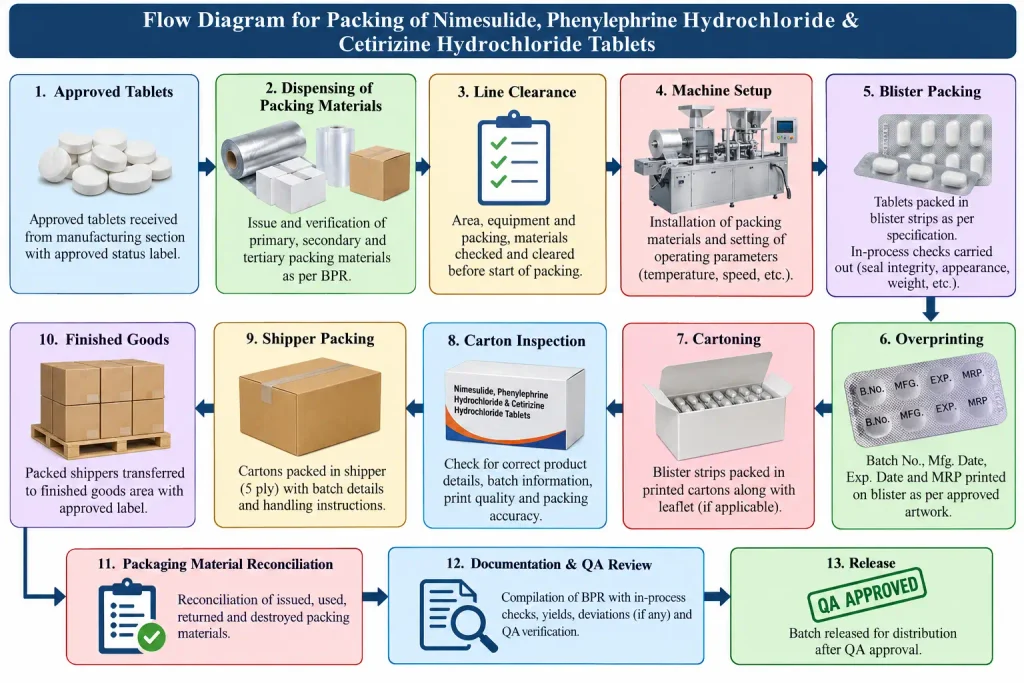
After line clearance, the blister packing machine is set up according to approved operating parameters, including forming temperature, sealing temperature, and machine speed. Tablets undergo blister packing, followed by in-process checks such as leak testing, sealing integrity, and visual inspection. Subsequently, overprinting verification ensures accurate batch numbers, manufacturing dates, expiry dates, and pricing details. Packed blisters are placed into printed cartons, inspected for correctness, and transferred into designated shippers. The final stages involve finished goods transfer, packaging material reconciliation, rejection analysis, yield calculation, and documentation review. Quality Assurance verifies the completed Batch Packing Record before final batch release, ensuring packaging accuracy, regulatory compliance, product identification, and traceability throughout the pharmaceutical packaging process.
3. Critical Process Parameters (CPP) and Critical Quality Attributes (CQA) of Nimesulide, Phenylephrine Hydrochloride & Cetirizine Hydrochloride Tablets (BPR):
Critical Process Parameters (CPP) and Critical Quality Attributes (CQA) play an important role in ensuring the quality, safety, integrity, and consistency of Nimesulide, Phenylephrine Hydrochloride & Cetirizine Hydrochloride Tablets during pharmaceutical packaging operations.
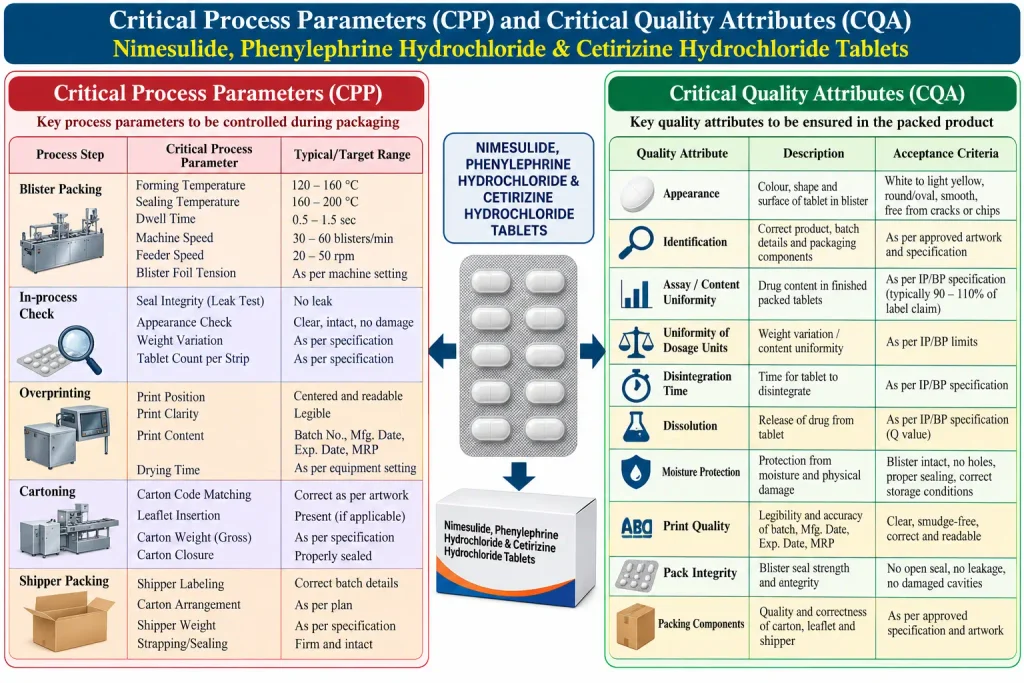
Critical Process Parameters (CPP) are packaging process variables that require monitoring and control to maintain consistent product quality. Important parameters include blister forming temperature, sealing temperature, machine speed, foil tension, environmental temperature, relative humidity, overprinting accuracy, carton filling, and shipper packing. Proper monitoring of these parameters helps prevent packaging defects, leakage, incorrect labeling, and product mix-ups.
Critical Quality Attributes (CQA) are the physical, chemical, and packaging-related characteristics that must meet predefined specifications to ensure acceptable product quality. Important attributes include tablet appearance, identification, assay, content uniformity, dissolution, disintegration, blister integrity, seal quality, overprinting legibility, correct tablet count, and packaging material conformity. The Batch Packing Record (BPR) documents essential in-process checks, including leak testing, packaging inspection, overprinting verification, material reconciliation, rejection analysis, and yield calculations. Effective control of CPPs and verification of CQAs support Good Manufacturing Practices (GMP), batch traceability, regulatory compliance, and consistent packaging quality.
Note: Numerical process limits and product acceptance criteria must be established using approved specifications, validated processes, and applicable pharmacopoeial requirements. Not every monitored parameter is necessarily classified as critical.