







1. INTRODUCTION PARACETAMOL, PHENYLEPHRINE HCL & CHLORPHENIRAMINE MALEATE TABLETS:
The Batch Manufacturing Record (BMR) of Paracetamol, Phenylephrine Hydrochloride & Chlorpheniramine Maleate Tablets is an essential pharmaceutical documentation system designed to ensure consistent product quality, manufacturing traceability, regulatory compliance, and adherence to Good Manufacturing Practices (GMP). Each uncoated tablet contains Paracetamol IP 500 mg, Phenylephrine Hydrochloride IP 10 mg, and Chlorpheniramine Maleate IP 4 mg. This combination contains an analgesic and antipyretic, a nasal decongestant, and an antihistamine, respectively, and is commonly formulated for symptomatic relief of cold-related conditions. The BMR provides a structured framework for recording manufacturing operations, including raw material dispensing, sifting, mixing, granulation where applicable, drying, lubrication, compression, in-process quality control, and finished product transfer. It also facilitates documentation of critical process parameters (CPPs), critical quality attributes (CQAs), equipment identification, personnel responsibilities, and production yield. Proper implementation of the BMR supports batch-to-batch consistency, minimizes manufacturing errors, prevents cross-contamination, and ensures complete traceability of materials and processing activities. Any manufacturing deviations must be documented, investigated, and appropriately resolved in accordance with approved procedures. The associated Batch Packing Record (BPR) covers packaging material dispensing, line clearance, overprinting verification, blister or strip packing, leak testing, in-process checks, reconciliation, rejection analysis, and final yield documentation. All manufacturing and packing activities must be performed according to approved procedures and reviewed by authorized Production and Quality Assurance personnel before batch disposition. Accurate and contemporaneous documentation strengthens data integrity, product quality assurance, and compliance with applicable pharmaceutical regulatory requirements.
Skip to PDF content2. Flow Diagram for Paracetamol, Phenylephrine HCl & Chlorpheniramine Maleate Tablets (BMR):
The Manufacturing and Packing Process Flow Diagram of Paracetamol, Phenylephrine Hydrochloride & Chlorpheniramine Maleate Tablets illustrates the sequential operations involved in tablet production and packaging under Good Manufacturing Practices (GMP). The manufacturing process begins with dispensing and verification of raw materials, followed by sifting, mixing, wet granulation, drying, milling, and lubrication. The lubricated granules are compressed into tablets using a tablet compression machine. In-process quality control checks include weight variation, hardness, friability, and other applicable parameters to ensure consistent tablet quality.
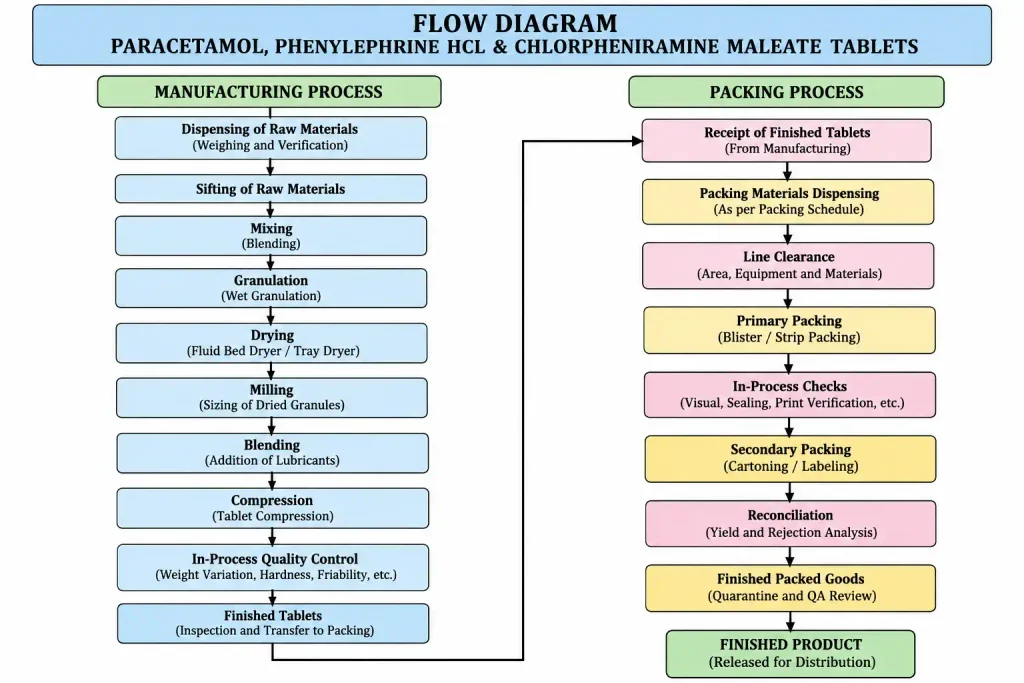
After compression, finished tablets undergo inspection and are transferred to the packing department. Packaging operations include receipt of tablets, packaging material dispensing, line clearance, blister or strip packing, sealing verification, and secondary packaging. The final stages involve reconciliation of packed quantities, rejection analysis, finished goods quarantine, and Quality Assurance review before product release. The flow diagram supports manufacturing traceability, process control, documentation accuracy, and regulatory compliance. The illustrated manufacturing sequence is representative and must be verified against the approved product-specific BMR before implementation.
2. Critical Process Parameters (CPPs) and Critical Quality Attributes (CQAs) of Paracetamol, Phenylephrine HCl & Chlorpheniramine Maleate Tablets (BMR):
The Critical Process Parameters (CPPs) and Critical Quality Attributes (CQAs) are essential elements in ensuring consistent manufacturing quality, safety, and efficacy of Paracetamol, Phenylephrine Hydrochloride & Chlorpheniramine Maleate Tablets. The CPP and CQA diagram illustrates the relationship between manufacturing operations and the quality characteristics of the finished tablets. Major manufacturing stages include dispensing, sifting, blending, granulation, drying, milling, lubrication, compression, and packing. Important process parameters include mixing time, impeller speed, granulation endpoint, drying temperature, residual moisture, compression force, tablet weight adjustment, and sealing temperature. These parameters require appropriate monitoring and control to maintain product consistency.
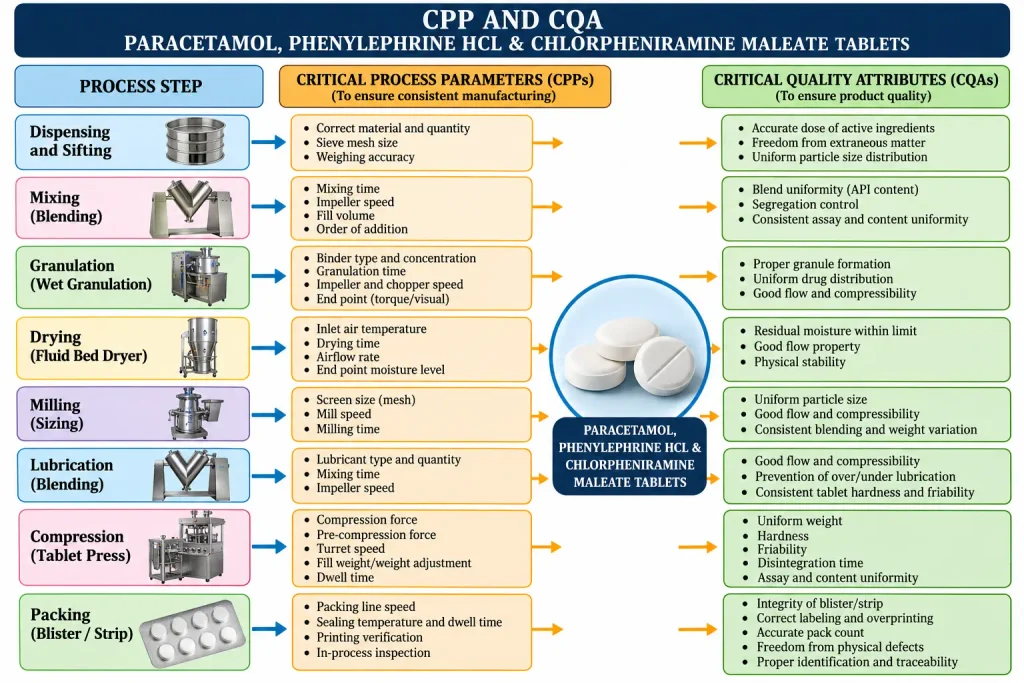
Critical quality attributes include tablet weight variation, hardness, friability, disintegration, assay, content uniformity, dissolution, and packaging integrity, as applicable to the approved product specifications. Effective monitoring of CPPs and CQAs helps minimize manufacturing deviations, improve process reproducibility, and ensure compliance with Good Manufacturing Practices (GMP).
Note: This is an illustrative CPP–CQA overview. The actual criticality, processing stages, operating ranges, and acceptance criteria must be established through approved manufacturing documents, development studies, and quality risk assessments.