





1. Introduction – Operation, Cleaning and Maintenance of Pellet Trolleys:
The SOP provides a standardized procedure for the safe handling, cleaning, and routine maintenance of pellet/pallet trolleys used for material movement in the Production Department. The SOP requires personnel to verify that the trolley is clean and operating smoothly before use, keep the material properly supported on pallets, and position the trolley arms centrally below the pallet to maintain balance and prevent material from falling. Dedicated trolleys are required for their respective areas, and careful movement is necessary to prevent damage to walls and floors. The procedure also defines cleaning of the lifting arms, handle, forks, and wheels using a lint-free cloth with purified water, followed by drying. Routine maintenance includes removal of threads or foreign matter from wheels, weekly lubrication, and fortnightly checking of hydraulic-cylinder oil levels and leakage where applicable. Proper implementation of this SOP supports
Skip to PDF content2. Flow Diagram – Operation, Cleaning and Maintenance of Pellet Trolleys:
The SOP describes the systematic method for safe use, cleaning, and upkeep of pellet trolleys used for material handling in the Production Department. Before use, the trolley should be checked for smooth operation and cleanliness. Materials are placed on pallets, and the trolley arms are positioned centrally below the pallet to maintain proper balance during transfer. Trolleys must be moved carefully to avoid damage to walls and floors, and dedicated trolleys should be used for their respective areas.
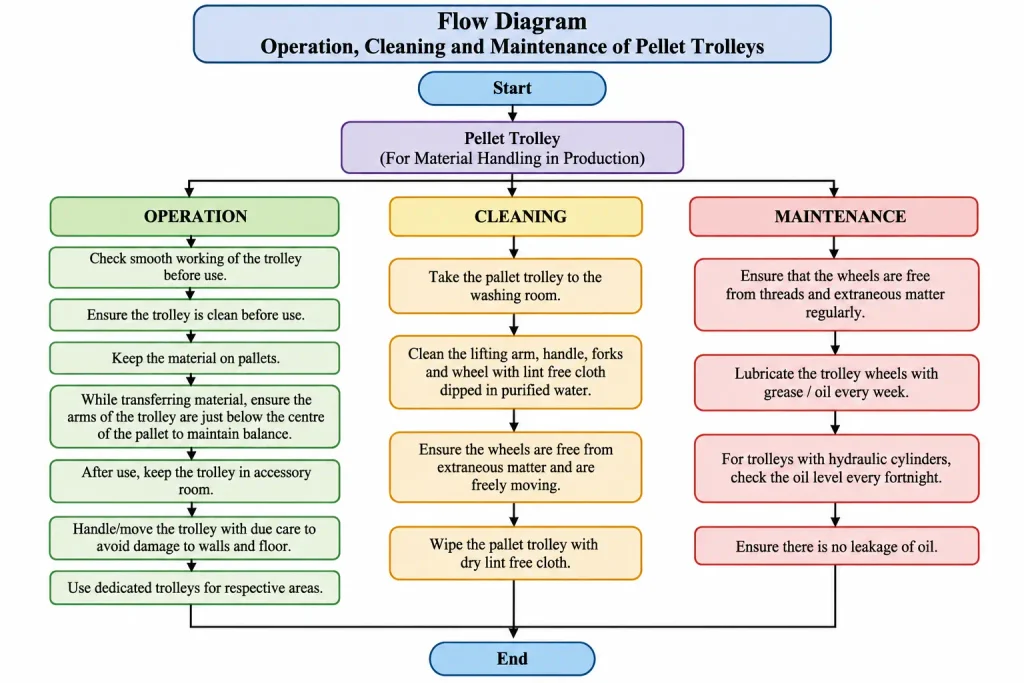
For cleaning, the trolley is taken to the washing room, where the lifting arms, handle, forks, and wheels are cleaned using a lint-free cloth dipped in purified water and then wiped dry. Maintenance includes keeping the wheels free from threads and extraneous matter, weekly lubrication, and checking hydraulic-cylinder oil levels every fortnight while ensuring that no oil leakage is present.
3. Benefits of Following SOP – Operation, Cleaning and Maintenance of Pellet Trolleys:
Following the SOP helps ensure safe, hygienic, and controlled material movement between manufacturing and packing areas. Before use, checking the trolley for smooth operation and cleanliness reduces the chances of equipment malfunction, contamination, material spillage, and unsafe handling. Correct positioning of the trolley arms below the centre of the pallet helps maintain balance and prevents materials from falling during transfer.
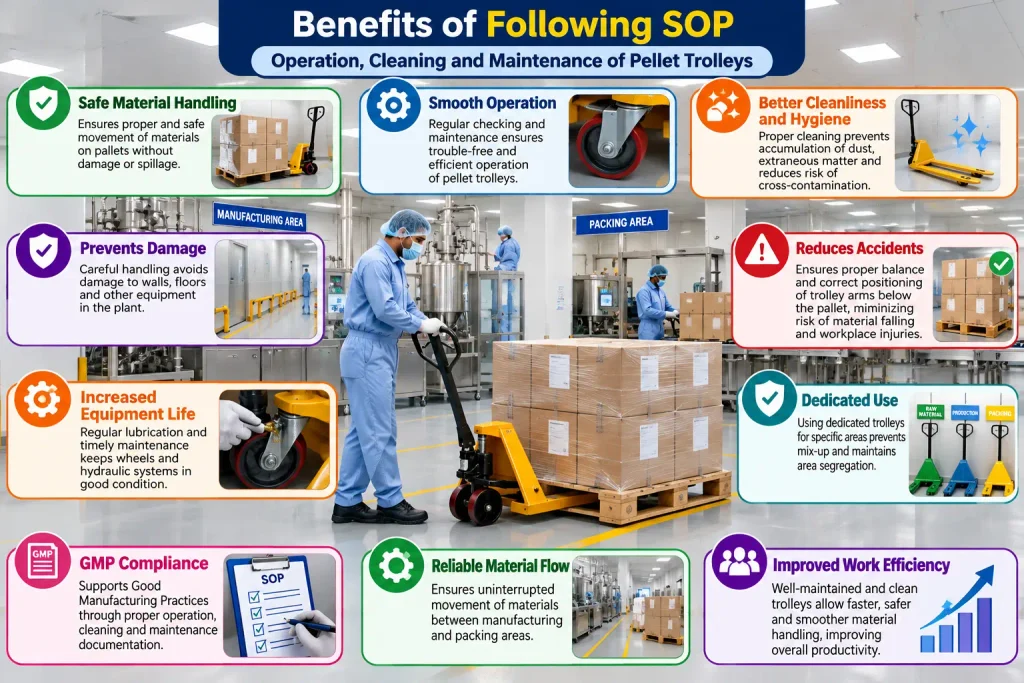
Regular cleaning of the lifting arms, handle, forks, and wheels helps keep the trolley free from extraneous matter, while periodic lubrication supports smooth wheel movement and extends equipment service life. Hydraulic trolleys also require oil-level and leakage checks to maintain reliable performance.Overall, adherence to this SOP supports GMP compliance, safer material handling, reduced equipment damage, better housekeeping, prevention of cross-contamination, dedicated-area use, reliable material flow, and improved operational efficiency in pharmaceutical manufacturing and packing areas.
4. Brainstorming for SOP Failure – Operation, Cleaning and Maintenance of Pellet Trolleys:
The Brainstorming for SOP Failure – Operation, Cleaning and Maintenance of Pellet Trolleys identifies possible failures that may occur when the defined trolley operation, cleaning, and maintenance practices are not followed. Key concerns include using a trolley that is not clean or not working smoothly, improper placement of materials on pallets, incorrect positioning of trolley arms, careless movement causing damage to walls or floors, and use of a trolley in the wrong area. These failures can lead to material imbalance, spillage, contamination, equipment damage, and unsafe handling.
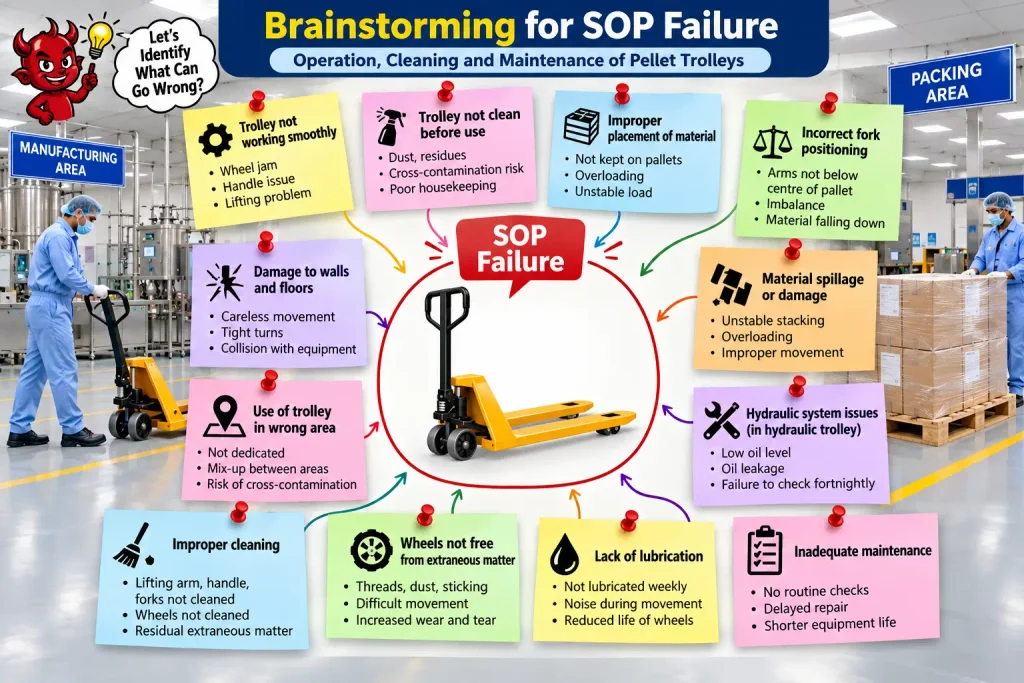
Cleaning-related failures may include inadequate cleaning of the lifting arm, handle, forks, and wheels, as well as accumulation of threads or other extraneous matter. Maintenance failures may involve missed weekly lubrication, poor wheel condition, low hydraulic oil level, or oil leakage. Such deficiencies can affect trolley movement, reliability, equipment life, and overall GMP compliance. This brainstorming exercise helps identify potential weak points in advance so that suitable controls, training, inspection, cleaning, and preventive maintenance activities can be strengthened.
5. 5-Why Analysis for SOP Failure – Operation, Cleaning and Maintenance of Pellet Trolleys:
The 5-Why Analysis for SOP Failure – Operation, Cleaning and Maintenance of Pellet Trolleys is used to identify the underlying causes of recurring failures associated with trolley operation, cleaning, and maintenance. Typical problems may include material falling during movement, contamination on wheels or forks, poor trolley movement, hydraulic oil leakage, and damage to walls or floors. The SOP requires the trolley to be clean and working smoothly before use, materials to remain properly supported on pallets, and the trolley arms to be positioned centrally below the pallet for safe and balanced transfer.
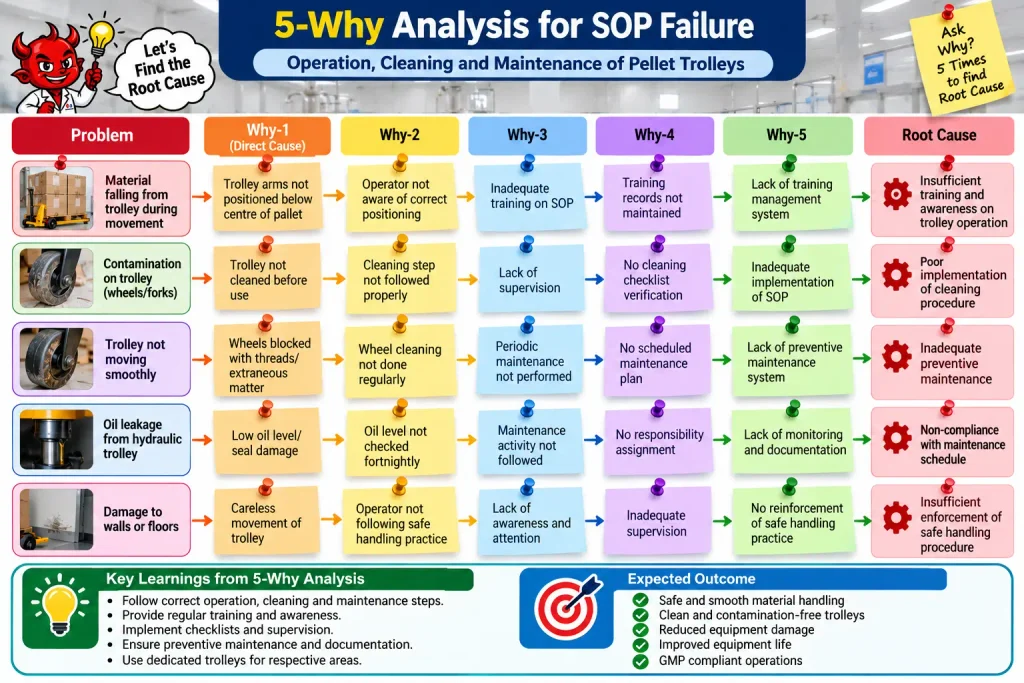
The analysis may trace these failures to causes such as inadequate operator awareness, poor adherence to cleaning steps, insufficient supervision, missed maintenance activities, or failure to check hydraulic oil levels. The SOP specifically requires cleaning of the lifting arm, handle, forks, and wheels, keeping wheels free from extraneous matter, weekly lubrication, and fortnightly hydraulic oil-level and leakage checks. Using the 5-Why approach helps determine the root cause so that appropriate corrective and preventive actions can be implemented to improve safe material handling, cleanliness, equipment reliability, maintenance compliance, and GMP performance.
6. Fault Tree Analysis for SOP Failure – Operation, Cleaning and Maintenance of Pellet Trolleys:
The Fault Tree Analysis for SOP Failure – Operation, Cleaning and Maintenance of Pellet Trolleys systematically evaluates how different operational, cleaning, and maintenance failures can contribute to an overall SOP failure. The top event may be defined as unsafe, unclean, or improper use and maintenance of the pellet trolley. Major contributing events include material falling during movement, trolley wheels becoming jammed, contamination on trolley surfaces, hydraulic oil leakage, and damage to walls or floors.According to the SOP, such failures can result from incorrect positioning of trolley arms below the pallet centre, careless movement, failure to ensure cleanliness before use, accumulation of extraneous matter around the wheels, or use of the trolley in an unsuitable area.
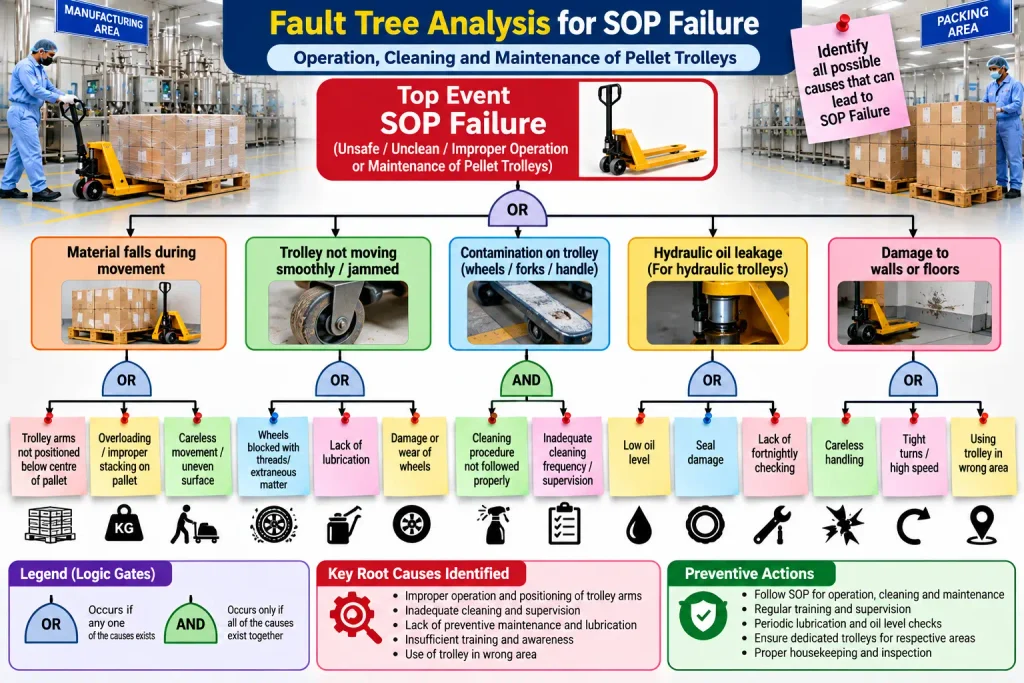
Maintenance-related branches may include missed weekly lubrication, failure to remove threads or foreign matter from wheels, inadequate hydraulic oil-level checks, and failure to detect oil leakage.The Fault Tree Analysis helps identify critical failure pathways and root causes so that suitable preventive measures such as operator training, routine inspection, proper cleaning, scheduled lubrication, hydraulic checks, and dedicated trolley use can be strengthened to support.
7. Impact Assessment for SOP Failure – Operation, Cleaning and Maintenance of Pellet Trolleys:
The evaluates the possible consequences of improper trolley use, inadequate cleaning, and missed maintenance activities. Operational failures may lead to material spillage, falling loads, contamination, delayed material movement, equipment damage, and unsafe working conditions. The SOP requires smooth trolley operation, cleanliness before use, correct positioning of trolley arms below the pallet centre, and careful movement to prevent damage to walls and floors.
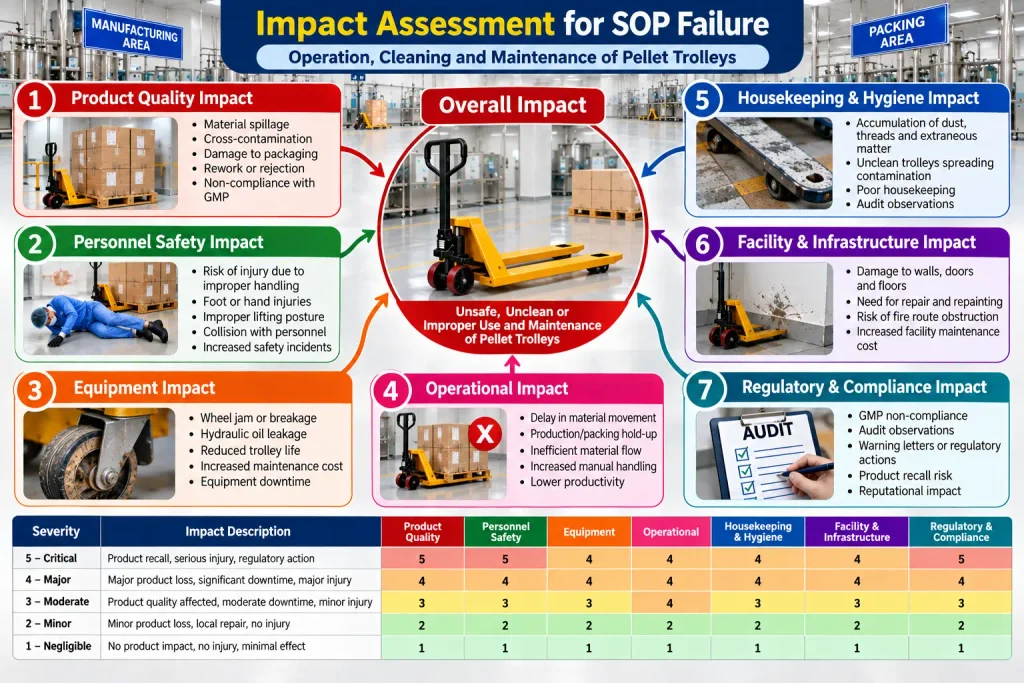
Cleaning and maintenance failures can further affect hygiene and equipment reliability. Accumulation of threads or extraneous matter around wheels may restrict movement, while inadequate lubrication can accelerate wear. In hydraulic trolleys, failure to check oil levels or detect leakage can result in malfunction and increased maintenance requirements. Overall, SOP failure may impact Therefore, regular inspection, proper cleaning, preventive maintenance, and operator adherence are essential to minimize risk and maintain safe pharmaceutical operations.
8. CAPA for SOP Failure – Operation, Cleaning and Maintenance of Pellet Trolleys:
intended to correct identified deficiencies and prevent their recurrence during material handling activities. Typical failures may include material falling during trolley movement, jammed or poorly moving wheels, contamination of forks or handles, hydraulic oil leakage, damage to walls or floors, excessive wheel wear, and use of trolleys in unauthorized areas. Corrective actions should focus on immediate restoration of safe conditions, such as cleaning contaminated trolley parts, removing extraneous matter from wheels, repairing hydraulic leakage, lubricating moving parts, correcting pallet positioning, repairing damaged facility surfaces, and retraining operators. The SOP specifically requires pre-use cleanliness and smooth operation checks, careful material transfer, dedicated trolley use, routine cleaning, weekly wheel lubrication, and fortnightly checking of hydraulic oil level and leakage.
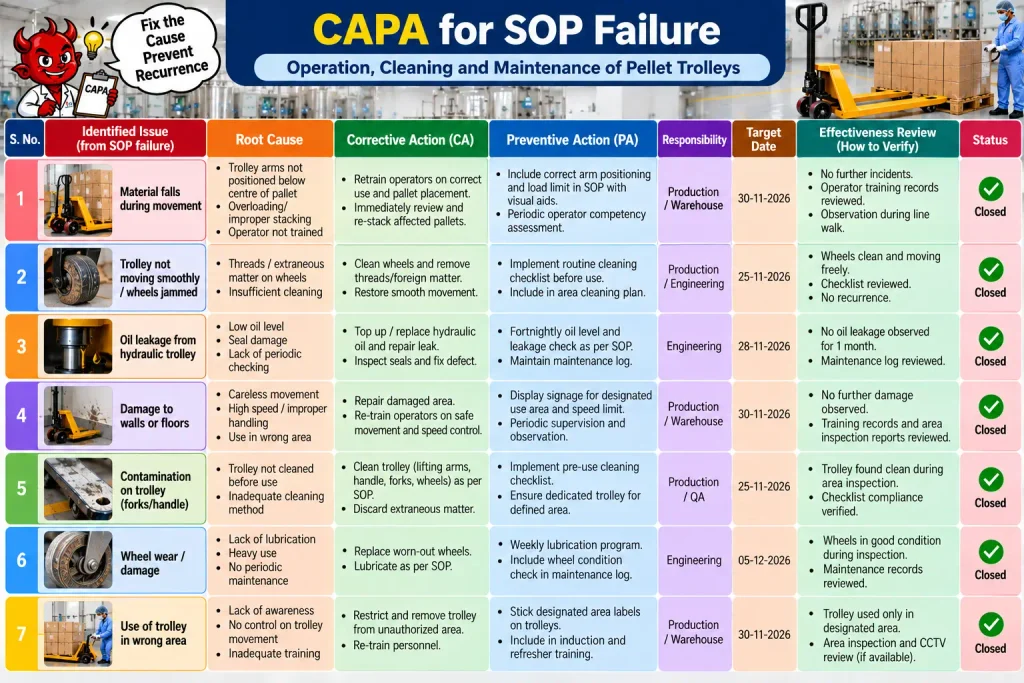
Preventive actions should include , CAPA effectiveness should be confirmed through follow-up inspections, absence of repeat failures, review of cleaning and maintenance records, and observation of correct trolley handling practices.
Questions & Answers – Operation, Cleaning and Maintenance of Pellet Trolleys:
Q1. What is the objective of this SOP?
The objective is to describe the procedure for the operation, cleaning, and maintenance of pellet trolleys used in the Production Department.
Q2. Who is responsible for implementation of this SOP?
The concerned Production personnel, Production Chemist, and Production Manager are responsible for following this SOP.
Q3. What should be checked before transferring material on the trolley?
The trolley should be checked to ensure smooth working and it should be clean before use.
Q4. How should materials be placed before transfer?
Materials to be transferred should be kept on pallets.
Q5. How should the trolley arms be positioned during material transfer?
The trolley arms should lie just below the centre of the pallet to maintain balance and prevent the material from falling.
Q6. Where should the trolley be kept after use?
After use, the trolley should be kept in the accessory room.
Q7. Why should the trolley be moved carefully?
It should be handled with due care to avoid damage to walls and floors.
Q8. Can the same trolley be used in different areas?
The SOP states that dedicated trolleys shall be used for respective areas.
Q9. Where should the trolley be taken for cleaning?
The pallet trolley should be taken to the washing room for cleaning.
Q10. Which parts of the trolley should be cleaned?
The lifting arm, handle, forks, and wheels should be cleaned
Q11. What should be used for cleaning the trolley?
A lint-free cloth dipped in purified water should be used, followed by wiping with a dry lint-free cloth.
Q12. What should be checked regarding the trolley wheels?
The wheels should be free from threads and extraneous matter and should move freely.
Q13. How frequently should the trolley wheels be lubricated?
The trolley wheels should be lubricated with grease or oil every week.
Q14. How frequently should hydraulic-cylinder oil level be checked?
For trolleys fitted with hydraulic cylinders, the oil level should be checked fortnightly.
Q15. What additional check is required for hydraulic trolleys?
It should be ensured that there is no oil leakage from the hydraulic system.
Q16. What is the reference mentioned in the SOP?
The SOP lists the reference as “As per GMP.”
Reference Guidelines – Operation, Cleaning and Maintenance of Pellet Trolleys:
- WHO Good Manufacturing Practices for Pharmaceutical Products – requirements for premises, equipment, sanitation, material handling, cleaning, maintenance, and prevention of contamination.
- PIC/S Guide to Good Manufacturing Practice for Medicinal Products – PE 009 – expectations for equipment cleanliness, maintenance, material movement, housekeeping, and prevention of mix-up or contamination.
- EU Guidelines for Good Manufacturing Practice, EudraLex Volume 4, Chapter 3 – Premises and Equipment – guidance for equipment design, maintenance, cleaning, and prevention of contamination.
- EU GMP Chapter 5 – Production – controls for material handling, prevention of cross-contamination, cleanliness, and appropriate production practices.
- Schedule M of the Drugs Rules, India – GMP requirements relating to premises, production areas, equipment, sanitation, maintenance, and handling practices.
- 21 CFR Part 211.67 – Equipment Cleaning and Maintenance – requirements for appropriate cleaning and maintenance of equipment used in pharmaceutical manufacturing.
- 21 CFR Part 211.56 – Sanitation – requirements for maintaining manufacturing areas and equipment in a clean and sanitary condition.
- 21 CFR Part 211.63 – Equipment Design, Size, and Location – requires equipment to be suitably designed, located, and maintained for its intended pharmaceutical use.