








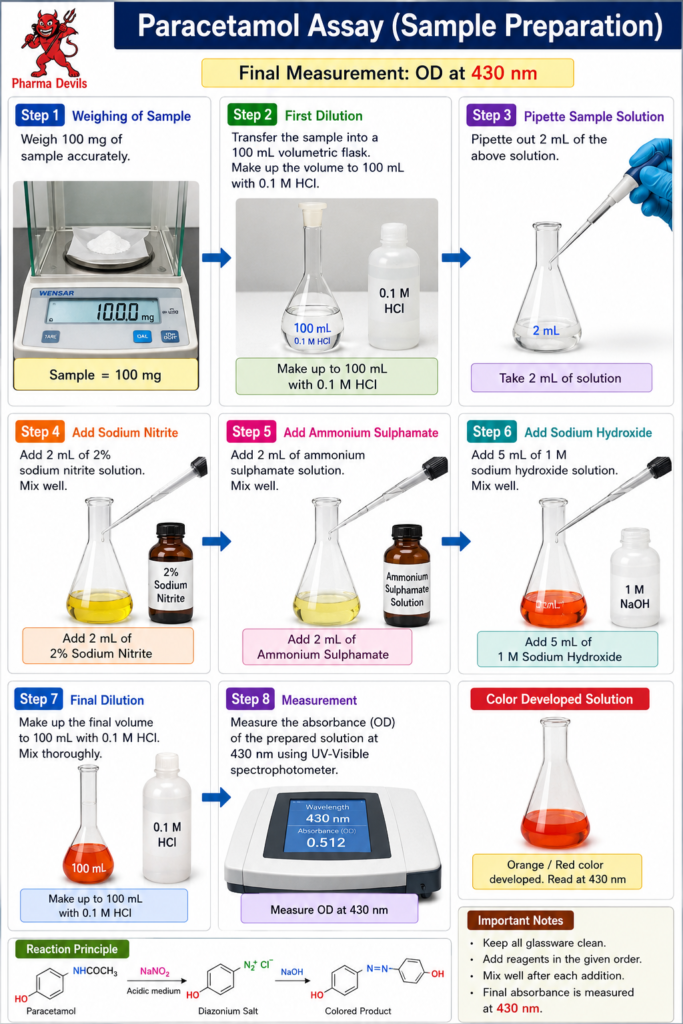
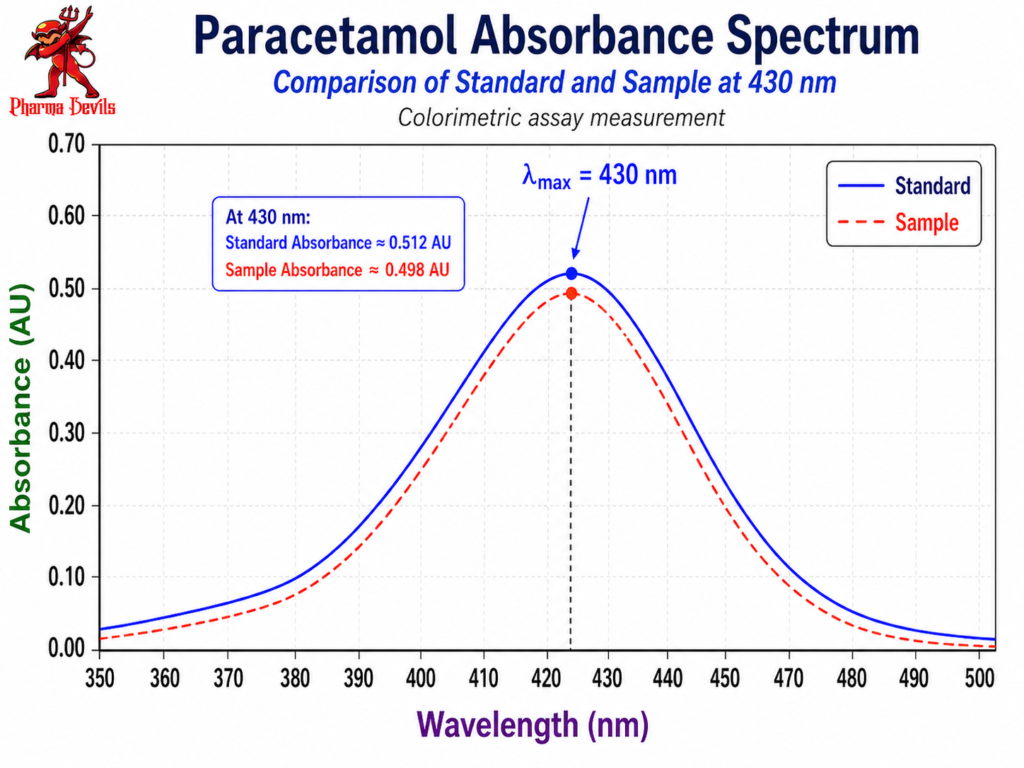
Since both standard and sample final concentrations are same, assay is calculated by direct absorbance comparison.
Formula
% Assay=Standard ODSample OD×100
Substitution
% Assay=0.5120.498×100
=0.97265625×100
Final Result
% Assay=97.27%
Result: Paracetamol Assay = 97.27%
The Paracetamol Assay (CD Method) content in the sample was found to be 97.27% by UV-Visible spectrophotometric method at 430 nm.
Paracetamol, also known as acetaminophen, is a widely used medicine for the treatment of pain and fever. It belongs to the class of analgesic and antipyretic drugs. Paracetamol is commonly used for headache, body pain, toothache, muscle pain, back pain, cold, flu, and fever. It is available in many dosage forms such as tablets, capsules, syrups, drops, suspensions, and injections.
Chemically, Paracetamol is known as N-acetyl-p-aminophenol. Its molecular formula is C₈H₉NO₂, and its molecular weight is approximately 151.16 g/mol. It appears as a white crystalline powder, slightly soluble in water and freely soluble in alcohol. Paracetamol has an aromatic ring, phenolic hydroxyl group, and amide group, which are responsible for its chemical and analytical properties.
The main action of Paracetamol is to reduce pain and fever by inhibiting prostaglandin synthesis, mainly in the central nervous system. It acts on the hypothalamic heat-regulating center to reduce elevated body temperature. Unlike aspirin and other NSAIDs, Paracetamol has very weak anti-inflammatory activity and usually does not cause significant gastric irritation at normal doses.
Paracetamol is generally safe when used within the recommended dose. However, overdose can cause serious liver damage due to the formation of a toxic metabolite called NAPQI. Therefore, dose control is very important, especially in children, elderly patients, and patients with liver disease.
In pharmaceutical analysis, Paracetamol can be assayed by different methods such as UV spectrophotometry, colorimetric/diazotization method, HPLC, and titrimetric methods. In UV methods, absorbance is measured at a specific wavelength, while in colorimetric methods, a colored complex is formed and measured using a spectrophotometer. These assays help ensure the correct amount of Paracetamol is present in pharmaceutical formulations.