







1. Introduction to Paracetamol & Dicyclomine Hydrochloride Tablets (BMR):
The Batch Manufacturing Record (BMR) for Paracetamol & Dicyclomine Hydrochloride Tablets is an essential pharmaceutical document designed to ensure systematic manufacturing, quality control, traceability, and compliance with Good Manufacturing Practices (GMP). Each uncoated tablet contains Paracetamol IP 325 mg and Dicyclomine Hydrochloride IP 20 mg. Paracetamol acts as an analgesic and antipyretic, while Dicyclomine Hydrochloride is an antispasmodic agent that helps relieve smooth muscle spasms. This combination is intended for the management of pain associated with abdominal cramps and spasmodic conditions. The BMR provides detailed instructions for raw material dispensing, sifting, binder preparation, wet granulation, drying, sizing, blending, lubrication, compression, and packaging operations. It also includes equipment details, process parameters, in-process quality checks, yield reconciliation, and documentation requirements. The manufacturing process involves four granulation lots, followed by subsequent processing under controlled environmental conditions. Critical quality attributes, including tablet weight variation, hardness, friability, disintegration, and assay, must be monitored according to approved specifications. Proper documentation, line clearance, material identification, and Quality Assurance verification are essential throughout manufacturing. This BMR serves as a comprehensive reference for production personnel, ensuring batch consistency, product quality, regulatory compliance, and complete traceability from raw material dispensing to finished product release.
Skip to PDF content2. Flow Diagram Description of Paracetamol & Dicyclomine Hydrochloride Tablets (BMR):
The manufacturing flow diagram of Paracetamol & Dicyclomine Hydrochloride Tablets illustrates the systematic sequence of pharmaceutical manufacturing operations, ensuring product quality, consistency, traceability, and compliance with Good Manufacturing Practices (GMP). The manufacturing process begins with raw material dispensing, where Paracetamol IP, Dicyclomine Hydrochloride IP, and approved excipients are weighed according to the Batch Manufacturing Record (BMR). The materials are subsequently sifted through specified sieves to ensure appropriate particle size and remove foreign particles. During binder preparation and wet granulation, starch paste is prepared and used for granulation in a Rapid Mixer Granulator (RMG). The wet granules are dried using a Fluid Bed Dryer (FBD), followed by sizing and milling to achieve suitable granule characteristics. The dried granules undergo blending and lubrication to support uniform distribution of ingredients and improve powder flow during compression.
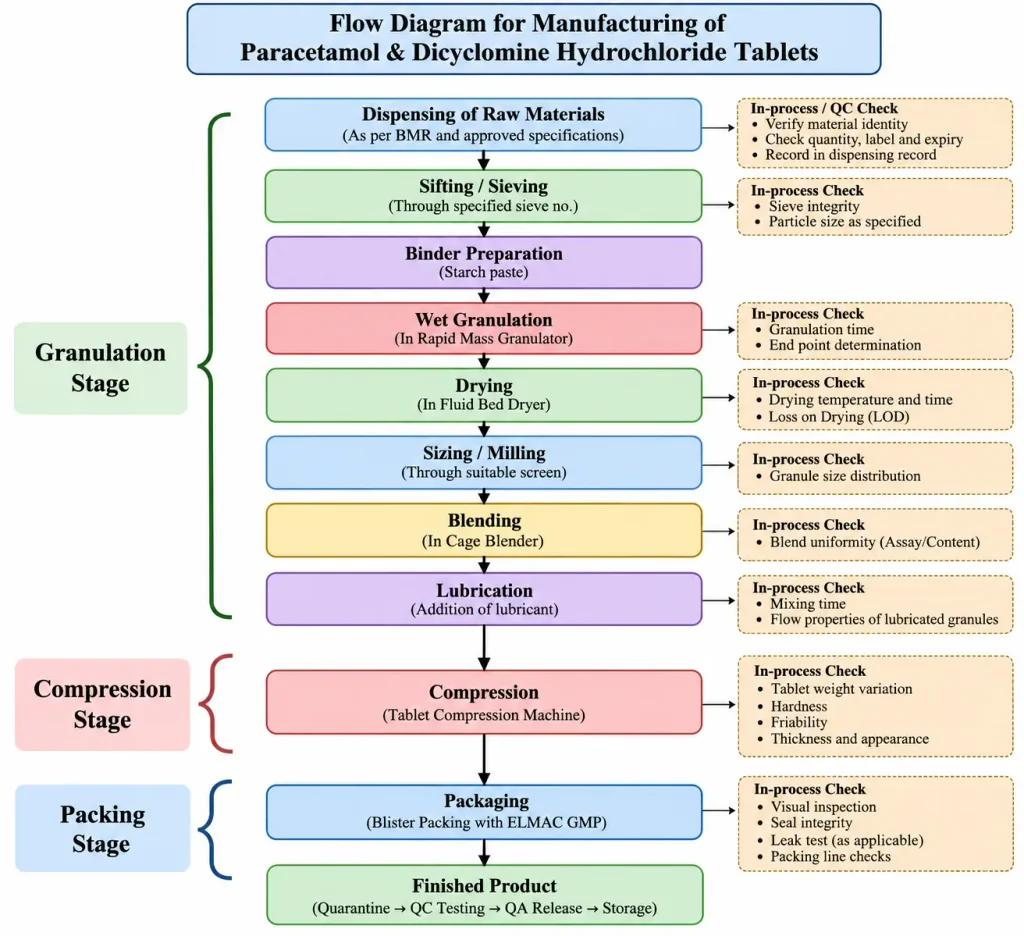
The lubricated granules are compressed into tablets using a compression machine. Important in-process checks include tablet weight variation, hardness, thickness, friability, and appearance. Finally, the compressed tablets undergo blister packaging, followed by finished product testing, batch reconciliation, Quality Assurance review, and release. This flow diagram provides a visual overview of the manufacturing stages and associated quality control checkpoints, helping production and QA personnel maintain consistent manufacturing practices.
3. Critical Process Parameters (CPP) and Critical Quality Attributes (CQA) of Paracetamol & Dicyclomine Hydrochloride Tablets:
The Critical Process Parameters (CPP) and Critical Quality Attributes (CQA) of Paracetamol 325 mg and Dicyclomine Hydrochloride 20 mg Tablets are essential for ensuring consistent product quality, manufacturing efficiency, and compliance with Good Manufacturing Practices (GMP). Critical Process Parameters (CPP) are manufacturing variables that require appropriate monitoring and control to maintain the desired product quality. During dispensing and sifting, material quantities, sieve integrity, and particle size are monitored. Binder preparation and wet granulation involve controlling binder concentration, mixing time, impeller speed, and granulation endpoint.

During drying, inlet air temperature, drying duration, and Loss on Drying (LOD) are important parameters. Blending and lubrication require controlled mixing time, blender speed, and lubricant distribution. Compression parameters include compression force, turret speed, fill depth, and tablet weight. Critical Quality Attributes (CQA) represent the physical, chemical, and performance characteristics required for acceptable finished tablets. These include appearance, average weight, weight variation, hardness, friability, thickness, disintegration, dissolution, assay, and content uniformity, where applicable. Blister packaging integrity is also evaluated to ensure adequate product protection. Effective monitoring of CPPs and verification of CQAs help maintain batch consistency, minimize manufacturing deviations, and ensure that finished tablets meet approved quality specifications.