






1. Introduction to Batch Manufacturing Record (BMR) of Paracetamol, Phenylephrine Hydrochloride, Diphenhydramine Hydrochloride & Caffeine Anhydrous Tablets IP:
The Batch Manufacturing Record (BMR) of Paracetamol, Phenylephrine Hydrochloride, Diphenhydramine Hydrochloride & Caffeine Anhydrous Tablets IP is an essential pharmaceutical document designed to ensure systematic manufacturing, quality control, and compliance with Good Manufacturing Practices (GMP). This combination formulation contains four active pharmaceutical ingredients that provide analgesic, antipyretic, nasal decongestant, antihistaminic, and stimulant effects. Each film-coated tablet contains Paracetamol IP 500 mg, Phenylephrine Hydrochloride IP 5 mg, Diphenhydramine Hydrochloride IP 25 mg, and Caffeine Anhydrous IP 30 mg, along with suitable excipients. The BMR provides comprehensive documentation of manufacturing activities, including raw material dispensing, sifting, binder preparation, wet granulation, drying, milling, blending, lubrication, and tablet compression. It also covers in-process quality checks, equipment identification, environmental monitoring, material reconciliation, and batch yield calculations. Critical quality parameters such as tablet weight variation, hardness, thickness, friability, disintegration time, and granule moisture content are monitored to maintain consistent product quality. Proper execution and verification of the BMR ensure complete batch traceability, manufacturing consistency, data integrity, and regulatory compliance. This documentation supports Quality Assurance review, deviation investigations, batch release decisions, and continuous improvement in pharmaceutical manufacturing operations.
Skip to PDF content1. Manufacturing Process Flow Diagram of Paracetamol, Phenylephrine HCl, Diphenhydramine HCl & Caffeine Anhydrous Tablets IP:
The manufacturing flow diagram illustrates the systematic production process of Paracetamol, Phenylephrine Hydrochloride, Diphenhydramine Hydrochloride & Caffeine Anhydrous Tablets IP, ensuring compliance with Good Manufacturing Practices (GMP) and established quality standards.
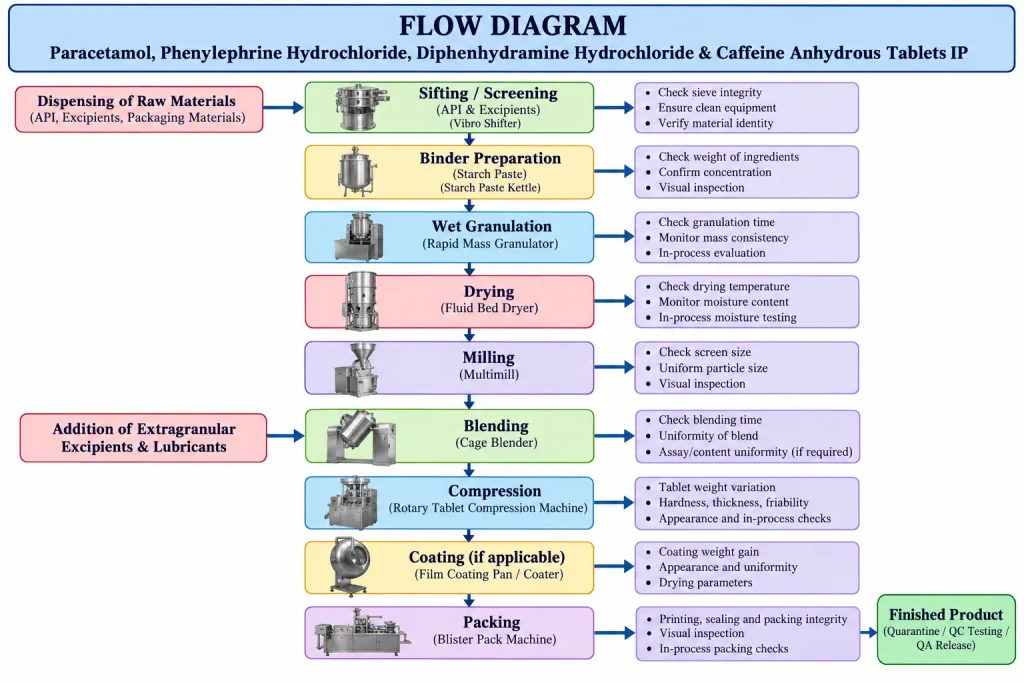
The process begins with raw material dispensing and sifting to ensure accurate quantities and remove unwanted particles. Binder preparation is performed using starch paste, followed by wet granulation in a Rapid Mixer Granulator (RMG) to achieve suitable granule consistency. The wet granules undergo drying in a Fluid Bed Dryer (FBD), followed by milling and sizing to obtain the required particle size distribution. Subsequently, the granules are blended with additional active ingredients, excipients, and lubricants to achieve a uniform mixture. The lubricated blend is compressed into tablets using a rotary compression machine. Critical parameters, including tablet
Critical Process Parameters (CPP) and Critical Quality Attributes (CQA) of Paracetamol, Phenylephrine HCl, Diphenhydramine HCl & Caffeine Anhydrous Tablets IP
The Critical Process Parameters (CPP) and Critical Quality Attributes (CQA) are essential elements in the manufacturing and quality assurance of Paracetamol, Phenylephrine Hydrochloride, Diphenhydramine Hydrochloride & Caffeine Anhydrous Tablets IP. They help ensure consistent product quality, safety, efficacy, and compliance with Good Manufacturing Practices (GMP).
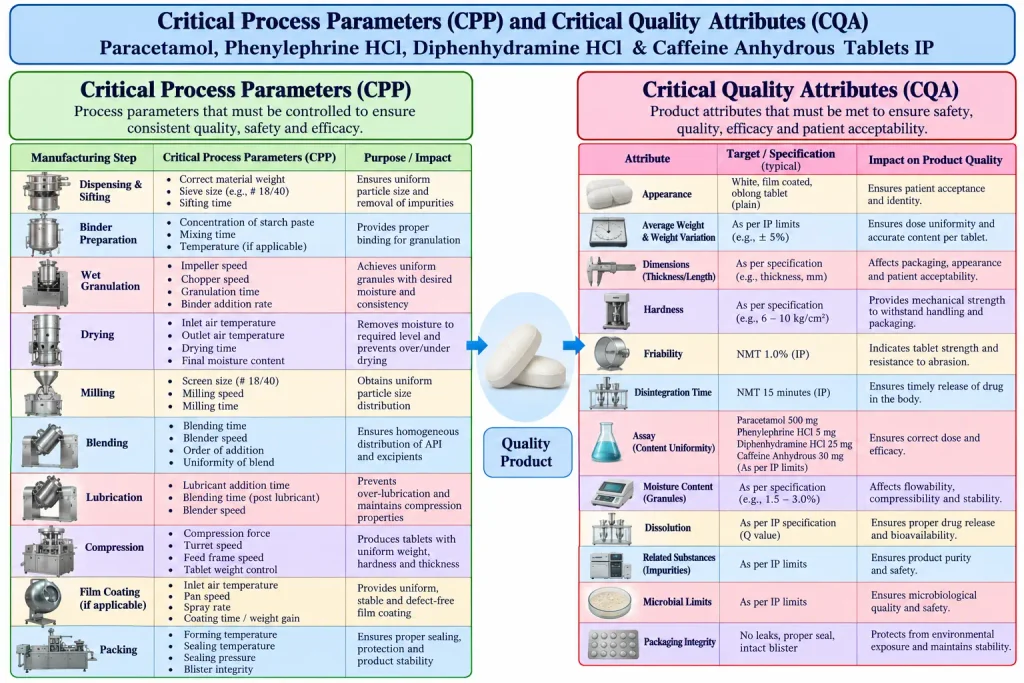
Critical Process Parameters (CPP) include important manufacturing variables such as sifting mesh size, binder concentration, granulation time, mixing speed, drying temperature, granule moisture content, milling screen size, blending duration, lubrication time, and tablet compression force. These parameters require appropriate monitoring and control to maintain manufacturing consistency and minimize process variability.
Critical Quality Attributes (CQA) include tablet appearance, average weight, weight variation, hardness, thickness, friability, disintegration time, assay, content uniformity, dissolution, related substances, and microbial quality, as applicable to the approved product specifications. The Batch Manufacturing Record (BMR) specifies important in-process controls, including granule loss on drying (LOD) of 2.2–2.8%, average tablet weight of 900 mg, friability not more than 1%, and disintegration time not more than 15 minutes. Effective monitoring of CPPs and verification of CQAs help identify process deviations, reduce manufacturing defects, and ensure batch-to-batch consistency.
Proper CPP and CQA management supports process validation, quality risk management, regulatory compliance, and the consistent manufacture of pharmaceutical tablets meeting established quality standards.
Note: The CPP classifications shown are illustrative and require confirmation through product-specific quality risk assessment and process validation.