







1. Introduction for Post Risk Assessment for Blister Packing Machine:
The Post Risk Assessment for the Blister Packing Machine evaluates potential risks associated with the machine’s design, installation, operation, performance, and safety. The equipment is intended for packing tablets and capsules using printed aluminium foil with PVC, PVDC, or aluminium-based forming materials. The assessment follows the FMEA (Failure Mode and Effects Analysis) approach and considers severity, occurrence, and detectability to calculate the Risk Priority Number (RPN). The assessment covers risks related to design and installation qualification, calibration, equipment controls, alarms and interlocks, temperature sensors, recipe preparation, password protection, cleaning, feeding, sealing, coding, cutting, forming, camera systems, and safety guards. Appropriate existing controls and recommended actions are identified for each failure mode. The assessment helps confirm that identified risks are adequately controlled so the blister packing machine can consistently support product quality, safe operation, and reliable packaging performance throughout its lifecycle.
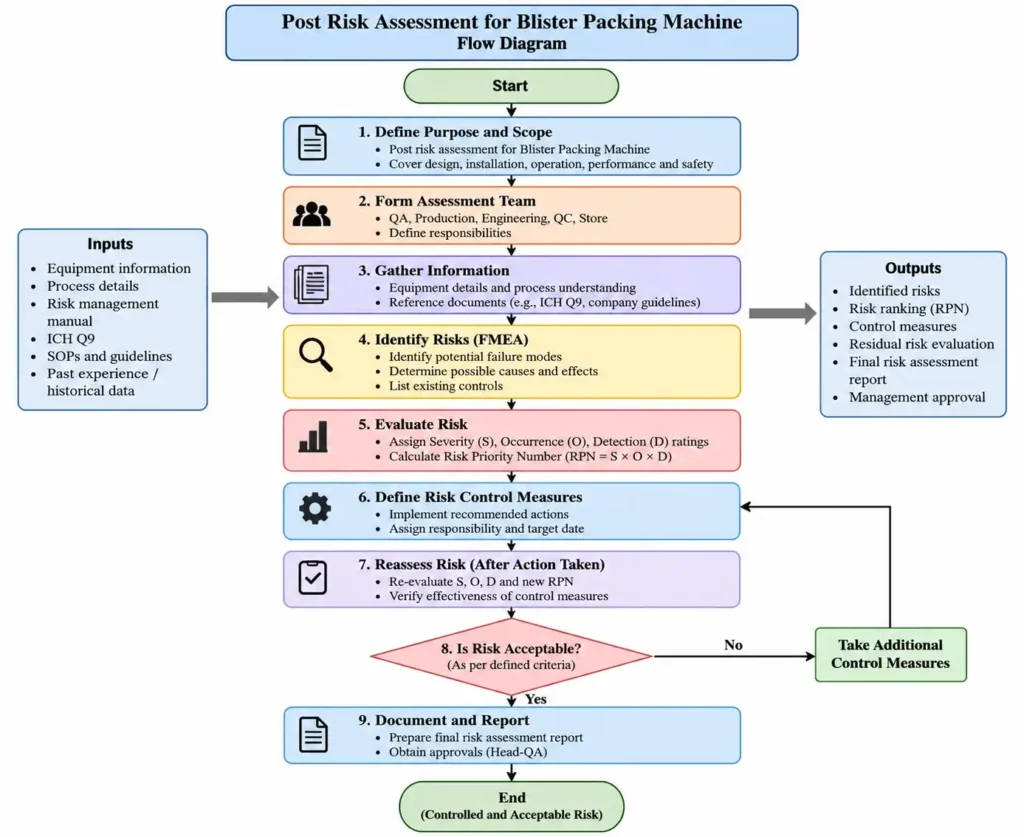
Skip to PDF content2. Flow Diagram for Post Risk Assessment process for the Blister Packing Machine:
The flow diagram explains the systematic Post Risk Assessment process for the Blister Packing Machine. It begins by defining the purpose and scope, followed by formation of a multidisciplinary team involving QA, Production, Engineering, QC, and Store. Required equipment information and reference documents are reviewed before identifying potential failure modes through FMEA. Each risk is evaluated using Severity, Occurrence, and Detection ratings to calculate the Risk Priority Number (RPN). Appropriate control measures are then implemented and responsibilities assigned. Risks are reassessed after actions, and additional controls are applied if required. Acceptable risks are documented, reviewed, approved, and formally closed.
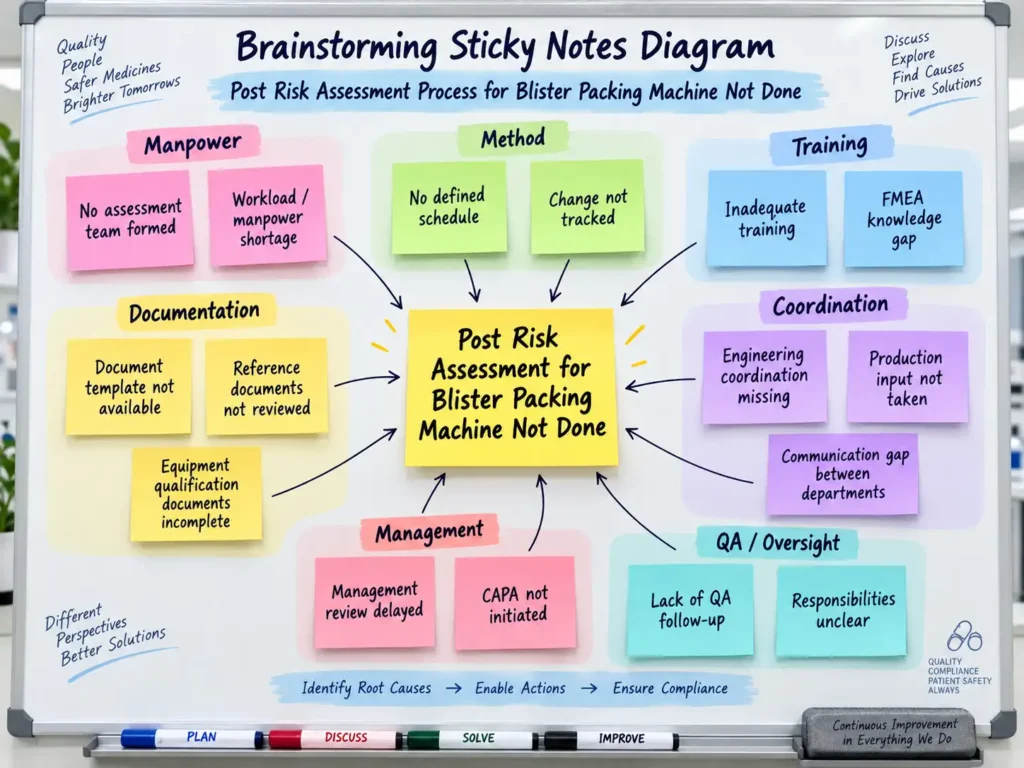
3. Brainstorming – Post Risk Assessment for Blister Packing Machine Not Done:
The brainstorming diagram identifies possible reasons why the Post Risk Assessment for the Blister Packing Machine was not performed. The potential causes are grouped into key areas such as manpower, method, training, documentation, coordination, management, and QA oversight. Issues include absence of an assessment team, manpower shortages, undefined schedules, inadequate FMEA knowledge, incomplete qualification documents, poor interdepartmental communication, delayed management review, lack of CAPA initiation, and insufficient QA follow-up. This brainstorming exercise helps the team collect different viewpoints, recognize organizational and procedural gaps, and identify likely root causes requiring further investigation and corrective action to ensure timely completion of post risk assessment activities.
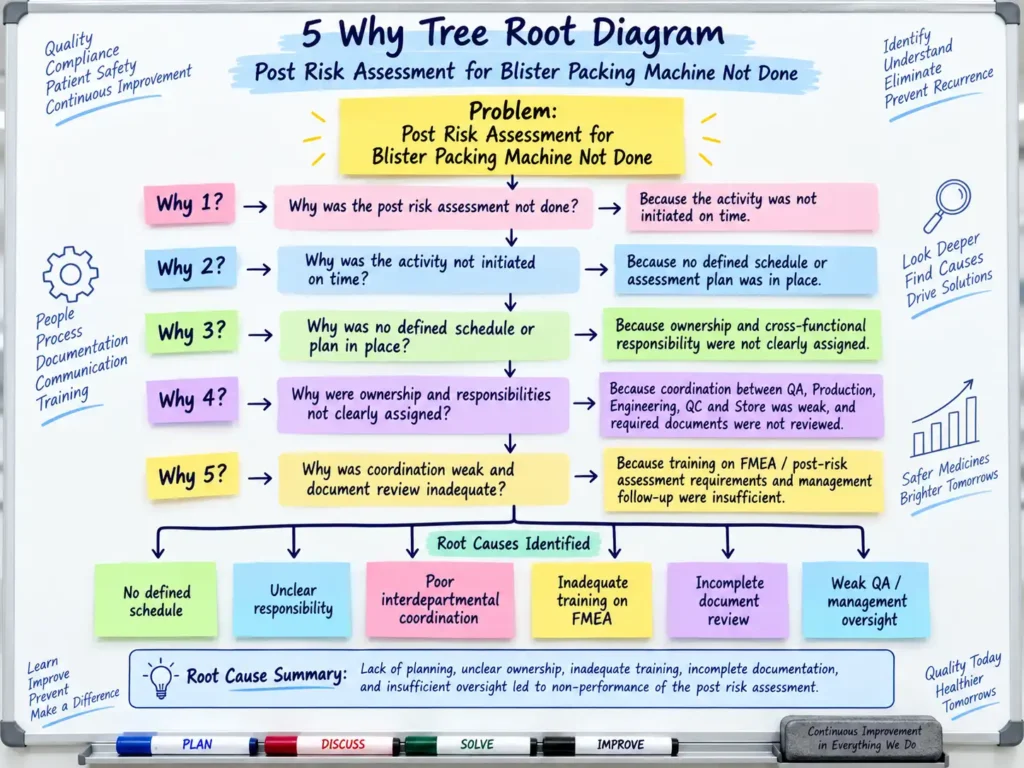
4. 5 Why Analysis – Post Risk Assessment for Blister Packing Machine Not Done:
The 5 Why Analysis identifies the underlying causes for non-completion of the Post Risk Assessment for the Blister Packing Machine. The analysis indicates that the activity was not initiated on time because a defined assessment schedule was absent. This occurred due to unclear ownership and responsibilities among concerned departments. Weak coordination between QA, Production, Engineering, QC, and Store further delayed document review and assessment activities. Inadequate training on FMEA and post-risk assessment requirements also contributed to the failure. The analysis highlights poor planning, insufficient documentation review, unclear responsibility, inadequate training, and weak QA or management oversight as major root causes.
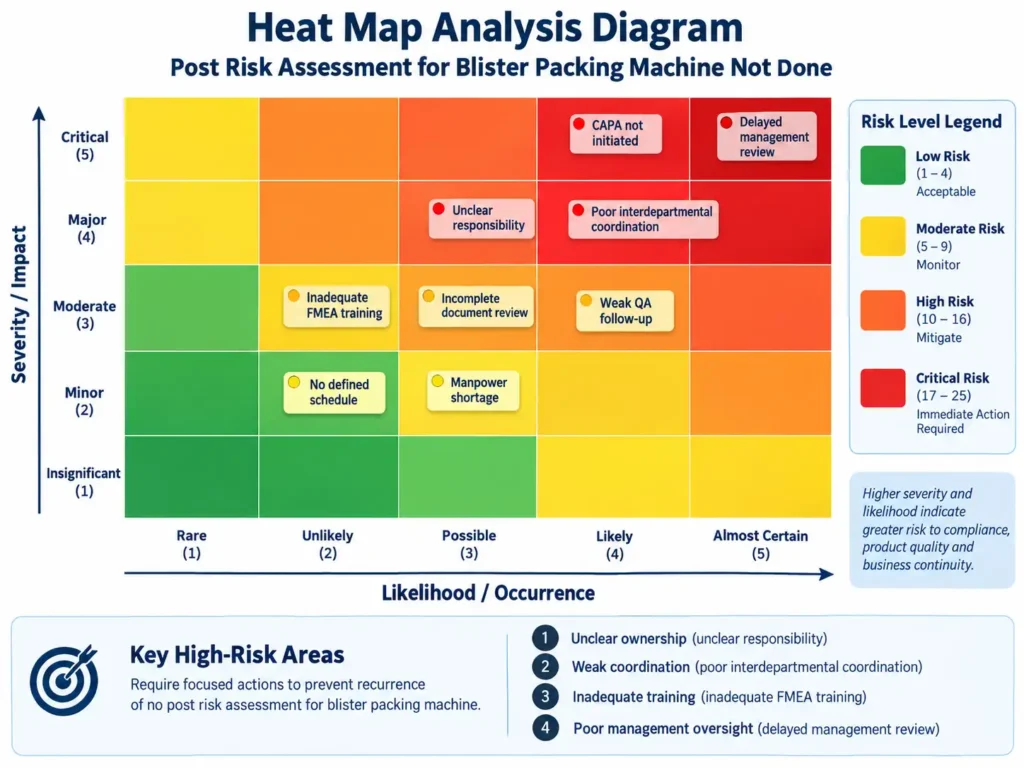
5. Heat Map Analysis – Post Risk Assessment for Blister Packing Machine Not Done:
The Heat Map Analysis evaluates the risks associated with failure to perform the Post Risk Assessment for the Blister Packing Machine. Risks are plotted according to their severity and likelihood of occurrence and categorized as low, moderate, high, or critical. Major concerns include delayed management review, failure to initiate CAPA, unclear responsibility, poor interdepartmental coordination, weak QA follow-up, inadequate FMEA training, incomplete document review, manpower shortage, and absence of a defined assessment schedule. The heat map helps prioritize critical and high-risk issues so that timely corrective actions can be implemented to prevent recurrence and strengthen the overall quality risk management process.
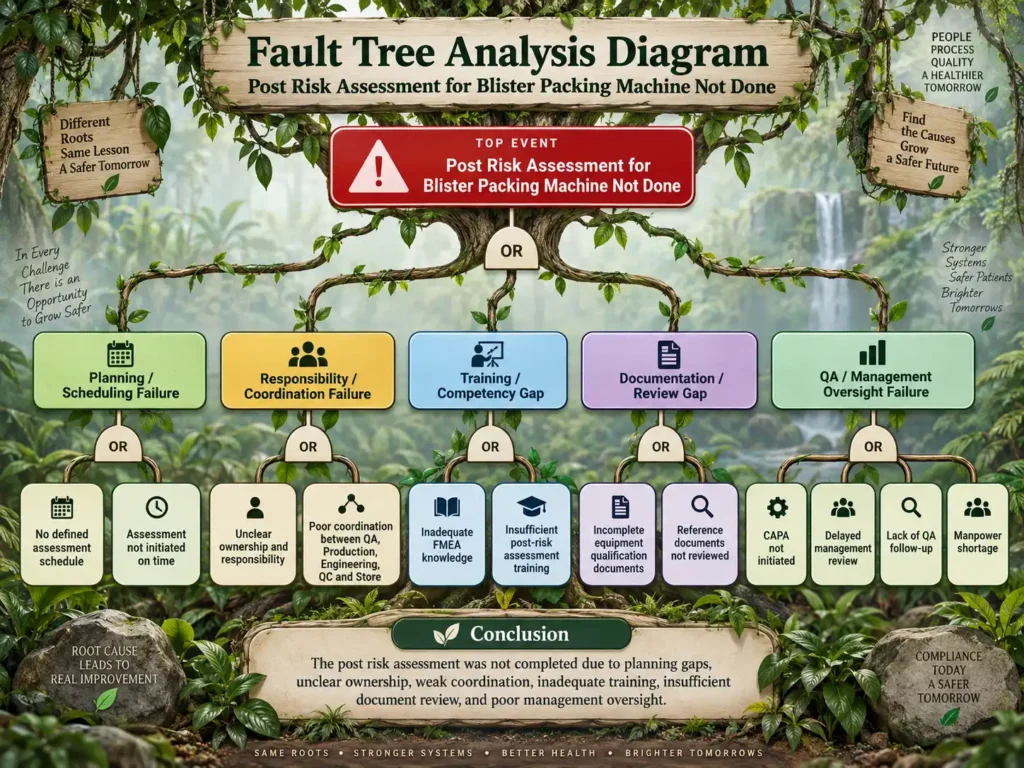
6. Fault Tree Analysis – Post Risk Assessment for Blister Packing Machine Not Done:
The Fault Tree Analysis identifies the major causes responsible for non-completion of the Post Risk Assessment for the Blister Packing Machine. The top event is linked to failures in planning, responsibility, training, documentation, and QA or management oversight. Contributing causes include absence of a defined assessment schedule, unclear ownership, poor coordination among QA, Production, Engineering, QC, and Store, inadequate FMEA knowledge, incomplete qualification documents, missing reference review, delayed management review, weak QA follow-up, and failure to initiate CAPA. The analysis helps identify interconnected causes and supports focused corrective and preventive actions to strengthen the overall quality risk management process.
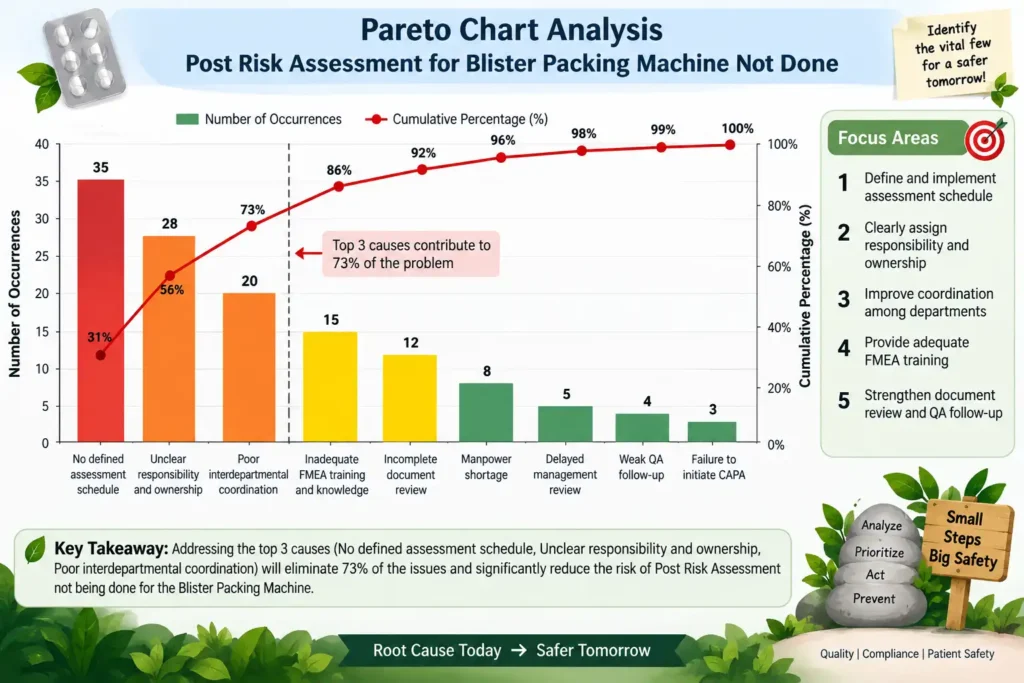
7. Pareto Chart Analysis – Post Risk Assessment for Blister Packing Machine Not Done:
The Pareto Chart Analysis prioritizes the major potential causes responsible for non-completion of the Post Risk Assessment for the Blister Packing Machine. The chart highlights issues such as absence of a defined assessment schedule, unclear responsibility and ownership, poor interdepartmental coordination, inadequate FMEA training, incomplete document review, manpower shortage, delayed management review, weak QA follow-up, and failure to initiate CAPA. The cumulative percentage line helps identify the “vital few” causes requiring immediate attention. The illustrated analysis shows that addressing planning, ownership, coordination, training, and documentation gaps can significantly reduce recurrence and strengthen the overall quality risk management process.
8. Corrective Action and Preventive Action (CAPA) with Effectiveness Review:
Post Risk Assessment for Blister Packing Machine Not Done
The CAPA should address the identified gaps in planning, responsibility, training, documentation review, interdepartmental coordination, and QA oversight. The source document requires participation of QA, Engineering, Production, QC, and Store and uses FMEA for risk assessment.
| No. | Identified Issue / Root Cause | Corrective Action | Preventive Action | Responsibility | Effectiveness Review |
|---|---|---|---|---|---|
| 1 | Post Risk Assessment not initiated on time | Prepare and execute the pending Post Risk Assessment immediately using FMEA. | Include post-risk assessment in the approved qualification/risk-management schedule. | QA / User Dept. | Verify completion and approval within the defined target date. |
| 2 | No defined assessment schedule | Prepare a documented timeline with responsibilities and completion dates. | Maintain a master tracker for all equipment risk assessments with periodic QA review. | QA | Review tracker after 30 and 90 days; no overdue assessment should remain. |
| 3 | Unclear responsibility and ownership | Nominate responsible personnel from QA, Production, Engineering, QC, and Store. | Define responsibilities in the applicable SOP or risk-management procedure. | QA Head | Confirm responsibilities are documented and understood during follow-up review. |
| 4 | Poor interdepartmental coordination | Conduct a cross-functional meeting and collect all required equipment information. | Establish scheduled cross-functional risk-review meetings. | QA / Engineering / Production | Verify meeting records and timely closure of assigned actions for three consecutive reviews. |
| 5 | Inadequate FMEA knowledge | Train concerned personnel on FMEA, Severity, Occurrence, Detection and RPN calculation. | Include Quality Risk Management/FMEA in the annual training program. | QA / Training Coordinator | Post-training assessment should demonstrate satisfactory understanding; review completed FMEA for calculation accuracy. |
| 6 | Incomplete document review | Review URS, DQ, IQ, OQ, manuals, drawings, calibration and supporting qualification documents before assessment. | Introduce a controlled checklist for document availability and verification. | QA / Engineering | Audit three subsequent assessments; required documents should be available and reviewed. |
| 7 | Weak QA follow-up | QA to review pending actions, recommended controls and residual risks before closure. | Introduce periodic QA review of open risk assessments and CAPAs. | QA | No overdue critical/major action during the defined effectiveness period. |
| 8 | CAPA/management review delay | Escalate overdue actions and obtain management review and approval. | Include risk-assessment status as a routine management-review agenda item. | Head-QA / Management | Verify timely review and closure during the next three management-review cycles. |
Effectiveness Review
After implementation of the CAPA, QA should reassess the identified risks by reviewing Severity, Occurrence, Detectability and the revised RPN. The document specifically provides for review of the risk assessment after actions are taken and recording the resulting RPN.
Suggested effectiveness criteria: All planned actions are completed within target dates; trained personnel demonstrate adequate FMEA understanding; required qualification and reference documents are available; no post-risk assessment remains overdue; responsibilities are clearly assigned; and residual risks fall within the organization’s approved acceptance criteria. The source document classifies RPN ≥76 as critical, 51–75 as major, 26–50 as moderate, and up to 25 as minor.
The CAPA may be considered effective when follow-up confirms sustained compliance and the final risk assessment is reviewed, documented, and approved by the responsible departments and Head-QA.
9. Questions and Answers – Post Risk Assessment for Blister Packing Machine:
Q1. What is the purpose of the Post Risk Assessment for the Blister Packing Machine?
Answer: The purpose is to assess risks associated with the Blister Packing Machine after implementation and verify that the equipment can consistently support product quality, safety, and reliable operation throughout its lifecycle.
Q2. What products are packed using the Blister Packing Machine?
Answer: The machine is intended for packing tablets and capsules using printed aluminium foil with base materials such as PVC, PVDC, or aluminium.
Q3. Which risk assessment methodology is used?
Answer: The assessment is performed using Failure Mode and Effects Analysis (FMEA).
Q4. Which departments are involved in the risk assessment?
Answer: Quality Assurance, Engineering, Production, Quality Control, and Store are involved in the assessment process.
Q5. What are the main parameters used for calculating risk?
Answer: The assessment uses Severity (S), Occurrence (O), and Detection (D). These values are multiplied to calculate the Risk Priority Number: RPN = S × O × D.
Q6. What are the risk acceptance categories defined in the document?
Answer: RPN ≥76 is Critical, 51–75 is Major, 26–50 is Moderate, and up to 25 is Minor. CAPA is required for Critical, Major, and Moderate risks.
Q7. What can happen if Design Qualification documentation is inadequate?
Answer: The equipment may not function as intended, cGMP requirements may not be met, safety requirements may be unclear, and important design or component information may be missed.
Q8. Why is proper Installation Qualification important?
Answer: Inadequate IQ can result in improper equipment installation, missing component identification, incomplete documentation, and unreliable equipment performance.
Q9. Why is MOC verification important during IQ?
Answer: Material of Construction verification helps ensure suitable product-contact materials are used. Failure to verify MOC may create a risk of product contamination.
Q10. Why must measuring instruments be calibrated before qualification?
Answer: Calibrated instruments such as multimeters, spirit levels, tachometers, and clamp meters are required to verify installation accurately and ensure the equipment can perform as intended.
Q11. What risks are associated with inadequate recipe and password controls?
Answer: Inadequate recipe preparation may prevent correct machine operation, while insufficient password protection may allow uncontrolled access to machine settings and recipes.
Q12. Why are alarms and interlocks important?
Answer: Alarms and interlocks help identify abnormal equipment conditions, prevent unsafe operation, and support proper machine functioning. Their verification is included during Operational Qualification.
Q13. What may happen if the Blister Packing Machine is not cleaned properly?
Answer: Improper cleaning can result in product contamination. The document identifies line clearance and cleaning procedures as existing control measures.
Q14. What risks can arise from improper sealing adjustments?
Answer: Incorrect sealing roller settings, temperature, mounting, or dismantling may cause improper knurling and compromise blister sealing quality.
Q15. Why is the feeding system important?
Answer: Failure of the feeding system may result in improper packing. The document indicates that the activity is controlled through the vibrator and trained personnel.
Q16. What is the purpose of reassessing risk after corrective actions?
Answer: The risk is reassessed by reviewing Severity, Occurrence, Detectability, and the new RPN to confirm whether implemented control measures have reduced the risk to an acceptable level.
Q17. Who approves the final risk assessment report?
Answer: The final report includes approval by representatives from Quality Assurance, Production, Quality Control, Engineering, Store, and Head-QA.
Q18. When should the final risk assessment be considered complete?
Answer: It should be considered complete after risks and critical control parameters are identified, control measures are documented and reviewed, relevant supporting documents are attached where applicable, and the final report is approved.
10. Reference Guidelines – Post Risk Assessment for Blister Packing Machine:
- ICH Q9 – Quality Risk Management
Provides the framework for identification, assessment, control, communication, and review of quality risks. The document specifies FMEA as the risk-assessment approach. - Organization’s Approved Risk Management Manual / Risk Assessment Guideline
The post-risk assessment should be performed in accordance with the company’s approved Quality Risk Management procedure or risk-assessment guidance. - Approved Equipment Qualification Documents
URS, DQ, IQ, OQ, equipment manuals, drawings, calibration records, and supporting qualification documentation should be reviewed as applicable during the assessment. The document specifically identifies such records as controls and verification inputs during qualification activities. - Applicable SOPs for Equipment Operation, Cleaning, Qualification and Change Control
The risk assessment refers to established procedures for qualification verification, equipment operation, cleaning, and change control as important control measures.