








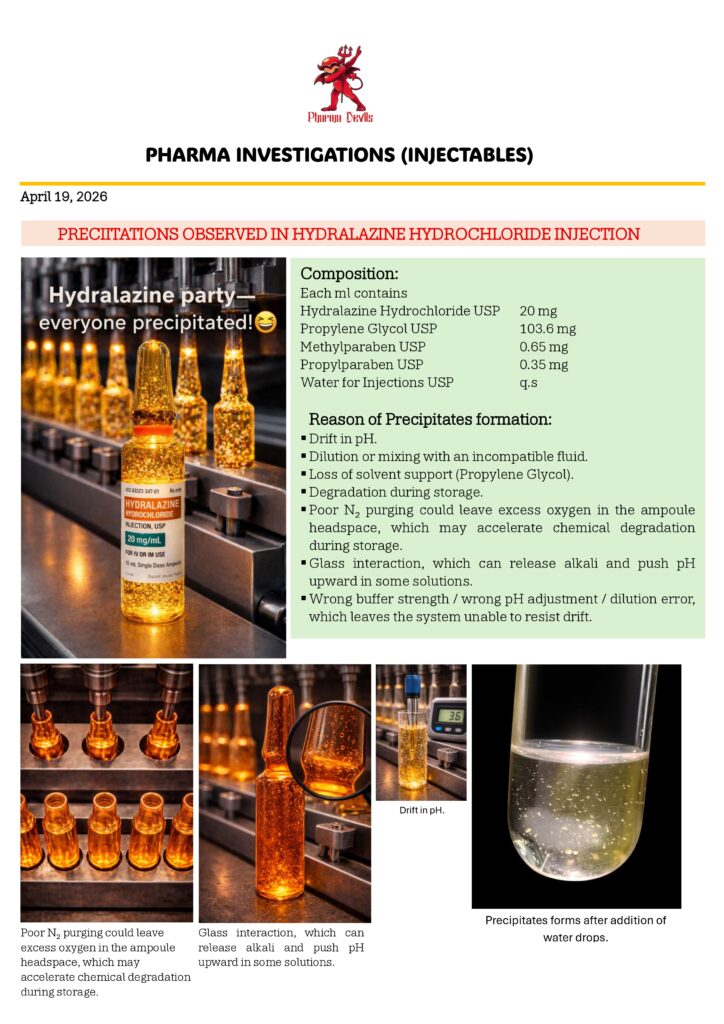
Precipitations observed in Hydralazine Hydrochloride Injection are a critical quality concern in pharmaceutical manufacturing and finished product evaluation. Hydralazine Hydrochloride Injection is a sterile liquid dosage form, and any visible precipitation, turbidity, crystals, or particulate matter may indicate product instability, contamination risk, or formulation-related failure.
Precipitation may occur due to several reasons, including pH variation, improper solubility, temperature fluctuation, incompatible excipients, interaction with container closure system, incorrect manufacturing process, or storage under unsuitable conditions. Hydralazine Hydrochloride is sensitive to environmental and formulation changes; therefore, strict control of pH, concentration, water quality, filtration, and storage conditions is essential.
During manufacturing, precipitation may be observed after solution preparation, pH adjustment, filtration, filling, sterilization, or stability storage. If precipitation appears, the batch must be immediately placed on hold, and Quality Assurance should be informed. The affected containers should not be released until a complete investigation is performed.
The investigation should include visual inspection, pH testing, assay, related substances, particulate matter testing, sterility evaluation, container closure compatibility review, and comparison with approved specifications. Manufacturing records should be checked for raw material quality, weighing accuracy, mixing time, filtration integrity, sterilization cycle, hold time, and environmental conditions. Stability data should also be reviewed to identify whether precipitation is temperature-related or time-dependent.
Corrective and preventive actions may include optimization of pH, review of formulation composition, improvement in mixing procedure, control of storage temperature, use of compatible packaging materials, validation of filtration process, and enhancement of visual inspection practices. If precipitation affects product safety, strength, purity, or quality, the batch should be rejected as per quality system requirements.
Precipitation in Hydralazine Hydrochloride Injection can compromise patient safety because injectable products must remain clear, sterile, and free from visible particles. A well-controlled manufacturing process, validated formulation, proper storage, routine stability monitoring, and strong quality control system are essential to prevent precipitation and ensure safe pharmaceutical injection products.