






Brief Description
This Standard Operating Procedure (SOP) describes the process for the conditional release of raw materials and finished products when Microbial Limit Test (MLT) results are still under completion. The procedure is applicable to raw materials and finished products handled through the Quality Control Laboratory. QC and QA personnel are responsible for execution, while the QC Manager and Head QA/QC ensure proper implementation. Conditional release is permitted only for MLT and generally after 3 days of analysis. It is not allowed for pharmacopoeial parameters such as assay, dissolution, pH, or appearance. Raw materials must be received from an approved vendor, and conditional release should be supported with proper justification and approval. Finished products may be conditionally released only for transit to a customer depot/C&F and can be released for sale only after completion and satisfactory approval of the final MLT results.
Skip to PDF content1. Flow Diagram:
The flow diagram explains the conditional release process for raw materials and finished products in a simple step-by-step manner. Conditional release is used only when the Microbial Limit Test (MLT) is still under completion and there is an urgent requirement. It is not permitted for parameters such as assay, dissolution, pH, or appearance.
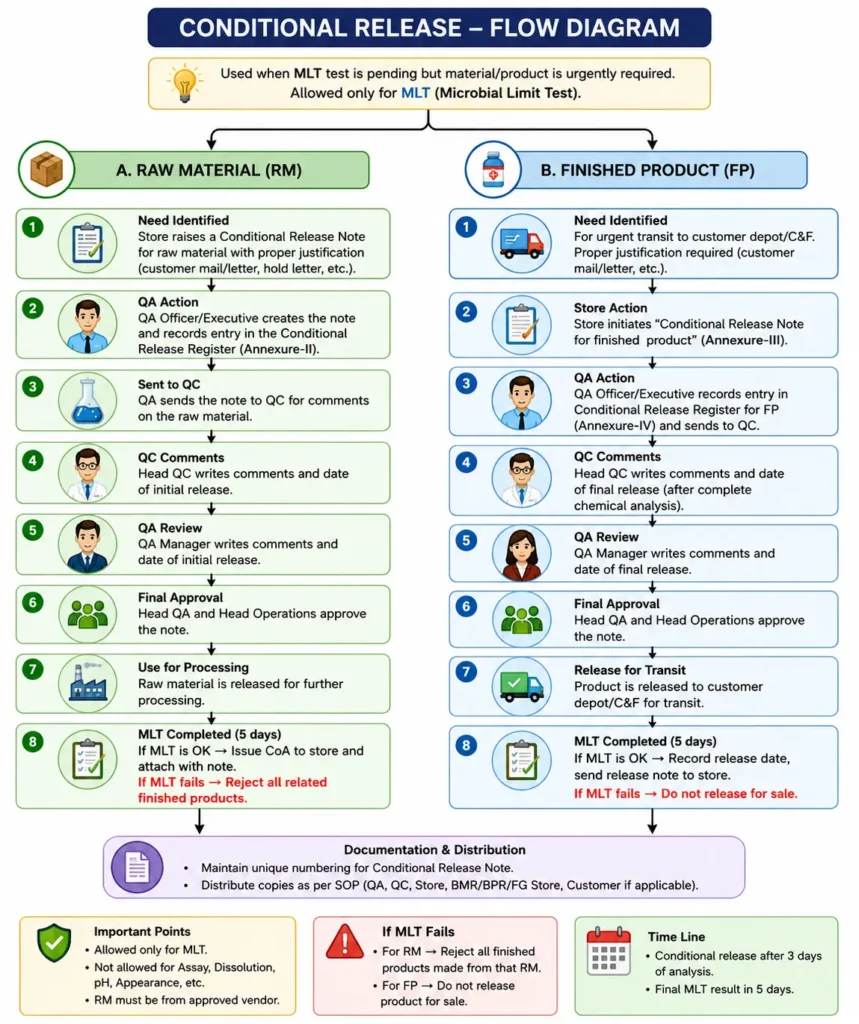
The process starts when the Store Department raises a Conditional Release Note with proper justification. QA records the request and forwards it to QC for review and comments. After satisfactory review, approval is provided by Head QA and Head Operations. Raw material may then be used for further processing, while finished product may be sent only for transit to the depot/C&F.After completion of MLT, the final release is recorded. If the MLT result fails, related products must not be released for sale.
2. Brainstorming for SOP Failure:
Brainstorming is a simple method used to identify all possible reasons for the failure of an SOP. A team from concerned departments discusses the problem and writes possible causes on sticky notes. The causes can be grouped under People, Process, Equipment, Material, Environment, Documentation, Management, and Other Reasons. For example, an SOP may fail because of lack of training, unclear steps, outdated instructions, equipment problems, wrong material, incomplete records, poor supervision, communication gaps, or unsuitable working conditions. During brainstorming, every idea is considered first without immediately rejecting it.
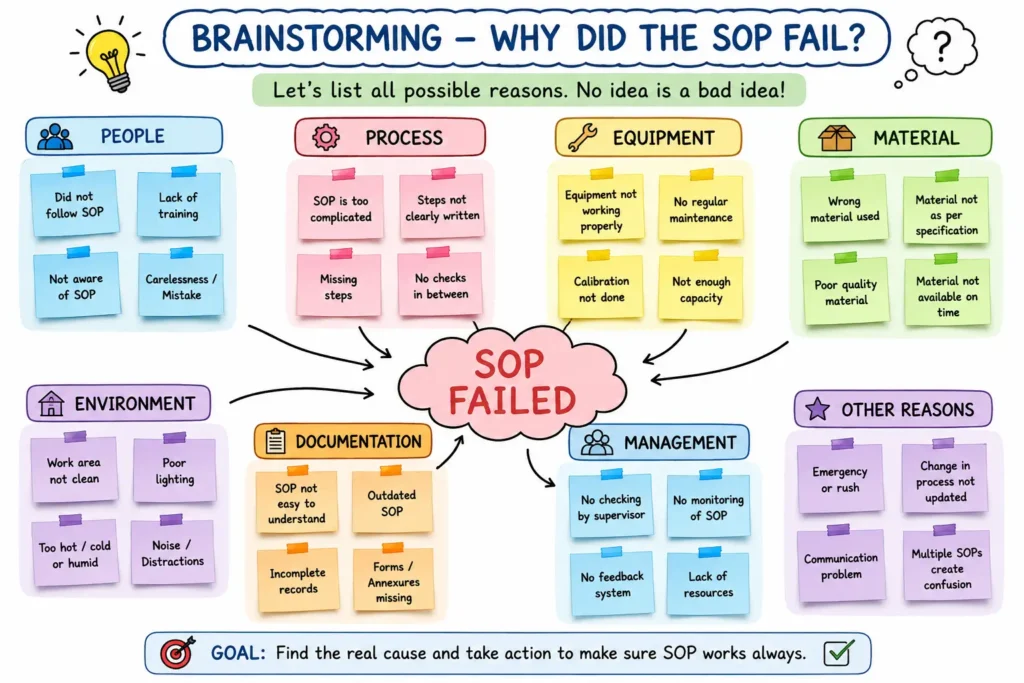
After collecting the possible causes, the team reviews them, removes unrelated points, and selects the most likely causes for further investigation. Tools such as 5-Why Analysis, Fishbone Analysis, or FMEA can then be used to find the actual root cause. Finally, suitable corrective and preventive actions are taken to avoid repeat SOP failure.
3. 5-Why Analysis for SOP Failure:
The 5-Why Analysis is a simple root cause analysis tool used to find the actual reason behind an SOP failure. The investigation starts with the main problem, such as “SOP failed,” and then the question “Why?” is asked repeatedly.For example, the first reason may be that the operator did not follow the SOP. The next question identifies that the operator was not fully trained. Further questioning may show that training was given only once, refresher training was not planned, and there was no proper training follow-up system.
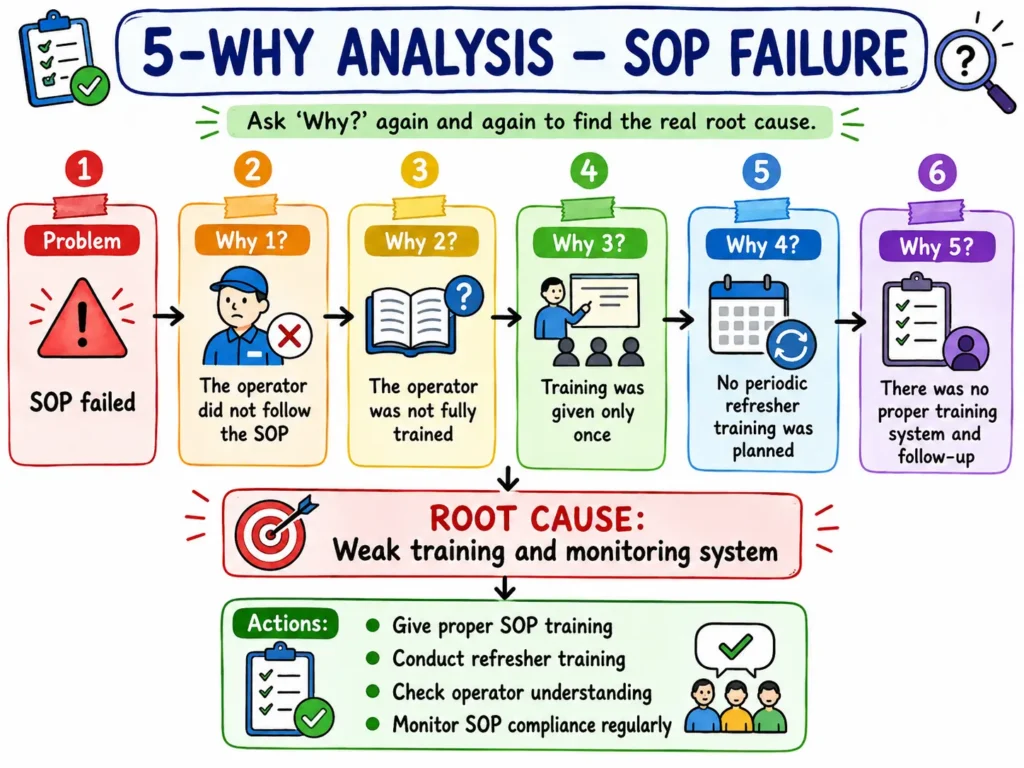
By continuing this process, the team moves from the visible problem to the real root cause. In this example, the root cause is a weak training and monitoring system. Corrective actions may include proper SOP training, refresher training, checking employee understanding, and regularly monitoring SOP compliance to prevent repeat failure.
4. Fishbone Analysis for SOP Failure:
Fishbone Analysis, also called an Ishikawa or Cause-and-Effect Analysis, is used to identify the possible causes of an SOP failure. The main problem, “SOP Failure,” is written at the head of the fishbone, while different groups of possible causes are placed on the major branches.Common cause categories include People, Process, Equipment, Material, Environment, and Documentation. For example, SOP failure may occur due to poor training, unclear instructions, equipment breakdown, wrong material, unsuitable working conditions, outdated SOPs, or incomplete records.
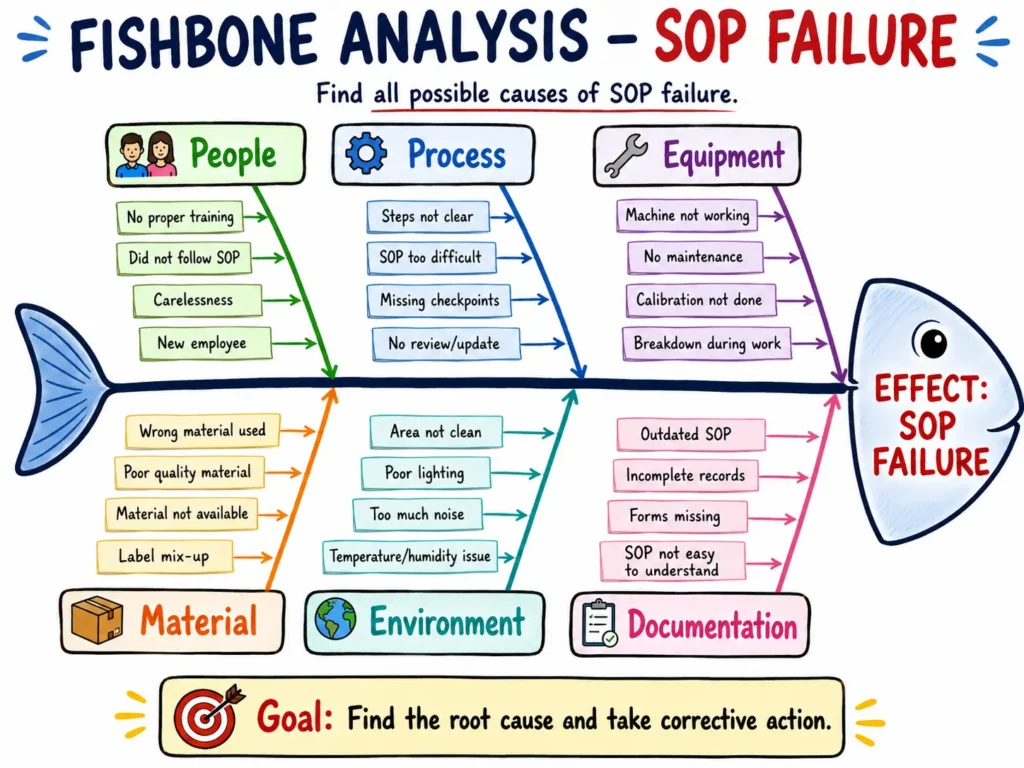
The investigation team reviews all possible causes and identifies which factors are most likely responsible for the failure. These causes are then studied further to determine the actual root cause.Fishbone Analysis provides a clear and organized way to understand the problem and supports suitable corrective and preventive actions (CAPA) to avoid repeat SOP failures.
5. Fault Tree Analysis (FTA) for SOP Failure:
Fault Tree Analysis (FTA) is a structured method used to identify the possible causes of an SOP failure. The analysis starts with the main problem, called the Top Event, such as “SOP not followed” or “SOP not effective.” From this point, the problem is divided into different possible cause groups.Common causes may be related to People, Process, Equipment, Material, Environment, and Documentation. Examples include inadequate training, unclear SOP steps, equipment malfunction, wrong material, poor working conditions, and outdated or inaccessible SOPs.
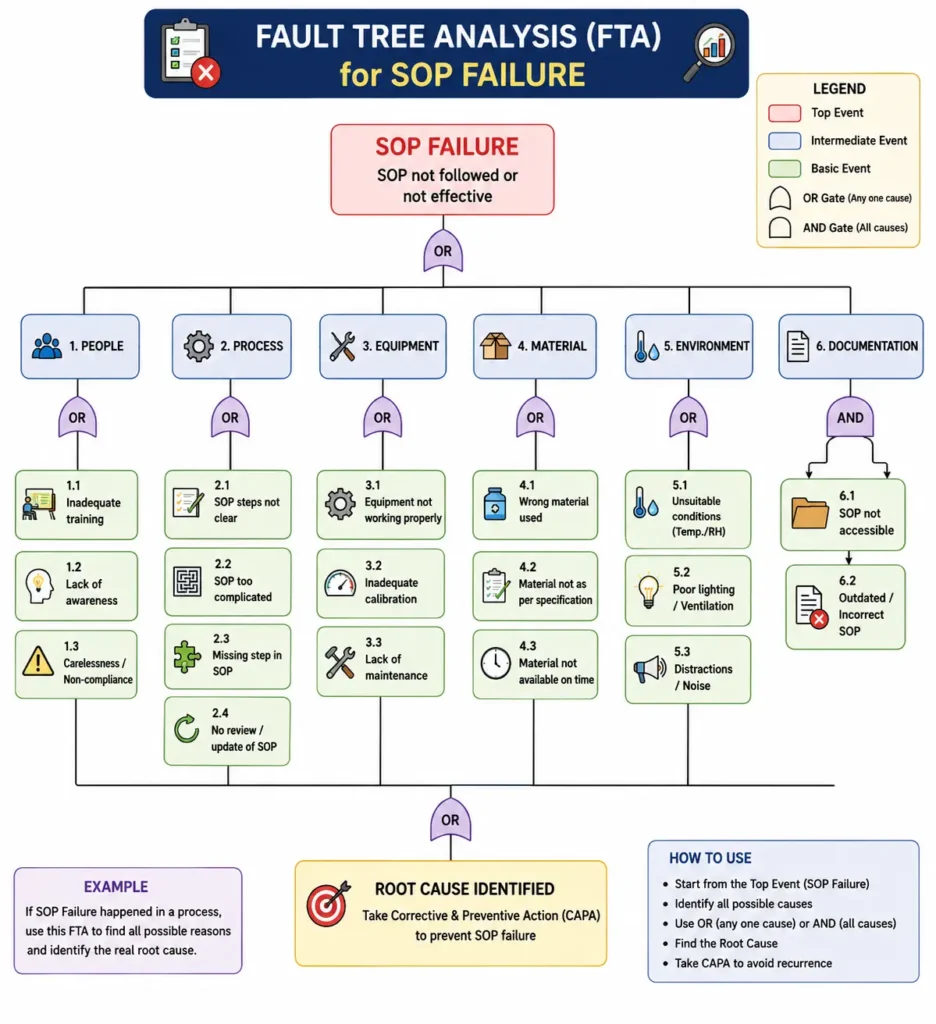
FTA uses OR gates when any one cause can lead to failure and AND gates when more than one condition must occur together. This makes it easier to understand how different causes contribute to the problem.The final aim is to identify the root cause and implement suitable Corrective and Preventive Actions (CAPA) to prevent the SOP failure from happening again.
Questions & Answers – Procedure for Conditional Release
Q1. What is the purpose of this SOP?
Answer: The purpose of this SOP is to define the procedure for the conditional release of raw materials and finished products.
Q2. For which test is conditional release allowed?
Answer: Conditional release is allowed only for MLT – Microbial Limit Test.
Q3. Is conditional release allowed for assay, dissolution, pH, or appearance?
Answer: No. Conditional release is not allowed for pharmacopoeial parameters such as assay, dissolution, pH, and appearance.
Q4. When can a raw material be conditionally released?
Answer: A raw material may be conditionally released in case of urgency and after 3 days of analysis, subject to the SOP requirements.
Q5. From which vendor can raw material be considered for MLT conditional release?
Answer: Raw material should be received from an approved vendor.
Q6. Which department initiates the Conditional Release Note for raw material?
Answer: The Store Department initiates the Conditional Release Note for raw material.
Q7. What justification is required for conditional release?
Answer: Proper justification should be provided along with supporting documents such as a hold letter, requirement letter, or customer/store mail.
Q8. What is the responsibility of QA during conditional release?
Answer: QA prepares or processes the Conditional Release Note, records the entry in the conditional release record, and sends the note to QC for comments.
Q9. Who gives comments from QC?
Answer: The Head QC writes the comments and relevant release date on the Conditional Release Note.
Q10. Who gives final approval for use of conditionally released raw material?
Answer: The note is approved by Head QA and authorized by Head Operations before the raw material is used for further processing.
Q11. What happens if a conditionally released raw material fails in MLT?
Answer: All finished products manufactured from that raw material shall be rejected.
Q12. Can a finished product be conditionally released directly for sale?
Answer: No. Conditional release of finished product is permitted for transit to customer depot/C&F, and final market release can occur only after final QC release.
Q13. When is finished product conditional release allowed for MLT?
Answer: It may be given after 3 days of MLT, if the result is found satisfactory at that stage and other SOP conditions are fulfilled.
Q14. When can the finished product be released in the market?
Answer: The product can be released for sale only after the final MLT result and final QC release.
Q15. What records are maintained for conditional release?
Answer: The SOP includes a Conditional Release Note and Conditional Release Record for raw materials and finished products, along with a final Release Note.