








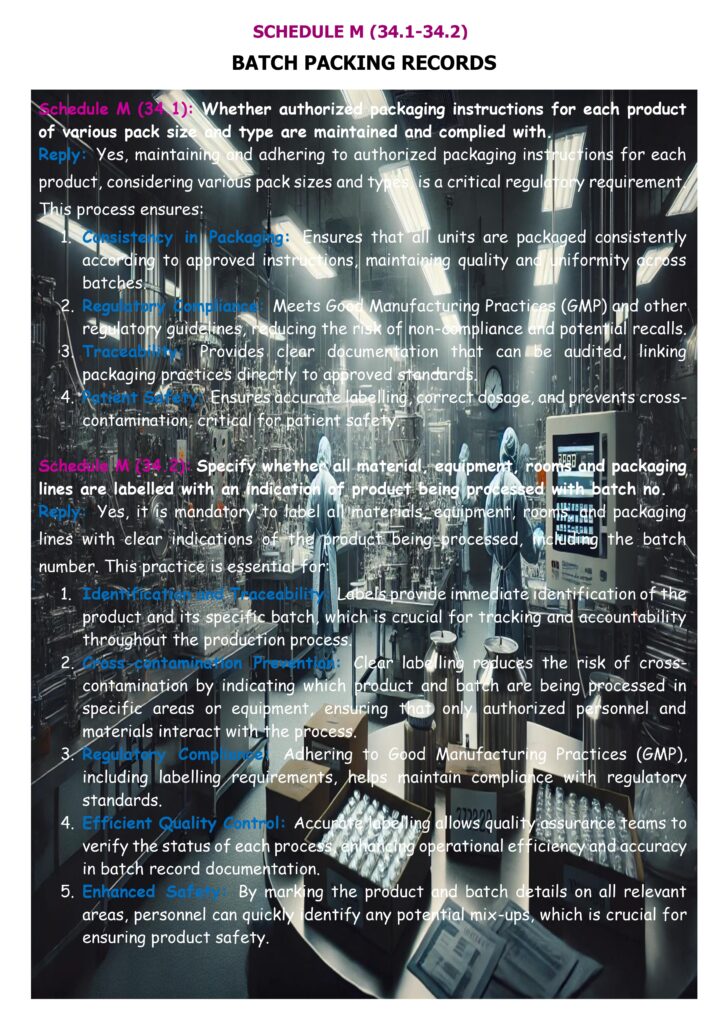
Risk-Based Inspection (RBI) means the inspector decides the depth and sampling intensity based on patient/product-quality risk—packaging controls are always high-risk because failures can cause wrong product/strength, wrong batch/expiry, or wrong label. A risk-based approach is commonly described as enabling the frequency, depth and breadth of inspections to be set accordingly.
Schedule M – Point 34.1–34.2 (Packaging documentation controls) in RBI
34.1: Approved packaging instructions (Master Packaging Instructions)
Schedule M requires formally authorised packaging instructions for each product, pack size and type, and they should include (or reference): product name and strength, pack size, a complete list of packaging materials with codes, specimens of printed materials showing where batch/expiry are marked, special precautions including careful examination of the packaging area and equipment to confirm line clearance before and after packaging, a description of packaging operations/equipment, and in-process controls with sampling and acceptance limits.
RBI focus: Inspectors verify the instructions are current, controlled, and actually used at the line—especially after artwork/version changes. They compare the master instructions with issued components, coding set-ups, and shop-floor practices to see if the documented “special precautions” (line clearance, segregation, verification steps) are effective.
34.2: Batch Packaging Record (BPR) completeness and real-time recording
Schedule M also requires a batch packaging record for each batch/part-batch, based on approved packaging instructions, and it mandates that before packaging begins, checks confirm the line/workstation is clear of previous products/documents/materials and the equipment is clean and suitable—and these checks are recorded.
RBI focus: Inspectors sample BPRs (often high-risk SKUs: look-alike packs, multiple strengths, recent artwork changes) and test:
- Line clearance evidence (pre/post clearance, checklist use, signatures, timestamps).
- Printed material issuance and reconciliation (labels/foils/cartons/leaflets; destruction/returns).
- In-process packaging checks (code verification, overprint, barcode/2D code checks, seal integrity where relevant).
- Deviation handling and batch impact assessment for any reconciliation mismatch, coding error, or rework.
- Data integrity (ALCOA+): contemporaneous entries, traceability to equipment/line, and no unexplained overwriting.
If 34.1–34.2 controls are weak, RBI typically expands into batch release governance, complaint/recall history, and packaging change control because patient-risk rises sharply.