







Brief Description
This Standard Operating Procedure describes the method for identifying and handling bulky material packs or bags that are required for Quality Control sampling during receipt and unloading. The procedure is applicable to materials such as Glass/PET bottles, Lactose, Sugar, and Starch. Its main objective is to ensure that the required number of boxes or bags for sampling is calculated and separated systematically during unloading.The Stores Officer is responsible for calculating the number of packs or bags to be kept aside, placing them on separate pallets, and providing the appropriate status label. The Quality Control Analyst performs sampling according to the applicable QC procedure.During unloading, the packs selected for sampling are placed on dedicated pallets and labeled “Quarantine for Quality Control Sampling.” If different pallets are used, each pallet receives an individual status label. After sampling, the sampled packs or bags should be dispensed first.
Skip to PDF content1. Flow Diagram:
The flow diagram illustrates a simple gate-to-sampling process for receiving bulky materials. It begins with the arrival of the material consignment and initial verification before the vehicle is permitted to proceed for unloading. After entry, the Stores Officer coordinates with Quality Control for the planned sampling activity. As defined in the SOP, the required number of packs or bags for sampling is calculated and identified during unloading. The selected packs are kept separately on dedicated pallets to avoid duplication of work.
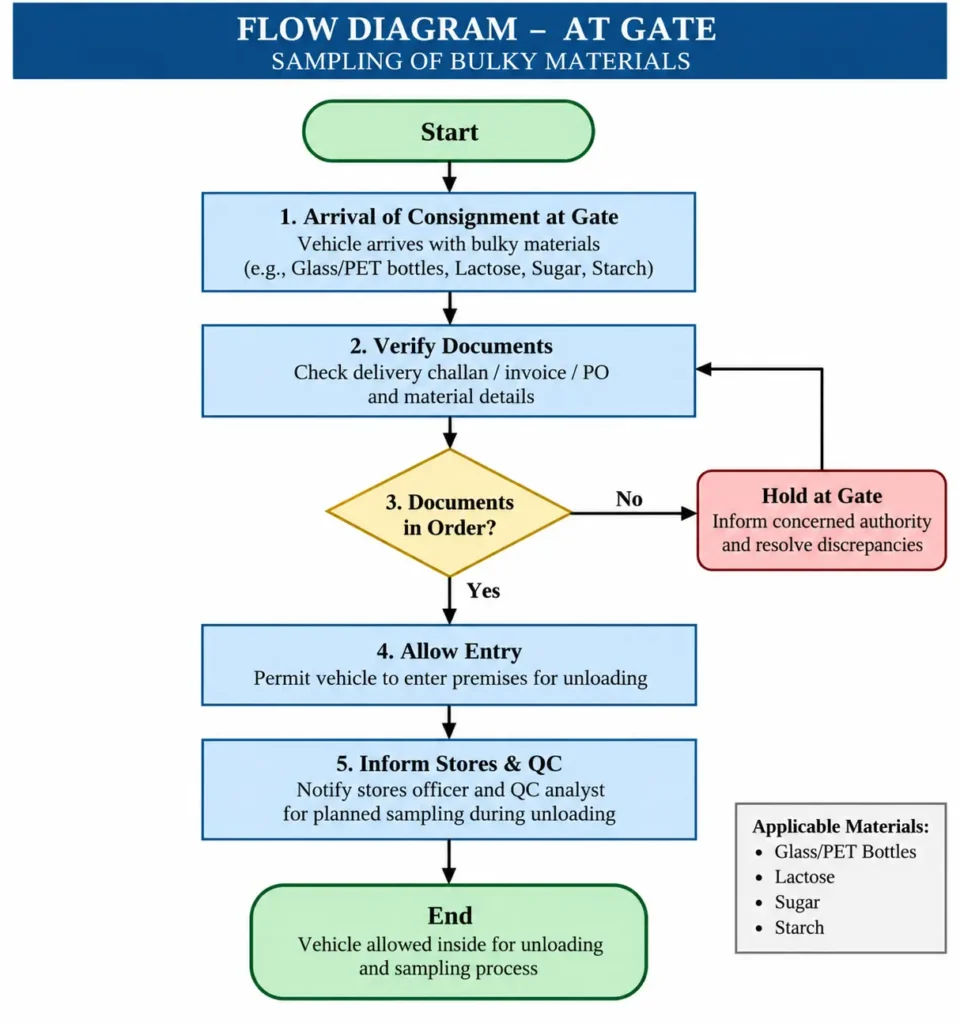
The pallets containing materials selected for sampling are labeled “Quarantine for Quality Control Sampling.” If more than one pallet is used, each pallet is provided with an individual status label. QC then performs sampling according to the applicable procedure, and the sampled packs or bags are subsequently prioritized for dispensing.
2. Brainstorming for SOP Failure:
The brainstorming diagram presents the possible causes that may lead to failure of the SOP for Sampling of Bulky Materials. The teacher-and-blackboard format makes the analysis simple, visual, and suitable for GMP training. Key potential failures include incorrect calculation of packs or bags for sampling, failure to keep selected packs aside during unloading, use of improper or non-dedicated pallets, missing quarantine status labels, and incorrect identification of packs for sampling. These points directly relate to the Stores Officer’s responsibilities and the defined sampling procedure.
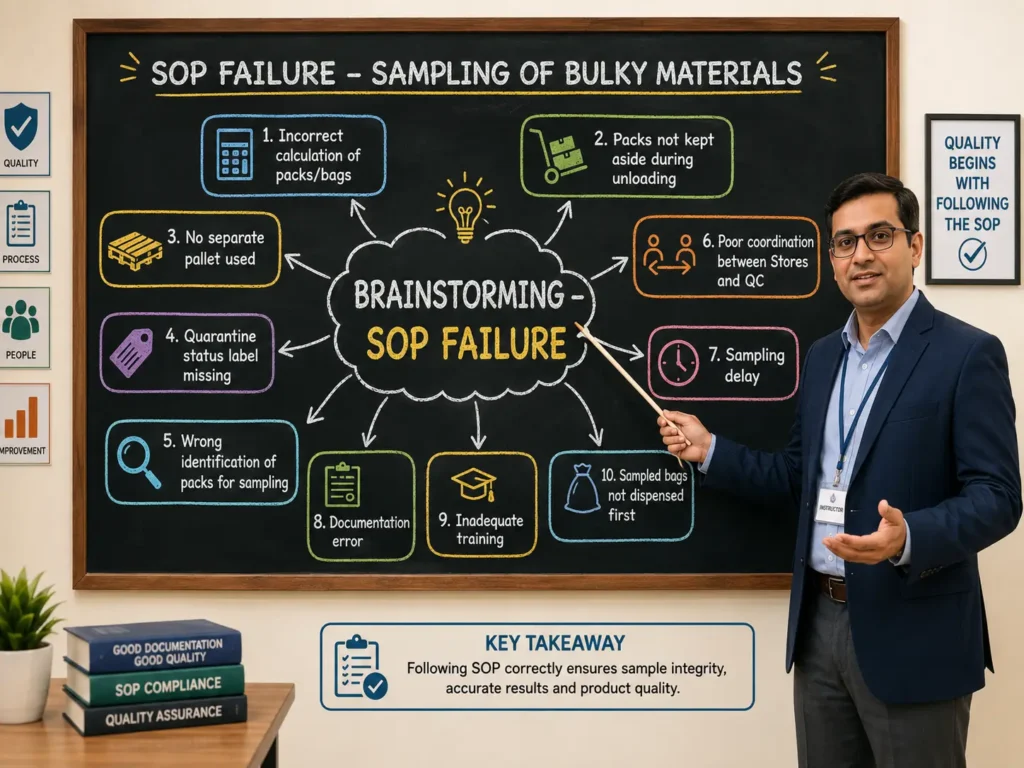
Other possible causes include poor coordination between Stores and QC, sampling delays, documentation errors, inadequate training, and failure to dispense sampled packs or bags first. The SOP requires selected materials to be placed on dedicated pallets, appropriately labeled for QC sampling, and sampled packs to be dispensed first.This brainstorming approach helps identify risk areas and supports appropriate CAPA to prevent recurrence.
3. 5-Why Analysis for SOP Failure:
The 5-Why sticky-note diagram identifies the root causes behind failures in the SOP for Sampling of Bulky Materials. The SOP requires calculation of the required packs or bags for sampling, keeping identified packs on dedicated pallets, applying quarantine status labels, and dispensing sampled packs first. The analysis examines three possible failures: incorrect calculation of sampling packs, failure to segregate and label sampled packs properly, and delay in giving priority to sampled materials.
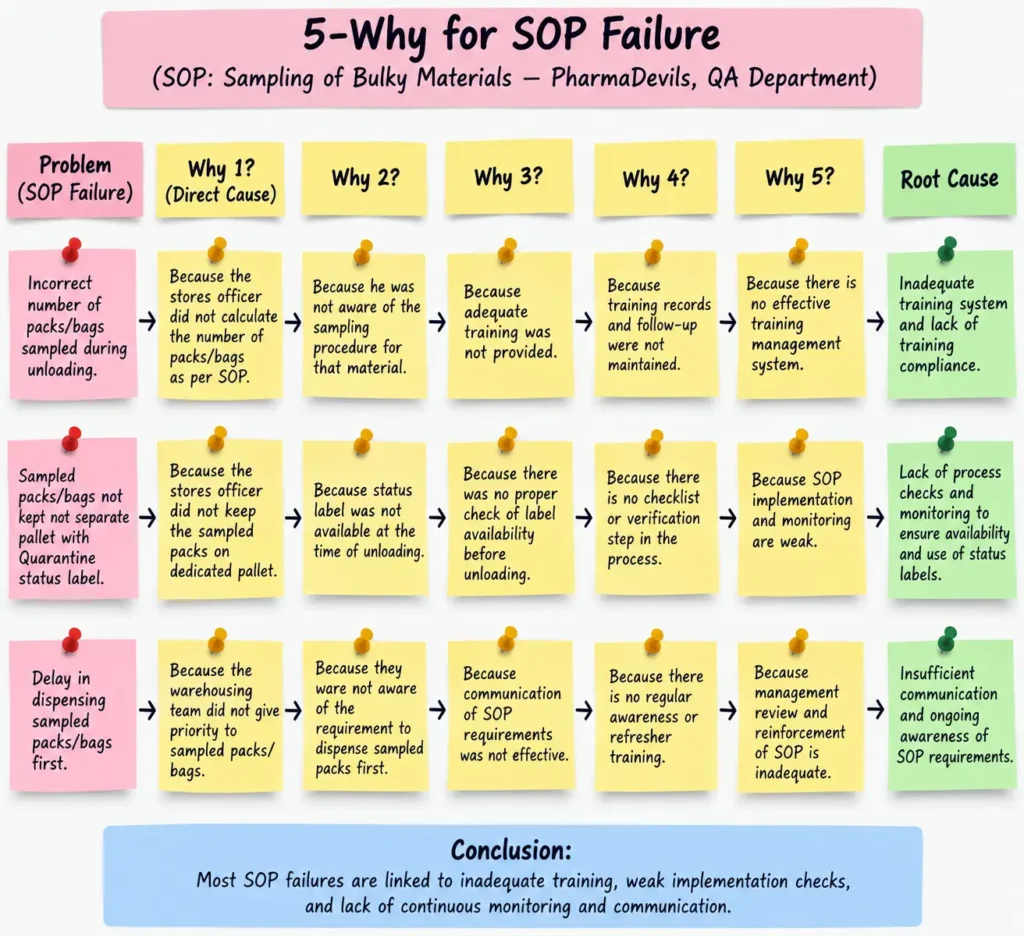
By repeatedly asking “Why?”, the diagram traces these problems to deeper causes such as inadequate training, poor awareness of SOP requirements, weak verification systems, missing process checks, insufficient monitoring, and ineffective communication. The final root causes show that SOP failures are generally related to weaknesses in training, implementation control, supervision, and continuous awareness. This 5-Why approach supports effective root-cause identification and helps in developing appropriate CAPA to prevent recurrence.
4. 5-Why Analysis for SOP Failure:
The 5-Why Analysis is used to identify the underlying causes of failure in the SOP for Sampling of Bulky Materials. It begins with a specific problem, such as incorrect calculation of packs or bags, failure to segregate sampled material, missing status labels, or improper handling during unloading, and repeatedly asks “Why?” until the root cause is identified.
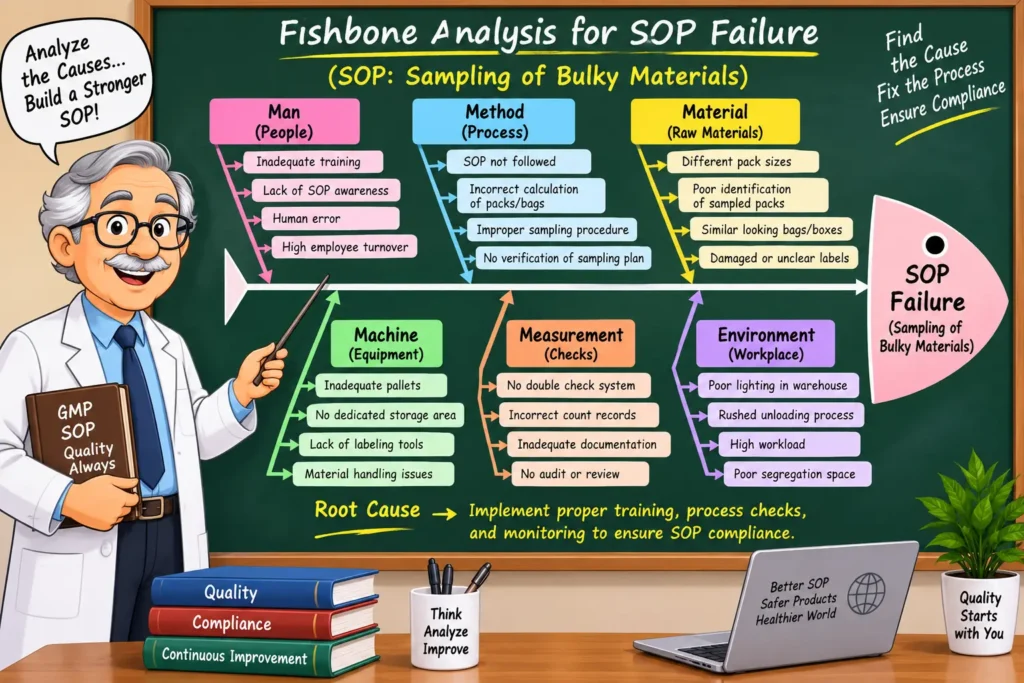
The SOP requires the required packs or bags to be calculated, identified during unloading, kept on dedicated pallets, labeled for quality control sampling, and sampled packs or bags to be dispensed first. Possible root causes of failure may include inadequate training, lack of SOP awareness, weak supervision, poor verification, insufficient monitoring, and ineffective communication. The 5-Why method helps separate immediate causes from deeper system-related causes and supports development of suitable Corrective and Preventive Actions (CAPA) to prevent recurrence and improve SOP compliance.
5. Fault Tree Analysis for SOP Failure:
The Fault Tree Analysis (FTA) diagram explains how different causes can combine and lead to failure of the SOP for Sampling of Bulky Materials. The tree format represents the main event, SOP Failure, through major branches such as People/Training, Method/Procedure, Material/Identification, Equipment/Storage, Measurement/Verification, and Environment/Workplace.
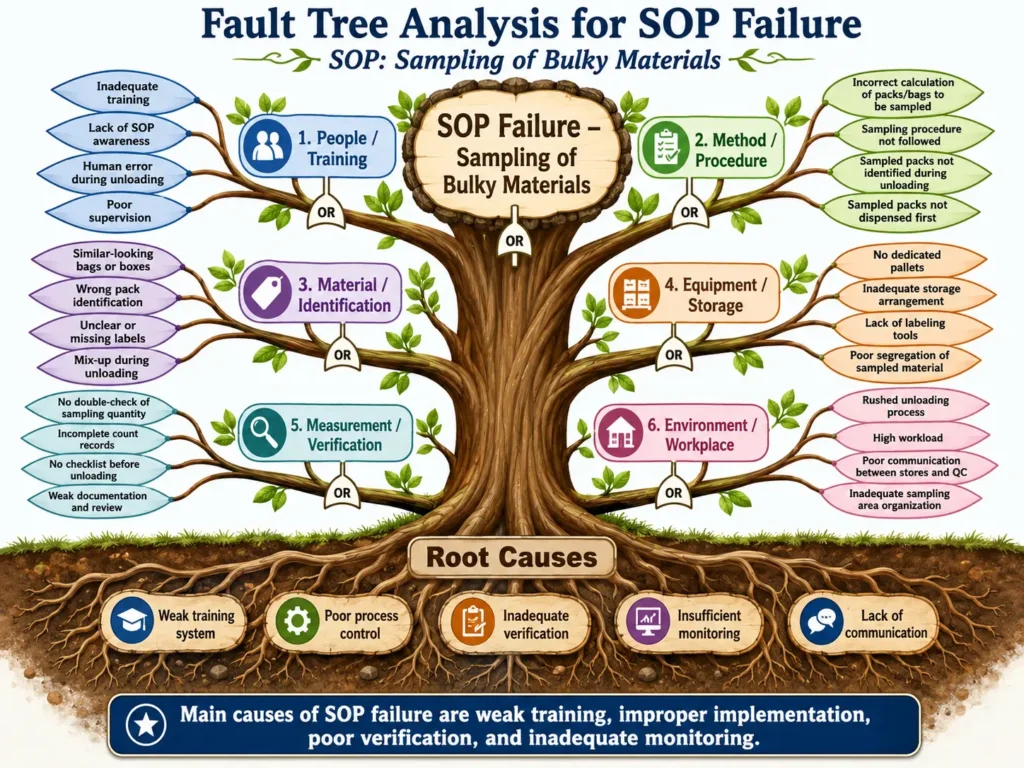
Possible contributing causes include inadequate training, lack of SOP awareness, incorrect calculation of packs or bags, improper identification during unloading, unclear labels, poor segregation, incomplete records, weak verification, high workload, and communication gaps. The SOP requires the required number of packs or bags to be calculated, identified during unloading, kept on dedicated pallets, labeled with quarantine status for QC sampling, and sampled packs to be dispensed first. The analysis highlights root causes such as weak training, poor process control, inadequate verification, insufficient monitoring, and ineffective communication, helping the organization develop suitable CAPA and prevent recurrence.
Questions & Answers – SOP for Sampling of Bulky Materials
Q1. What is the objective of this SOP?
Answer: To provide a procedure for calculating the number of boxes or bags of bulky materials to be withdrawn for Quality Control sampling during unloading.
Q2. Which materials are covered under this SOP?
Answer: The SOP applies to Glass/PET Bottles, Lactose, Sugar, and Starch.
Q3. Who is responsible for calculating the number of packs or bags to be kept aside?
Answer: The Stores Officer is responsible for calculating the required number of packs or bags after receipt.
Q4. Who is responsible for sampling the packs or bags?
Answer: The Quality Control Analyst is responsible for sampling according to the applicable QC procedure.
Q5. When should the packs or bags to be sampled be identified?
Answer: They should be identified during unloading itself.
Q6. Where should the selected packs or bags be kept?
Answer: They should be kept on dedicated pallets to avoid duplication of work.
Q7. What status label should be provided to the sampling pallet?
Answer: A “Quarantine for Quality Control Sampling” status label should be provided.
Q8. What should be done if unloading is carried out on different pallets?
Answer: Individual status labels should be provided to each pallet.
Q9. Which packs or bags should be dispensed first?
Answer: The sampled packs or bags of the material should be dispensed first.
Q10. Who provides training for this SOP?
Answer: The Manager-QC is the trainer, and the Chemist-QC is the trainee. The training period is one hour.
Q11. Where are the controlled copies of the SOP distributed?
Answer: Control Copy 1 is with the Head of Department-QC, Control Copy 2 is in the Sampling Area, and the Master Copy is with the Head of Department-Quality Assurance.
Q12. Does this SOP list any reference or enclosure?
Answer: No. Both the reference and enclosure sections are stated as Nil.